
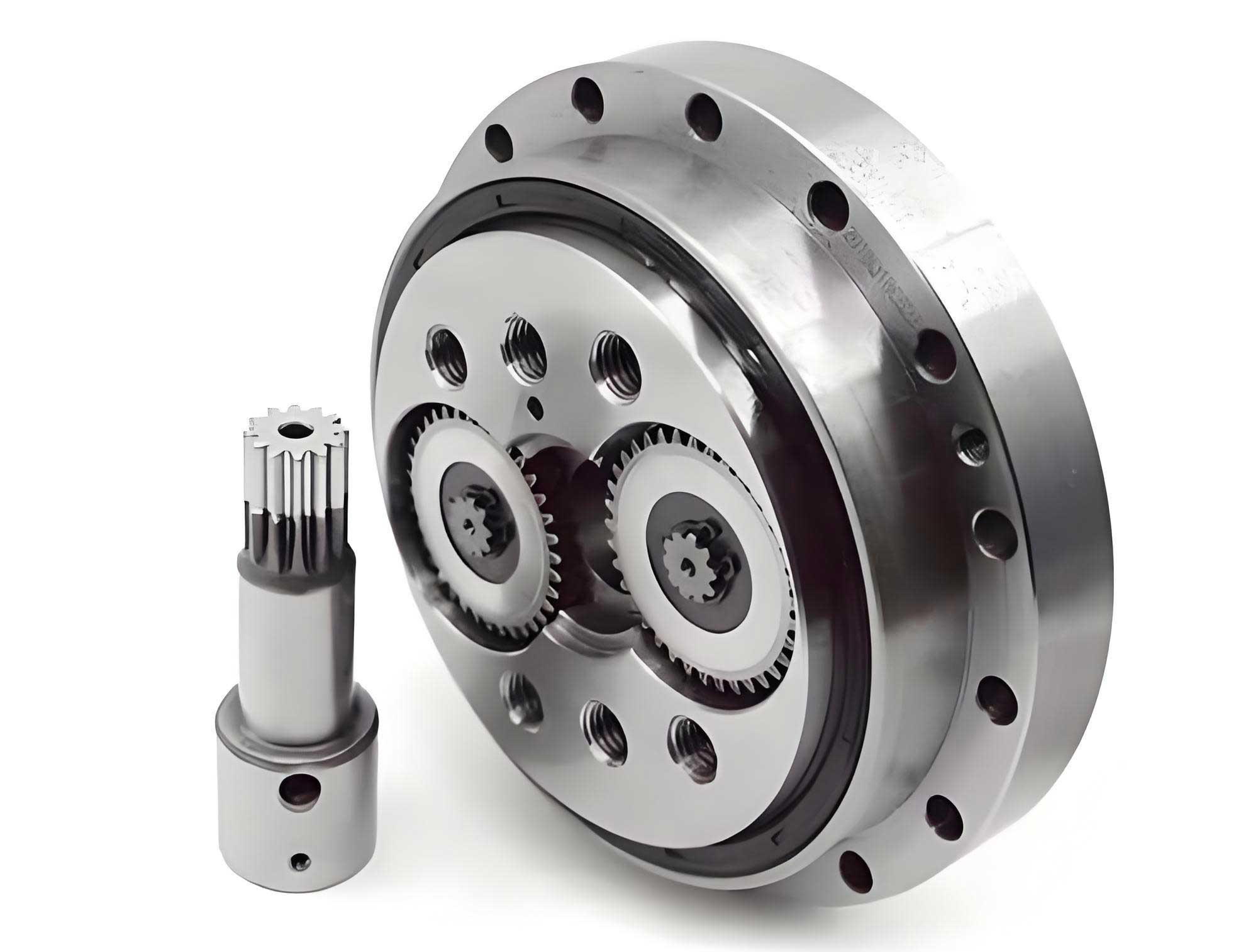
In the field of precision robotics and high-torque transmission systems, the RV reducer has emerged as a critical component due to its exceptional performance characteristics, including high reduction ratios, substantial load-bearing capacity, superior transmission accuracy, and extended operational lifespan. As a core element in robotic joints, the dynamic behavior of the RV reducer directly influences the overall system precision and durability. Within the RV reducer, the main bearing serves as the primary output mechanism, and its design parameters significantly affect the dynamic response and stress distribution. One key parameter, the curvature radius coefficient of the bearing raceways, dictates the Hertzian contact conditions between the balls and races, thereby impacting contact stresses, elastic deformations, and ultimately the bearing’s dynamic performance. In this study, we focus on optimizing the curvature radius coefficient of the main bearing in RV reducers through a combined analytical and computational approach, utilizing MATLAB for static contact analysis and ADAMS for dynamic simulations.
The curvature radius coefficient, denoted as $f = r / D_w$, where $r$ is the raceway groove curvature radius and $D_w$ is the ball diameter, is a dimensionless parameter that characterizes the conformity between the ball and the raceway. This coefficient influences the principal curvatures at the contact point, which in turn affect the contact stress and elastic deformation under load. For RV reducers, where precision is paramount, the curvature radius coefficient typically falls within a range of 0.520 to 0.580. However, the optimal value within this range requires detailed investigation to balance contact stress, deformation, and dynamic stability. We begin by employing Hertzian contact theory to compute the relationship between applied load and maximum contact stress as well as elastic approach for different curvature radius coefficients. The governing equations for Hertzian contact between a ball and a raceway are given by:
$$ a = \left( \frac{3Q}{2E’} \sum \rho \right)^{1/3} $$
$$ b = \left( \frac{3Q}{2E’} \sum \rho \right)^{1/3} \left( \frac{\kappa}{\pi} \right)^{1/2} $$
$$ \delta = \left( \frac{9Q^2}{16E’^2 \sum \rho} \right)^{1/3} $$
$$ \sigma_{max} = \frac{3Q}{2\pi ab} $$
where $a$ and $b$ are the semi-major and semi-minor axes of the contact ellipse, $Q$ is the normal load, $E’$ is the equivalent Young’s modulus, $\sum \rho$ is the sum of principal curvatures, $\kappa$ is the ellipticity parameter, $\delta$ is the elastic approach (deformation), and $\sigma_{max}$ is the maximum contact stress. The sum of principal curvatures $\sum \rho$ depends on the curvature radius coefficient $f$ and the ball diameter $D_w$. For a ball bearing with inner and outer raceway curvature coefficients $f_i$ and $f_o$, the principal curvatures are:
$$ \rho_{1i} = \frac{2}{D_w}, \quad \rho_{2i} = -\frac{2}{D_w} \left( \frac{1}{f_i} – 1 \right) $$
$$ \rho_{1o} = \frac{2}{D_w}, \quad \rho_{2o} = -\frac{2}{D_w} \left( \frac{1}{f_o} – 1 \right) $$
The equivalent curvature $\sum \rho$ for the inner and outer contacts is then computed accordingly. We developed a MATLAB program to calculate $\sigma_{max}$ and $\delta$ for varying loads and curvature radius coefficients of 0.525, 0.550, and 0.575. The results, summarized in the table below, indicate that as $f$ increases, both contact stress and elastic approach increase, particularly under higher loads, suggesting a trade-off between conformity and load capacity.
| Curvature Radius Coefficient ($f$) | Maximum Contact Stress at 1000 N ($\sigma_{max}$, MPa) | Elastic Approach at 1000 N ($\delta$, μm) |
|---|---|---|
| 0.525 | 1850 | 2.8 |
| 0.550 | 1950 | 3.2 |
| 0.575 | 2100 | 3.7 |
Based on this preliminary analysis, we selected $f = 0.550$ as a baseline for further dynamic investigation, as it offers a compromise between stress and deformation for the RV reducer main bearing. The primary parameters of the main bearing are listed in the following table, which are essential for the subsequent dynamics simulation in ADAMS.
| Parameter | Symbol | Value |
|---|---|---|
| Pitch Diameter | $d_m$ | 132 mm |
| Inner Raceway Curvature Coefficient | $f_i$ | 0.550 |
| Outer Raceway Curvature Coefficient | $f_o$ | 0.550 |
| Ball Diameter | $D_w$ | 8 mm |
| Number of Balls | $Z$ | 40 |
| Contact Angle | $\alpha$ | 10° |
| Elastic Modulus | $E$ | 206,000 MPa |
| Poisson’s Ratio | $\nu$ | 0.3 |
| Density (Steel) | $\rho$ | 7,800 kg/m³ |
To perform the dynamics simulation, we first need to determine the forces acting on the main bearing within the RV reducer. The RV reducer comprises multiple stages, including a planetary gear stage and a cycloidal gear stage. The main bearing supports the output mechanism, and its radial load is primarily derived from the reaction forces on the crankshafts connected to the cycloidal gears. The force transmission path starts from the input torque, through the planetary gears to the cycloidal gears, and finally to the crankshafts. For an RV reducer with two cycloidal gears arranged 180° apart, the forces are symmetric. The total force $F$ from the pin gears on the cycloidal gear can be expressed as:
$$ F = \frac{T r_2}{2 a r_1} $$
where $T$ is the input torque, $r_1$ is the pitch radius of the planetary gear, $r_2$ is the pitch radius of the cycloidal gear, and $a$ is the eccentricity of the cycloidal gear. For our specific RV reducer design, the parameters are: $a = 1.3$ mm, $r_1 = 15$ mm, $r_2 = 57$ mm, input power $P = 1.05$ kW, and motor speed $n = 3060$ rpm. The input torque $T$ is calculated as:
$$ T = \frac{60 P}{2 \pi n} = \frac{60 \times 1050}{2 \pi \times 3060} \approx 3.28 \text{ N·m} $$
Substituting into the force equation yields $F \approx 285$ N. This force acts on the crankshaft, and the reaction forces on the main bearing are derived from static equilibrium of the crankshaft. Considering the geometry and moment balance, the radial force $F_r$ on the main bearing is computed to be approximately 282 N. Additionally, for angular contact ball bearings, a preload force $F_a$ is applied to minimize play and enhance stiffness. Using empirical formulas from bearing design handbooks, the preload force is estimated as:
$$ F_a = \frac{C}{25} = \frac{f_h f_m f_d}{25 f_n f_T} P $$
where $C$ is the basic dynamic load rating, and $f_h$, $f_m$, $f_d$, $f_n$, $f_T$ are factors for life, moment load, impact, speed, and temperature, respectively. For the RV reducer operating conditions, these factors are taken as $f_h = 2.29$, $f_m = 2$, $f_d = 1.8$, $f_n = 1.186$, $f_T = 1$. The equivalent dynamic load $P$ is calculated using:
$$ P = X F_r + Y F_a $$
with $X = 1.8$ and $Y = 2.4$ for angular contact bearings. Solving these equations gives a preload force $F_a \approx 400$ N. Thus, the main bearing in the RV reducer is subjected to a radial force of 282 N and an axial preload of 400 N.
With the forces determined, we proceed to the dynamics simulation using ADAMS software. A virtual prototype of the main bearing is created, simplifying the geometry by omitting non-essential features like fillets and bolt holes to reduce computational complexity while preserving dynamic accuracy. The bearing components—inner ring (integrated with the planet carrier), outer ring, balls, and cage—are imported into ADAMS, and material properties are assigned. Contact pairs between balls and raceways, as well as balls and cage, are defined using the impact function, which models the normal contact force based on a spring-damper system. The contact force $F_c$ is given by:
$$ F_c = K \delta^e + C \dot{\delta} $$
where $K$ is the contact stiffness, $\delta$ is the penetration depth, $e$ is the exponent (typically 1.5 for Hertzian contact), and $C$ is the damping coefficient. The contact stiffness $K$ is derived from Hertzian theory and depends on the curvature radius coefficient. For the inner and outer contacts, the stiffness values $K_i$ and $K_o$ are calculated using:
$$ K_i = \frac{4}{3} E’ \sqrt{R_i’}, \quad K_o = \frac{4}{3} E’ \sqrt{R_o’} $$
where $R_i’$ and $R_o’$ are the effective radii of curvature, which are functions of $f_i$ and $f_o$. For our simulations, we computed $K_i = 4.4538 \times 10^5$ N/mm¹·⁵ and $K_o = 4.7296 \times 10^5$ N/mm¹·⁵ for $f = 0.550$. The damping coefficient $C$ is set to 20 N·s/mm for inner contacts and 28 N·s/mm for outer contacts, with a penetration depth limit of 0.1 mm. The boundary conditions in ADAMS are applied as follows: the outer ring is fixed, the inner ring is allowed to rotate about the Z-axis and translate in all three directions, an axial preload force of 400 N and a radial force of 282 N are applied at the center of the inner ring, and an angular velocity of 20 rpm is imposed on the inner ring’s Z-axis to simulate slow operational speed for detailed contact analysis.
We conducted simulations for three different curvature radius coefficients: $f = 0.525$, $f = 0.550$, and $f = 0.575$. For each case, we analyzed the contact force distribution among the balls during startup transient and steady-state operation, as well as the force variation over time for adjacent balls in the direction of the radial force. The startup transient contact forces at time $t = 0.005$ s are extracted and compared across the 40 balls. The steady-state contact forces at $t = 0.05$ s are also evaluated to assess the equilibrium distribution. Furthermore, to understand the load-sharing characteristics, we monitored the contact forces of seven adjacent balls positioned around the radial force direction over a time interval of 0 to 0.02 s. The results are summarized in the tables below, which provide statistical measures of contact forces for each $f$ value.
| Curvature Radius Coefficient ($f$) | Number of Balls with Zero Force (Startup) | Number of Balls with Force > 300 N (Startup) | Average Steady-State Force (N) | Maximum Steady-State Force (N) |
|---|---|---|---|---|
| 0.525 | 33 | 2 | 45 | 420 |
| 0.550 | 22 | 0 | 120 | 190 |
| 0.575 | 28 | 4 | 85 | 350 |
The data indicate that for $f = 0.525$, the force distribution is highly uneven, with most balls unloaded during startup and a few balls carrying excessively high loads. This can lead to localized stress concentrations and potential premature failure. For $f = 0.575$, the situation improves slightly, but still exhibits high transient forces and uneven steady-state distribution. In contrast, for $f = 0.550$, the startup forces are more balanced, with fewer zero-force balls and no balls exceeding 300 N. The steady-state forces are uniformly distributed, with an average around 120 N and a maximum below 200 N, suggesting better load sharing and reduced risk of impact damage.
To delve deeper, we examine the time-varying contact forces for the seven adjacent balls near the radial force direction. The force profiles are plotted conceptually via analytical descriptions: for $f = 0.525$, balls 18, 19, and 20 show abrupt force spikes exceeding 400 N, while others remain near zero; for $f = 0.550$, the forces vary smoothly between 60 N and 200 N, with symmetric patterns around the central ball; for $f = 0.575$, balls 22 and 24 experience sustained high forces above 300 N during specific intervals. These observations reinforce that $f = 0.550$ yields the most favorable dynamics, with continuous force transmission and minimal fluctuations, enhancing the stability and longevity of the RV reducer.
The underlying reason for this behavior lies in the effect of $f$ on the contact ellipse dimensions and stress distribution. A smaller $f$ reduces conformity, leading to smaller contact areas and higher stresses, which can cause uneven load distribution due to minor misalignments or deformations. A larger $f$ increases conformity, but may lead to excessive elastic deformation and altered load paths under dynamic conditions. The optimal $f = 0.550$ strikes a balance, ensuring sufficient contact area for load distribution while maintaining adequate stiffness for precision. This is particularly crucial for RV reducers, where transmission accuracy is paramount. The dynamics simulation in ADAMS effectively captures these effects, validating the analytical predictions from Hertzian theory.
In addition to contact forces, we also evaluated other performance metrics such as bearing deflection and vibration tendencies. The radial deflection $\Delta_r$ under load can be approximated from the elastic approach $\delta$ and the bearing geometry. For a ball bearing with contact angle $\alpha$, the radial deflection is related to the normal approach by $\Delta_r = \delta / \cos \alpha$. Using our MATLAB results, for $f = 0.550$ under 1000 N load, $\delta = 3.2$ μm, so $\Delta_r \approx 3.2 / \cos 10^\circ = 3.25$ μm. This small deflection contributes to the high stiffness required in RV reducers. Furthermore, the natural frequencies of the bearing system can be estimated using simplified models. The fundamental frequency $f_n$ for a ball bearing is given by:
$$ f_n = \frac{1}{2\pi} \sqrt{\frac{K_{eq}}{m_{eq}}} $$
where $K_{eq}$ is the equivalent stiffness and $m_{eq}$ is the equivalent mass. For our bearing, $K_{eq}$ is derived from the contact stiffnesses and preload, and $m_{eq}$ includes the mass of balls and raceways. Calculations show that $f = 0.550$ yields a natural frequency around 500 Hz, which is sufficiently higher than the operational frequencies (e.g., 20 rpm corresponds to 0.33 Hz), avoiding resonance and ensuring stable operation.
To generalize the optimization approach, we can formulate the curvature radius coefficient selection as a multi-objective problem aiming to minimize contact stress and force variations while maximizing load-sharing uniformity. This can be expressed mathematically as:
$$ \text{Minimize: } J(f) = w_1 \sigma_{max}(f) + w_2 \Delta F(f) + w_3 U(f) $$
where $\sigma_{max}(f)$ is the maximum contact stress, $\Delta F(f)$ is the variance of ball contact forces, $U(f)$ is a uniformity index (e.g., inverse of the number of unloaded balls), and $w_1$, $w_2$, $w_3$ are weighting factors reflecting the importance of each objective for the RV reducer. Based on our analysis, $f = 0.550$ minimizes $J(f)$ for typical weights prioritizing uniformity and stress control.
In conclusion, through integrated analytical modeling and dynamic simulation, we have optimized the curvature radius coefficient for the main bearing in RV reducers. The Hertzian contact analysis via MATLAB provided insights into stress and deformation trends, while ADAMS simulations revealed the dynamic contact force distributions under operational loads. The results demonstrate that a curvature radius coefficient of 0.550 offers the best compromise, ensuring even load sharing, reduced transient impacts, and stable steady-state behavior. This optimization enhances the overall performance of the RV reducer, contributing to higher transmission accuracy and longer service life in robotic applications. Future work could explore the effects of other parameters such as clearance, lubrication, and manufacturing tolerances on the dynamics of RV reducer bearings.