
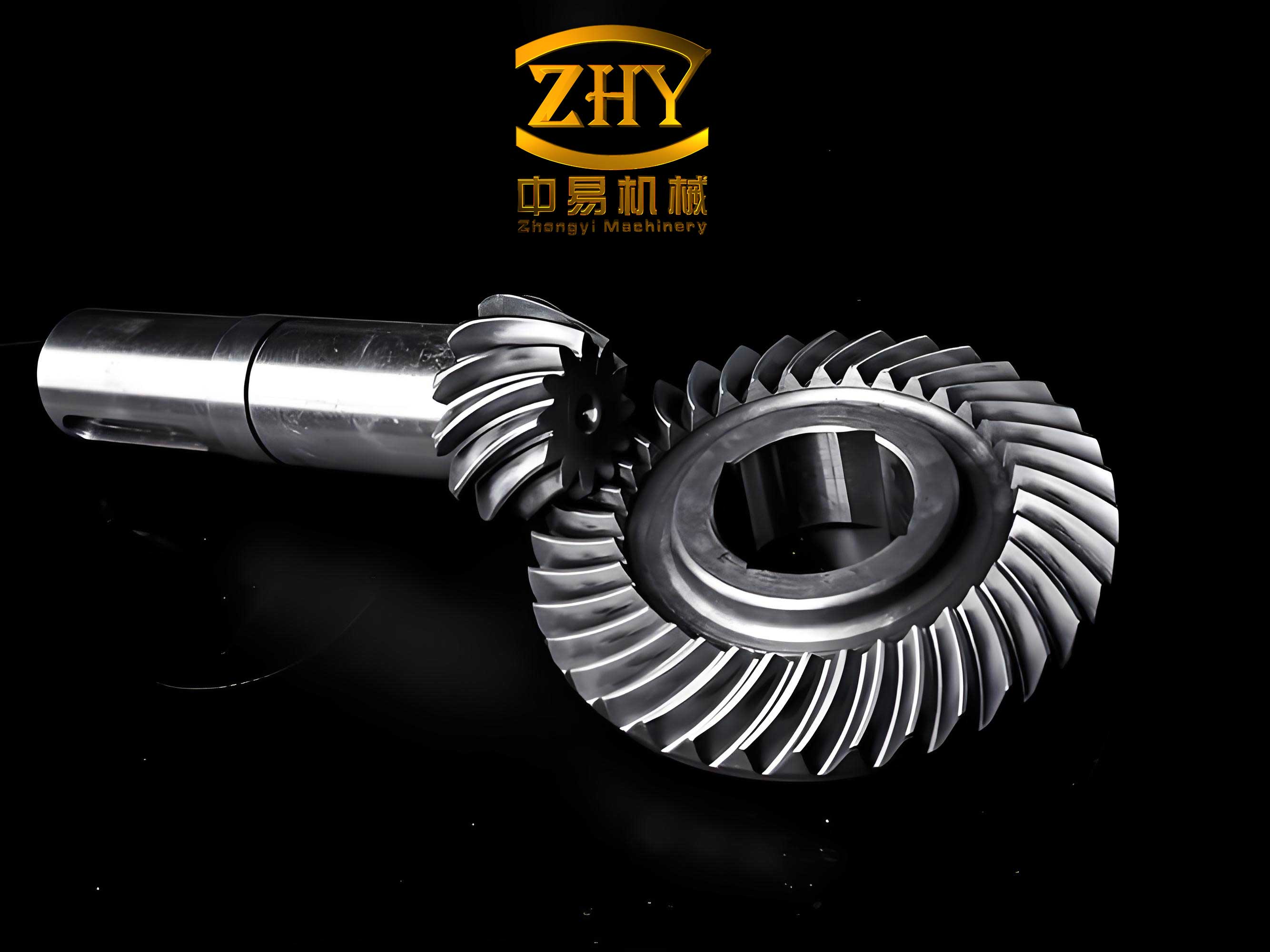
In the pursuit of precision within modern mechanical power transmission systems, the manufacturing of spiral bevel gears represents a pinnacle of engineering challenge and sophistication. These gears are critical components, enabling efficient power transfer between non-parallel, intersecting shafts with high torque capacity and smooth, quiet operation, especially in demanding applications like automotive differentials, aerospace propulsion, and heavy industrial machinery. The final quality and performance of a spiral bevel gear pair hinge on two primary technological pillars: advanced heat treatment, which governs the core metallurgical properties and durability, and precision finishing processes, with grinding being paramount for high-performance gears. While heat treatment ensures the necessary hardness and fatigue resistance, it invariably introduces geometric distortions and scale. Precision grinding, particularly on computer numerical control (CNC) gear grinding machines, is the definitive process for correcting these distortions, achieving micron-level dimensional accuracy, superior surface finish, and the precise flank topography required for optimal contact pattern and noise behavior. In a paired spiral bevel gear set, the benefits of grinding for correcting individual tooth errors and enhancing surface integrity are unequivocal, leading to markedly superior performance and longevity compared to non-ground counterparts.
The heart of the CNC grinding process for a spiral bevel gear pinion (the driving member) is the formed grinding wheel, typically made of advanced abrasives like SG (Seeded Gel). The wheel’s active profile is meticulously dressed to mirror the desired tooth flank geometry. This profile is defined by several key parameters, chief among them being the wheel diameter and the wheel angles. The wheel diameter is intrinsically linked to the machine kinematics and the gear’s root geometry and is generally held constant during the initial setup phase for a given batch, only being adjusted later as a primary means for contact pattern correction. The wheel angles, however, present a more nuanced opportunity for optimization. These angles are defined relative to the wheel’s axis and consist of the working side angle and the non-working (or clearance) side angle. The working side angle is fundamentally determined by the designed pressure angle of the gear tooth (commonly 20° for many industrial spiral bevel gears) and is subject to fine-tuning based on the lapped contact pattern of the mating gear set. The non-working side angle, typically chosen with a smaller value (e.g., 16°) solely to prevent interference with the opposite flank of the adjacent tooth during grinding, has traditionally been treated as a secondary, fixed parameter. However, a deliberate and informed selection of this non-working side angle can yield significant economic and operational benefits by directly influencing the wheel’s usable life and dressing efficiency.
The grinding wheel is a consumable tool. During its service life, it undergoes repeated dressing cycles to restore its precise form and sharpness, which erodes the wheel’s abrasive layer radially. This radial wear reduces the wheel’s effective diameter and, consequently, its usable profile height. Once this height is consumed, the wheel must be discarded, even if significant abrasive material remains in the non-critical zones. The central thesis of this optimization is that the geometry of the non-working side profoundly affects the initial and subsequent usable heights of the wheel profile. By strategically increasing the non-working side angle within safe limits, the axial height of the wheel profile for a given diameter can be maximized. This directly translates to a greater reserve of abrasive material available for dressing before the wheel reaches its minimum usable height, thereby reducing wheel consumption, lowering dressing time per part, and ultimately reducing manufacturing cost per gear.
Geometric Analysis of Wheel Profile and Dressing Impact
To quantify this effect, we must analyze the geometry of both the concave (outer cutter) and convex (inner cutter) wheels used for grinding the respective flanks of a spiral bevel gear pinion. The profile of these wheels can be approximated as a trapezoidal section, defined by the working angle (α_w), the non-working angle (α_n), and the wheel width or point width (W). The critical dimension for wheel life is the effective dressing height (H), measured from the wheel’s outer diameter (D) to the theoretical point where the two angled flanks would intersect.
The relationship between the wheel diameter, the angles, and this effective height can be derived. For a wheel being dressed to a smaller diameter (a common occurrence as the wheel wears and is re-trued), the change in height (ΔH) for a given change in radius (ΔR) is a function of the angles. Consider a wheel where the working side is fixed at α_w = 20°. The initial dressed profile height H_initial is determined by the initial radius R_initial and the angles. After dressing to a smaller radius R_final = R_initial – ΔR, the new height H_final is reduced. The key insight is that the rate of this height reduction with respect to radial wear depends on α_n.
We can model the profile height (H) as a function of the wheel’s tip radius (R) and the two flank angles. The geometry leads to the following relationship for a symmetric point (though the wheels are asymmetric, the principle for each side is separable):
$$ H(R) = R \cdot \left( \tan(\alpha_w) + \tan(\alpha_n) \right) – \frac{W}{2} \cdot \left( \frac{1}{\tan(\alpha_w)} + \frac{1}{\tan(\alpha_n)} \right) $$
However, for the purpose of analyzing the impact of dressing on height, we can simplify by considering the contribution of each flank independently. The axial distance from the wheel’s tip (at radius R) to a line parallel to the axis defining the “root” of the profile is contributed by each angle. For a radial reduction ΔR, the reduction in height on one flank (ΔH_side) is approximately:
$$ \Delta H_{side} \approx \Delta R \cdot \tan(\alpha_{side}) $$
Therefore, the total reduction in effective profile height ΔH_total when the wheel radius is reduced by ΔR is:
$$ \Delta H_{total} = \Delta R \cdot \left( \tan(\alpha_w) + \tan(\alpha_n) \right) $$
This equation reveals the core principle: The rate of height loss is proportional to the sum of the tangents of the working and non-working angles. A smaller α_n (e.g., 16° versus 20°) yields a smaller tan(α_n), resulting in a smaller ΔH_total for the same ΔR. This seems to suggest a smaller angle is better. However, this only describes the dressing *rate*. The more important factor is the *initial absolute height* available for a given starting diameter, which determines the total dressing capacity before the wheel is exhausted.
The initial height H_initial for a newly shaped wheel (or after a major re-profiling) with a large starting diameter is given by a similar relation. Crucially, for a fixed wheel tip width W and starting diameter D_start, a larger α_n creates a *taller* initial profile. This taller profile provides a greater “reservoir” of height to be consumed during its service life through successive dressings that reduce R. While each dressing step on a wheel with a larger α_n removes slightly more height per unit radial reduction, the starting point is significantly higher, leading to a greater total number of permissible dressing cycles and a larger total volume of abrasive material utilized.
The following tables illustrate this with concrete numerical examples, based on the typical scenario from the source material. We assume a wheel tip width (W) constant and analyze the effective height for different diameter and angle combinations.
| Wheel State | Working Angle α_w | Non-Working Angle α_n | Radius Change ΔR (mm) | Effective Height H (mm) | Height Difference vs. 16° case (mm) |
|---|---|---|---|---|---|
| After Dressing (Smaller D) | 20° | 16° | -1.27 | 21.14 | 0.00 (Baseline) |
| After Dressing (Smaller D) | 20° | 20° | -1.27 | 23.02 | +1.88 |
| After Dressing (Larger D) | 20° | 16° | +1.27 | 24.90 | 0.00 (Baseline) |
| After Dressing (Larger D) | 20° | 20° | +1.27 | 27.10 | +2.20 |
| Wheel State | Working Angle α_w | Non-Working Angle α_n | Radius Change ΔR (mm) | Effective Height H (mm) | Height Difference vs. 16° case (mm) |
|---|---|---|---|---|---|
| After Dressing (Smaller D) | 20° | 16° | -1.27 | 20.85 | 0.00 (Baseline) |
| After Dressing (Smaller D) | 20° | 20° | -1.27 | 22.68 | +1.83 |
| After Dressing (Larger D) | 20° | 16° | +1.27 | 24.55 | 0.00 (Baseline) |
| After Dressing (Larger D) | 20° | 20° | +1.27 | 26.70 | +2.15 |
The data in Tables 1 and 2 conclusively demonstrate the significant gain in usable profile height achieved by increasing the non-working angle from 16° to 20°. For both concave and convex wheels, and for both dressing operations that increase or decrease the effective diameter (simulating wear correction or contact pattern adjustment), the height advantage ranges from approximately 1.8 mm to 2.2 mm. This represents a substantial increase in the abrasive reservoir, directly delaying the point at which the wheel must be scrapped.
Mathematical Model for Wheel Life Extension
We can formalize the economic benefit by modeling wheel life. Let us define:
- $ L $ = Total usable radial wear allowance of the wheel (mm).
- $ \delta r $ = Radial wear per part (or per dressing cycle) (mm/part).
- $ N $ = Number of parts ground per wheel life.
Ignoring initial profile height for simplicity, $ N \approx L / \delta r $. The radial wear allowance L is constrained by the initial profile height $ H_0 $ and the dressing mechanics. The maximum allowable radial wear $ L_{max} $ before the height is exhausted is related to the initial height by the inverse of the relationship derived earlier:
$$ L_{max} \approx \frac{H_0}{\tan(\alpha_w) + \tan(\alpha_n)} $$
If $ \delta r $ is relatively constant, the wheel life in number of parts is:
$$ N \approx \frac{H_0}{\delta r \cdot (\tan(\alpha_w) + \tan(\alpha_n))} $$
Now, consider two scenarios for the same wheel blank and grinding process, differing only in the dressed non-working angle: Case A with $ \alpha_n^A $ and Case B with $ \alpha_n^B $, where $ \alpha_n^B > \alpha_n^A $. The initial height $ H_0^B $ will be greater than $ H_0^A $ for the same starting diameter. The ratio of wheel life between the two cases is approximately:
$$ \frac{N_B}{N_A} \approx \frac{H_0^B}{H_0^A} \cdot \frac{\tan(\alpha_w) + \tan(\alpha_n^A)}{\tan(\alpha_w) + \tan(\alpha_n^B)} $$
Given that $ H_0 $ is roughly proportional to $ (\tan(\alpha_w) + \tan(\alpha_n)) $ for a constant base geometry, the ratio simplifies, indicating that the life extension primarily comes from the increased initial abrasive volume. For the example of $ \alpha_w = 20° $, $ \alpha_n^A = 16° $, $ \alpha_n^B = 20° $:
$$ \tan(20°) \approx 0.364, \quad \tan(16°) \approx 0.287, \quad \tan(20°) \approx 0.364 $$
$$ \frac{N_{20°}}{N_{16°}} \approx \frac{0.364+0.364}{0.364+0.287} \cdot \frac{0.364+0.287}{0.364+0.364} = \frac{0.728}{0.651} \approx 1.118 $$
This suggests an ~12% potential increase in the number of dressing cycles or parts per wheel. In practice, the gain is often more significant because the constraint is the absolute height $ H_0 $, and the larger angle allows the full radial wear allowance L to be utilized with a taller starting profile, effectively increasing $ H_0 $ more than the simple ratio suggests, as seen in the tables where height increased by 8-9%.
Practical Application and Constraints in Spiral Bevel Gear Production
The implementation of this optimization strategy in a production environment for spiral bevel gears is not without constraints. The primary and absolute constraint is the prevention of grinding interference. The non-working flank of the wheel must never contact the already-finished opposite flank of the adjacent tooth during the grinding cycle of the target flank. The safe minimum value for $ \alpha_n $ is therefore a function of the gear’s geometric parameters:
- Gear Tooth Geometry: The primary factors are the number of teeth (Z), module (m), spiral angle (β), and pressure angle. A gear with a low tooth count and a large module has a wide tooth slot (large space width). This provides ample clearance, allowing $ \alpha_n $ to be increased substantially—potentially even equal to or slightly greater than $ \alpha_w $—without risk of interference.
- Profile and Lengthwise Curvature: The complex crowned and longitudinally curved flank of a spiral bevel gear means clearance must be checked not just at the pitch point but along the entire active profile and at the extremes of the face width. CNC grinding machine simulation software is essential for performing this verification digitally before setting the wheel on the machine.
- Grinding Wheel Diameter: The chosen wheel diameter affects the entry and exit path of the wheel into the tooth space. A smaller wheel diameter generally has better clearance but may affect other aspects of the grinding kinematics and surface generation.
The optimization process thus becomes an iterative analysis: For a given spiral bevel gear pinion design, the maximum permissible non-working angle $ \alpha_{n_{max}} $ is determined via simulation, ensuring a safety margin against interference. This calculated $ \alpha_{n_{max}} $ is then compared to the standard default (e.g., 16°). If $ \alpha_{n_{max}} $ is significantly larger, it is economically advantageous to dress the wheel to this larger angle. For high-volume production of large, coarse-pitch spiral bevel gears commonly found in heavy machinery, this practice can yield considerable savings.
Furthermore, the benefit extends beyond mere wheel consumption. Each dressing cycle consumes machine time. A wheel with a greater usable height requires fewer dressing interruptions over its lifetime for a given number of parts. This increases overall equipment effectiveness (OEE) by reducing non-cutting time. The relationship can be expressed as:
$$ \text{Total Dressing Time Saved} = (N_A – N_B) \cdot t_d $$
Where $ t_d $ is the time required for one complete precision dressing cycle. This saving directly reduces the cycle time cost attributed to each ground spiral bevel gear.
Extended Considerations and Advanced Implications
The principle of optimizing the non-working flank angle opens avenues for more sophisticated manufacturing strategies for spiral bevel gears:
1. Adaptive Dressing Protocols: Instead of a fixed $ \alpha_n $, a variable strategy could be employed. When a new wheel is first dressed to its maximum diameter, $ \alpha_n $ could be set to its maximum safe value to maximize initial height. As the wheel wears and is re-dressed to smaller diameters, the tooth slot geometry relative to the wheel effectively changes. It may become possible, or even necessary, to slightly adjust $ \alpha_n $ during subsequent dressings to maintain optimal clearance and continued height utilization.
2. Material-Specific Optimization: The wear rate $ \delta r $ is not constant; it depends on the gear material (e.g., case-hardened steel vs. nitrided steel). For materials that are more abrasive and cause faster wheel wear, the economic value of maximizing $ H_0 $ is even greater. The model can be adapted to include a cost function $ C_{total} = C_{wheel}/N + C_{dressing} \cdot N_d + C_{grinding} $, where $ N_d $ is the number of dresses. Minimizing $ C_{total} $ with respect to $ \alpha_n $ (within the interference constraint) provides a true cost-optimal manufacturing parameter.
3. Interaction with Contact Pattern Correction: The primary method for adjusting the length and position of the contact pattern on a spiral bevel gear tooth is often a controlled change in the grinding wheel diameter. As shown in the tables, changing the diameter (a ±ΔR operation) has a height impact modulated by $ \alpha_n $. A larger $ \alpha_n $ means that a given diameter change for contact pattern tuning will result in a larger change in the wheel profile height. This interaction must be understood and accounted for by the process engineer to ensure that pattern corrections do not inadvertently consume the wheel height reserve too quickly. The relationship can be defined as a sensitivity coefficient:
$$ S_{H/D} = \frac{\partial H}{\partial D} = \frac{1}{2} \cdot \left( \tan(\alpha_w) + \tan(\alpha_n) \right) $$
A higher $ S_{H/D} $ implies a more sensitive process, demanding tighter control over diameter compensation decisions.
4. Implications for Wheel Specification and Inventory: If a manufacturer standardizes on larger non-working angles for a family of spiral bevel gears, it may influence the initial specification of the wheel blank. A slightly thicker wheel blank might be justified to fully exploit the potential for increased abrasive volume, knowing that the dressing strategy will utilize it effectively.
In conclusion, the grinding of spiral bevel gears is a process where minute attention to geometric detail yields disproportionate rewards in quality and cost. Moving beyond the conventional treatment of the grinding wheel’s non-working angle as a mere clearance parameter, and re-conceptualizing it as a key variable for resource optimization, represents a significant step in lean and efficient precision manufacturing. By applying the geometric and mathematical models outlined, manufacturers can make informed decisions to extend grinding wheel life, reduce dressing downtime, and lower the per-unit cost of producing these critical high-performance components, all while maintaining or even enhancing the final quality of the spiral bevel gear. This optimization is particularly potent in the production of large, heavy-duty spiral bevel gears, where the consumable costs and machining times are substantial, making even fractional percentage improvements highly valuable. The strategy underscores a fundamental principle in advanced manufacturing: true efficiency is found not only in faster cutting speeds but in the intelligent maximization of every resource, including the humble grinding wheel profile.