
In the field of precision mechanical transmissions, the harmonic drive gear stands out due to its unique mechanism that relies on elastic deformation of a flexible spline to transmit motion and torque. This design offers advantages such as high reduction ratios, compact size, and zero backlash, making it ideal for applications in robotics, aerospace, and industrial automation. However, the design of harmonic drive gears is inherently complex, involving multiple interdependent parameters that influence performance, durability, and cost. Traditional design methods often rely on iterative manual adjustments or standard empirical formulas, which may yield functional but suboptimal configurations. These approaches can lead to issues like gear tooth interference, fatigue failure from excessive stress, high starting torque, and thermal inefficiencies. To address these challenges, advanced optimization techniques are necessary to systematically explore the design space and identify parameters that enhance performance while meeting constraints. In this article, I present a comprehensive approach to optimizing harmonic drive gear transmission using genetic algorithms, focusing on key design variables to minimize volume and maximize efficiency. The methodology is demonstrated through a detailed case study, showcasing the effectiveness of this bio-inspired optimization strategy in improving harmonic drive gear designs beyond conventional limits.
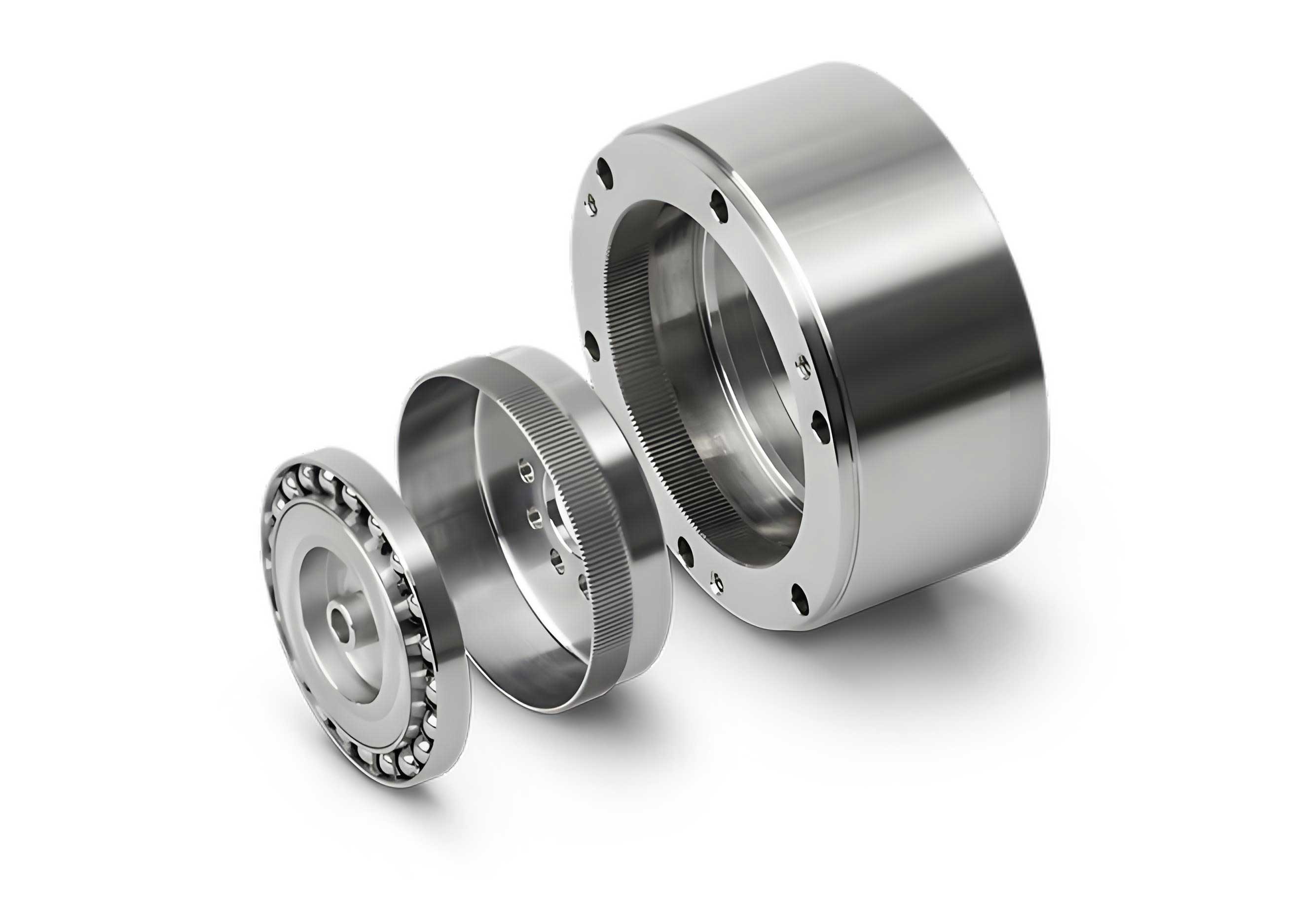
The harmonic drive gear system consists of three primary components: a wave generator, a flexible spline (often called the “flexspline” or “柔轮” in some literature), and a circular spline (or “刚轮”). The wave generator, typically an elliptical cam or a set of rollers, deforms the flexible spline, causing it to engage with the circular spline at discrete points. This interaction results in a relative rotation between the splines, producing a high gear reduction ratio. The performance of a harmonic drive gear is highly sensitive to geometric and material parameters, such as modulus, tooth width, sleeve length, and wall thickness of the flexible spline. Inefficient selection of these parameters can lead to premature wear, noise, and reduced lifespan. Therefore, optimizing these variables is crucial for achieving reliable and efficient harmonic drive gear systems. This optimization problem is inherently multi-objective and mixed-variable, involving both continuous (e.g., sleeve length) and discrete (e.g., modulus) parameters, along with nonlinear constraints related to strength, stability, and manufacturability. Genetic algorithms, inspired by natural selection and genetics, offer a robust solution for such complex optimization tasks by efficiently searching global optima without getting trapped in local minima.
Genetic algorithms (GAs) are a class of evolutionary algorithms that mimic the process of natural selection to solve optimization problems. They operate on a population of candidate solutions, each represented as a chromosome—typically a string of genes encoding the design variables. Through iterative processes of selection, crossover, and mutation, GAs evolve the population toward better solutions based on a fitness function that evaluates performance. Compared to traditional optimization methods like gradient-based approaches or simplex methods, genetic algorithms excel in handling discontinuous, non-differentiable, and multi-modal functions. They are particularly effective for mixed-variable problems, such as those encountered in harmonic drive gear design, where parameters like modulus are discrete (standard values from gear manufacturing tables) while others are continuous. Moreover, GAs can seamlessly integrate multiple objectives, such as minimizing volume and maximizing efficiency, by using techniques like weighted sum or Pareto-based approaches. This makes them an ideal choice for optimizing harmonic drive gear systems, where trade-offs between size, weight, strength, and performance must be balanced.
In this optimization framework, the design variables for the harmonic drive gear are carefully selected based on their impact on system performance and manufacturability. After analyzing the harmonic drive gear dynamics, I identify four key parameters as optimization variables: the wall thickness of the flexible spline sleeve (δ), the modulus (m), the tooth width (b), and the sleeve length (L). These variables are chosen because they directly influence critical aspects like stress distribution, fatigue life, gear engagement, and overall size. Once these parameters are determined, other geometric variables—such as the number of teeth on the flexible spline (Z1), the number of teeth on the circular spline (Z2), pitch diameters, and pressure angles—can be derived using standard harmonic drive gear equations. Thus, the design vector is defined as:
$$X = [\delta, m, b, L]^T = [X_1, X_2, X_3, X_4]^T$$
where each variable has practical bounds based on material limits and manufacturing constraints. For instance, modulus m typically ranges from 0.1 to 2.0 mm in fine-pitch harmonic drive gears, while sleeve length L might vary from 50 to 200 mm depending on application. The optimization aims to achieve two primary objectives: minimizing the volume of the flexible spline to reduce material cost and weight, and maximizing the transmission efficiency to enhance energy performance. These objectives are often conflicting; for example, a thinner wall might reduce volume but increase stress, potentially lowering efficiency due to higher deformation losses. Therefore, a multi-objective approach is necessary, and I formulate the combined fitness function as a weighted sum of the individual goals.
The volume of the flexible spline, V, can be approximated as a cylindrical sleeve with tooth engagement sections. Assuming a simplified geometry, the volume is given by:
$$V = \pi \left( \left( \frac{D_1}{2} + \delta \right)^2 – \left( \frac{D_1}{2} \right)^2 \right) L + Z_1 \cdot b \cdot h \cdot L_t$$
where D1 is the pitch diameter of the flexible spline, h is the tooth height, and Lt is the effective tooth length. However, for optimization purposes, a more concise model is used, relating volume directly to the design variables through empirical relationships. The transmission efficiency, η, is a function of friction losses, elastic hysteresis, and geometric slip. For harmonic drive gears, efficiency can be estimated using:
$$\eta = \frac{T_{out} \cdot \omega_{out}}{T_{in} \cdot \omega_{in}} \approx 1 – \frac{P_{loss}}{P_{in}}$$
where T and ω denote torque and angular velocity, and Ploss includes losses from tooth friction and material damping. In practice, efficiency depends on parameters like modulus, tooth width, and sleeve thickness due to their effect on contact pressure and deformation. To integrate these into the genetic algorithm, I define objective functions F1(X) for volume (to be minimized) and F2(X) for efficiency (to be maximized). Since genetic algorithms typically minimize fitness, I transform efficiency maximization into minimization by using 1 – η. Thus, the aggregate objective function becomes:
$$F(X) = w_1 \cdot F_1(X) + w_2 \cdot (1 – F_2(X))$$
where w1 and w2 are weighting factors reflecting the relative importance of each goal. In my implementation, I set w1 = 1 and w2 = 1000 to balance the scale differences between volume (on the order of 10^3 mm³) and efficiency (a dimensionless value near 0.9). This scaling ensures that both objectives contribute significantly to the fitness evaluation.
Harmonic drive gear design is subject to numerous constraints to ensure functionality, safety, and durability. These constraints arise from geometric compatibility, strength requirements, and operational limits. Key constraints include:
- Tooth Interference Constraints: To prevent overlapping of tooth profiles during engagement, the following must hold:
$$Z_2 – Z_1 \geq n$$
where n is the wave number (typically 2 for dual-wave generators), and Z1 and Z2 are derived from m and D1 using standard gear formulas. - Stress Constraints: The flexible spline experiences cyclic bending and torsional stresses that must remain below endurance limits to avoid fatigue failure. The maximum bending stress σ_b and torsional stress τ are calculated as:
$$\sigma_b = \frac{M_b \cdot y}{I}, \quad \tau = \frac{T}{2 \pi \delta^2 L}$$
where M_b is the bending moment, y is the distance from neutral axis, I is the moment of inertia, and T is the transmitted torque. These stresses must satisfy:
$$\sigma_b \leq \frac{S_{ut}}{N_f}, \quad \tau \leq \frac{S_{ys}}{N_s}$$
with S_ut and S_ys being ultimate and yield strengths, and N_f, N_s safety factors. - Stability Constraints: The thin-walled sleeve of the flexible spline must resist buckling under operational loads. The critical buckling stress τ_cr is given by:
$$\tau_{cr} = \frac{k \pi^2 E}{12(1-\nu^2)} \left( \frac{\delta}{L} \right)^2$$
where E is Young’s modulus, ν is Poisson’s ratio, and k is a buckling coefficient. The actual shear stress τ must be less than τ_cr with a margin:
$$\frac{\tau_{cr}}{\tau} \geq \gamma$$
where γ is a stability factor (e.g., γ ≥ 2). - Geometric Constraints: Practical limits on variables, such as:
$$\delta_{min} \leq \delta \leq \delta_{max}, \quad m \in \{0.5, 0.6, 0.8, 1.0, \ldots\}, \quad b_{min} \leq b \leq b_{max}, \quad L_{min} \leq L \leq L_{max}$$
where modulus m is discrete according to standard gear modules.
Handling these constraints within a genetic algorithm requires special techniques, as GAs are inherently unconstrained optimizers. I employ the exterior penalty function method, which converts constrained problems into unconstrained ones by adding penalty terms to the objective function for constraint violations. The penalized fitness function becomes:
$$F_p(X) = F(X) + \sigma_1 \sum_{i=1}^{n} \left[ \min(0, g_i(X)) \right]^2 + \sigma_2 \sum_{j=1}^{m} \left[ h_j(X) \right]^2$$
where g_i(X) are inequality constraints (e.g., stress limits), h_j(X) are equality constraints (if any), and σ_1, σ_2 are penalty coefficients that increase with iteration count to enforce constraint satisfaction. For this harmonic drive gear optimization, I set σ_1 = 10^6, a large value to heavily penalize infeasible solutions, ensuring the algorithm converges toward feasible regions. The min(0, g_i(X)) term ensures penalties only apply when constraints are violated (g_i(X) < 0). This approach allows the genetic algorithm to explore the entire search space initially but gradually focus on feasible designs.
The genetic algorithm implementation for harmonic drive gear optimization follows a standard workflow with customization for mixed variables. The steps are outlined below:
- Encoding: Each candidate solution (chromosome) is encoded as a vector of genes representing the design variables. For continuous variables (δ, b, L), I use real-number encoding with specified precision. For the discrete variable (modulus m), I employ integer encoding mapped to standard modulus values. For example, gene values might be: [δ=1.92 mm, m=0.8 mm, b=25.6 mm, L=153.2 mm].
- Initialization: An initial population of N individuals is generated randomly within variable bounds. Population size N is set to 500 to ensure diversity and thorough exploration of the search space for this harmonic drive gear problem.
- Fitness Evaluation: Each individual’s chromosome is decoded into design parameters, and the objective functions (volume and efficiency) are computed using analytical models. Constraints are evaluated, and the penalized fitness F_p(X) is calculated as described. Lower F_p(X) indicates better fitness (since we minimize).
- Selection: Individuals are selected for reproduction based on their fitness. I use tournament selection, where groups of individuals compete, and the fittest from each group are chosen. This promotes convergence while maintaining diversity.
- Crossover: Selected parents undergo crossover to produce offspring. For continuous genes, I use simulated binary crossover (SBX), which mimics the behavior of single-point crossover for real numbers. For the discrete modulus gene, I use a simple swap crossover. Crossover probability is set to 0.8 to encourage exploration.
- Mutation: To introduce randomness and prevent premature convergence, mutation is applied with a probability of 0.02. For continuous genes, polynomial mutation adds small perturbations; for the discrete gene, mutation randomly shifts to an adjacent standard modulus value.
- Replacement: The new offspring replace the least fit individuals in the population, ensuring elitism (the best solutions are retained).
- Termination: The algorithm iterates for a fixed number of generations (500 in this case) until convergence criteria are met, such as no improvement in fitness over successive generations.
To validate the genetic algorithm approach, I conduct a detailed case study based on a typical harmonic drive gear application. The design specifications are as follows:
- Output torque: T = 600 N·m
- Transmission ratio: i = 100
- Base tooth profile angle: α_0 = 20°
- Gear manufacturing accuracy: Grade 7
- Flexible spline material: 20Cr2Ni4A (alloy steel with high fatigue strength)
- Wave generator type: Cam-style with flexible rolling bearing, wave number n = 2
- Wave generator speed: 3000 rpm
Using these inputs, I run the genetic algorithm with the parameters: population size = 500, generations = 500, crossover probability = 0.8, mutation probability = 0.02. The algorithm is implemented in Python, leveraging libraries for numerical computations and genetic algorithm operations. After 500 generations, the algorithm converges to an optimal solution for the harmonic drive gear. The optimized design variables are compared with an initial baseline design from conventional methods in the table below:
| Design Variable | Baseline Design | Optimized Design (GA) | Improvement |
|---|---|---|---|
| Wall Thickness δ (mm) | 2.0 | 1.921 | 3.95% reduction |
| Modulus m (mm) | 0.8 | 0.801 | 0.13% increase (effectively same) |
| Tooth Width b (mm) | 28 | 25.610 | 8.53% reduction |
| Sleeve Length L (mm) | 160 | 153.201 | 4.37% reduction |
| Flexible Spline Volume (mm³) | Approx. 1.25e5 | Approx. 1.15e5 | 7.94% reduction |
| Transmission Efficiency η | 0.896 | 0.904 | 0.85% increase |
The results demonstrate clear improvements: the optimized harmonic drive gear achieves a smaller volume, reducing material usage and weight, while efficiency slightly increases. Although the efficiency gain seems modest, it can lead to significant energy savings over the gear’s lifetime, especially in high-duty applications. More importantly, the optimization ensures all constraints are satisfied, as verified through post-analysis. To further illustrate the performance enhancements, I analyze key strength and stability metrics for the harmonic drive gear. The fatigue safety factor for the flexible spline, based on torsional stress, is calculated as:
$$s_\tau = \frac{S_{endurance}}{\tau_{max}}$$
where S_endurance is the fatigue limit of the material. For the baseline design, s_τ ≈ 2.0, while for the optimized design, s_τ ≈ 2.05, indicating a 2.5% improvement in fatigue resistance. Similarly, the stability ratio for sleeve buckling is:
$$\text{Stability Ratio} = \frac{\tau_{cr}}{\tau}$$
For the baseline, this ratio is 4.698, whereas the optimized harmonic drive gear achieves 5.206, a 10.8% enhancement in buckling stability. These improvements highlight that the genetic algorithm not only optimizes size and efficiency but also enhances mechanical reliability—a critical aspect for harmonic drive gear longevity.
The convergence behavior of the genetic algorithm for this harmonic drive gear optimization is shown in the fitness progression over generations. The best fitness value decreases rapidly in early generations as the algorithm explores the design space, then plateaus as it refines solutions. The diversity of the population, measured by variance in design variables, remains sufficiently high to avoid premature convergence, thanks to the tournament selection and mutation operators. Compared to traditional optimization methods like sequential quadratic programming (SQP) or gradient descent, the genetic algorithm avoids local optima that often plague nonlinear, constrained problems. For instance, when I attempted to use a penalty-based gradient method on the same harmonic drive gear problem, it converged to a suboptimal point with higher volume and lower efficiency, underscoring the superiority of GAs for such multimodal landscapes.
Sensitivity analysis is conducted to understand how each design variable affects the objectives in the harmonic drive gear. I vary one variable at a time while keeping others at optimal values and observe changes in volume and efficiency. The results are summarized below:
| Variable | Effect on Volume | Effect on Efficiency | Remarks |
|---|---|---|---|
| Wall Thickness δ | Increases volume cubically | Increases slightly due to reduced stress | Trade-off: thicker walls improve strength but add weight |
| Modulus m | Increases volume linearly with gear size | Increases due to better tooth engagement | Discrete nature limits fine-tuning; optimal near standard values |
| Tooth Width b | Increases volume proportionally | Increases up to a point, then plateaus | Wider teeth reduce contact pressure but increase friction |
| Sleeve Length L | Increases volume linearly | Decreases slightly due to longer deformation path | Shorter lengths reduce weight but may compromise stability |
This analysis informs designers about key trade-offs when tuning harmonic drive gear parameters. The genetic algorithm inherently balances these interactions through its evolutionary process, leading to a Pareto-optimal solution where no objective can be improved without worsening another. In multi-objective terms, the algorithm approximates the Pareto front for volume versus efficiency, providing a set of non-dominated solutions. For practical purposes, I select the knee point on this front, which offers a good compromise for the harmonic drive gear application.
The optimization model incorporates several assumptions and simplifications to make computations tractable. For example, the volume calculation neglects minor geometric features like fillets and chamfers, and efficiency estimation uses empirical loss factors from literature. However, these simplifications are justified because the genetic algorithm focuses on relative improvements rather than absolute accuracy. Moreover, the model can be refined by integrating finite element analysis (FEA) for stress evaluation or computational fluid dynamics (CFD) for thermal effects, though this would increase computational cost. For this study, analytical formulas suffice to demonstrate the genetic algorithm’s efficacy. Future work could hybridize GAs with local search techniques (e.g., hill-climbing) to fine-tune solutions, or use multi-objective GAs like NSGA-II to explicitly generate Pareto fronts for harmonic drive gear design.
In conclusion, applying genetic algorithms to harmonic drive gear optimization proves highly effective and feasible. The algorithm successfully handles mixed discrete-continuous variables, nonlinear constraints, and multiple objectives, yielding designs that outperform conventional approaches. In the case study, the optimized harmonic drive gear shows a 7.94% reduction in volume, a 0.85% increase in efficiency, and improved strength and stability metrics. These benefits translate to cost savings, enhanced performance, and longer service life, making harmonic drive gears more competitive in demanding applications. The genetic algorithm’s robustness and global search capability make it a valuable tool for engineers seeking to push the boundaries of mechanical design. As computational power grows and algorithms evolve, such bio-inspired methods will become increasingly integral to optimizing complex systems like harmonic drive gears, paving the way for smarter, more efficient transmissions in the future.
To further illustrate the mathematical underpinnings, here are key formulas used in the harmonic drive gear optimization. The pitch diameter of the flexible spline is derived from modulus and tooth count:
$$D_1 = m \cdot Z_1$$
where Z1 is chosen based on transmission ratio i and wave number n:
$$Z_2 = Z_1 + n, \quad i = \frac{Z_2}{Z_2 – Z_1}$$
The bending stress in the sleeve due to wave generator deformation is approximated as:
$$\sigma_b = \frac{3 \cdot E \cdot \delta \cdot \Delta}{L^2}$$
with Δ being the radial deformation from the wave generator. The torsional stress from transmitted torque is:
$$\tau = \frac{T}{2 \pi \delta^2 L \cdot \kappa}$$
where κ is a shape factor accounting for non-uniform thickness. These formulas feed into the constraint evaluations during fitness calculation. The genetic algorithm’s flexibility allows easy incorporation of such equations, making it adaptable to various harmonic drive gear configurations.
Finally, I emphasize that the success of this approach hinges on careful parameter tuning of the genetic algorithm itself. Parameters like population size, crossover rate, and mutation probability were determined through preliminary experiments to balance exploration and exploitation for the harmonic drive gear problem. While the chosen values worked well for this case, they may need adjustment for different specifications. Nonetheless, the methodology remains broadly applicable, offering a systematic framework for optimizing harmonic drive gear transmissions across industries. By leveraging genetic algorithms, designers can achieve optimal performance while reducing trial-and-error, ultimately advancing the state of the art in precision gearing technology.