
In my extensive experience within the power transmission industry, the manufacturing of high-performance gear shafts presents a significant challenge, particularly when it comes to balancing precise mechanical properties with minimal distortion. Gear shafts are critical components, and their failure can lead to catastrophic system breakdowns. This article details a comprehensive study and successful optimization of the heat treatment process for a specific type of splined gear shaft. The initial conventional method led to unacceptable deformation, prompting a thorough investigation and the development of a superior, more reliable technique. The focus here is on the journey from a problematic double carburizing process to an efficient combined carburizing and induction hardening approach, which not only solved the distortion issue but also enhanced economic efficiency. Throughout this discussion, the term ‘gear shafts’ will be frequently emphasized, as the core subject revolves around their processing and performance.
The fundamental role of gear shafts in transmitting torque and motion cannot be overstated. They must possess a hard, wear-resistant surface to withstand contact stresses, while maintaining a tough, ductile core to absorb impact loads. This combination is typically achieved through case hardening processes like carburizing. However, when a single gear shaft features two distinct functional areas—such as a high-module gear section and a splined section—with differing case depth requirements, the standard one-size-fits-all heat treatment becomes inadequate. The specific gear shafts under discussion here exemplify this complexity. Their design necessitates a deep hardened case for the gear teeth to endure bending fatigue and a shallower, yet sufficiently hard, case for the splines to resist wear and plastic deformation under torsional loads.
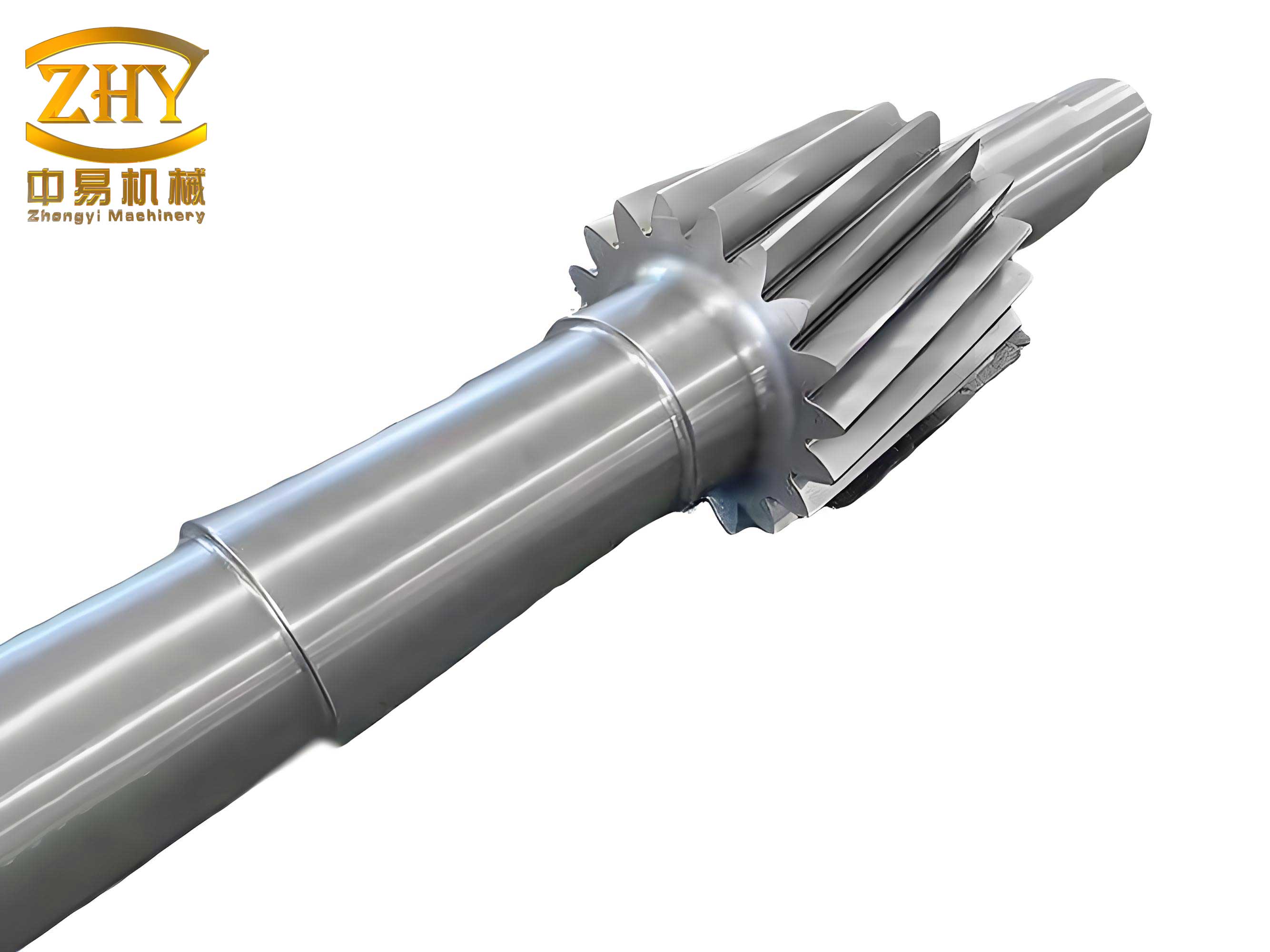
Let me begin by detailing the specifications of these gear shafts. The material specified was 20CrNi2MoA, a chromium-nickel-molybdenum alloy steel known for its excellent hardenability and core toughness. The chemical composition we worked with is summarized in Table 1. The mechanical property targets for the finished component were a tensile strength (σ_b) of at least 1080 MPa, a yield strength (σ_s) of at least 785 MPa, elongation (δ_5) of 8% or more, reduction of area (ψ) of 35% or more, and impact energy (A_KV) of at least 47 Joules.
| C | Si | Mn | S | P | Cr | Ni | Mo |
|---|---|---|---|---|---|---|---|
| 0.19 | 0.27 | 0.98 | 0.017 | 0.02 | 0.62 | 1.95 | 0.23 |
The technical requirements for the two key sections were distinct, as outlined in Table 2. The gear section required an effective case depth (ECD) of 2.8 to 3.5 mm with a surface hardness of 57-61 HRC, while the spline section needed an ECD of only 1.1 to 1.7 mm but with the same high surface hardness. The core hardness for both was specified between 35-40 HRC. Furthermore, the concentricity between the gear and spline axes was critical, required to be within 1.0 mm, and the gear teeth had to be free of grinding cracks after final machining. This disparity in case depth requirements for different sections of the same gear shaft was the root of our initial processing difficulties.
| Section | Effective Case Depth (mm) | Surface Hardness (HRC) | Core Hardness (HRC) | Concentricity (mm) |
|---|---|---|---|---|
| Gear Teeth | 2.8 – 3.5 | 57 – 61 | 35 – 40 | ≤ 1.0 |
| Spline | 1.1 – 1.7 | 57 – 61 | 35 – 40 |
Our first approach to manufacturing these gear shafts was the so-called “differential carburizing” or “two-step carburizing” method. The principle was straightforward: perform a full-length carburize to achieve the deep case required for the gear teeth, but protect the spline area with an anti-carburizing coating to limit its case depth. After this first treatment, the splines would be machined. Then, a second, shorter carburizing cycle would be applied specifically to the spline area to build its case to the required 1.7 mm depth (including a grinding allowance). Finally, a single quench and temper operation would harden both sections. The theoretical process sequence is illustrated in the following conceptual formula for total case depth, where it is approximated by a parabolic growth law:
$$d \approx k \sqrt{t}$$
Here, \(d\) is the case depth, \(k\) is a temperature-dependent diffusion constant, and \(t\) is the time. For two-step carburizing, the total process time \(t_{total}\) becomes \(t_1 + t_2\), tailored for different \(d\) values on the same component.
The detailed process flow we initially employed was: Forging → Rough Machining → Normalizing (at 900°C for microstructure homogenization) → Semi-Finishing → Gear Hobbing → First Carburizing (with spline area masked) → Machining of Splines → Second Carburizing (targeting splines) → Heating to 820-830°C → Quenching in 60-80°C fast oil → Tempering at 200°C. This was a complex and time-consuming sequence. We processed 15 such gear shafts using this method. The results were deeply unsatisfactory. The distortion, particularly the concentricity error between the gear and spline sections, was severe and unpredictable. Table 3 presents the distortion data from a sample of these gear shafts. The “twisting” or “warping” effect was pronounced, with concentricity errors reaching up to 2.44 mm. This level of distortion made subsequent grinding and finishing operations exceedingly difficult and risked rendering the gear shafts unusable. The long, slender geometry of these gear shafts, characterized by a high length-to-diameter ratio, exacerbated the distortion problem. The fundamental issue was the repeated exposure to high temperatures (during two carburizing cycles and the final quench), which introduced cumulative thermal stresses and phase transformation stresses.
| Shaft ID | Gear OD Change (mm) | Spline OD Change (mm) | Gear-Spline Concentricity Error (mm) | Gear Tooth Runout (mm) |
|---|---|---|---|---|
| 1 | 1.14 | 1.01 | 1.45 | 0.20 |
| 2 | 1.26 | 1.08 | 1.52 | 0.20 |
| 3 | 1.03 | 0.97 | 2.44 | 0.18 |
| 4 | 1.03 | 0.86 | 2.32 | 0.16 |
| 5 | 0.95 | 0.76 | 1.85 | 0.18 |
Faced with these challenges, we explored an alternative. We reasoned that if the spline hardness requirement could be relaxed from the very high 57-61 HRC to a level that still provided adequate strength for its function, a simpler local hardening method could be applied. After consultation and design analysis, it was confirmed that a surface hardness of 38-42 HRC on the splines would be sufficient for the required torque transmission and wear resistance. This opened the door to using induction surface hardening for the spline section, while the gear teeth would still undergo gas carburizing to achieve their deep, hard case. This became the cornerstone of our optimized process for these critical gear shafts.
To validate this concept, we first conducted fundamental hardenability tests on the 20CrNi2MoA material. Small cylindrical specimens (φ40 mm x 50 mm) were austenitized and quenched using different methods. The results, shown in Table 4, confirmed that this steel could achieve a hardness in the mid-40s HRC with either through-hardening in oil or local water quenching after heating, well above the new target of 38-42 HRC for the splines.
| Sample | Heating Method | Quenchant | Hardness After Quench (HRC) |
|---|---|---|---|
| 1 | Furnace | Oil | 44 – 47 |
| 2 | Flame | Water | 44 – 47 |
Encouraged by this, we proceeded to a full-scale simulation using a real splined shaft workpiece made of 20CrNi2MoA, with a prior tempering hardness of 246 HBW. The spline parameters were: module m_n=7, 38 teeth, 260 mm outer diameter, and 230 mm length. We applied induction hardening using a 10 kHz medium-frequency power supply. The key process parameters were: an annular inductor with a 2.5-3.0 mm air gap, a load voltage of 750 V, a load current of 168 A, a power factor of 0.95, delivering approximately 120 kW of power. The shaft was scanned continuously under the inductor at a speed of 65 mm/min, with water spray quenching at 0.1 MPa pressure. This was followed by a low-temperature tempering at 330°C to relieve stresses. The results were excellent, as summarized in Table 5. The spline achieved a uniform surface hardness of 43-45 HRC with a case depth of 1.5-2.5 mm following the contour of the spline teeth—an ideal distribution for bending fatigue strength. Most importantly, the distortion was minimal: radial expansion was only 0.15-0.20 mm, and axial change was 0.1-0.15 mm. Metallographic examination revealed a fine, acicular martensitic structure at the surface, indicative of a high-quality, fast quench.
| Surface Hardness (HRC) | Case Depth (mm) | Case Profile | Radial Distortion (mm) | Axial Distortion (mm) |
|---|---|---|---|---|
| 43 – 45 | 1.5 – 2.5 | Contour-Following | 0.15 – 0.20 | 0.10 – 0.15 |
The success of the simulation led to the formalization of the optimized production workflow for these gear shafts: Forging → Rough Machining → Normalizing → Semi-Finishing → Gear Hobbing → Single-Cycle Gas Carburizing (for gear teeth only, with spline area masked) → Quenching and Tempering → Machining of Splines → Induction Hardening of Splines → Final Precision Grinding of Gear Teeth → Assembly. This sequence eliminates the second high-temperature carburizing cycle, thereby drastically reducing the thermal history and associated distortion risks for the entire component.
We had the opportunity to apply this optimized process in a batch production run of 28 gear shafts for a major project. For a controlled comparison, 14 gear shafts were processed using the old differential carburizing method, and the other 14 were treated with the new combined carburizing and induction hardening process. The difference in outcomes was stark. The distortion data for the new batch is presented in Table 6. The concentricity error, which was the most critical issue, was consistently controlled within 0.20 mm for the spline section after induction hardening, and the overall distortion of the gear section from the single carburizing quench was also significantly lower and more predictable compared to the data in Table 3. All 14 gear shafts from the optimized batch met specifications without rework, resulting in a 100% qualification rate.
| Shaft ID | Gear OD Change (mm) | Gear Tooth Runout (mm) | Spline OD Change (mm) | Spline Radial Runout (mm) |
|---|---|---|---|---|
| 1 | 0.61 | 0.94 | 0.20 | ≤ 0.20 |
| 2 | 0.62 | 0.91 | 0.23 | ≤ 0.20 |
| 3 | 0.74 | 0.52 | 0.27 | ≤ 0.20 |
| 4 | 0.78 | 0.61 | 0.24 | ≤ 0.20 |
| 5 | 0.69 | 0.45 | 0.29 | ≤ 0.20 |
The economic advantages of this optimized process for producing such high-value gear shafts are substantial and quantifiable. A direct comparison is provided in Table 7. The induction hardening process is inherently faster, as it is a localized treatment with short heating cycles, reducing the total heat treatment time per gear shaft from 35 hours to about 25 hours. The cost per kilogram of treated component is lower due to reduced energy consumption, less furnace time, and elimination of anti-carburizing coatings and associated labor. Most significantly, the dramatic increase in first-pass yield from 70% to 100% eliminates costly scrap and rework, providing a major financial benefit. The process simplicity also reduces operational complexity and quality control risks.
| Process | Production Cycle Time (hours/unit) | Processing Cost (monetary unit/kg) | First-Pass Yield Rate (%) | Process Complexity |
|---|---|---|---|---|
| Differential Carburizing + Quench | 35 | 8 | 70 | High |
| Single Carburizing + Induction Hardening | 25 | 5 | 100 | Low |
From a materials science perspective, the optimization can be further understood through the principles of heat transfer and phase transformation. The induction heating process is governed by the skin effect, where the depth of current penetration (δ) is inversely proportional to the square root of frequency (f):
$$ \delta \approx \frac{1}{\sqrt{\pi f \mu \sigma}} $$
Here, \( \mu \) is the magnetic permeability and \( \sigma \) is the electrical conductivity. For our 10 kHz setup, this provided precise control over the heating depth to match the required spline case depth. The rapid heating and quenching also result in a finer martensitic structure and introduce beneficial compressive residual stresses at the surface, enhancing fatigue performance. In contrast, the long furnace cycles in carburizing promote grain growth and greater thermal stress buildup.
Furthermore, the core toughness of the gear shafts is preserved. The single quench after carburizing ensures the gear tooth core achieves the desired microstructure (lower bainite or tempered martensite) for high strength and toughness. The subsequent induction heating of the spline is a surface phenomenon; the bulk temperature of the component remains low, preventing any alteration to the already-tempered core of the gear section. This decoupling of treatments for different functional zones on the same gear shaft is a key innovation.
In conclusion, the journey to optimize the heat treatment for these complex gear shafts underscores a critical principle in manufacturing: simplicity and targeting often yield superior results to brute-force complexity. The shift from a double carburizing process to a strategy combining single carburizing for the gear teeth and localized induction hardening for the splines proved to be a resounding success. This optimized process for gear shafts delivers consistent, high-quality components with minimal distortion, high reliability, and excellent economic efficiency. It reduces energy consumption, shortens lead times, and maximizes production yield. The technical and economic data presented clearly validate this approach. For any application involving gear shafts with disparate surface property requirements on different sections, I strongly recommend evaluating such a hybrid heat treatment strategy. It leverages the strengths of different technologies—deep case carburizing for high-load gear contacts and fast, precise induction hardening for splines or other localized features—to create a superior product. The successful implementation described here serves as a valuable case study for the broader field of mechanical component manufacturing, particularly for critical transmission elements like gear shafts.