
In modern mechanical transmission systems, helical gears are widely used due to their smooth operation, high load capacity, and reduced noise compared to spur gears. However, under operational loads, deformation of supporting structures such as shafts and bearings can lead to misalignment, causing uneven load distribution, increased contact stresses, and transmission errors. To address these issues, tooth surface modification techniques, such as crowning and helix modifications, are employed. This article, from my perspective as an engineer using advanced simulation tools, explores the optimization of helical gear tooth surface modification based on the KISSsoft software, considering the deformation displacements of supporting devices. The focus is on comparing general crowning modifications with spiral crowning modifications, utilizing a combinatorial incremental approach to derive optimal modification parameters that enhance meshing performance, including contact pressure, transmission error, and load distribution factors.
The significance of helical gear modification lies in its ability to compensate for elastic deformations and manufacturing inaccuracies, thereby improving gear durability and efficiency. Traditional modification methods often rely on empirical formulas that may not fully account for the dynamic interactions within the gear system, particularly the effects of supporting structure flexibility. With the advent of computational tools like KISSsoft, it is now possible to perform detailed analyses that integrate gear geometry, material properties, load conditions, and support deformations. This allows for a more accurate prediction of meshing behavior and the optimization of modification parameters. In this work, I leverage KISSsoft’s capabilities to model a helical gear pair in a reducer system, considering the bending and torsional deformations of shafts and the displacements of bearings. By applying Weber’s slice theory, I establish a stiffness-displacement matrix for tooth contact, enabling a quasi-static analysis of the gear mesh under load. Two modification strategies are evaluated: general crowning (involving profile and lead crowning) and spiral crowning (combining crowning with helix correction). Through an incremental combinatorial optimization process, I determine the modification amounts that minimize key performance indicators, demonstrating the superiority of spiral crowning in real-world applications where support deformations are present.
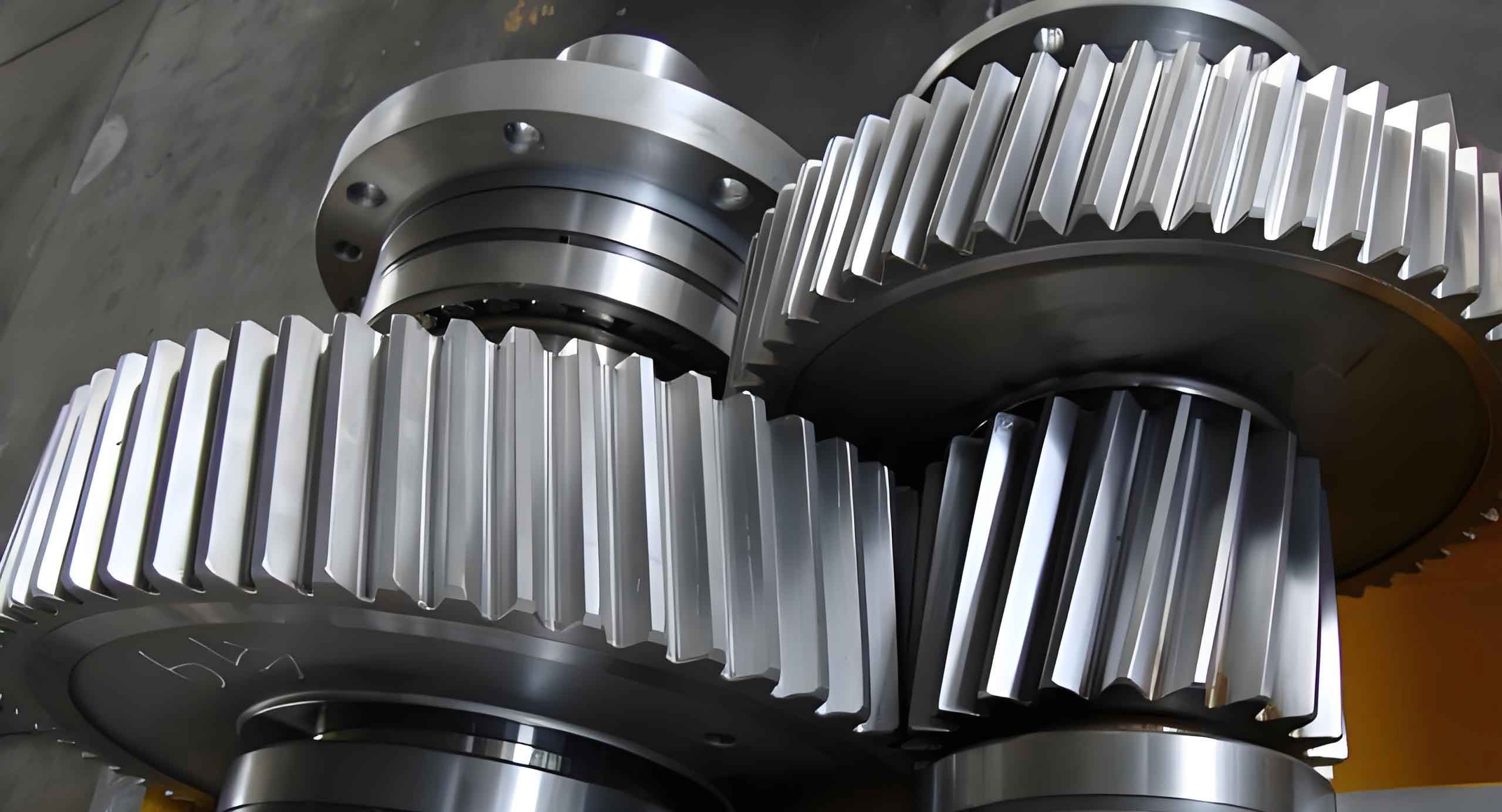
To understand the impact of supporting device deformation on helical gear performance, I first analyze the elastic behavior of the reducer’s high-speed and intermediate shafts along with their bearings. In KISSsoft, shafts and bearings are discretized into segments, simplifying the calculation of bending and torsional deformations. The shaft deformations are modeled using differential equations for deflection and torsion, while bearing deformations are derived from stiffness models based on load-displacement relationships. For a helical gear system, the combined displacements from shafts and bearings alter the ideal meshing positions, leading to misalignment. The total deformation at any point is the superposition of individual deformations, expressed through compatibility equations. For instance, the bending deflection δ of a shaft under load can be approximated using beam theory, and the torsional angle φ is given by:
$$ \theta = \frac{T L}{J G} $$
where T is torque, L is length, J is polar moment of inertia, and G is shear modulus. For bearings, the displacement δ_b under radial load F_r is often modeled as:
$$ \delta_b = \left( \frac{F_r}{K} \right)^{1/n} $$
where K and n are bearing-specific constants. These deformations are critical because they induce helix deviations and profile shifts in the helical gear mesh, exacerbating stress concentrations and transmission errors. By incorporating these effects into the gear analysis, I ensure that the modification strategy aligns with actual operating conditions, rather than assuming rigid supports. This approach is essential for helical gears, where the spiral tooth geometry makes them sensitive to axial and radial misalignments.
KISSsoft employs a slice-based model to analyze helical gear contact, which is necessary due to the inclined contact lines that vary with the meshing phase. Each helical gear tooth is divided into thin slices along the face width, and the contact condition for each slice is determined based on pressure angles. The meshing process involves evaluating the relative rotation and pressure angles of corresponding slices from the pinion and gear. For a slice i, the pressure angle τ_i is calculated as:
$$ \tau_i = \tan(\phi_{1,n} + \phi_{2,n}) $$
where φ_{1,n} and φ_{2,n} are the slice-specific angles derived from gear geometry and rotation. Contact occurs if τ_i lies between the minimum τ_b and maximum τ_E pressure angles, which depend on the base circle radii and helix angle. This slice methodology allows for a detailed assessment of load distribution across the helical gear tooth surface, accounting for the gradual engagement characteristic of helical gears.
The quasi-static contact analysis in KISSsoft is based on Weber’s theory, which models the compliance of gear teeth through stiffness matrices. For each slice, the total deformation δ_n includes components from tooth bending, body bending, and contact deformation. The tooth bending deformation δ_z for a slice is given by:
$$ \delta_z = \frac{F_{bti}}{b \cos^2 \alpha_{Fy}} \frac{1 – \nu^2}{E} \left[ 12 \int_{0}^{y_p} \frac{(y_p – y)^2}{(2x’)^3} dy + \left( \frac{24}{1 – \nu} + \tan^2 \alpha_{Fy} \right) \int_{0}^{y_p} \frac{dy}{2x’} \right] $$
where F_{bti} is the slice force, b is slice thickness, α_{Fy} is pressure angle, ν is Poisson’s ratio, E is elastic modulus, y_p is height along tooth, and x’ is transverse width. The body bending deformation δ_Rk and contact deformation δ_H are similarly derived, leading to the total slice stiffness C_petn:
$$ \frac{1}{C_{petn}} = \frac{1}{C_{zAn}} + \frac{1}{C_{zBn}} + \frac{1}{C_{RKAn}} + \frac{1}{C_{RKBn}} + \frac{1}{C_{HABn}} $$
where C_{zA}, C_{zB} are tooth bending stiffnesses, C_{RKA}, C_{RKB} are body bending stiffnesses, and C_{HAB} is contact stiffness. The stiffness-displacement matrix for all slices is assembled as:
$$ \begin{bmatrix} C_{pet1}+C_C & -C_C & 0 & \cdots & 0 \\ -C_C & C_{pet2}+2C_C & -C_C & \cdots & 0 \\ 0 & -C_C & \ddots & \cdots & 0 \\ \vdots & \vdots & \vdots & C_{petn}+C_C & -C_C \\ 0 & 0 & 0 & -C_C & C_{petn}+C_C \end{bmatrix} \begin{bmatrix} \delta_1 \\ \delta_2 \\ \vdots \\ \delta_n \end{bmatrix} = \begin{bmatrix} F_{bt1} \\ F_{bt2} \\ \vdots \\ F_{btn} \end{bmatrix} $$
This matrix equation solves for slice deformations under applied loads, enabling the calculation of contact pressures and transmission errors. For helical gears, this approach accurately captures the load-sharing behavior across multiple slices, which is crucial for evaluating modification effectiveness.
Modification techniques for helical gears aim to correct deviations caused by deformations and manufacturing errors. Crowning involves removing material from the tooth surface to create a barrel-shaped profile, which helps distribute load evenly and reduce edge loading. Two common types are profile crowning (modifying tooth profile) and lead crowning (modifying along face width). Spiral crowning combines crowning with helix correction, where the tooth surface is adjusted along a spiral path to compensate for misalignments due to shaft twists and bends. The modification model for spiral crowning includes parameters such as crowning amount C_H, helix modification amount C_α, effective face width b_cal, and contact deformation δ’. The goal is to optimize these parameters to minimize performance metrics like contact stress, transmission error peak-to-peak, and face load factor K_Hβ.
In this study, I use KISSsoft’s optimization module to perform a combinatorial incremental search for the best modification amounts. The helical gear pair parameters are listed in Table 1, representing a typical reducer application. The supporting shafts and bearings are modeled with their dimensions and material properties, as shown in Table 2. The shafts are made of 45 steel, and bearings are deep groove ball bearings (6308C and 6310C). The analysis considers the deformation displacements from these components, which are calculated through KISSsoft’s shaft and bearing modules. The results, including bending deflections and torsion angles, are used to derive initial helix modification amounts to compensate for shaft deformations: 3.43 μm for the pinion and -13.98 μm for the gear (negative indicating opposite direction). These values serve as a baseline for further optimization.
| Parameter | Pinion | Gear |
|---|---|---|
| Number of Teeth | 23 | 101 |
| Module (mm) | 2.5 | 2.5 |
| Pressure Angle (°) | 20 | 20 |
| Face Width (mm) | 75 | 66 |
| Helix Angle (°) | 14.362 | 14.362 |
| Profile Shift Coefficient | 0.3965 | 0.3965 |
| Material | 40Cr | |
| Component | Speed (rpm) | Torque (Nm) | Bearing Positions (mm) | Gear Position (mm) |
|---|---|---|---|---|
| High-Speed Shaft | 182.18 | 786.26 | 10, 260 | 189.5 |
| Intermediate Shaft | 800 | 179.50 | 131, 382 | 312 |
| Material | 45 Steel | |||
The optimization process involves varying the crowning amounts for the pinion’s profile and lead modifications from 0 to 10 μm in 11 steps (increment of 1 μm), resulting in 121 combinatorial cases. For each case, KISSsoft computes the maximum contact pressure σ_H, transmission error peak-to-peak ΔTE, and face load factor K_Hβ. Two scenarios are compared: general crowning (only profile and lead crowning) and spiral crowning (including helix correction based on shaft deformations). The results are summarized in Table 3, which shows the optimal values for each scenario. The data indicate that spiral crowning consistently yields lower performance metrics, highlighting its advantage in real systems with flexible supports.
| Modification Type | Optimal Profile Crowning (μm) | Optimal Lead Crowning (μm) | Max Contact Pressure (MPa) | Transmission Error Peak-to-Peak (μm) | Face Load Factor K_Hβ |
|---|---|---|---|---|---|
| General Crowning | 6 | 10 | 720 | 0.08 | 1.25 |
| Spiral Crowning | 5 | 3 | 670 | 0.05 | 1.13 |
The contact pressure distribution for the optimized spiral crowning case is elliptical and centered on the tooth surface, indicating uniform load sharing. The face load distribution is nearly even, with a maximum of 113 N/mm, and the transmission error is minimized to 0.05 μm. These improvements are attributed to the helix correction, which counteracts the misalignment from shaft deformations. In contrast, general crowning reduces stresses but does not fully address helix deviations, leading to higher transmission errors and load concentrations. The superiority of spiral crowning is evident in the reduced metrics, which translate to enhanced gear life, lower noise, and higher efficiency.
To delve deeper, the mathematical formulation for contact pressure in helical gears under modification can be expressed using Hertzian theory. For two contacting cylinders (approximating gear slices), the maximum contact pressure σ_H is:
$$ \sigma_H = \sqrt{\frac{F E^*}{\pi R^* b}} $$
where F is normal load, E* is equivalent modulus, R* is equivalent radius, and b is contact width. With modification, the effective radius changes, altering pressure distribution. The transmission error TE, defined as the deviation from ideal motion, is calculated as:
$$ TE = \theta_{out} – \frac{N_1}{N_2} \theta_{in} $$
where θ are angular positions, and N are tooth numbers. Modification reduces TE by smoothing the stiffness variations during mesh. The face load factor K_Hβ, which quantifies load distribution unevenness, is derived from slice forces:
$$ K_{H\beta} = \frac{\max(F_{bti})}{\text{mean}(F_{bti})} $$
Optimization aims to minimize K_Hβ close to 1, indicating uniform load. For helical gears, these calculations are performed per slice and integrated across the face width.
The combinatorial optimization in KISSsoft uses an incremental search algorithm. For each modification combination, the software solves the stiffness-displacement matrix, computes performance metrics, and stores results. The process can be summarized as:
- Define modification ranges: profile crowning C_a from 0 to 10 μm, lead crowning C_β from 0 to 10 μm.
- For each C_a and C_β, apply modifications to the helical gear tooth surface.
- Run contact analysis considering support deformations.
- Extract σ_H, ΔTE, and K_Hβ.
- Select combination with lowest weighted sum of metrics.
This method ensures a thorough exploration of the design space. The optimal spiral crowning case (C_a=5 μm, C_β=3 μm) also includes the helix correction of 3.43 μm from shaft deformation analysis. For the gear, the helix correction is -13.98 μm. Further refinement with smaller increments (e.g., 0.1 μm) could yield even more precise values, but the current results demonstrate significant improvement.
In practical applications, helical gear modification must balance performance gains with manufacturing feasibility. Spiral crowning requires advanced grinding or honing processes but offers substantial benefits in high-precision systems like reducers for wind turbines or automotive transmissions. The KISSsoft approach facilitates this by providing data-driven insights, reducing reliance on empirical rules. For instance, the software can generate modification maps showing how performance varies with parameters, aiding in design decisions.
Beyond the case study, the methodology can be extended to other gear types or load conditions. The key is to accurately model support deformations, which vary with system layout. For helical gears in multi-stage reducers, interactions between stages may necessitate global optimization. Additionally, dynamic effects like vibrations could be incorporated for a more comprehensive analysis, though the quasi-static model suffices for many engineering purposes.
In conclusion, optimizing helical gear tooth surface modification using KISSsoft, while accounting for supporting device deformations, leads to enhanced meshing performance. Spiral crowning, which combines crowning with helix correction, outperforms general crowning by reducing contact pressure, transmission error, and load unevenness. This approach aligns with real-world conditions where shafts and bearings flex under load, making it a valuable tool for gear designers. Future work could explore multi-objective optimization algorithms or experimental validation to further refine the models. Ultimately, the integration of advanced software like KISSsoft into the design process enables the development of more reliable and efficient helical gear systems, pushing the boundaries of mechanical transmission technology.
The continuous evolution of helical gear design underscores the importance of simulation-driven optimization. As industries demand higher power densities and quieter operations, techniques like spiral crowning will become standard. By leveraging tools such as KISSsoft, engineers can ensure that helical gears operate at peak performance, minimizing wear and maximizing lifespan. This not only benefits individual machines but also contributes to energy savings and sustainability in mechanical systems worldwide.