
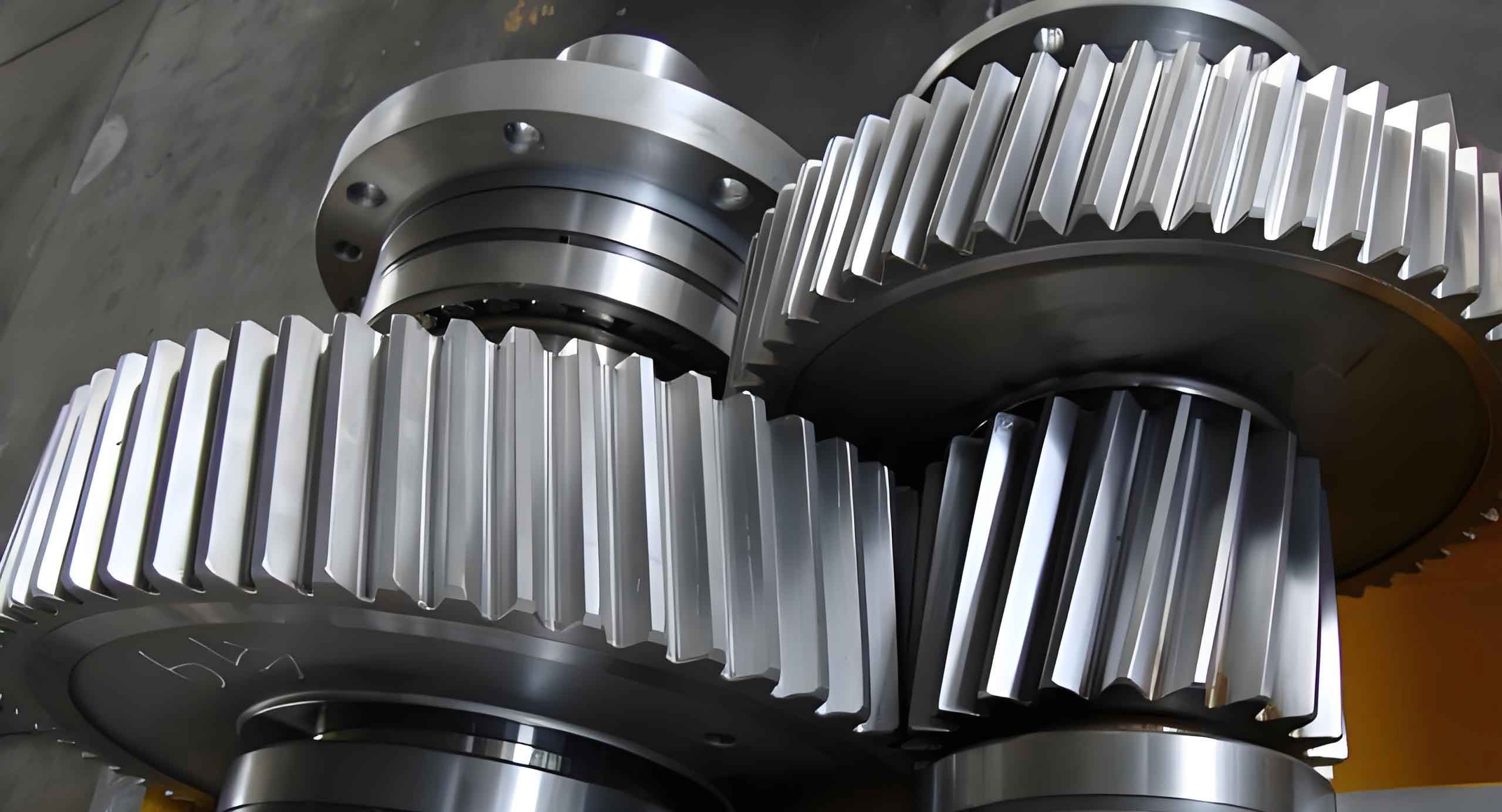
In modern manufacturing, the demand for high-performance components like helical gears is ever-increasing. Helical gears are critical in automotive, aerospace, and energy sectors due to their smooth transmission, low noise, and high load-bearing capacity. Traditional machining methods for helical gears are inefficient, leading to material waste and reduced mechanical properties. Hot precision forging offers a superior alternative, enhancing material utilization, productivity, and part strength. This study focuses on optimizing the hot forging process for helical gears made from 20CrMnTiH steel, a low-carbon alloy steel commonly used in gear applications. I aim to explore the hot workability of this material through processing maps and simulate the microstructural evolution during helical gear forging using finite element analysis. The goal is to establish optimal process parameters that ensure defect-free components with refined microstructures.
The core of this investigation lies in the dynamic material model (DMM), which forms the basis for constructing hot processing maps. These maps are powerful tools for evaluating material behavior under various thermomechanical conditions. They help identify safe processing windows where desirable microstructural mechanisms, such as dynamic recrystallization (DRX), occur, while avoiding instabilities like adiabatic shear bands or void formation. For helical gear forging, understanding these aspects is crucial, as the complex geometry and severe deformation can lead to inhomogeneous microstructures. In this work, I will detail the development of processing maps for 20CrMnTiH steel at different strains, analyze the flow stress behavior, and validate the findings through microstructural observation and finite element simulation. Ultimately, the insights will be applied to simulate the hot forging of a helical gear, providing a comprehensive view of how process parameters influence micro-deformation and DRX evolution.
To begin, let’s delve into the theoretical framework of hot processing maps. The dynamic material model treats the workpiece as a nonlinear power dissipater. The total power input \( P \) is divided into two complementary parts: the dissipator content \( G \), associated with plastic deformation and heat generation, and the dissipator co-content \( J \), related to microstructural changes such as DRX or dynamic recovery. The strain rate sensitivity index \( m \) governs this partition and is defined as:
$$ m = \frac{\partial J}{\partial G} = \frac{\partial (\log \sigma)}{\partial (\log \dot{\varepsilon})} $$
Here, \( \sigma \) is the flow stress (in MPa), and \( \dot{\varepsilon} \) is the strain rate (in s\(^{-1}\)). When \( m = 1 \), the material is in an ideal linear dissipative state, where \( J \) reaches its maximum value \( J_{\text{max}} \). The efficiency of power dissipation \( \eta \), which indicates the proportion of energy used for microstructural evolution, is derived as:
$$ \eta = \frac{2m}{m + 1} $$
A high \( \eta \) value (typically 0.35–0.45 for DRX) suggests favorable conditions for hot working. Conversely, instability criteria based on the principle of maximum entropy production rate identify regions to avoid. The instability parameter \( \xi \) is given by:
$$ \xi = \frac{\partial \log(m/(m+1))}{\partial \log \dot{\varepsilon}} + m < 0 $$
If \( \xi < 0 \), flow instabilities like shear bands or cracking may occur. By superimposing contour plots of \( \eta \) and \( \xi \) over temperature and strain rate axes, hot processing maps are constructed. These maps guide the selection of optimal parameters for forging processes, including those for helical gear manufacturing.
For 20CrMnTiH steel, hot compression tests were conducted using a Gleeble-3500 simulator. The conditions included temperatures of 850, 950, 1050, and 1150°C, strain rates of 0.01, 0.1, and 1 s\(^{-1}\), and a true strain of 0.916. The flow stress data revealed typical behavior: stress increases with strain rate and decreases with temperature. This data is essential for calculating \( m \) and constructing processing maps. Below is a table summarizing the flow stress values at a strain of 0.916 for different conditions:
| Temperature (°C) | Strain Rate (s\(^{-1}\)) | Flow Stress (MPa) |
|---|---|---|
| 850 | 0.01 | 145 |
| 850 | 0.1 | 210 |
| 850 | 1 | 285 |
| 950 | 0.01 | 95 |
| 950 | 0.1 | 135 |
| 950 | 1 | 185 |
| 1050 | 0.01 | 55 |
| 1050 | 0.1 | 80 |
| 1050 | 1 | 120 |
| 1150 | 0.01 | 35 |
| 1150 | 0.1 | 50 |
| 1150 | 1 | 75 |
Using equations (1) to (3), hot processing maps were developed for strains of 0.2, 0.4, 0.6, 0.8, and 0.916. The maps show that as strain increases, instability regions shrink, and safe processing windows expand. At high strains (e.g., 0.916), distinct features emerge: Region A (850–956°C, 0.23–1 s\(^{-1}\)) is an instability zone with low \( \eta \) values, where localized flow or shear bands may occur. Regions B and C are high-efficiency zones. Region B (1040–1066°C, 0.67–1 s\(^{-1}\)) has a peak \( \eta \) of 0.43, indicating intense DRX. Region C (850–906°C, 0.01–0.02 s\(^{-1}\)) has a peak \( \eta \) of 0.36, also suitable for DRX. Region D (high-temperature, low-strain-rate area) exhibits low \( \eta \) values (<0.11), where grain growth may dominate. Thus, the optimal windows for hot forging are 850–906°C at 0.01–0.02 s\(^{-1}\) and 1040–1066°C at 0.67–1 s\(^{-1}\). These parameters are particularly relevant for helical gear forging, as they ensure microstructural refinement.
Microstructural analysis corroborates these findings. Samples deformed in instability region A show a “necklace” structure with elongated grains and fine DRX grains along boundaries, indicative of adiabatic shear bands. In contrast, samples from regions B and C display uniform, fine DRX grains, enhancing mechanical properties. Region D samples exhibit coarse grains due to prolonged exposure. To validate the processing maps, finite element (FE) simulations were performed using DEFORM-3D. A coupled thermo-mechanical-microstructural model was developed for 20CrMnTiH steel, incorporating constitutive equations for flow stress and DRX kinetics. The DRX volume fraction \( X_{\text{drex}} \) and grain size \( d_{\text{drex}} \) are modeled as:
$$ X_{\text{drex}} = 1 – \exp\left[-k_d \left( \frac{\varepsilon – \varepsilon_c}{\varepsilon_p} \right)^{n_d}\right] $$
where \( \varepsilon_c \) is the critical strain for DRX, \( \varepsilon_p \) is the peak strain, and \( k_d \), \( n_d \) are material constants. The grain size evolution follows:
$$ d_{\text{drex}} = A \dot{\varepsilon}^m \exp\left(\frac{Q}{RT}\right) $$
with \( A \), \( m \) as constants, \( Q \) as activation energy, \( R \) as gas constant, and \( T \) as temperature. Simulations under optimal conditions (e.g., 1050°C, 1 s\(^{-1}\)) predict complete DRX with grain sizes around 20–26 μm, matching experimental measurements within 10% error. This confirms the reliability of the processing maps and the FE model.
Now, applying these insights to helical gear forging, I developed a 3D FE model for closed-die hot forging of a helical gear. The gear geometry involves complex tooth profiles, requiring precise material flow to avoid defects. The process parameters were selected from the optimal windows: a billet temperature of 1050°C, a die speed of 30 mm/s (approximating a strain rate of ~1 s\(^{-1}\)), and an H13 tool steel die with a friction coefficient of 0.25. The initial grain size was set to 55.67 μm. The simulation captures coupled deformation, heat transfer, and DRX evolution. Below is a table outlining key simulation parameters:
| Parameter | Value |
|---|---|
| Billet Material | 20CrMnTiH Steel |
| Die Material | H13 Tool Steel |
| Billet Temperature | 1050°C |
| Friction Coefficient | 0.25 |
| Punch Speed | 30 mm/s |
| Initial Grain Size | 55.67 μm |
| Strain Rate Range | 0.67–1 s\(^{-1}\) |
The forging process for helical gears can be divided into three stages: upsetting, tooth filling, and final filling. During upsetting, strain is low, and little DRX occurs. As the punch advances, the billet contacts the die cavity, initiating tooth filling. Here, strain concentrates in the tooth regions, leading to significant DRX. The final stage ensures complete cavity filling, with DRX spreading throughout the gear teeth. The simulation results show that at 100% deformation, the tooth areas achieve nearly 100% DRX volume fraction, with grain sizes refined to approximately 10 μm. In contrast, the gear core experiences partial DRX, and the upper/lower surfaces show minimal changes due to cooling and low strain. This heterogeneity is typical in helical gear forging but is minimized under optimal conditions.
To elaborate, the DRX evolution in helical gear forging is governed by local strain and temperature fields. The effective strain \( \varepsilon_{\text{eff}} \) in tooth regions can exceed 2.0, well above the critical strain for DRX. The temperature rise due to deformation heat and friction further accelerates DRX kinetics. The FE model solves the energy balance equation:
$$ \rho C_p \frac{\partial T}{\partial t} = k \nabla^2 T + \eta \sigma \dot{\varepsilon} $$
where \( \rho \) is density, \( C_p \) is specific heat, \( k \) is thermal conductivity, and \( \eta \sigma \dot{\varepsilon} \) represents heat generation from plastic work. This coupling ensures accurate prediction of microstructural changes. For instance, in the tooth root—a critical area for helical gear performance—the combination of high strain and temperature results in fine, uniform grains, enhancing fatigue resistance and strength. This is vital for helical gears used in high-stress applications like automotive transmissions.
Moreover, the processing maps guide the avoidance of instability during helical gear forging. For example, at lower temperatures (850–950°C) and higher strain rates (>0.23 s\(^{-1}\)), flow instabilities could cause shear bands in the gear teeth, leading to premature failure. By staying within the safe windows, the forging process produces helical gears with superior integrity. The FE simulation visualizes this: under optimal parameters, the strain distribution is homogeneous, and DRX grains are evenly sized. In contrast, simulated trials in instability regions show localized thinning and erratic grain growth.
The significance of this study extends beyond 20CrMnTiH steel. The methodology—combining processing maps with FE simulation—can be applied to other materials for helical gear forging, such as alloy steels or titanium alloys. For helical gears, which require precise tooth geometry and high durability, controlling microstructural evolution is key. Future work could explore multi-objective optimization, balancing DRX extent with energy consumption, or investigate the effects of die design on material flow in helical gear forging. Additionally, advanced models like cellular automata could be integrated into FE software for more detailed microstructural predictions.
In conclusion, this research demonstrates the effectiveness of hot processing maps for optimizing the hot forging of helical gears. For 20CrMnTiH steel, optimal parameters are 850–906°C at 0.01–0.02 s\(^{-1}\) and 1040–1066°C at 0.67–1 s\(^{-1}\), where dynamic recrystallization produces fine, uniform grains. Instability regions, characterized by low efficiency and potential defects, should be avoided. Finite element simulations confirm that helical gear forging under these conditions leads to complete DRX in tooth areas, refining grains from 55.67 μm to ~10 μm, thereby improving mechanical properties. This integrated approach provides a robust framework for designing hot forging processes for complex components like helical gears, ensuring high performance and reliability in industrial applications.
Throughout this discussion, the term helical gear has been emphasized repeatedly to underscore its centrality in this study. Helical gears are not just end-products but also a testbed for advanced manufacturing techniques. The insights gained here can drive innovation in gear production, reducing costs and enhancing quality. As industries push for lighter and stronger components, the role of helical gears will only grow, making such optimization studies increasingly valuable. By leveraging processing maps and simulation, manufacturers can achieve precise control over microstructures, paving the way for next-generation helical gears in demanding environments.