
Gear shafts are critical components in mechanical transmission systems, widely used due to their high efficiency, reliability, durability, and compact structure. The performance of a gear shaft directly impacts the overall system’s effectiveness, making it essential to optimize its manufacturing processes, particularly hot forging. In this study, I focus on enhancing the hot forging process for gear shafts using a Radial Basis Function (RBF) neural network model. This approach allows for precise control of process parameters to improve mechanical properties and reduce forming forces. By leveraging neural networks, I aim to bridge the gap between simulation-based studies and practical applications, providing a robust framework for optimizing gear shaft production. The integration of RBF neural networks into hot forging processes represents a significant advancement in manufacturing technology, enabling real-time adjustments and predictive modeling for superior outcomes.
The RBF neural network is a type of artificial neural network that utilizes radial basis functions as activation functions in the hidden layer. Its structure consists of an input layer, a hidden layer with radial basis functions, and an output layer with linear combinations. For the gear shaft hot forging process, the input parameters include die preheating temperature, billet heating temperature, friction coefficient, and forging speed. The output parameters are yield strength and maximum forming force. The RBF neural network maps the input vectors directly to the hidden space without weighted connections, and the output is a linear weighted sum of the hidden layer outputs. The mathematical representation of the RBF neural network can be expressed as follows:
$$ y_k = \sum_{j=1}^{M} w_{kj} \phi( \| \mathbf{x} – \mathbf{c}_j \| ) + b_k $$
where \( y_k \) is the k-th output, \( w_{kj} \) are the weights, \( \phi \) is the radial basis function (e.g., Gaussian function), \( \mathbf{x} \) is the input vector, \( \mathbf{c}_j \) are the center vectors, and \( b_k \) is the bias term. The Gaussian function is defined as:
$$ \phi(r) = \exp\left(-\frac{r^2}{2\sigma^2}\right) $$
with \( r = \| \mathbf{x} – \mathbf{c}_j \| \) representing the Euclidean distance, and \( \sigma \) controlling the spread of the function. In this model, the input parameters are normalized to ensure consistent scaling, as shown in the functions for friction coefficient and forging speed (\( x_1 \)) and die preheating temperature and billet heating temperature (\( x_2 \)):
$$ x_1 = a_1 \left( \frac{\text{friction coefficient} – 0.25}{0.25} \right) + a_2 \left( \frac{\text{forging speed} – 45}{45} \right) $$
$$ x_2 = b_1 \left( \frac{\text{die preheating temperature} – 280}{280} \right) + b_2 \left( \frac{\text{billet heating temperature} – 1150}{1150} \right) $$
where \( a_1 = 0.41729 \), \( a_2 = 0.58271 \), \( b_1 = 0.45674 \), and \( b_2 = 0.54326 \). These parameters were determined through iterative training of the neural network, ensuring accurate predictions for the gear shaft hot forging process.
The material used for the gear shaft is 45 steel, known for its balanced mechanical properties and suitability for forging applications. The chemical composition of 45 steel is detailed in Table 1, which includes elements such as carbon, manganese, and silicon that influence the material’s strength and formability. This composition ensures that the gear shaft can withstand high stresses during operation while maintaining durability.
| C | Cu | Ni | Si | Mn | Cr | P | S | Fe |
|---|---|---|---|---|---|---|---|---|
| 0.46 | 0.20 | 0.20 | 0.26 | 0.65 | 0.20 | 0.02 | 0.02 | Bal. |
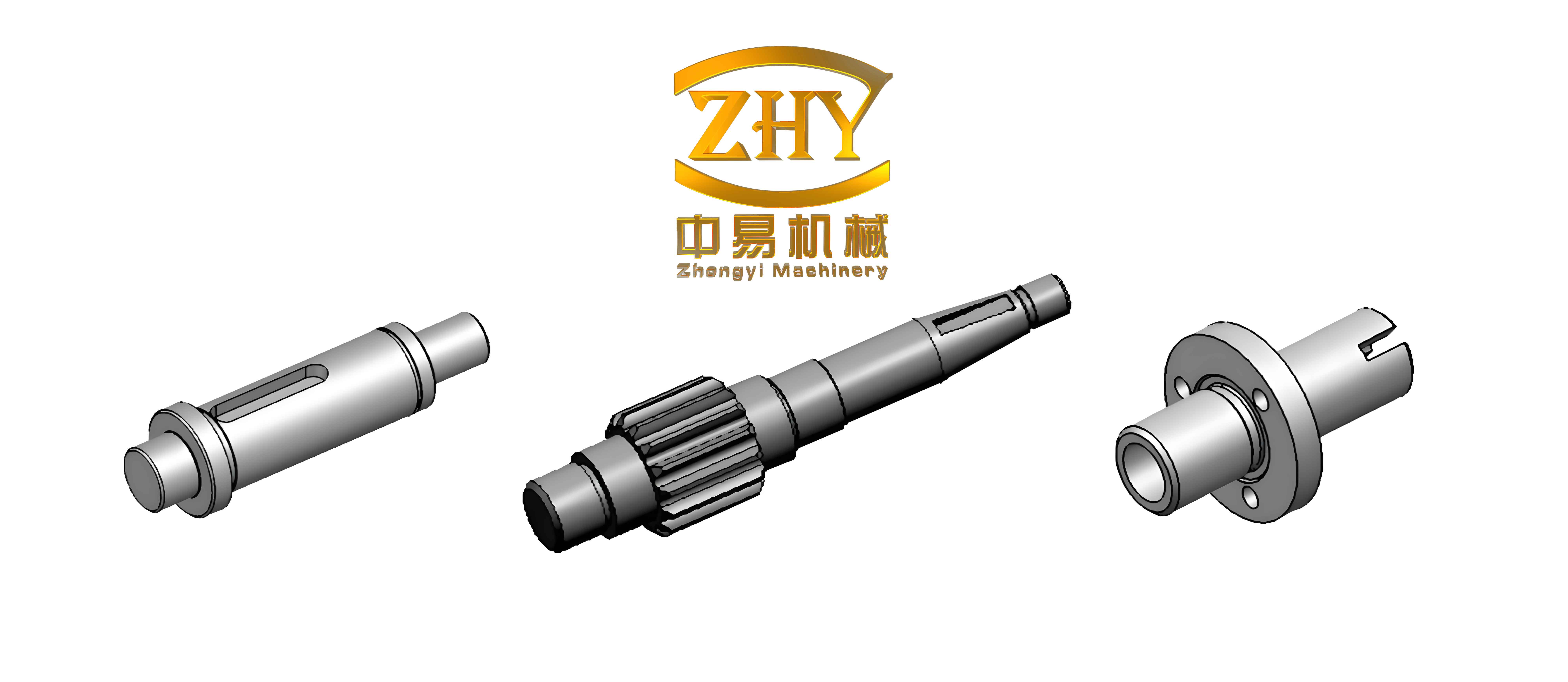
Hot forging experiments were conducted on a YT32-315 four-column universal hydraulic press, with dies made from H13 steel to withstand high temperatures and pressures. The gear shaft dimensions, as illustrated in the figure below, include critical features such as diameters and radii that affect the forging quality. A total of 50 sets of process parameters were randomly selected to generate gear shaft forgings under varying conditions. From these, specimens were extracted from the φ5 mm × 38 mm region for yield strength testing using a CMT5105 electronic universal testing machine. Each test was repeated five times, with the median three values averaged to ensure reliability. The maximum forming force was measured using a force sensor integrated into the hydraulic press, providing real-time data during forging.
The RBF neural network model was trained using the 50 experimental datasets to predict the yield strength and maximum forming force based on the input parameters. The training process involved initializing the input parameters, iterating through hidden layer computations, and adjusting weights to minimize the relative error. The convergence behavior of the model is shown in Figure 4, where the error decreases rapidly with increasing iterations, reaching a stable minimum after approximately 200 epochs. This indicates the model’s ability to learn complex relationships between the forging parameters and the resulting gear shaft properties. The fitting performance, as depicted in Figure 5, demonstrates high accuracy, with the predicted values closely matching the experimental data. The three-dimensional surface plots for \( x_1 \) and \( x_2 \) against the output function \( F \) (representing yield strength and maximum forming force) show smooth transitions, confirming the model’s robustness in capturing nonlinear interactions.
To optimize the gear shaft hot forging process, the RBF neural network model was employed to identify the best combination of input parameters. The optimization goal was to maximize yield strength while minimizing the maximum forming force, thereby improving efficiency and product quality. The model’s output for various parameter combinations is visualized in Figure 6, where the function \( F \) is plotted against \( x_1 \) and \( x_2 \). The optimal point corresponds to the parameters that yield the highest yield strength and lowest forming force. After optimization, the results were validated through additional forging trials, confirming the model’s predictions. The key performance metrics before and after optimization are summarized in Table 2, highlighting significant improvements in both yield strength and forming force.
| Parameter | Before Optimization | After Optimization | Improvement |
|---|---|---|---|
| Die Preheating Temperature (°C) | 280 | 300 | +7.1% |
| Billet Heating Temperature (°C) | 1150 | 1150 | 0% |
| Friction Coefficient | 0.25 | 0.3 | +20% |
| Forging Speed (mm/s) | 45 | 40 | -11.1% |
| Yield Strength (MPa) | 425 | 456 | +7.3% |
| Maximum Forming Force (kN) | 565 | 508 | -10.1% |
The optimization process revealed that the best production parameters for gear shaft hot forging are a die preheating temperature of 300°C, billet heating temperature of 1150°C, friction coefficient of 0.3, and forging speed of 40 mm/s. These settings resulted in a yield strength increase from 425 MPa to 456 MPa and a reduction in maximum forming force from 565 kN to 508 kN. The yield strength improvement of 7.3% and forming force reduction of 10.1% demonstrate the effectiveness of the RBF neural network in enhancing the gear shaft forging process. The underlying mechanism can be attributed to better control of thermal and mechanical conditions, which reduces defects such as voids and cracks while promoting uniform grain structure. The relationship between input parameters and outputs can be further analyzed using sensitivity analysis, where partial derivatives indicate the influence of each parameter:
$$ \frac{\partial F}{\partial x_i} = \sum_{j=1}^{M} w_j \frac{\partial \phi}{\partial x_i} $$
This equation helps quantify how changes in parameters like friction coefficient or forging speed affect the yield strength and forming force, guiding further refinements in the gear shaft manufacturing process.
In conclusion, the application of RBF neural networks to gear shaft hot forging optimization provides a powerful tool for achieving superior mechanical properties and process efficiency. The model’s ability to accurately predict outcomes based on input parameters allows for targeted adjustments, reducing trial-and-error approaches. The optimized parameters not only improve the gear shaft’s performance but also lower energy consumption and tool wear, contributing to sustainable manufacturing practices. Future work could explore the integration of real-time monitoring systems with the neural network for adaptive control, further advancing the production of high-quality gear shafts. This study underscores the potential of machine learning in transforming traditional forging processes, offering a scalable solution for industrial applications.