
In the design of automotive drive axles, the quest for smoother operation and quieter performance is paramount. Among the key components, the final drive gear set plays a critical role. While spiral bevel gears are common, hyperboloid gears (often called hypoid gears) offer superior advantages. These advantages include enhanced smoothness of transmission, greater strength, improved bearing stiffness, and crucially, the spatial offset between their driving and driven axes. This offset facilitates more flexible vehicle layout design, making hyperboloid gears the preferred choice for passenger cars, off-road vehicles, and light trucks.
The noise generated by a final drive unit stems primarily from gear meshing, bearings, and oil churning. While all sources are important, the meshing noise of the hyperboloid gears can be significantly controlled through the judicious selection of their geometric parameters. The core idea is to achieve a specific, optimal value for the face overlap coefficient, denoted as $\epsilon_\gamma$. When this coefficient exceeds a certain threshold, typically greater than 2.0, a marked improvement in transmission smoothness and a reduction in noise can be realized. Traditional design methods rely heavily on empirical selection of these parameters, which introduces a degree of uncertainty and often fails to precisely achieve the desired $\epsilon_\gamma$. This article presents a methodology that applies optimization techniques to determine the optimal geometric parameters for circular-arc tooth hyperboloid gears, ensuring the overlap coefficient reaches a predefined, rational value accurately and efficiently.
Calculation of the Face Overlap Coefficient, $\epsilon_\gamma$
The face overlap coefficient, $\epsilon_\gamma$, for hyperboloid gears is analogous to the axial contact ratio in helical cylindrical gears. It represents the component of the total contact ratio along the instantaneous axis of rotation. Its value is a primary factor influencing the meshing noise of hyperboloid gears. The formula for calculating $\epsilon_\gamma$ is given by:
$$\epsilon_\gamma = \frac{b}{p_{xa}}$$
Where $b$ is the face width of the larger gear (driven gear), and $p_{xa}$ is the axial pitch. The axial pitch can be further derived from the geometric parameters. A more detailed, computable expression for the face overlap coefficient involves several intermediate parameters:
$$\epsilon_\gamma = \frac{b}{p_{xa}} = \frac{b \cdot \tan \beta_m}{p_x} = \frac{b \cdot \tan \beta_m}{\pi m_t}$$
Here, $\beta_m$ is the mean spiral angle at the midpoint of the face width, and $m_t$ is the transverse module. The comprehensive calculation requires the following set of equations, which define the intricate geometry of the hyperboloid gear pair. Let us define the key parameters first:
- $i_0$: Final drive ratio (Driven gear teeth / Driving gear teeth).
- $z_1$, $z_2$: Number of teeth on the driving (pinion) and driven (gear) gear, respectively ($i_0 = z_2 / z_1$).
- $E$: Offset distance (the perpendicular distance between the axes of the two gears).
- $\delta_2’$: Approximate pitch angle of the driven gear.
- $\beta_1$, $\beta_2$: Spiral angles at the midpoint for the pinion and gear, respectively.
- $\beta_m$: Mean spiral angle, $(\beta_1 + \beta_2)/2$.
- $R_{m2}$: Mean pitch radius of the driven gear.
- $R_{m1}$: Mean pitch radius of the driving gear.
- $d_{2}$: Pitch diameter of the driven gear.
- $m$: Outer transverse module.
The step-by-step calculation for $\epsilon_\gamma$ is as follows:
1. Calculate the approximate driven gear pitch angle:
$$\delta_2′ = \arctan\left(\frac{z_2}{z_1 \sqrt{1 – (E / d_2)^2}}\right)$$
2. Calculate the driven gear mean cone distance:
$$L_{m2} = \frac{d_2}{2 \sin \delta_2′} – \frac{b}{2}$$
3. Calculate the mean pitch radius of the driven gear:
$$R_{m2} = L_{m2} \cdot \sin \delta_2’$$
4. Calculate the mean pitch radius of the driving gear:
$$R_{m1} = \sqrt{R_{m2}^2 + E^2 – 2 R_{m2} E \cos(90^\circ + \delta_2′)}$$
5. Calculate the driving gear offset angle:
$$\theta_1 = \arcsin\left(\frac{E}{R_{m1}}\right)$$
6. Calculate the spiral angles. The relationship between the spiral angles is governed by the offset and ratio. A practical formula for the mean spiral angle $\beta_m$ is central to the design. The individual angles can be derived from the geometry of the pitch surfaces. A key relation is:
$$\sin \beta_1 = \frac{R_{m2}}{R_{m1}} \sin \beta_2$$
And the mean is $\beta_m = (\beta_1 + \beta_2)/2$.
7. Finally, the face overlap coefficient is calculated using:
$$\epsilon_\gamma = \frac{b \cdot \tan \beta_m}{\pi m_t}$$
Where the transverse module at the mean point $m_t$ relates to the outer module $m$ and the geometry: $m_t \approx m \cdot (R_{m2} / (d_2/2))$.
It is evident that $\epsilon_\gamma$ is a complex, nonlinear function of multiple geometric parameters: $\beta_m$ (or $\beta_1$ and $\beta_2$), $b$, $m$, $z_1$ (or $z_2$), and $E$.
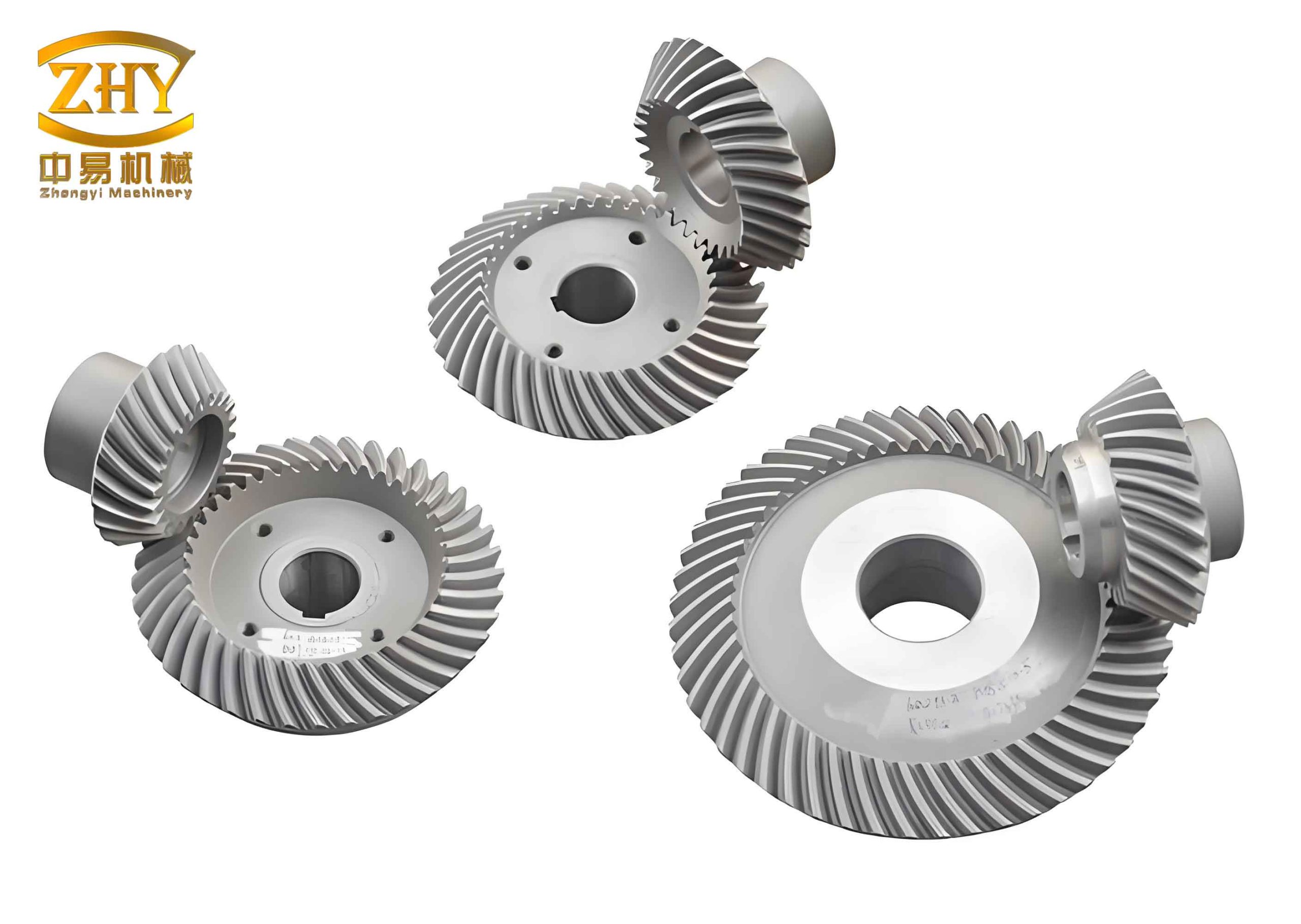
Optimization Design for Parameter Selection of Hyperboloid Gears
Definition of the Objective Function
The primary design goal is to enhance transmission smoothness and reduce meshing noise by precisely achieving a target face overlap coefficient. Empirical evidence suggests that excellent results are obtained when $\epsilon_\gamma \ge 2.0$. Therefore, if we predefine a target value, say $\epsilon_{\gamma \text{target}} = 2.1$, the objective of the optimization is to minimize the deviation between the calculated and target values. Thus, the objective function $F(X)$ can be formulated as:
$$\min F(X) = | \epsilon_\gamma(X) – \epsilon_{\gamma \text{target}} |$$
Where $X$ is the vector of design variables. For a perfect match, $F(X) = 0$.
Identification of Design Variables
From the detailed calculation of $\epsilon_\gamma$, the independent variables that fundamentally define the geometry and directly influence the overlap coefficient are: the mean spiral angle $\beta_m$, the face width $b$, the outer transverse module $m$, the number of pinion teeth $z_1$, and the offset distance $E$. The driven gear teeth are determined by the fixed ratio $i_0$ ($z_2 = i_0 \cdot z_1$). Therefore, the design variable vector is:
$$X = [x_1, x_2, x_3, x_4, x_5]^T = [\beta_m, b, m, z_1, E]^T$$
Analysis and Formulation of Constraints
The selection of these variables cannot be arbitrary; they are bound by practical design considerations regarding geometry, manufacturability, and strength.
1. Constraints on Tooth Number Selection: Too few teeth can reduce $\epsilon_\gamma$ and risk undercutting, while too many teeth lead to impractical sizes. For smooth and quiet operation, the sum of teeth typically lies between 40 and 50.
$$40 \le z_1 + z_2 \le 50$$
Since $z_2 = i_0 \cdot z_1$, this becomes $40 \le z_1 (1 + i_0) \le 50$.
2. Constraint on Face Width $b$: A larger $b$ increases $\epsilon_\gamma$ but poses manufacturing challenges, increases sensitivity to misalignment and thermal distortion, and reduces assembly space. The face width is usually limited to 10 times the module.
$$b \le 10m \quad \text{or} \quad b – 10m \le 0$$
3. Constraint on Pinion Offset $E$: An excessive offset leads to early wear, scoring, and potential undercutting. For passenger cars and light trucks, $E$ should not exceed 20% of the driven gear pitch diameter $d_2$.
$$E \le 0.2 d_2 \quad \text{where} \quad d_2 = m \cdot z_2$$
4. Constraints on Bending and Contact Stress: The gears must satisfy strength requirements. The bending stress $\sigma_F$ and contact stress $\sigma_H$ must be below their respective allowable limits $[\sigma_F]$ and $[\sigma_H]$.
- Bending Strength Condition: $\sigma_F \le [\sigma_F]$ for both pinion and gear.
- Contact Strength Condition: $\sigma_H \le [\sigma_H]$.
The calculation of these stresses involves several load and geometry factors. The formulas are summarized below:
Driven Gear Bending Stress ($\sigma_{F2}$):
$$\sigma_{F2} = \frac{2000 T_{2\text{mean}} K_0 K_s K_m}{b \cdot m \cdot d_2 \cdot K_v \cdot J_2}$$
Where:
- $T_{2\text{mean}}$: Average calculation torque on the driven gear (N·m).
- $K_0$: Overload factor.
- $K_s$: Size factor.
- $K_m$: Load distribution factor.
- $K_v$: Dynamic factor.
- $J_2$: Driven gear geometry factor.
Driving Gear Bending Stress ($\sigma_{F1}$):
$$\sigma_{F1} = \sigma_{F2} \cdot \frac{J_2}{J_1}$$
Where $J_1$ is the pinion geometry factor.
Contact Stress ($\sigma_H$):
$$\sigma_H = C_p \sqrt{\frac{2000 T_{1\text{mean}} K_0 K_s K_m K_v}{b \cdot d_1^2 \cdot C_s \cdot I}}$$
Where:
- $C_p$: Elasticity coefficient ($\sqrt{\text{N/mm}^2}$).
- $T_{1\text{mean}}$: Average calculation torque on the driving gear, $T_{1\text{mean}} = T_{2\text{mean}} / (i_0 \cdot \eta)$, $\eta$ is mesh efficiency.
- $d_1$: Pinion pitch diameter, $d_1 = m \cdot z_1$.
- $C_s$: Surface condition factor.
- $I$: Contact geometry factor.
The allowable stresses $[\sigma_F]$ and $[\sigma_H]$ depend on the material and heat treatment. For case-hardened alloy steel like 20CrMnTi, typical values are $[\sigma_F] = 700 \text{ MPa}$ and $[\sigma_H] = 2800 \text{ MPa}$.
In summary, the constraint functions $g_j(X) \le 0$ are:
$$
\begin{aligned}
&g_1(X) = 40 – z_1(1+i_0) \le 0 \\
&g_2(X) = z_1(1+i_0) – 50 \le 0 \\
&g_3(X) = b – 10m \le 0 \\
&g_4(X) = E – 0.2 \cdot (m \cdot i_0 \cdot z_1) \le 0 \\
&g_5(X) = \sigma_{F2} – [\sigma_F] \le 0 \\
&g_6(X) = \sigma_H – [\sigma_H] \le 0
\end{aligned}
$$
Optimization Mathematical Model
This is a nonlinear programming problem with five design variables and six inequality constraints. The complete model is:
$$
\begin{aligned}
&\text{Find: } X = [\beta_m, b, m, z_1, E]^T\\
&\text{Minimize: } F(X) = | \epsilon_\gamma(X) – \epsilon_{\gamma \text{target}} |\\
&\text{Subject to: } g_j(X) \le 0, \quad j = 1, 2, …, 6\\
&\qquad \qquad \quad \beta_m^L \le \beta_m \le \beta_m^U, \quad b^L \le b \le b^U, \quad … \quad (\text{Side bounds})
\end{aligned}
$$
Numerical Calculation Example
Consider the design of a final drive for a passenger car with the following specifications:
| Parameter | Symbol | Value/Note |
|---|---|---|
| Fully Laden Weight | $G_a$ | 15000 N |
| Max. Engine Torque | $T_{emax}$ | 130 N·m |
| Final Drive Ratio | $i_0$ | 4.875 |
| Wheel-to-Drive Shaft Ratio | $i_{wheel}$ | 1.0 (Direct) |
| Tire Specification | – | 6.95-14 (Substituting $D_f$=0.72m) |
| Target Overlap Coefficient | $\epsilon_{\gamma \text{target}}$ | 2.1 (Case 1) and 2.5 (Case 2) |
| Gear Material | – | 20CrMnTi, Case-Hardened |
| Allowable Bending Stress | $[\sigma_F]$ | 700 MPa |
| Allowable Contact Stress | $[\sigma_H]$ | 2800 MPa |
Pre-Calculation of Load Parameters:
The average calculation torque $T_{2\text{mean}}$ on the driven gear is derived from vehicle dynamics, considering gradeability, adhesion, and load distribution. Using standard formulas with a performance factor $G_a=15000/9.8 \approx 1530$ kg, and coefficients for a passenger car (road resistance coefficient $f=0.015$, grade coefficient $i_m=0.08$, overload factor $K_0=1.0$), the torque is calculated. For this example, a value of $T_{2\text{mean}} = 650$ N·m is used. Correspondingly, $T_{1\text{mean}} = T_{2\text{mean}} / (i_0 \cdot \eta) = 650 / (4.875 \times 0.96) \approx 139$ N·m (assuming mesh efficiency $\eta=0.96$).
Optimization Setup and Results:
The Random Direction Search method is employed to solve this nonlinear optimization problem. The algorithm is implemented in FORTRAN. The side bounds for the design variables are initialized based on practical ranges:
| Variable | Lower Bound | Upper Bound |
|---|---|---|
| $\beta_m$ (deg) | 35 | 50 |
| $b$ (mm) | 30 | 60 |
| $m$ (mm) | 4.5 | 6.5 |
| $z_1$ | 6 | 9 |
| $E$ (mm) | 25 | 40 |
The known constants are input as per the following list:
| Program Identifier | Parameter | Value |
|---|---|---|
| G | $G_a$ (N) | 15000 |
| FN | $f$ | 0.015 |
| IM | $i_m$ | 0.08 |
| ETAW | $\eta_{wheel}$ | 0.96 |
| ETAG | $\eta_{gear}$ | 0.96 |
| TE | $T_{emax}$ (N·m) | 130 |
| I0 | $i_0$ | 4.875 |
Case 1: Target $\epsilon_{\gamma \text{target}} = 2.1$
After approximately 3 minutes and 50 iterations, the optimization converges to the following results:
| Optimized Variable | Value |
|---|---|
| Mean Spiral Angle, $\beta_m$ | 42.75° |
| Face Width, $b$ | 48.2 mm |
| Outer Module, $m$ | 5.31 mm |
| Pinion Teeth, $z_1$ | 7.0 |
| Offset, $E$ | 32.1 mm |
| Achieved $\epsilon_\gamma$ | 2.100 |
| Driven Gear Teeth, $z_2$ | 34.1 (Theoretical, adjust to 34) |
| Driven Gear Pitch Dia., $d_2$ | ~180.8 mm |
Case 2: Target $\epsilon_{\gamma \text{target}} = 2.5$
Seeking a higher overlap coefficient for potentially lower noise, the target is set to 2.5. After about 4.5 minutes and 58 iterations, the results are:
| Optimized Variable | Value |
|---|---|
| Mean Spiral Angle, $\beta_m$ | 46.18° |
| Face Width, $b$ | 52.7 mm |
| Outer Module, $m$ | 4.98 mm |
| Pinion Teeth, $z_1$ | 7.8 |
| Offset, $E$ | 29.8 mm |
| Achieved $\epsilon_\gamma$ | 2.500 |
| Driven Gear Teeth, $z_2$ | 38.0 (Theoretical, adjust to 38) |
| Driven Gear Pitch Dia., $d_2$ | ~189.2 mm |
Discussion and Conclusion
The optimization results from both cases clearly demonstrate the effectiveness of the proposed method. The primary objective of precisely achieving a predetermined face overlap coefficient is met, with $F(X) \approx 0$. This eliminates the blindness inherent in the traditional trial-and-error approach where parameters are selected empirically and $\epsilon_\gamma$ is merely checked afterward.
Comparing the two cases provides valuable insight:
- Higher $\epsilon_\gamma$ Target: To achieve a larger overlap coefficient ($\epsilon_\gamma = 2.5$), the optimization algorithm naturally favors a larger mean spiral angle ($\beta_m$ increased from 42.75° to 46.18°) and a slightly increased face width. Interestingly, it suggests a marginally smaller module and a different offset to balance all constraints, particularly the bending and contact stress limits. The overall gear size ($d_2$) remains similar or slightly larger.
- Parameter Rationalization: In both results, the optimized parameters like $b/m$ ratio, $E/d_2$ ratio, and tooth sum fall within recommended practical ranges, confirming the validity of the constraint definitions.
- Post-Processing: Since the computer treats variables as continuous, some minor adjustments are necessary for manufacturing. For instance, $z_1$ must be an integer. In Case 1, we can set $z_1=7$, $z_2=34$ (since $7 \times 4.875 = 34.125$). The other parameters (like $m$, $b$, $E$) can then be fine-tuned slightly in a subsequent step to maintain the exact $\epsilon_\gamma$ with the integer tooth counts, or the optimization can be rerun with $z_1$ fixed as an integer.
The core strength of this optimization-driven design for hyperboloid gears lies in its systematic and goal-oriented nature. It allows the designer to directly target a key performance metric—the face overlap coefficient—that is strongly correlated with noise and smoothness. By simultaneously satisfying all geometric, manufacturability, and strength constraints, the method yields a balanced and optimal set of parameters. This approach ensures that the final design of the hyperboloid gear pair is not only quiet and smooth but also robust, compact, and efficient, fully leveraging the advantages of this type of gearing in automotive final drive applications.