
In modern manufacturing, the demand for high-precision helical gears has increased significantly due to their applications in high-speed, heavy-load, and low-noise transmission systems. Internal helical gears, in particular, play a critical role in various mechanical systems, and their form grinding process is essential for achieving the required accuracy and surface quality. The selection of grinding process parameters, such as grinding depth, feed rate, and wheel speed, directly influences the grinding forces, surface integrity, and overall efficiency. In this study, we explore the internal relationship between form gear grinding and surface grinding, investigate the mechanism of CNC form grinding for internal helical gears, and derive a mathematical model for grinding forces. Through orthogonal experiments, we optimize the process parameters to enhance grinding efficiency and surface quality for internal helical gears.
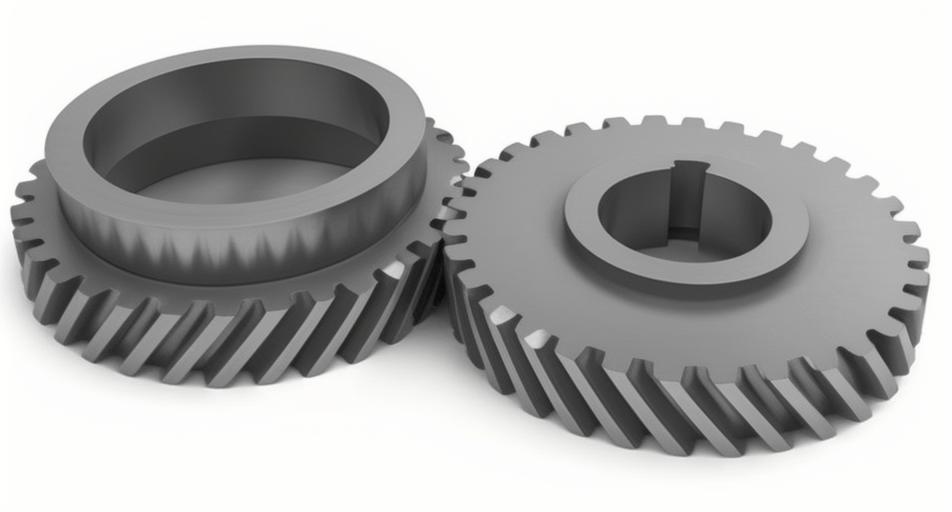
The form grinding process for internal helical gears involves using a shaped grinding wheel to precisely grind the tooth profile, ensuring high dimensional accuracy and surface finish. This method is widely adopted for hard-faced gears after carburizing and quenching, as it allows for controlled material removal and minimizes thermal damage. However, improper parameter selection can lead to increased grinding forces, surface burns, and reduced tool life. Therefore, optimizing these parameters is crucial for improving productivity and quality in the manufacturing of helical gears. We begin by establishing a grinding force model based on the analogy between form grinding and surface grinding, considering the unique geometry of helical gears.
The grinding force model for internal helical gears is derived from the fundamental principles of plane grinding, adapted to account for the involute profile and helical nature of the gears. In plane grinding, the tangential and normal grinding forces are expressed as functions of process parameters. For form grinding of helical gears, the contact between the wheel and gear tooth is analogous to a curved plane, and the grinding forces vary along the involute curve. The mathematical model incorporates parameters such as wheel speed \(v_s\), feed rate \(v_w\), grinding depth \(a_p\), and gear geometry. The relationship between plane grinding and form grinding parameters is summarized in Table 1.
| Plane Grinding Parameter | Form Grinding Parameter |
|---|---|
| \(v_s\) | \(v_s\) |
| \(v_w\) | \(v_w\) |
| \(a_p\) | \(a_e = a_p \sin r\) |
| \(d_s\) | \(d_e = d_s (\sin r)^{-1}\) |
| \(l_c\) | \(l_c\) |
Here, \(r\) represents the pressure angle of the gear, \(a_e\) is the effective grinding depth in the radial direction, \(d_e\) is the equivalent wheel diameter in form grinding, and \(l_c\) is the contact arc length. The grinding forces for a point on the involute curve can be derived using coordinate transformations. The involute equation, with the base circle center as the origin, is given by:
$$ x_M = r_b \sin(u – \sigma_0) – r_b u \cos(u – \sigma_0) $$
$$ y_M = r_b \cos(u – \sigma_0) + r_b u \sin(u – \sigma_0) $$
where \(u\) is the involute development angle, \(\sigma_0\) is the rotation angle around the base circle center, and \(r_b\) is the base radius. The wheel speed at any point on the involute is expressed as:
$$ v_s(u) = 2\pi n [r_b \cos(u – \sigma_0) + r_b u \sin(u – \sigma_0) – a] $$
with \(n\) as the wheel speed in rpm and \(a\) as the center distance. The unit width grinding forces at point M are then modeled as:
$$ F’_t(M) = \left[ K_1 + K_2 \ln\left( \frac{v_s(u)^{1.5}}{a_p^{0.25} v_w^{0.5}} \right) \frac{v_w a_e}{v_s(u)} + \left( A \alpha + \frac{4\beta p_0 v_w}{d_e v_s(u)} \right) (d_e a_e)^{0.5} \right] $$
$$ F’_n(M) = \left[ K_3 + K_4 \ln\left( \frac{v_s(u)^{1.5}}{a_p^{0.25} v_w^{0.5}} \right) \frac{v_w a_e}{v_s(u)} + \frac{4A p_0 v_w}{d_e v_s(u)} \left( \frac{a_e}{d_e} \right)^{0.5} \right] $$
where \(K_1\), \(K_2\), \(K_3\), \(K_4\), \(\alpha\), \(\beta\), and \(p_0\) are experimental constants, and \(A\) is the wheel wear area ratio. Integrating along the involute curve from 0 to \(u\), the total grinding forces become:
$$ F_t(M) = \int_0^u r_b u \left[ K_1 + K_2 \ln\left( \frac{v_s(u)^{1.5}}{a_p^{0.25} v_w^{0.5}} \right) \frac{v_w a_e}{v_s(u)} + \left( A \alpha + \frac{4\beta p_0 v_w}{d_e v_s(u)} \right) (d_e a_e)^{0.5} \right] du $$
$$ F_n(M) = \int_0^u r_b u \left[ K_3 + K_4 \ln\left( \frac{v_s(u)^{1.5}}{a_p^{0.25} v_w^{0.5}} \right) \frac{v_w a_e}{v_s(u)} + \frac{4A p_0 v_w}{d_e v_s(u)} \left( \frac{a_e}{d_e} \right)^{0.5} \right] du $$
This model highlights the dependence of grinding forces on process parameters and wheel characteristics for helical gears. To validate the model, we conducted grinding experiments on a CNC form grinding machine, measuring tangential grinding forces via power consumption. The experimental setup involved grinding internal helical gears made of 20CrMnTi steel, hardened to 58-62 HRC, using a specialized form grinding wheel. The grinding parameters were varied, and the results confirmed the model’s accuracy, as shown in Table 2.
| Experiment No. | Grinding Depth \(a_e\) (mm) | Feed Rate \(v_w\) (m/min) | Wheel Speed \(v_s\) (m/s) | Tangential Force \(F_t\) (N) – Experimental | Tangential Force \(F_t\) (N) – Theoretical |
|---|---|---|---|---|---|
| 1 | 0.01 | 4 | 42.846 | 20.167 | 20.465 |
| 2 | 0.02 | 4 | 42.846 | 30.754 | 30.205 |
| 3 | 0.03 | 4 | 42.846 | 37.944 | 37.927 |
| 4 | 0.03 | 5 | 42.846 | 42.637 | 42.311 |
| 5 | 0.03 | 6 | 42.846 | 46.669 | 46.265 |
| 6 | 0.03 | 5 | 35.705 | 47.957 | 47.414 |
| 7 | 0.03 | 5 | 49.987 | 38.697 | 38.427 |
The close agreement between experimental and theoretical values validates the grinding force model for internal helical gears. Next, we employed an orthogonal experiment to optimize the process parameters. A three-factor, three-level orthogonal array was designed, with factors being grinding depth \(a_e\), feed rate \(v_w\), and wheel speed \(v_s\). The levels are shown in Table 3, and the evaluation indicators included grinding force, basic grinding time, and surface quality.
| Level | Factor A: Grinding Depth \(a_e\) (mm) | Factor B: Feed Rate \(v_w\) (m/min) | Factor C: Wheel Speed \(v_s\) (m/s) |
|---|---|---|---|
| 1 | 0.01 | 4 | 35.705 |
| 2 | 0.02 | 5 | 42.846 |
| 3 | 0.03 | 6 | 49.987 |
The basic grinding time \(t_b\) for a single gear is calculated as:
$$ t_b = \frac{\pi d z b Z}{1000 a_p v_s v_w} $$
where \(d\) is the gear diameter, \(z\) is the number of teeth, \(b\) is the face width, and \(Z\) is the grinding allowance. Surface quality, represented by roughness \(R_a\), is modeled empirically as:
$$ R_a = 2.34 v_s^{-0.45} v_w^{0.08} a_e^{0.15} $$
The orthogonal experiment results are summarized in Table 4, and range analysis was performed to determine the influence of each factor on the indicators, as shown in Table 5.
| Experiment No. | Factor Combination | Grinding Force \(F_t\) (N) | Basic Time \(t_b\) (min) | Surface Quality \(R_a\) (μm) |
|---|---|---|---|---|
| 1 | A1B1C1 | 22.934 | 639.565 | 0.2622 |
| 2 | A1B2C2 | 22.830 | 426.377 | 0.2459 |
| 3 | A1B3C3 | 22.672 | 304.555 | 0.2328 |
| 4 | A2B1C2 | 30.205 | 266.485 | 0.2680 |
| 5 | A2B2C3 | 30.601 | 182.733 | 0.2546 |
| 6 | A2B3C1 | 41.287 | 213.188 | 0.3005 |
| 7 | A3B1C3 | 34.447 | 152.277 | 0.2657 |
| 8 | A3B2C1 | 47.414 | 170.551 | 0.3148 |
| 9 | A3B3C2 | 46.265 | 118.438 | 0.2942 |
| Indicator | Factor | Mean \(k_1\) | Mean \(k_2\) | Mean \(k_3\) | Range \(R\) | Optimal Scheme | Influence Order |
|---|---|---|---|---|---|---|---|
| Grinding Force | A | 22.812 | 34.301 | 42.709 | 19.897 | A1B1C3 | A > C > B |
| B | 29.195 | 33.615 | 36.741 | 7.546 | |||
| C | 37.212 | 33.100 | 29.240 | 7.972 | |||
| Basic Time | A | 456.832 | 220.802 | 147.089 | 309.743 | A3B3C3 | A > B > C |
| B | 352.776 | 259.887 | 212.060 | 140.716 | |||
| C | 341.101 | 270.433 | 213.188 | 127.913 | |||
| Surface Quality | A | 0.247 | 0.274 | 0.292 | 0.045 | A1B1C3 | A > C > B |
| B | 0.265 | 0.272 | 0.276 | 0.011 | |||
| C | 0.292 | 0.269 | 0.251 | 0.041 |
The range analysis reveals that grinding depth has the most significant impact on grinding force, followed by wheel speed and feed rate. For basic grinding time, grinding depth is the dominant factor, while for surface quality, grinding depth and wheel speed are crucial. Based on this, we determined optimal parameter combinations for rough and finish grinding stages of helical gears. For rough grinding, the optimal combination is A3B3C3: grinding depth of 0.03 mm, feed rate of 6 m/min, and wheel speed of 49.987 m/s. For finish grinding, A1B1C3 is optimal: grinding depth of 0.01 mm, feed rate of 4 m/min, and wheel speed of 49.987 m/s.
To verify the optimization, we conducted validation experiments on a CNC form grinding machine. The parameters and results are shown in Table 6. The grinding time for one full cycle was recorded, demonstrating improved efficiency with optimized parameters.
| Experiment No. | Grinding Depth \(a_e\) (mm) | Feed Rate \(v_w\) (m/min) | Wheel Speed \(v_s\) (m/s) | Grinding Time for One Cycle \(t\) (h) |
|---|---|---|---|---|
| 1 | 0.01 | 4 | 49.987 | 2.0 |
| 2 | 0.02 | 5 | 49.987 | 1.2 |
| 3 | 0.03 | 6 | 49.987 | 0.6 |
The results indicate that the optimized parameters reduce grinding time significantly, enhancing productivity for helical gears. Additionally, the surface quality was assessed using a gear measuring center, showing reductions in profile deviations: 0.8 μm for the right flank and 1.2 μm for the left flank, meeting design specifications. This confirms the effectiveness of the optimized parameters for finish grinding of internal helical gears.
In conclusion, this study establishes a grinding force model for internal helical gears and optimizes process parameters through orthogonal experiments. The findings highlight the critical role of grinding depth, wheel speed, and feed rate in controlling grinding forces and surface quality. The optimized parameters for rough and finish grinding stages provide practical guidance for manufacturers aiming to improve efficiency and accuracy in helical gear production. Future work could explore the effects of additional factors, such as wheel wear and coolant conditions, to further enhance the grinding process for helical gears.