
In precision motion control systems, such as those found in robotics, aerospace actuators, and radar servo mechanisms, the performance of a harmonic drive gear is paramount. One of the most critical performance metrics is gear backlash, which directly impacts positional accuracy, repeatability, stiffness, and efficiency. A significant design challenge lies in determining the geometric parameters of the harmonic drive gear to achieve a specified, often minimal, backlash requirement. Traditional design approaches have often incorporated backlash reduction as an empirical value within the mathematical model, leading to suboptimal and imprecise results. This article presents a refined methodology by formally modeling backlash reduction through the compensation of an additional torsional angle in the flexspline. This approach enables the establishment of a more accurate and rigorous optimization model for the meshing parameters of an involute tooth profile harmonic drive gear.
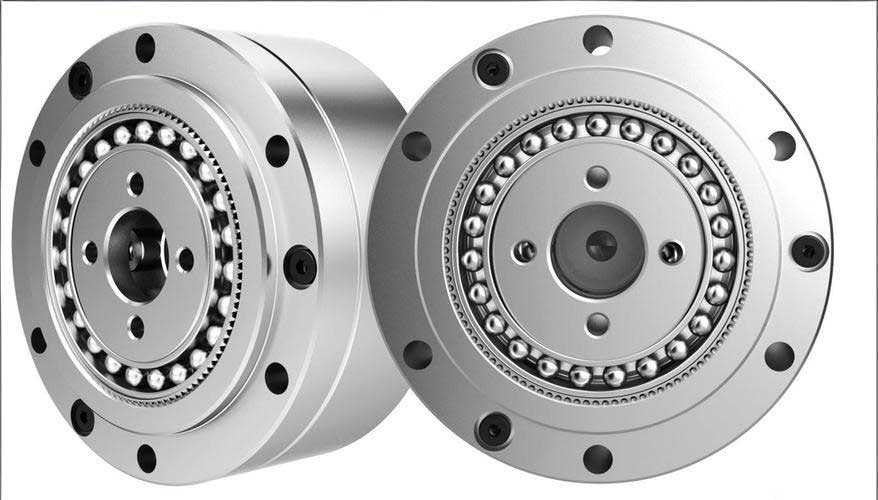
The core operational principle of a strain wave harmonic drive gear involves three primary components: a rigid circular spline (刚轮), a flexible flexspline (柔轮), and an elliptical wave generator. As the wave generator rotates, it deforms the flexspline into an elliptical shape, causing its external teeth to engage with the internal teeth of the circular spline at two diametrically opposite regions. The kinematic reduction is achieved due to the difference in the number of teeth between the two splines. Accurate modeling of the instantaneous contact geometry between the tooth flanks is essential for predicting and controlling backlash.
To analyze backlash, we consider the wave generator as fixed, with the flexspline as the input (driving) member and the circular spline as the output (driven) member. The geometric model for calculating side clearance (backlash) at a given angular position of the undeformed end of the flexspline is illustrated in the figure above. The backlash is not uniform along the engagement arc and is evaluated at critical points, typically near the points of initial contact and disengagement. For a pair of engaging teeth, two distinct backlash values can be defined: \( j_{t1} \) on one flank and \( j_{t2} \) on the opposite flank, calculated as the Euclidean distance between corresponding points on the two tooth profiles when they are in a non-contacting, aligned position dictated by the wave generator’s shape.
The mathematical expressions for these backlash values are:
$$ j_{t1} = \sqrt{(x_{K2} – x_{K1})^2 + (y_{K1} – y_{K2})^2} $$
$$ j_{t2} = \sqrt{(x_{P2} – x_{P1})^2 + (y_{P1} – y_{P2})^2} $$
where points \( K_1, P_1 \) lie on the flexspline tooth profile and points \( K_2, P_2 \) lie on the circular spline tooth profile.
Based on the theory of involute gear engagement and differential geometry, the coordinates of these points can be derived. For point \( K_1 \) on the flexspline:
$$ x_{K1} = r_b \left[ \sin(\theta_b – u_k + \psi) + u_k \cdot \cos(\theta_b – u_k + \psi) \right] + \rho \cdot \sin \phi_1 – r_m \cdot \sin \psi $$
$$ y_{K1} = r_b \left[ \cos(\theta_b – u_k + \psi) – u_k \cdot \sin(\theta_b – u_k + \psi) \right] + \rho \cdot \cos \phi_1 – r_m \cdot \cos \psi $$
where:
\( r_b \) is the base radius of the flexspline.
\( \theta_b, u_k, \psi \) are geometric and angular parameters related to the involute profile and wave generator position.
\( \rho \) is the radial deformation of the flexspline neutral line.
\( \phi_1 \) is the rotation angle of the deformed section of the flexspline.
\( r_m \) is a reference radius.
The corresponding point \( K_2 \) on the circular spline is given by:
$$ x_{K2} = r_{M1} \cdot \sin(\phi_2 + \xi_{K2}) $$
$$ y_{K2} = r_{M1} \cdot \cos(\phi_2 + \xi_{K2}) $$
Here, \( r_{M1} = \sqrt{x_{K1}^2 + y_{K1}^2} \) is the polar radius of point \( K_1 \).
\( \phi_2 = (z_g / z_b) \cdot \phi \) is the rotation angle of the circular spline (\( z_g \) and \( z_b \) are tooth numbers of the circular spline and flexspline, respectively; \( \phi \) is the wave generator angle relative to the undeformed flexspline).
\( \xi_{K2} = \theta_2 + \text{inv} \alpha – \text{inv} \alpha_{k2} \), where \( \theta_2 \) is half the angular tooth space on the circular spline pitch circle, \( \alpha \) is the standard pressure angle, and \( \alpha_{k2} \) is the pressure angle at point \( K_2 \).
Similarly, the coordinates for points \( P_1 \) and \( P_2 \) can be expressed as:
$$ x_{P1} = r_b \left[ \sin(\psi – \theta_b + u_k) – u_k \cdot \cos(\psi – \theta_b + u_k) \right] + \rho \cdot \sin \phi_1 – r_m \cdot \sin \psi $$
$$ y_{P1} = r_b \left[ \cos(\psi – \theta_b + u_k) + u_k \cdot \sin(\psi – \theta_b + u_k) \right] + \rho \cdot \cos \phi_1 – r_m \cdot \cos \psi $$
$$ x_{P2} = r_{M2} \cdot \sin(\phi_2 – \xi_{P2}) $$
$$ y_{P2} = r_{M2} \cdot \cos(\phi_2 – \xi_{P2}) $$
with \( r_{M2} = \sqrt{x_{P1}^2 + y_{P1}^2} \).
The angular parameters \( \phi_1, \psi, \) and \( \mu \) (implicit in \( \rho \)) are functions of the wave generator angle \( \phi \) and the wave generator profile (e.g., a “four-force” type with \( \beta = 30^\circ \)). Consequently, for a given harmonic drive gear geometry, the backlash is a function of several key design parameters and the instantaneous angle:
$$ j_t = f(\phi, x_g, x_b, \omega^*_0, h_n) $$
where the design vector is \( \mathbf{X} = [x_g, x_b, \omega^*_0, h_n, \phi] \).
| Symbol | Description |
|---|---|
| \( x_g \) | Profile shift coefficient of the circular spline (刚轮). |
| \( x_b \) | Profile shift coefficient of the flexspline (柔轮). |
| \( \omega^*_0 \) | Radial deformation coefficient ( \( \omega_0 / m \), where \( \omega_0 \) is the nominal radial deformation and \( m \) is the module). |
| \( h_n \) | Depth of meshing (啮入深度). |
| \( \phi \) | Angle of the wave generator relative to the undeformed flexspline, defining the specific cross-section for analysis. |
The objective of the optimization is to minimize the gear backlash \( j_t \) over the operational range, which can be formulated as finding the design vector \( \mathbf{X}^* \) that minimizes the objective function \( F(\mathbf{X}) = j_t \), subject to a set of stringent geometric and operational constraints \( g_i(\mathbf{X}) \geq 0 \).
The constraints ensure proper, interference-free operation of the harmonic drive gear:
- Tooth Profile Overlap Interference: At any engagement position, the profiles must not intersect. This requires:
$$ x_{K2} – x_{K1} \geq 0, \quad y_{K1} – y_{K2} \geq 0 \quad \text{and} \quad x_{P1} – x_{P2} \geq 0, \quad y_{P2} – y_{P1} \geq 0 $$ - Undercut or Fillet Interference: The active involute profile must not interfere with the fillet curve of the mating gear.
$$ r_{ag} + \omega_0 \leq r_{j2b} $$
$$ r_{j1g} + \omega_0 \leq r_{ab} $$
where \( r_{ag}, r_{ab} \) are addendum circle radii and \( r_{j1g}, r_{j2b} \) are fillet circle radii. - Maximum Meshing Depth Limit: The depth of engagement \( h_n \) must not exceed a permissible limit related to the addendum:
$$ m(0.5 z_g + x_g + h_a^*) – 0.5 d_{j1g} – h_n \geq 0 $$
where \( h_a^* \) is the addendum coefficient and \( d_{j1g} \) is a diameter related to the generating tool. - Radial Clearance: Sufficient clearance must exist between the tooth tip of one gear and the root of the other.
$$ 0.5(d_{jb} – d_{ag}) – \omega_0 – 0.15m \geq 0 $$ - Tooth Tip Thickness: To prevent weak, pointed teeth, a minimum tip thickness must be maintained.
$$ s_{ag} – 0.25m \geq 0 $$
$$ s_{ab} – 0.25m \geq 0 $$ - Disengagement Clearance at Minor Axis: To ensure teeth can disengage smoothly at the minor axis of the wave generator.
$$ d_{ag} – d_{ab} < 2.16 \omega^*_0 $$ - Continuous Meshing Condition: Ensures the flexspline tooth tip does not exit engagement prematurely.
$$ \xi_{ab} – \xi_{K2} > 0 $$
A critical advancement in this model is the explicit compensation for load-induced torsional deflection. In a power-transmitting harmonic drive gear, the applied torque causes the flexspline to twist relative to the circular spline, effectively reducing the operational backlash. The reduction in backlash at the pitch circle due to torque \( T \) can be estimated as:
$$ j_T = \frac{T \cdot b}{d_g^2 \cdot \delta \cdot G} $$
where \( b \) is the face width, \( d_g \) is the pitch diameter of the circular spline, \( \delta \) is the flexspline wall thickness, and \( G \) is the shear modulus of the flexspline material. This backlash reduction is equivalent to an additional rotational displacement \( \phi_0 \) of the flexspline’s deformed section:
$$ \phi_0 = \frac{j_T}{d_g / 2} = \frac{2 j_T}{d_g} $$
Therefore, the compensated rotation angle \( \phi_1 \) of the deformed flexspline section becomes:
$$ \phi_1 = \phi + \frac{v}{r_m} + \phi_0 $$
where \( v/r_m \) is the geometric rotation due to wave generator deformation. Incorporating \( \phi_0 \) directly into the coordinate equations (like those for \( x_{K1}, y_{K1} \)) refines the backlash calculation model \( j_t = f(\phi, x_g, x_b, \omega^*_0, h_n, \phi_0) \), making it accurate for both unloaded and loaded conditions.
Given the nonlinear nature of the objective function and the multiple inequality constraints, a robust optimization algorithm is required. A hybrid approach combining the downhill simplex method (Nelder-Mead) and the interior penalty function method is effective. The downhill simplex method is efficient for problems with a moderate number of variables (n ≤ 20) as it does not require gradient information, while the interior penalty function method handles constraints by keeping the search within the feasible region. This optimization routine can be effectively implemented in a programming environment suitable for technical computing.
To validate the model, consider the design of a harmonic drive gear for a radar servo system with the following specifications:
• Circular spline teeth: \( z_g = 200 \)
• Flexspline teeth: \( z_b = 202 \)
• Module: \( m = 0.5 \text{ mm} \)
• Pressure angle: \( \alpha = 20^\circ \)
• Wave generator: Four-force type with \( \beta = 30^\circ \)
• Flexspline wall thickness: \( \sigma = 1.1 \text{ mm} \)
• Output torque: \( T_{max} = 300 \text{ N·m} \)
• Target: Minimum backlash approaching zero.
The manufacturing process involves a hob for the flexspline and a shaper cutter (\( z_0=80, x_0=0 \)) for the circular spline. For the loaded case, the torsional backlash reduction and additional angle are calculated as:
$$ j_T = \frac{2 \times 300 \times 10^3 \times 0.15 \times 100}{100^2 \times 1.1 \times 8 \times 10^4} \approx 0.01023 \text{ mm}, \quad \phi_0 = \frac{0.01023}{50} = 0.0002046 \text{ rad} $$
This \( \phi_0 \) is incorporated into the optimization model for the loaded condition analysis.
Optimizations were performed for two scenarios: (A) considering the load-induced torsional compensation (\( \phi_0 \neq 0 \)), and (B) neglecting it (\( \phi_0 = 0 \)). The table below presents selected optimization results from multiple starting points for both scenarios.
| Set | Scenario | \( x_g \) | \( x_b \) | \( \omega^*_0 \) | \( h_n \text{ (mm)} \)\) | \( \phi \text{ (°)} \)\) | \( j_t \text{ (mm)} \)\) |
|---|---|---|---|---|---|---|---|
| I | With Load Compensation | 2.88417 | 3.03895 | 1.08246 | 0.90388 | 0.28514 | 2.4e-7 |
| II | With Load Compensation | 2.43850 | 2.57514 | 1.06854 | 0.87648 | 0.77133 | 8.5e-7 |
| III | With Load Compensation | 2.41695 | 2.57124 | 1.08346 | 0.88710 | 0.13498 | 8.0e-8 |
| ① | No Load Compensation | 2.91583 | 3.00404 | 1.07417 | 0.91263 | 0.71553 | -0.011 |
| ② | No Load Compensation | 2.43305 | 2.54960 | 1.09906 | 0.90384 | -0.41295 | -0.011 |
| ③ | No Load Compensation | 2.37778 | 2.49813 | 1.10245 | 0.89664 | -0.06006 | -0.011 |
Analysis of the results for the loaded scenario (Sets I, II, III) reveals that all satisfy the constraints and provide near-zero minimum backlash. The backlash variation over the engagement angle (\( \phi \)) differs for each set. Set II, characterized by a relatively smaller radial deformation coefficient \( \omega^*_0 \) and a larger meshing depth \( h_n \), exhibits a backlash curve that is minimal and well-distributed, making it the most suitable choice for the final design.
The profound impact of load compensation is evident when comparing scenarios. Consider Set II parameters (optimized for the loaded condition). If these same parameters are analyzed *without* including the torsional compensation \( \phi_0 \) in the calculation (simulating an unloaded test condition), the resulting backlash curve shifts upward, showing a consistently positive backlash. This positive backlash under no-load is a primary source of mechanical deadband or hysteresis.
Conversely, consider Set ② parameters (optimized *neglecting* load effects). If these parameters are analyzed *with* the torsional compensation \( \phi_0 \) included (simulating the actual loaded condition), the backlash curve shifts downward. Crucially, in the engagement zone (e.g., \( \phi \) between 0° and 7°), the backlash becomes negative. A negative backlash indicates tooth profile interference, which would lead to binding, increased wear, elevated torque, and potential failure of the harmonic drive gear under load.
This comparative analysis conclusively demonstrates that for a harmonic drive gear intended for power transmission applications, optimizing meshing parameters without accounting for torsional deflection is fundamentally flawed. The resulting design, while potentially optimal for a no-load/assembly condition, becomes sub-optimal and prone to interference under operational torque. The methodology presented here, which explicitly incorporates the load-induced additional torsional angle \( \phi_0 \) into the geometric backlash model, enables the determination of parameters that ensure near-zero *effective* backlash under load while avoiding interference. This provides a reliable and precise foundation for the manufacture of high-performance harmonic drive gear units where accuracy, stiffness, and smooth operation are critical.