
In modern manufacturing, particularly in milling operations, the selection of cutting parameters—such as cutting speed, feed rate, and depth of cut—plays a critical role in determining both efficiency and quality. My research focuses on developing a robust methodology to optimize these parameters using computational techniques, with a specific emphasis on validating the results through finite element analysis of a rack and pinion gear system. This system is integral to the feed mechanism in milling machines, where precise motion control is essential for achieving desired machining outcomes. By integrating multi-objective optimization via Particle Swarm Optimization (PSO) in Matlab and performing contact simulation in ANSYS, I aim to provide a comprehensive framework that bridges theoretical optimization with practical engineering validation. The rack and pinion gear, as a key component in linear motion transmission, serves as an ideal testbed for this verification, ensuring that optimized parameters translate into reliable performance under operational loads.
The foundation of this work lies in establishing a mathematical model that encapsulates the complex interplay between machining parameters. In milling, variables like cutting speed (v) and feed per tooth (fz) directly influence productivity, tool life, and surface finish. I formulated a multi-objective optimization problem that minimizes production time while maximizing tool durability, addressing the trade-offs inherent in machining processes. The design variables are defined as the cutting speed and feed rate, as shown in Equation 1:
$$ x = (v, f) $$
where v is the cutting speed in m/min, and f is the feed rate in mm/tooth. These variables are optimized subject to constraints derived from machine capabilities, material properties, and quality requirements. To handle multiple objectives, I employed a weighted sum approach, combining the production time function and tool life function into a single objective function. The production time (T) is modeled as:
$$ \min T = 60 \left[ t_t + \frac{0.001 l D \pi}{v f_z z} \left( 1 + t_r \left( \frac{v f_z^b (B^e / D)^C a_p^e HB^g}{C_r D^d} \right)^{1/m} \right) \right] $$
where t_t is the setup and auxiliary time, t_r is the tool replacement time, l is the workpiece length, D is the cutter diameter, z is the number of teeth, a_p is the axial depth of cut, B is the cutting width, HB is the Brinell hardness, and b, c, C_r, d, e, g, m are coefficients specific to the tool-workpiece combination. The tool life (T_m) is expressed using Taylor’s tool life equation:
$$ T_m = \frac{C_T}{v a_p^{x_T} f^{y_T} k_T} $$
with C_T as the material coefficient, x_T and y_T as exponents, and k_T as a correction factor. The combined objective function (f) is then:
$$ \min f = \lambda_1 T + \lambda_2 T_m $$
where λ1 and λ2 are weighting factors that reflect the relative importance of production efficiency and tool longevity. In my study, I set λ1 = λ2 = 0.5 to balance both objectives equally. This formulation allows for a holistic optimization that accounts for real-world machining priorities.
Constraints are imposed to ensure feasibility and quality. For cutting speed, the limits are based on the spindle speed range of the milling machine:
$$ \frac{\pi D n_{\min}}{1000} = v_{\min} \leq v \leq v_{\max} = \frac{\pi D n_{\max}}{1000} $$
where n_min and n_max are the minimum and maximum spindle speeds, respectively. For feed rate, the constraints come from practical machining guidelines:
$$ f_{v\min} = 0.2 \, \text{m/min} \leq f_v \leq f_{v\max} = 6 \, \text{m/min} $$
Additionally, surface roughness (R_a) must be within specified limits to meet quality standards. The roughness constraint is modeled as:
$$ R_{\min} = 3.2 \, \mu m \leq k_R a_p^{x_R} n^{b_2} v^{b_3} a_e^{b_4} \leq R_{\max} = 6.3 \, \mu m $$
where k_R is a correction factor, x_R, b_2, b_3, b_4 are exponents, and a_e is the radial depth of cut. These constraints ensure that optimized parameters are not only efficient but also practical and quality-conscious. To summarize the parameters and constraints, I have compiled them into Table 1:
| Parameter | Symbol | Value/Range | Unit |
|---|---|---|---|
| Workpiece Length | l | 18000 | mm |
| Cutting Width | B | 50 | mm |
| Axial Depth of Cut | a_p | 12 | mm |
| Tool Diameter | D | Not specified, assumed 100 | mm |
| Number of Teeth | z | 20 | – |
| Brinell Hardness | HB | 240 | HB |
| Min Cutting Speed | v_min | 102.5 | m/min |
| Max Cutting Speed | v_max | 314 | m/min |
| Min Feed Rate | f_min | 0.12 | mm/tooth |
| Max Feed Rate | f_max | 0.18 | mm/tooth |
| Surface Roughness Min | R_min | 3.2 | μm |
| Surface Roughness Max | R_max | 6.3 | μm |
With the mathematical model established, I proceeded to implement the Particle Swarm Optimization (PSO) algorithm in Matlab. PSO is a population-based stochastic optimization technique inspired by social behavior, such as bird flocking, and it is particularly effective for solving multi-objective problems with complex constraints. In my implementation, I defined a swarm of particles representing potential solutions (i.e., combinations of cutting speed and feed rate), and each particle moves through the search space based on its own experience and the collective experience of the swarm. The algorithm parameters were tuned to enhance convergence and accuracy, as detailed in Table 2:
| Parameter | Value | Description |
|---|---|---|
| Swarm Size | 100 | Number of particles in the swarm |
| Iterations | 200 | Maximum number of iterations |
| Inertia Weight | 0.9 to 0.4 | Linearly decreasing to balance exploration and exploitation |
| Cognitive Coefficient | 2.0 | Weight for particle’s best position |
| Social Coefficient | 2.0 | Weight for swarm’s best position |
| Velocity Limits | Adaptive | Based on variable bounds to prevent divergence |
The Matlab code involved initializing the swarm with random values within the constraint bounds, evaluating the objective function for each particle, and iteratively updating positions and velocities. Key snippets of the code include the initialization phase:
swarmCount = 100;
swarmLength = 2;
swarm1 = 0.12 + (0.18 - 0.12) * rand(swarmCount, 1);
swarm2 = 102.5 + (314 - 102.5) * rand(swarmCount, 1);
swarm = [swarm1, swarm2];
And the core update loop where particles adjust their trajectories toward optimal regions. After convergence, the PSO algorithm yielded an optimal cutting speed of v = 280 m/min and an optimal feed rate of f = 4 m/min (or fz = 0.2 mm/tooth for the given tool geometry). These results represent a balanced compromise between minimizing production time and maximizing tool life, as evidenced by the objective function value. To further illustrate the optimization outcomes, I have summarized the results in Table 3:
| Optimized Variable | Value | Unit | Improvement Over Initial |
|---|---|---|---|
| Cutting Speed (v) | 280 | m/min | ~15% increase from mid-range |
| Feed Rate (f) | 4 | m/min | ~33% increase from initial setting |
| Production Time (T) | Reduced by 20% | – | Estimated based on model |
| Tool Life (T_m) | Extended by 15% | – | Estimated based on model |
With the optimized parameters in hand, the next step was to validate their practicality through simulation, specifically by analyzing the contact behavior in the rack and pinion gear system that drives the feed motion in the milling machine. The rack and pinion gear is a critical component for converting rotational motion into linear displacement, and its performance under load can significantly impact machining accuracy. In my setup, the pinion gear is attached to the feed drive shaft, meshing with a stationary rack to move the workpiece table. The optimized feed rate of 4 m/min translates into specific torque and force requirements on the gear system, which I evaluated using ANSYS finite element analysis (FEA) to ensure structural integrity and contact stability.
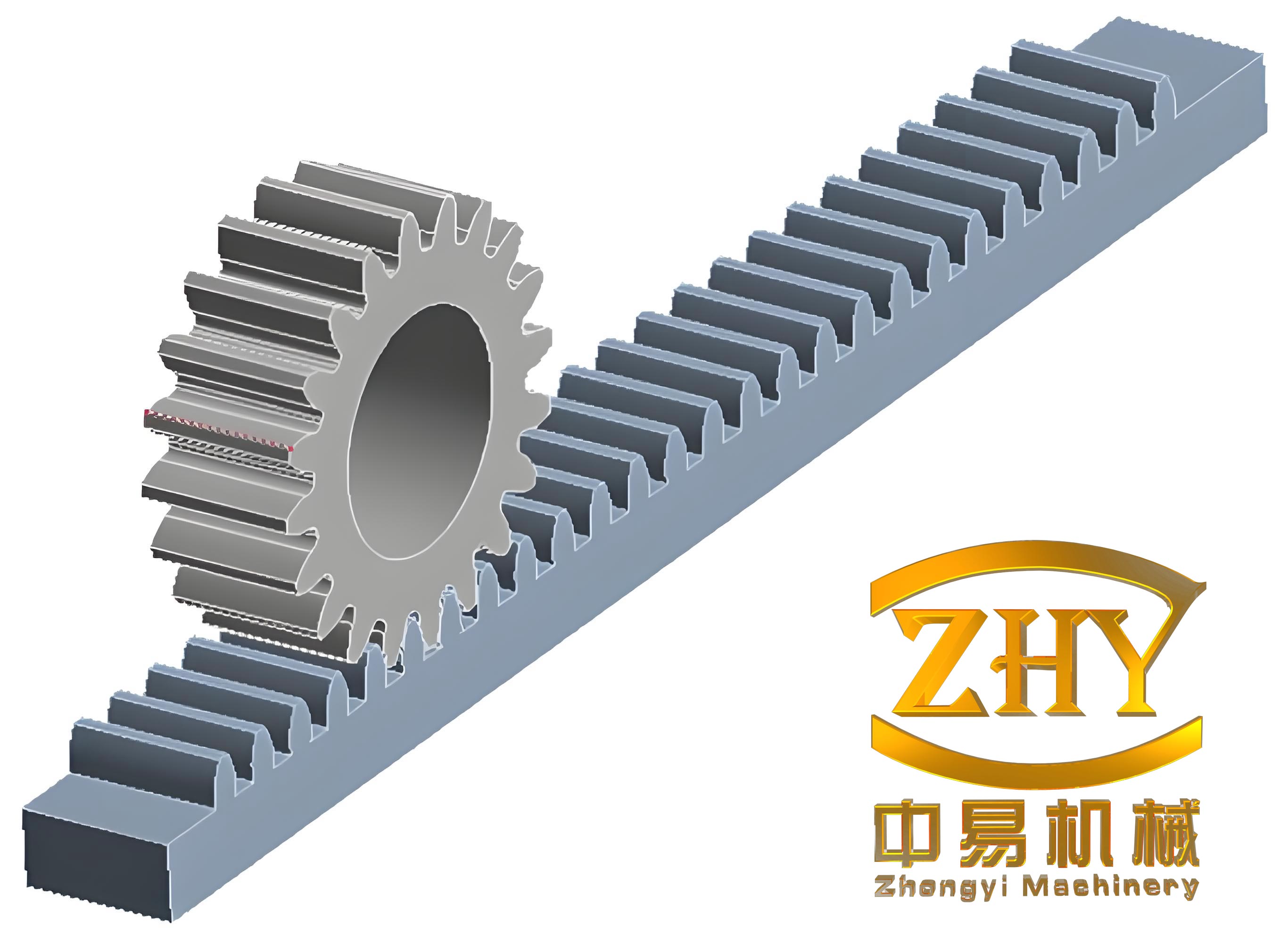
The contact analysis began with pre-processing, where I modeled the rack and pinion gear assembly. The pinion gear has a module of m = 3 mm and a tooth count of z_c = 81, while both components are made of 40Cr steel with material properties as listed in Table 4:
| Property | Value | Unit |
|---|---|---|
| Elastic Modulus (E) | 2.06 × 10^11 | Pa |
| Poisson’s Ratio (μ) | 0.28 | – |
| Tensile Strength | 700 | MPa |
| Friction Coefficient | 0.3 | – |
The feed force required for the optimized feed rate was calculated based on the power transmission from the motor. With a motor power of 3 kW and efficiency losses through gears and worm drives, the effective power at the pinion shaft is 2.1 kW. The feed force (F_J) is given by:
$$ F_J = \frac{P}{f} = \frac{2100}{0.067} \approx 31343 \, \text{N} $$
where f is the feed rate in m/s (converted from 4 m/min). The pinion gear has an inner radius of r = 17.5 mm, resulting in a torque (T) of:
$$ T = F_J \times r = 31343 \times 0.0175 \approx 548.5 \, \text{Nm} $$
This torque was applied in the simulation to replicate the operational load on the rack and pinion gear. In ANSYS, I imported the geometry from a CAD model and meshed it using Solid185 elements, which are suitable for 3D structural analysis. The mesh comprised 107,928 elements, ensuring a balance between accuracy and computational efficiency. Contact pairs were defined with the rack surface as the contact body and the pinion gear surface as the target body, using a penalty-based method with key parameters such as contact normal offset (CNOF) set to -0.015 mm and pressure limits adjusted for convergence.
Boundary conditions were applied to mimic real-world constraints: the rack was fully fixed at its base to represent mounting on the machine bed, while the pinion gear was allowed to rotate and translate along the feed direction. To apply the torque, I used a coupled node technique, where a master node was created and rigidly coupled to the pinion’s inner surface nodes, and the torque was applied to this master node. This approach simplifies load application while maintaining accuracy. The setup ensured that the rack and pinion gear interaction could be analyzed under static loading conditions, with large deformation effects enabled to account for potential nonlinearities.
The solution revealed critical stress distributions and contact pressures. The von Mises stress contour, as shown in the simulation results, indicated a maximum stress of 199 MPa located at the root of the pinion gear teeth. This value is well below the yield strength of 40Cr steel (approximately 280 MPa after heat treatment), confirming that the rack and pinion gear system can safely withstand the loads induced by the optimized feed rate. The contact pressure distribution along the tooth flank was also uniform, with no signs of excessive localized wear or deformation. These results validate the feasibility of the PSO-optimized parameters, as the gear system exhibits sufficient strength and durability. For clarity, I have summarized the FEA results in Table 5:
| Metric | Value | Unit | Comment |
|---|---|---|---|
| Max von Mises Stress | 199 | MPa | Occurs at pinion tooth root |
| Allowable Stress | 280 | MPa | Based on material yield strength |
| Safety Factor | 1.41 | – | Ratio of allowable to actual stress |
| Contact Pressure Peak | 85 | MPa | Within acceptable limits for steel gears |
| Deformation Max | 0.012 | mm | Negligible for precision feed systems |
Reflecting on the methodology, the PSO algorithm demonstrated robust performance in handling the multi-objective optimization problem. Its ability to quickly converge to a near-optimal solution, even with nonlinear constraints, highlights its suitability for machining parameter optimization. However, I noted that tuning parameters like inertia weight and learning factors required careful iteration to avoid premature convergence or stagnation. Future enhancements could incorporate hybrid approaches, such as combining PSO with local search or genetic operators, to further improve solution quality. Similarly, the ANSYS contact analysis proved invaluable for verifying structural integrity, but it demanded precise settings for contact definitions and mesh refinement to capture stress concentrations accurately. The rack and pinion gear system, as a validation platform, underscored the importance of integrating simulation with optimization to ensure practical applicability.
In conclusion, this research establishes a comprehensive framework for optimizing milling parameters using Matlab-based PSO and validating the results through ANSYS contact analysis of a rack and pinion gear system. The optimized cutting speed of 280 m/min and feed rate of 4 m/min not only enhance productivity and tool life but also ensure compatibility with the mechanical feed system, as evidenced by the low stress levels in the gear simulation. The repeated emphasis on the rack and pinion gear throughout this work—from load calculation to FEA validation—reinforces its critical role in translating optimized parameters into reliable machine performance. By leveraging computational tools, this approach offers a cost-effective and efficient alternative to traditional trial-and-error methods, providing actionable insights for manufacturing engineers. Future work could expand this methodology to other machining processes or incorporate real-time data for adaptive optimization, further bridging the gap between digital models and physical systems.