
In the field of mechanical transmission, straight bevel gears play a critical role due to their ability to transmit power between intersecting shafts. The demand for high-performance gears with superior strength, wear resistance, and precision has led to the adoption of advanced forging processes. Among these, the hot-cold compound forming process has emerged as a prominent method for manufacturing straight bevel gears, as it combines the advantages of hot forging (e.g., lower forming forces and improved material flow) with cold finishing (e.g., enhanced surface quality and dimensional accuracy). However, the design of the pre-forging tooth profile is pivotal to the success of this process, as improper profiles can lead to defects such as metal folding or insufficient surface refinement during cold finishing. This article delves into the optimization of pre-forging tooth profiles for straight bevel gears, leveraging numerical simulations and physical experiments to highlight the superiority of non-standard designs over traditional approaches.
The hot-cold compound forming process for straight bevel gears typically involves several stages: billet heating, upsetting, hot forging, trimming, cooling with descaling, phosphating-soaping treatment, and cold finishing. This sequence ensures that the initial hot forging step achieves near-net shape with minimal oxidation, while the cold finishing step refines the tooth surface to meet stringent precision requirements. For instance, a typical differential planetary straight bevel gear used in automotive applications is manufactured using this route. The material often employed is 20CrMnTi steel, which offers good hardenability and toughness. The gear parameters, such as tooth number, pressure angle, and module, are critical in determining the pre-forging design. Below is a summary of key parameters for a representative straight bevel gear:
| Parameter | Value |
|---|---|
| Number of Teeth | 11 |
| Pressure Angle (°) | 22.5 |
| Pitch Cone Angle (°) | 31.43 |
| Root Cone Angle (°) | 26.18 |
| Module | 6.5 |
| Face Width (mm) | 30 |
| Tip Cone Angle (°) | 36.10 |
In the pre-forging stage, the tooth profile design must account for material flow, volume consistency, and the subsequent cold finishing allowances. Traditionally, standard pre-forging tooth profiles are derived by uniformly offsetting the tooth surface outward from the cold-finished gear profile, while the root circle is offset inward based on volume conservation. This can be expressed mathematically as: $$ \Delta S = k \cdot m $$ where $\Delta S$ is the surface offset, $m$ is the module, and $k$ is a factor dependent on the cold finishing allowance. However, this approach often results in issues during cold finishing, such as metal folding at the tooth root or inadequate surface refinement. To illustrate, four standard design schemes with varying surface offsets were analyzed:
| Scheme | Surface Offset (mm) |
|---|---|
| Scheme 1 | 0.9 |
| Scheme 2 | 0.4 |
| Scheme 3 | 0.2 |
| Scheme 4 | 0.15 |
Numerical simulations using Deform-3D software were conducted to evaluate these schemes. The finite element model incorporated a plastic workpiece (AISI-4120 steel, analogous to 20CrMnTi) and rigid dies, with a shear friction factor of 0.1 and an initial billet temperature of 1100°C for hot forging. The cold finishing process was simulated with a punch speed of 26 mm/s, and mesh refinement ensured accuracy with a minimum element size of 0.7 mm. The results revealed that as the cold finishing allowance increased, the forming load rose significantly, with maximum loads of 5500 kN, 4600 kN, 2750 kN, and 2700 kN for Schemes 1 to 4, respectively. Moreover, metal folding occurred at the tooth root in Schemes 1-3 due to constraints imposed by the die, as the pre-forged tooth profile exceeded the cold die cavity. The folding mechanism can be described by the material flow equation: $$ \frac{\partial \sigma}{\partial x} + \rho g = \rho \frac{du}{dt} $$ where $\sigma$ is stress, $\rho$ is density, $g$ is gravity, and $u$ is displacement. This indicates that excessive constraints lead to localized stress concentrations and folding. Scheme 4, with the smallest offset, eliminated folding but resulted in poor surface quality due to insufficient material flow during cold finishing.
To address these limitations, a non-standard pre-forging tooth profile was proposed. This design increases the cold finishing allowance on the tooth flank (particularly in the mid-height region, where gear meshing occurs) while reducing it at the root. The volume conservation principle is maintained, but the offset is non-uniform. The optimization can be represented by: $$ \Delta S_{\text{flank}} = \Delta S_{\text{standard}} + \delta $$ $$ \Delta S_{\text{root}} = \Delta S_{\text{standard}} – \delta $$ where $\delta$ is an adjustment factor based on simulation feedback. This approach minimizes root constraints and enhances flank refinement. Numerical simulations of the non-standard design showed no folding defects and higher effective strain on the tooth surface, indicating improved material flow. The equivalent strain $\bar{\epsilon}$ is given by: $$ \bar{\epsilon} = \sqrt{\frac{2}{3} \epsilon_{ij} \epsilon_{ij}} $$ where $\epsilon_{ij}$ is the strain tensor. Comparative analysis demonstrated that the non-standard profile achieved better surface integrity and dimensional accuracy.
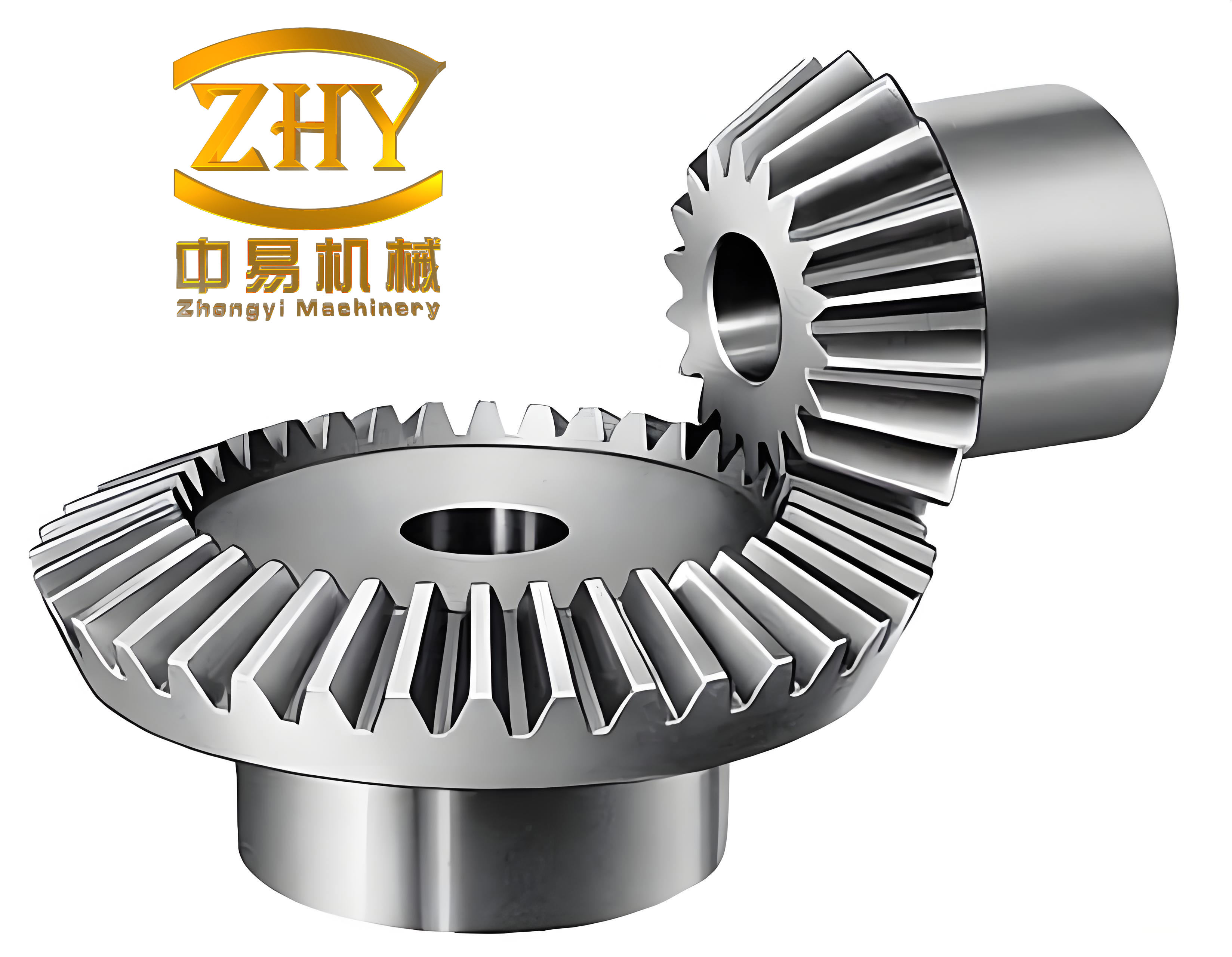
Physical experiments were conducted to validate the numerical findings. For the standard pre-forging tooth profile (Scheme 4), hot forging was performed on a 4000 kN friction press at 1100°C, with dies preheated to 200°C and water-based graphite lubricant. Cold finishing was carried out on a 1200-ton hydraulic press. The resulting straight bevel gears exhibited surface pits and low precision, failing to meet the IT8 grade requirement. In contrast, the non-standard pre-forging tooth profile was manufactured under identical conditions. The hot-forged gears showed no root constraints, and after cold finishing, the tooth surfaces were smooth and free of defects, achieving the desired accuracy. The improvement can be attributed to the optimized material flow, which reduces tangential forces and prevents defect formation.
The superiority of the non-standard pre-forging tooth profile for straight bevel gears is further underscored by the load-displacement curves from simulations. The non-standard design resulted in a more gradual load increase, peaking at approximately 2800 kN, compared to the sharp rises in standard schemes. This indicates reduced resistance and better formability. Additionally, the effective strain distribution was more uniform, with values up to 1.5 on the flank, versus 0.8 in Scheme 4. The relationship between strain and surface quality can be modeled as: $$ R_a = C \cdot \bar{\epsilon}^{-n} $$ where $R_a$ is surface roughness, and $C$ and $n$ are material constants. Higher strain correlates with lower roughness, confirming the enhanced performance of non-standard profiles.
In conclusion, the optimization of pre-forging tooth profiles for straight bevel gears is essential for maximizing the benefits of hot-cold compound forming. While standard designs with uniform offsets can lead to folding or poor surface quality, non-standard profiles with tailored allowances eliminate defects and improve precision. This approach leverages numerical simulation to guide design adjustments, ensuring that straight bevel gears meet the rigorous demands of modern applications. Future work could explore the integration of machine learning for real-time profile optimization, further advancing the manufacturing of high-performance straight bevel gears.