
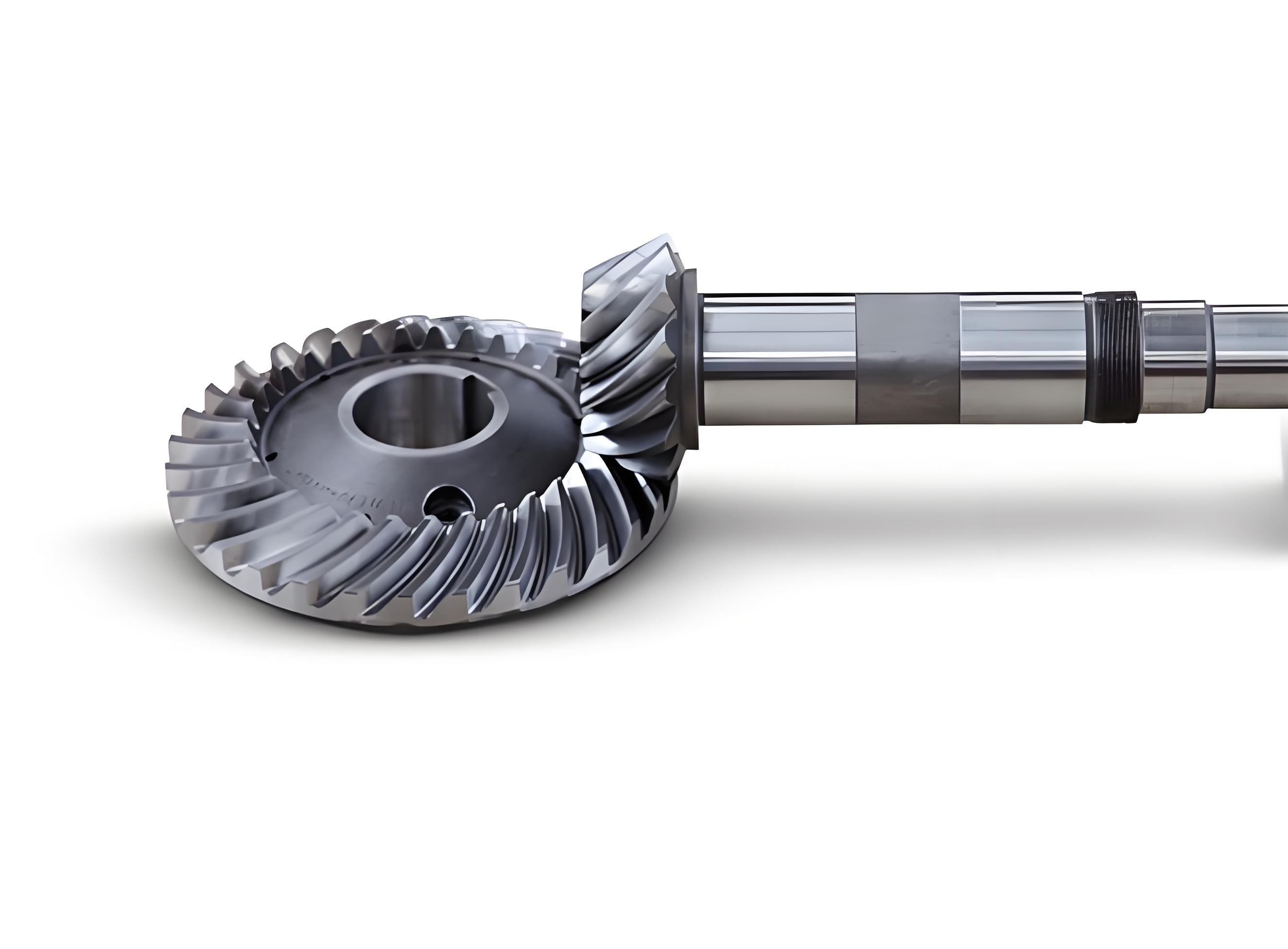
The design of spiral bevel gears is a complex and critical task in mechanical power transmission systems, particularly in demanding applications such as aerospace, automotive differentials, and heavy industrial machinery. Traditional design methodologies often treat design parameters—such as material properties, geometric dimensions, and applied loads—as deterministic values. While this approach simplifies the calculation process, it fails to account for the inherent variabilities and uncertainties present in real-world manufacturing and operating conditions. Consequently, a design optimized under deterministic assumptions may prove to be sub-optimal or even infeasible when subjected to statistical fluctuations, potentially compromising performance and safety. To address this limitation, this paper explores a comprehensive optimization framework for spiral bevel gears that integrates probabilistic reliability analysis directly into the design process. By modeling key factors like bending strength, contact strength, and operational stress as random variables following statistical distributions, the proposed method aims to identify optimal gear parameters that not only minimize objectives like size or weight but also guarantee a pre-specified, high level of operational reliability.
The fundamental challenge in gear design lies in balancing competing requirements: compactness, load-carrying capacity, longevity, and manufacturability. For spiral bevel gears, which transmit power between intersecting shafts, the geometric complexity involving parameters like spiral angle, face width, and module adds further dimensions to the optimization problem. The integration of reliability theory transforms this from a deterministic search into a probabilistic one, where the goal is to ensure that the probability of failure (e.g., pitting or tooth breakage) remains below an acceptable threshold throughout the design life. This paradigm shift requires establishing a mathematical model where constraints are formulated not as simple inequalities but as probabilistic statements about system performance.
Foundations of Reliability-Based Design
In reliability-based design optimization (RBDO), the strength of a component (\(S\)) and the stress it experiences (\(\sigma\)) are considered random variables with their own probability distributions. Failure occurs when the stress exceeds the strength (\(\sigma > S\)). The reliability (\(R\)) is then the probability of the safe state (\(S > \sigma\)), expressed as:
$$ R = P(S – \sigma > 0) $$
For many mechanical components, including gears, extensive experimental data suggests that material strength (endurance limits for bending \(S_{fe}\) and contact \(S_{Hc}\)) can be reasonably modeled by a normal (Gaussian) distribution. Similarly, while stress distribution is influenced by many factors, according to the Central Limit Theorem, it can also be approximated as normally distributed for practical purposes. This assumption simplifies the analysis significantly.
If the strength \(S \sim N(\mu_S, \sigma_S^2)\) and stress \(\sigma \sim N(\mu_\sigma, \sigma_\sigma^2)\) are independent normal variables, then the safety margin \(Y = S – \sigma\) is also normally distributed, \(Y \sim N(\mu_S – \mu_\sigma, \sigma_S^2 + \sigma_\sigma^2)\). The reliability is:
$$ R = P(Y > 0) = \Phi(\beta) $$
where \(\Phi(\cdot)\) is the cumulative distribution function (CDF) of the standard normal variable, and \(\beta\) is the reliability index or safety index, given by the well-known Hasofer-Lind reliability formulation:
$$ \beta = \frac{\mu_S – \mu_\sigma}{\sqrt{\sigma_S^2 + \sigma_\sigma^2}} $$
This equation serves as the crucial link between the deterministic world of stresses and strengths and the probabilistic world of reliability. The means (\(\mu_S, \mu_\sigma\)) are typically calculated from standard gear design formulas (AGMA, ISO, Gleason standards), while the standard deviations (\(\sigma_S, \sigma_\sigma\)) are expressed using coefficients of variation (\(\xi\)): \(\sigma_S = \xi_S \mu_S\) and \(\sigma_\sigma = \xi_\sigma \mu_\sigma\). Values for these coefficients are derived from handbooks and statistical analysis of material and manufacturing data.
Mathematical Model for Reliability-Constrained Optimization
We now formulate a complete RBDO model for a pair of spiral bevel gears. Consider a gearset with a fixed transmission ratio \(u = z_2 / z_1\), where \(z_1\) and \(z_2\) are the pinion and gear tooth counts, respectively.
Design Variables
The primary independent geometric parameters defining the spiral bevel gear pair are selected as the design variables. Given the transmission ratio, only one of the tooth counts is independent. Therefore, the design variable vector \(\mathbf{X}\) is:
$$ \mathbf{X} = [z_1, \beta_m, b, m_t]^T $$
where:
- \(z_1\): Number of teeth on the pinion.
- \(\beta_m\): Mean spiral angle at the midpoint of the face width (in degrees).
- \(b\): Face width (in mm).
- \(m_t\): Transverse module at the large end of the gear (in mm).
Objective Function
A common optimization goal in gearbox design is to minimize the overall volume or weight, which correlates with material cost and system inertia. An approximate volume objective for the spiral bevel gear pair can be formulated based on a cylindrical volume defined by the face width and the mean outside diameters. The objective function to minimize is:
$$ f(\mathbf{X}) = 0.78539 \cdot \left( d_{a1}^2 + d_{a2}^2 \right) \cdot \left( \frac{R_m}{R_e} \right)^2 \cdot \frac{b}{\cos(0.5\beta_m)} $$
where:
- \(d_{a1}, d_{a2}\): Outside diameters of pinion and gear.
- \(R_e\): Outer cone distance.
- \(R_m\): Mean cone distance (\(R_m = R_e – 0.5b\)).
- The term \(\cos(0.5\beta_m)\) in the denominator acts as a weighting factor to ensure the spiral angle influences the objective during optimization iterations.
Deterministic and Probabilistic Constraints
The optimization is subject to a set of constraints that ensure proper function, manufacturability, and, most importantly, reliability.
1. Contact Fatigue Reliability Constraint:
The probability of failure due to surface pitting must be less than \(1 – R_{req}\), where \(R_{req}\) is the required system reliability. Using the reliability index formulation, the constraint for contact stress (\(\sigma_H\)) not exceeding contact strength (\(S_H\)) is:
$$ \beta_{H} = \frac{\mu_{S_H} – \mu_{\sigma_H}}{\sqrt{(\xi_{S_H} \mu_{S_H})^2 + (\xi_{\sigma_H} \mu_{\sigma_H})^2}} \geq \beta_{req} $$
Here, \(\beta_{req} = \Phi^{-1}(R_{req})\). The mean contact stress \(\mu_{\sigma_H}\) is calculated from standard load-sharing equations, considering dynamic and load distribution factors. A common form based on fundamental gear theory is:
$$ \mu_{\sigma_H} = Z_E \cdot Z_{H\beta} \cdot \sqrt{ \frac{F_{mt}}{b \cdot d_{m1}} \cdot \frac{u+1}{u} \cdot K_A \cdot K_V \cdot K_{H\beta} } $$
where \(Z_E\) is the elasticity factor, \(Z_{H\beta}\) is the zone factor, \(F_{mt}\) is the mean tangential load, \(d_{m1}\) is the pinion mean diameter, and \(K_A\), \(K_V\), \(K_{H\beta}\) are application, dynamic, and face load factors, respectively. The mean contact strength \(\mu_{S_H}\) is derived from material endurance limits.
2. Bending Fatigue Reliability Constraint (for both pinion and gear):
Similarly, for tooth bending failure, separate constraints for the pinion (\(i=1\)) and gear (\(i=2\)) are enforced:
$$ \beta_{F,i} = \frac{\mu_{S_{F,i}} – \mu_{\sigma_{F,i}}}{\sqrt{(\xi_{S_F} \mu_{S_{F,i}})^2 + (\xi_{\sigma_F} \mu_{\sigma_{F,i}})^2}} \geq \beta_{req}, \quad i=1,2 $$
The mean bending stress is typically:
$$ \mu_{\sigma_{F,i}} = \frac{F_{mt}}{b \cdot m_{mn}} \cdot Y_{Fa,i} \cdot Y_{Sa,i} \cdot Y_{\epsilon} \cdot Y_{\beta} \cdot K_A \cdot K_V \cdot K_{F\beta} $$
where \(m_{mn}\) is the mean normal module, \(Y_{Fa}\) (form factor), \(Y_{Sa}\) (stress correction factor), \(Y_{\epsilon}\) (contact ratio factor), and \(Y_{\beta}\) (spiral angle factor) are geometry-dependent coefficients.
3. Geometric and Design Practice Constraints:
These are deterministic constraints that ensure practical and functional designs for spiral bevel gears.
$$
\begin{aligned}
&z_1 \geq z_{1,min} \quad &\text{(Minimum pinion teeth for undercutting prevention)} \\
&\beta_{min} \leq \beta_m \leq \beta_{max} \quad &\text{(Spiral angle range, e.g., } 25^\circ \leq \beta_m \leq 40^\circ) \\
&m_t \geq m_{t,min} \quad &\text{(Minimum module for strength, e.g., 1.5 mm)} \\
&\epsilon_{\beta} \geq \epsilon_{\beta,min} \quad &\text{(Minimum face contact ratio, e.g., } \epsilon_{\beta} \geq 1.25) \\
&b_{min} \leq b \leq b_{max} \quad &\text{(Face width limits, often } 0.25R_e \leq b \leq 0.3R_e)
\end{aligned}
$$
The following table summarizes typical coefficient of variation (COV) values used in reliability analysis for spiral bevel gears.
| Random Variable | Symbol | Coefficient of Variation (COV) Range | Remarks |
|---|---|---|---|
| Bending Fatigue Strength | \(\xi_{S_F}\) | 0.02 – 0.10 | Depends on material processing consistency. |
| Contact Fatigue Strength | \(\xi_{S_H}\) | 0.02 – 0.08 | Influenced by heat treatment and case depth uniformity. |
| Bending Stress | \(\xi_{\sigma_F}\) | 0.04 – 0.08 | Primarily due to load and geometric tolerances. |
| Contact Stress | \(\xi_{\sigma_H}\) | 0.03 – 0.06 | Affected by alignment, load sharing, and mounting deflections. |
Optimization Algorithm and Solution Strategy
Solving the RBDO problem defined above is non-trivial because the reliability constraints involve implicit, non-linear functions of the design variables. The evaluation of \(\beta\) requires the computation of mean stresses and strengths, which themselves depend on complex gear geometry formulas. A double-loop approach is conceptually straightforward but computationally expensive: an outer optimization loop searches the design variable space, while an inner loop performs a reliability analysis (e.g., First-Order Reliability Method, FORM) for each candidate design to evaluate \(\beta\).
More efficient decoupled or single-loop methods are often employed. One practical approach is the Performance Measure Approach (PMA), which reformulates the probabilistic constraint \(\beta \geq \beta_{req}\) into finding the minimum performance target \(G_{p,t}\) such that \(P(G(\mathbf{X}) > G_{p,t}) = R_{req}\), where \(G(\mathbf{X}) = S – \sigma\) is the limit state function. The optimization then solves:
$$ \begin{aligned}
& \min_{\mathbf{X}} \quad f(\mathbf{X}) \\
& \text{subject to:} \quad G_{p,i}(\mathbf{X}) \geq 0 \quad \text{for } i = 1,2,3 \text{ (H, F1, F2)}
\end{aligned} $$
This can be integrated into a standard non-linear programming (NLP) framework. Algorithms such as Sequential Quadratic Programming (SQP) or gradient-based methods are suitable, provided analytical or numerical gradients of the constraints are available. The complexity of gear geometry necessitates careful implementation, often using specialized gear calculation libraries to ensure accurate evaluation of factors like \(Y_{Fa}\), \(Z_{H\beta}\), and contact ratios.
Detailed Computational Case Study
To demonstrate the efficacy of the proposed reliability-based optimization framework for spiral bevel gears, we consider a practical application from heavy machinery.
Application: A power transmission system in a heavy-duty scraper conveyor.
- Input Power: \(P_1 = 38 \, \text{kW}\)
- Pinion Speed: \(n_1 = 1440 \, \text{rpm}\)
- Gear Ratio: \(u = 2.5\)
- Prime Mover: Electric motor with moderate shock loading.
- Mounting: Pinion is overhung (cantilevered); gear is straddle-mounted.
- Design Life: 5 years, operating in three shifts.
- Material: Both pinion and gear are made from 40Cr steel, quenched and tempered, with case-hardened teeth to a surface hardness of 48-55 HRC.
- Target System Reliability: \(R_{req} = 0.999\) (\(\beta_{req} \approx 3.09\)).
We apply the RBDO model, selecting COV values from the mid-range of Table 1: \(\xi_{S_H} = 0.05\), \(\xi_{\sigma_H} = 0.045\), \(\xi_{S_F} = 0.06\), \(\xi_{\sigma_F} = 0.06\). The optimization is performed using an SQP algorithm integrated with a robust spiral bevel gear geometry and rating calculator.
The results of the Reliability-Based Design Optimization (RBDO) are compared against two baseline designs: 1) A traditional design based on handbook formulas with empirical safety factors, and 2) A Deterministic Optimization (DO) that minimizes volume subject to deterministic stress constraints (using mean values only, with no reliability consideration). The comparison is presented in the table below.
| Design Parameter / Result | Traditional Design (Handbook) | Deterministic Optimization (DO) | Reliability-Based Optimization (RBDO) |
|---|---|---|---|
| Pinion Teeth (\(z_1\)) | 12 | 12 | 12 |
| Mean Spiral Angle (\(\beta_m\)) | 36.0° | 36.85° | 36.24° |
| Face Width (\(b\)), mm | 40.0 | 35.3 | 38.1 |
| Transverse Module (\(m_t\)), mm | 7.75 | 7.205 | 7.461 |
| Pinion Pitch Diameter (\(d_1\)), mm | 93.00 | 86.46 | 89.53 |
| Gear Pitch Diameter (\(d_2\)), mm | 232.50 | 216.15 | 223.83 |
| Outer Cone Distance (\(R_e\)), mm | 125.22 | 116.41 | 120.55 |
| Objective Function (\(f(\mathbf{X})\)), mm³ | 1.594 × 10⁶ | 1.330 × 10⁶ | 1.463 × 10⁶ |
| Calculated Reliability (R) | N/A (Implied by S.F.) | ~0.97* (Estimated) | > 0.999 (Designed) |
| Key Implication | Adequate but conservative; reliability unknown. | Most compact but may not meet high-reliability target. | Optimal balance between compactness and guaranteed high reliability. |
*Estimated by performing a reliability analysis on the final deterministic-optimal design using the same statistical parameters.
Analysis, Discussion, and Engineering Implications
The results in Table 2 offer profound insights into the value of reliability-based optimization for spiral bevel gears.
1. Comparison with Traditional Design: The traditional handbook design, while safe, is inherently conservative. Its volume is approximately 9% larger than the RBDO solution. More importantly, the traditional method does not provide a quantitative measure of reliability; it only offers an implicit safety margin through factors. The RBDO solution achieves a similar, robust design but with a quantifiable assurance that the probability of failure within the design life is less than 0.1%.
2. Comparison with Deterministic Optimization: The purely deterministic optimization successfully minimizes volume, yielding a design 17% smaller than the traditional one. However, when this “optimal” design is analyzed probabilistically, its estimated reliability falls short of the 0.999 target. This is a critical finding: an optimal design under deterministic assumptions can be unreliable when real-world variabilities are considered. The RBDO process automatically inflates the design (increasing face width and module slightly compared to the DO result) to create the necessary safety margin in the presence of uncertainties, ensuring the reliability constraint is actively met.
3. Validation and Practical Application: The close agreement between the traditional design and the RBDO result in terms of parameters like spiral angle and module serves as a validation. It indicates that experienced engineers’ rules of thumb often indirectly account for uncertainty. The RBDO method makes this accounting explicit, systematic, and tunable to any required reliability level. For applications where weight is at an absolute premium (e.g., aerospace), the RBDO framework can be used to find the absolute lightest gearset that meets a stringent reliability target, which is a capability beyond traditional methods.
The general workflow for implementing this methodology in an engineering setting involves:
- Definition: Specify operational conditions, material data (including statistical properties), and target reliability.
- Modeling: Implement the gear geometry and stress calculation routines, and integrate the reliability index equations.
- Optimization Execution: Employ a suitable RBDO algorithm to search the design space.
- Verification: Perform a final, detailed reliability analysis (potentially using more advanced methods like Monte Carlo Simulation) on the optimal design to confirm the reliability meets or exceeds the target.
Conclusion and Future Perspectives
This paper has presented a comprehensive framework for the reliability-based design optimization of spiral bevel gears. By formally treating material strengths and operational stresses as random variables following normal distributions, the methodology allows designers to directly incorporate probabilistic reliability targets into the geometric parameter selection process. The established mathematical model, encompassing an objective function (e.g., volume minimization) and a set of mixed deterministic and probabilistic constraints, provides a rigorous basis for finding optimal designs that are inherently robust against real-world uncertainties.
The case study clearly demonstrates the practical significance of this approach. It bridges the gap between overly conservative traditional design and risk-prone deterministic optimization, yielding a solution that is both efficient and certifiably reliable. The ability to state, with statistical confidence, that a gearset has a reliability greater than 0.999 is a powerful advantage in safety-critical and high-value applications.
Future advancements in this field could focus on several areas:
- Advanced Probabilistic Models: Incorporating non-normal distributions (e.g., Weibull for fatigue strength) and spatial randomness (e.g., in case-hardening depth).
- System-Level Reliability: Extending the optimization to consider the reliability of the entire gearbox system, including bearings and shafts, rather than just the gear pair in isolation.
- Integration with Manufacturing Simulation: Linking the statistical parameters (COVs) directly to specific manufacturing process capabilities, enabling design-for-manufacturability and cost-reliability trade-off studies.
- Multi-Objective RBDO: Simultaneously optimizing for conflicting objectives like minimum volume, maximum efficiency, and minimum noise, all under reliability constraints.
The integration of reliability theory into the optimization of spiral bevel gears represents a mature and essential step towards more rational, predictable, and high-performance mechanical design.