
The manufacturing of high-precision spur gears via cold precision forging is a critical process in the automotive industry, particularly for transmission components. The dimensional accuracy, surface quality, and mechanical properties of these forged spur gears directly influence the performance, noise, and longevity of the transmission system. However, achieving net-shape geometry in spur gears through forging presents a significant challenge: the extremely high forming loads required to fill the intricate die cavity induce substantial elastic deformation in the tooling itself. This deformation, often non-uniform, is subsequently imparted onto the forged component during unloading, leading to deviations from the intended design specifications and compromising the gear’s meshing performance.
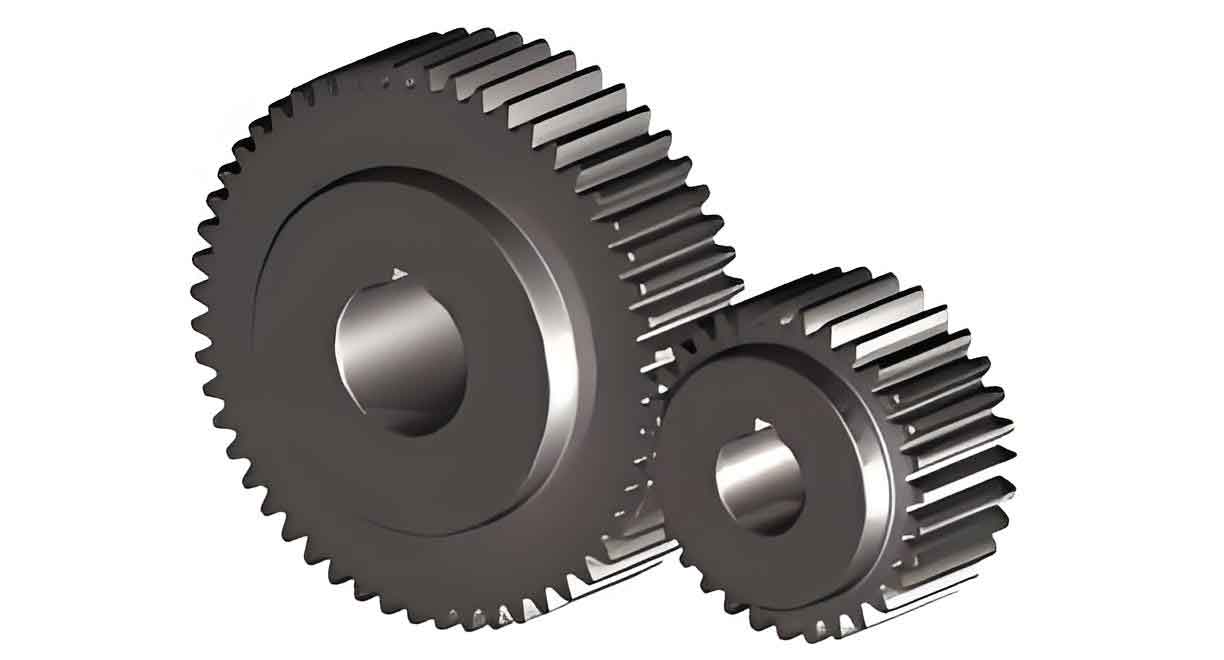
This investigation focuses on the pervasive issue of die elasticity in the closed-die forging of spur gears. The core problem lies in the fact that the final dimensions of the spur gear are not solely defined by the rigid die cavity but are a result of the complex interaction between the plastically deforming billet and the elastically deforming tool steel. To address this, our research explores an innovative billet design strategy based on the radial shunt principle. By introducing a central pressure relief hole in the initial billet, we aim to alter the metal flow and stress distribution during forging, thereby reducing the peak forming load and, consequently, the magnitude of die elastic expansion.
The primary objective of this study is to systematically analyze the influence of the pressure relief hole diameter on the elastic deformation behavior of the forging die for spur gears. We employ a coupled numerical simulation approach, first modeling the plastic deformation of the billet and then transferring the calculated interface pressures to a detailed elastic model of the die to quantify its deformation. Based on the spatial deformation map of the die cavity, a tooth profile compensation method is implemented to counteract the anticipated elastic deflection. Finally, experimental trials are conducted to validate the simulation findings. The goal is to establish a process parameter that minimizes die deformation and enhances the dimensional fidelity of cold-forged spur gears.
Our investigation centers on a standard spur gear with the following specifications, which are critical for defining the die cavity geometry and forming complexity:
| Parameter | Value | Unit |
|---|---|---|
| Module (m) | 3 | mm |
| Number of Teeth (z) | 24 | – |
| Pressure Angle (α) | 20 | ° |
| Face Width (b) | 10 | mm |
| Addendum Circle Diameter | 78 | mm |
| Dedendum Circle Diameter | 64.5 | mm |
To apply the radial shunt principle, the initial billet is designed with an outer diameter equal to the dedendum circle diameter of the target spur gear. A concentric pressure relief hole of variable diameter \(d_0\) is machined into the billet. The billet height \(h_0\) is calculated for each hole diameter based on the constant volume condition of plastic deformation. Five distinct billet designs were analyzed, as summarized below:
| Case | Pressure Relief Hole Diameter, \(d_0\) | Calculated Billet Height, \(h_0\) |
|---|---|---|
| 1 | 0 mm (Solid) | 12.2025 mm |
| 2 | 5 mm | 12.2736 mm |
| 3 | 10 mm | 12.5030 mm |
| 4 | 15 mm | 12.9002 mm |
| 5 | 20 mm | 13.5005 mm |
A two-step finite element analysis (FEA) methodology was implemented using DEFORM-3D software to decouple and accurately analyze the complex interactions. The material properties assigned in the model are essential for realistic simulation:
| Component | Material | Young’s Modulus, \(E\) | Poisson’s Ratio, \(ν\) | Yield Strength, \(σ_y\) |
|---|---|---|---|---|
| Billet | 20CrMnTiH Alloy Steel | 2.07 × 10⁵ MPa | 0.25 | 835 MPa |
| Die (Elastic Analysis) | H13 Tool Steel | 2.10 × 10⁵ MPa | 0.30 | 1750 MPa |
Step 1: Plastic Forging Simulation. The die and punch were modeled as rigid bodies. The billet was meshed with approximately 80,000 tetrahedral elements and defined as a rigid-plastic body. A constant punch velocity of 10 mm/s and a shear friction factor of 0.14 were applied. This step simulated the complete filling of the spur gear die cavity and recorded the final forging load \(P_{max}\) and the spatial distribution of contact pressure \(p(x,y,z)\) on the die surface.
Step 2: Die Stress and Elastic Deformation Analysis. The final deformed geometry and the calculated interface pressure distribution from Step 1 were mapped onto a refined elastic model of the die assembly using an interpolation algorithm with a defined tolerance. The die material was now defined as linear-elastic. The boundary conditions fixed the bottom of the die and the top of the punch in the forging direction. This step solved for the stress field \(σ_{ij}\) and the resulting elastic displacement field \(u_i\) within the die, particularly focusing on the radial displacement of the die cavity surface, which directly dictates the oversize of the forged spur gear. The relationship between the applied pressure and die deformation can be conceptually expressed by the elasticity equations governing the system. For a simplified thick-walled cylinder approximation of the die ring, the radial stress \(\sigma_r\) and tangential stress \(\sigma_\theta\) are functions of the internal pressure \(p_i\) (from the forging load) and the geometry:
$$
\sigma_r(r) = \frac{p_i R_i^2}{R_o^2 – R_i^2} \left(1 – \frac{R_o^2}{r^2}\right), \quad \sigma_\theta(r) = \frac{p_i R_i^2}{R_o^2 – R_i^2} \left(1 + \frac{R_o^2}{r^2}\right)
$$
where \(R_i\) and \(R_o\) are the inner and outer radii of the die ring, and \(r\) is the radial coordinate. The radial displacement \(u_r\) at the inner surface (\(r=R_i\)) is given by:
$$
u_r(R_i) = \frac{R_i}{E} \left[ \sigma_\theta(R_i) – \nu \sigma_r(R_i) \right]
$$
In our complex 3D case for spur gears, the internal pressure \(p_i\) is not uniform but a highly variable function \(p(\theta, z)\) mapped from the forging simulation, leading to a complex, non-axisymmetric displacement field \(u_r(\theta, z)\) that distorts the involute profile.
The forging load-stroke curves for all five billet designs revealed a characteristic three-stage profile, but with significantly different peak loads \(P_{max}\). The results are summarized as follows:
| Pressure Relief Hole Diameter, \(d_0\) | Maximum Forming Load, \(P_{max}\) | Percentage Change vs. Solid Billet |
|---|---|---|
| 0 mm (Solid) | 8589 kN | 0% (Baseline) |
| 5 mm | 8689 kN | +1.16% |
| 10 mm | 8551 kN | -0.44% |
| 15 mm | 8484 kN | -1.22% |
| 20 mm | 8217 kN | -4.33% |
Interestingly, the load initially increased slightly for \(d_0 = 5\) mm before decreasing monotonically for larger diameters. The minimum load occurred at \(d_0 = 20\) mm, representing a 4.33% reduction from the solid billet case. This non-monotonic trend can be attributed to two competing effects: a smaller hole may initially restrict beneficial metal flow into the relief zone, slightly increasing resistance, while a sufficiently large hole effectively creates an internal shunt, reducing the triaxial compressive stress state and lowering the required load. The forming load is a primary driver for die stress, which can be related by the contact area \(A_c\):
$$
P_{max} = \int_{A_c} p(\theta, z) \, dA \approx \bar{p} \cdot A_c
$$
where \(\bar{p}\) is the average interface pressure.
The equivalent (von Mises) stress distribution within the die body showed a consistent pattern across all cases but with varying intensity. The maximum stress was consistently concentrated at the tooth tip regions of the die cavity, confirming this as the critical zone for potential fatigue failure. The value of the maximum die stress \(\sigma_{vM}^{max}\) followed the same trend as the forging load, being highest for the 5 mm hole and lowest for the 20 mm hole.
To quantitatively analyze the elastic deformation of the spur gear die cavity, displacement tracking points were placed along a single tooth profile on three distinct horizontal planes: Upper, Middle, and Lower, spanning the face width. The radial displacement \(δ_r\) of these points from their original position was extracted. The results present a clear picture of the deformation mechanics.
The elastic deformation profiles for all cases and planes shared common features but different magnitudes. The deformation \(δ_r(s)\) along the tooth profile arc length \(s\) (from dedendum to addendum) always showed an increasing trend, with the minimum displacement near the tooth root and the maximum displacement (peak) at the tooth tip. This can be expressed as:
$$
δ_r(s) = f(P_{max}, d_0, z) \quad \text{with} \quad \frac{\partial δ_r}{\partial s} > 0 \quad \text{and} \quad δ_r^{max} = δ_r(s_{tip})
$$
The deformation was not uniform along the gear axis (face width). The Upper plane consistently exhibited the largest deformation, with the steepest gradient from root to tip. The Middle and Lower planes showed similar, more moderate deformation patterns. This axial gradient \(\frac{\partial δ_r}{\partial z}\) is positive from the lower to the upper plane, indicating a “bell-mouthing” or opening of the die cavity towards the top. This is a direct consequence of the higher localized pressures and less constrained material flow at the upper corner of the cavity during the final filling stage.
The magnitude of deformation was directly influenced by \(d_0\). The peak radial displacement \(δ_r^{max}\) at the tooth tip for the Upper plane is critically summarized below:
| \(d_0\) | \(δ_r^{max}\) at Upper Plane (Tooth Tip) | Trend |
|---|---|---|
| 0 mm | 0.591 mm | – |
| 5 mm | 0.640 mm | Maximum |
| 10 mm | 0.587 mm | Decreasing |
| 15 mm | 0.533 mm | Decreasing |
| 20 mm | 0.486 mm | Minimum |
This table confirms that the optimal billet design for minimizing die elastic deformation for these spur gears is the one with \(d_0 = 20\) mm, achieving a peak displacement nearly 0.15 mm less than the worst-case (5 mm hole) and about 0.1 mm less than the solid billet. The relationship between load, hole size, and deformation can be conceptually modeled as:
$$
δ_r^{max} \propto \frac{P_{max}(d_0)}{K_{die}}
$$
where \(K_{die}\) represents the effective structural stiffness of the die, which is constant. Since \(P_{max}(d_0=20)\) is the lowest, it produces the smallest \(δ_r^{max}\).
To proactively compensate for the predicted elastic deformation and improve the accuracy of the spur gears, an inverse compensation method was applied to the die tooth profile. The compensation value \(C(s,z)\) at each point on the original die surface was set equal and opposite to the simulated elastic displacement \(δ_r(s,z)\):
$$
C(s,z) = -δ_r(s,z)
$$
A new, compensated die cavity surface was generated using this offset data. A new forging simulation was run using the optimal \(d_0 = 20\) mm billet and the compensated die. The result was a significant improvement: the elastic spring-forward of the forged spur gear was reduced by 28.6% compared to forging with the uncompensated die. This validates the compensation strategy, showing that controlling die elasticity is paramount for precision in spur gear forging.
Experimental forging trials were conducted on a large-tonnage hydraulic press using billets with \(d_0 = 0, 10,\) and \(20\) mm. The measured peak forming loads followed the simulated decreasing trend with increasing hole diameter. Coordinate measuring machine (CMM) inspection of the forged spur gears confirmed the simulation findings: gears forged from billets with larger pressure relief holes exhibited smaller deviations from the theoretical involute profile. The measured elastic recovery of the gear teeth decreased with increasing \(d_0\), corroborating the finite element analysis and confirming that reducing the forming load via an internal shunt effectively mitigates die elastic deformation.
In conclusion, this study systematically demonstrates that die elastic deformation is a major factor limiting the dimensional accuracy of cold-forged spur gears. The diameter of a centrally located pressure relief hole in the billet is a crucial design parameter that significantly influences the forging load and, consequently, the die’s elastic expansion. For the specific spur gear geometry studied, an optimum hole diameter of \(d_0 = 20\) mm was identified, which minimized both the forming load and the resulting die cavity distortion. The deformation is non-uniform, being most severe at the tooth tips and on the upper face width plane of the die. By quantifying this deformation field through coupled FEA and applying an inverse compensation to the die profile, a substantial improvement (28.6% reduction in gear distortion) in the dimensional accuracy of the final spur gears can be achieved. This integrated approach of optimized billet design and die compensation provides a practical and effective pathway for enhancing the precision of cold-forged spur gears in industrial applications.