
In the pursuit of higher performance in precision motion control systems, the strain wave gear, also known as the harmonic drive, stands out due to its exceptional advantages: high reduction ratios in a compact package, near-zero backlash, high torque capacity, and coaxial input/output shafts. Its operation hinges on the controlled elastic deformation of a flexible spline, or “Flexspline,” by a wave generator, which meshes with a rigid circular spline to achieve speed reduction. While traditional involute tooth profiles have been widely used, the double-circular-arc (DCA) profile offers a significant advancement by enabling double-conjugate meshing, thereby improving load distribution, transmission accuracy, and stability under load. This article details a comprehensive methodology for the modeling, optimization, and analysis of strain wave gears employing this superior DCA tooth profile.
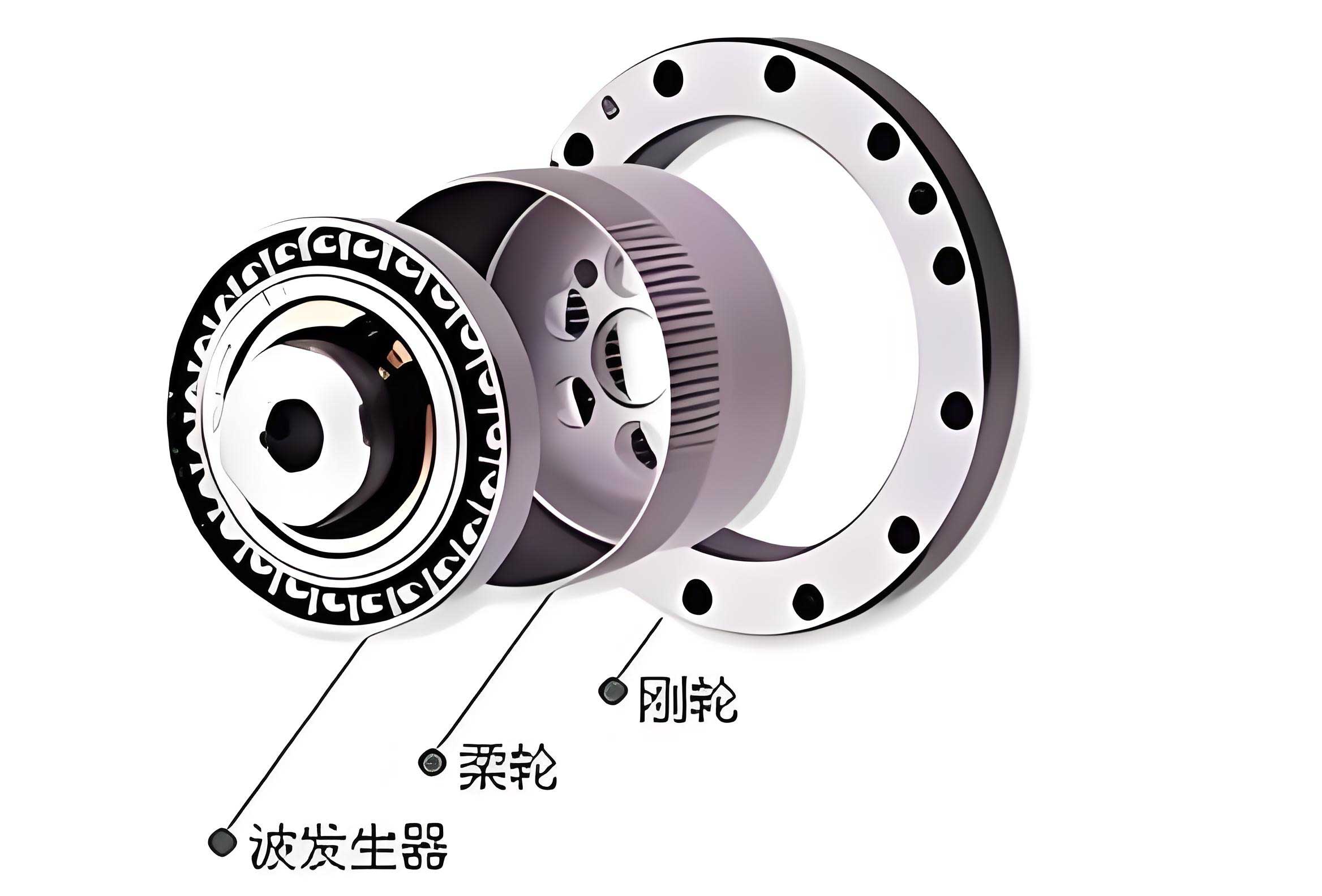
1. Mathematical Modeling of the DCA Strain Wave Gear
The core of designing a high-performance strain wave gear lies in accurately describing the geometry of its teeth and their kinematic interaction during the wave generator’s motion. The process begins with defining the Flexspline’s tooth profile in its undeformed state.
1.1 Geometry of the Flexspline’s Double-Circular-Arc Profile
The DCA profile for the Flexspline consists of three segments: a convex circular arc near the tooth tip, a concave circular arc near the tooth root, and a straight line connecting them tangentially. A local coordinate system \( S_1(O_1, X_1, Y_1) \) is attached to the Flexspline tooth, with the \( Y_1 \)-axis aligned with the tooth’s symmetry axis. Key geometric parameters are defined as follows:
- \( m \): Module
- \( z_1 \): Number of teeth on the Flexspline
- \( r_m \): Radius of the neutral curve (middle line) of the undeformed Flexspline ring
- \( h_a^* \): Addendum coefficient (\( h_a = h_a^* m \))
- \( c^* \): Bottom clearance coefficient
- \( \rho_a^*, \rho_f^* \): Radii coefficients for the convex and concave arcs (\( \rho_a = \rho_a^* m, \ \rho_f = \rho_f^* m \))
- \( l_a, e_a \): Offsets of the convex arc center \( M \) in the \( X_1 \) and \( Y_1 \) directions.
- \( l_f, e_f \): Offsets of the concave arc center \( N \) in the \( X_1 \) and \( Y_1 \) directions.
- \( \delta \): Profile angle (or transition angle).
- \( t \): Thickness of the Flexspline ring wall.
The coordinates of the arc centers and the corresponding central angles can be derived from basic gear geometry and the chosen coefficients. Let \( s \) be the arc-length parameter. The parametric equations for each segment in \( S_1 \) are:
Convex Arc Segment \( \overset{\frown}{AB} \):
$$ \mathbf{r}_{AB}(s) = \begin{bmatrix} \rho_a \cos\left( \alpha_a – \frac{s}{\rho_a} \right) + x_M \\ \rho_a \sin\left( \alpha_a – \frac{s}{\rho_a} \right) + y_M \\ 1 \end{bmatrix}, \quad \mathbf{n}_{AB}(s) = \begin{bmatrix} \cos\left( \alpha_a – \frac{s}{\rho_a} \right) \\ \sin\left( \alpha_a – \frac{s}{\rho_a} \right) \\ 1 \end{bmatrix} $$
for \( s \in [0, l_1] \), where \( l_1 = \rho_a (\alpha_a – \delta) \).
Straight Line Segment \( BC \):
$$ \mathbf{r}_{BC}(s) = \begin{bmatrix} \rho_a \cos \delta + x_M + (s – l_1)\sin \delta \\ \rho_a \sin \delta + y_M – (s – l_1)\cos \delta \\ 1 \end{bmatrix}, \quad \mathbf{n}_{BC} = \begin{bmatrix} -\cos \delta \\ -\sin \delta \\ 1 \end{bmatrix} $$
for \( s \in [l_1, l_2] \), where \( l_2 = l_1 + h_t / \cos \delta \) and \( h_t \) is the radial height of the straight segment.
Concave Arc Segment \( \overset{\frown}{CD} \):
$$ \mathbf{r}_{CD}(s) = \begin{bmatrix} x_N – \rho_f \cos\left( \delta + \frac{s – l_2}{\rho_f} \right) \\ y_N – \rho_f \sin\left( \delta + \frac{s – l_2}{\rho_f} \right) \\ 1 \end{bmatrix}, \quad \mathbf{n}_{CD}(s) = \begin{bmatrix} -\cos\left( \delta + \frac{s – l_2}{\rho_f} \right) \\ -\sin\left( \delta + \frac{s – l_2}{\rho_f} \right) \\ 1 \end{bmatrix} $$
for \( s \in [l_2, l_3] \), where \( l_3 = l_2 + \rho_f \alpha_f \). Here, \( \mathbf{n} \) represents the unit normal vector to the profile, crucial for subsequent meshing analysis.
1.2 Precise Calculation of Flexspline Rotation Considering Neutral Curve Elongation
A critical step in strain wave gear analysis is determining the exact angular position of each Flexspline tooth as it deforms. The wave generator, typically an elliptical cam, imposes a radial displacement on the Flexspline’s neutral curve. A common assumption for this deformation is:
$$ r(\varphi_1) = r_m + u_0 \cos(2\varphi_1) $$
where \( u_0 \) is the maximum radial deformation and \( \varphi_1 \) is the angular position relative to the wave generator’s major axis.
However, under deformation, the neutral curve elongates slightly. This elongation must be accounted for to accurately calculate the kinematic relationship between the wave generator’s rotation and the Flexspline’s apparent rotation. The total elongation over one quadrant is distributed among the teeth in that quadrant. The elongation per tooth is approximated by:
$$ l_w = \frac{ \int_{0}^{\pi/2} \sqrt{ r(\varphi_1)^2 + \left( \frac{dr(\varphi_1)}{d\varphi_1} \right)^2 } \, d\varphi_1 – \frac{r_m \pi}{2} }{ \frac{z_1}{4} + 1 } $$
The angular relationships between key coordinate systems—the wave generator frame \( S_0 \), the Flexspline tooth frame \( S_1 \), and the fixed Circular Spline frame \( S_2 \)—are derived considering this deformation. The rotation angle \( \beta \) of the Flexspline tooth coordinate system relative to the Circular Spline frame is a function of \( \varphi_1 \):
$$ \mu(\varphi_1) = \arctan\left( \frac{\dot{r}(\varphi_1)}{r(\varphi_1)} \right) = \arctan\left( \frac{-2u_0 \sin(2\varphi_1)}{r_m + u_0 \cos(2\varphi_1)} \right) $$
$$ \gamma(\varphi_1) = \varphi_1 – \varphi_2 $$
$$ \beta(\varphi_1) = \gamma(\varphi_1) + \mu(\varphi_1) $$
where \( \varphi_2 \) is the rotation angle of the wave generator, \( \mu \) is the tangent rotation angle due to deformation, and \( \gamma \) is the kinematic rotation.
1.3 Derivation of the Circular Spline Tooth Profile
The Circular Spline profile is the envelope of the family of Flexspline tooth profiles generated during its motion relative to the Circular Spline. Using the theory of gearing, the meshing condition states that the relative velocity at the contact point must be perpendicular to the common normal. This leads to the meshing equation:
$$ \mathbf{n}_i^T \cdot \mathbf{B} \cdot \mathbf{r}_i = 0 \quad (i = AB, BC, CD) $$
where \( \mathbf{B} \) is a matrix relating the relative velocity. For each discrete point on the Flexspline profile (parameter \( s \)), solving this equation yields the corresponding conjugate angle \( \varphi_1^* \) at which contact occurs. Notably, for the DCA profile, two valid solutions \( \varphi_1^* \) typically exist for a given \( s \), indicating the potential for double-conjugate contact.
The theoretical Circular Spline profile coordinates \( \mathbf{r}_i’ \) in its own frame \( S_2 \) are then obtained via coordinate transformation:
$$ \mathbf{r}_i'(s, \varphi_1^*) = \mathbf{M}_{21}(\beta(\varphi_1^*)) \cdot \mathbf{r}_i(s) $$
where the transformation matrix is:
$$ \mathbf{M}_{21} = \begin{bmatrix} \cos \beta & \sin \beta & r(\varphi_1^*) \sin \gamma(\varphi_1^*) \\ -\sin \beta & \cos \beta & r(\varphi_1^*) \cos \gamma(\varphi_1^*) \\ 0 & 0 & 1 \end{bmatrix} $$
By calculating \( \mathbf{r}_i’ \) for all \( s \) and their corresponding \( \varphi_1^* \), the complete theoretical tooth profile of the Circular Spline is generated.
2. Multi-Objective Optimization of Tooth Profile Parameters
The performance of a strain wave gear, especially its smoothness, load capacity, and positional accuracy, is highly sensitive to the geometric parameters of the tooth profile. An optimization framework is essential to find the best compromise between competing objectives.
2.1 Definition of Optimization Objectives and Variables
Two primary objectives are targeted to enhance the performance of the strain wave gear:
1. Minimization of Gear Backlash: Backlash is the clearance between mating tooth flanks. For precise positioning, minimal backlash is desired. The normal backlash \( j_n \) is calculated by finding the shortest distance from a point on the Flexspline profile to the Circular Spline profile along the common normal direction at various conjugate positions \( \varphi_1 \). The minimum value across all teeth and all rotation angles is taken as the objective \( j_{\min} \).
2. Maximization of Effective Meshing Tooth Height: This is the radial depth over which teeth are in contact under load. A larger effective meshing height \( h_e \) improves load distribution and reduces stress. It is defined as:
$$ h_e = r_{a,g} – r_{a,f} + u_0 $$
where \( r_{a,g} \) is the Circular Spline addendum radius and \( r_{a,f} \) is the Flexspline addendum radius.
Since these objectives conflict (reducing backlash often requires tighter tolerances that may reduce the engagement depth), a weighted sum approach is used to form a single objective function:
$$ \min F(\mathbf{X}) = w_1 \cdot \frac{j_{\min}(\mathbf{X})}{j_{\text{ref}}} + w_2 \cdot \left(1 – \frac{h_e(\mathbf{X})}{h_{\text{ref}}}\right) $$
where \( \mathbf{X} \) is the vector of design variables, and \( w_1, w_2 \) are weighting factors summing to 1. \( j_{\text{ref}} \) and \( h_{\text{ref}} \) are normalization constants.
The design variables selected for optimization, normalized by the module \( m \), are:
| Symbol | Description |
|---|---|
| \( h_a^* \) | Addendum coefficient |
| \( w^* \) | Radial deformation coefficient (\( u_0 = w^* m \)) |
| \( \rho_a^* \) | Convex arc radius coefficient |
| \( \rho_f^* \) | Concave arc radius coefficient |
| \( h_t^* \) | Straight segment radial height coefficient |
| \( \delta \) | Profile angle (in degrees) |
2.2 Optimization Process and Results
The optimization is performed for a specific strain wave gear configuration: module \( m = 0.35 \) mm, Flexspline teeth \( z_1 = 160 \), Circular Spline teeth \( z_2 = 162 \). The optimization algorithm (e.g., a genetic algorithm or gradient-based method) searches the design space defined by bounds on each variable to minimize \( F(\mathbf{X}) \).
The table below compares the key profile parameters before and after optimization:
| Parameter | Initial Design | Optimized Design |
|---|---|---|
| \( h_a^* \) | 0.6500 | 0.6190 |
| \( w^* \) | 1.0000 | 0.9987 |
| \( \rho_a^* \) | 1.4000 | 1.4562 |
| \( \rho_f^* \) | 1.8000 | 1.7860 |
| \( h_t^* \) | 0.1400 | 0.1404 |
| \( \delta \) (deg) | 11.000 | 10.999 |
The performance outcomes are significant:
| Performance Metric | Initial Design | Optimized Design | Improvement |
|---|---|---|---|
| Minimum Backlash \( j_{\min} \) | 3.5 µm | 2.4 µm | ~30% reduction |
| Effective Meshing Height \( h_e \) | 0.455 mm | 0.433 mm | Minor decrease (~5%) |
The optimization successfully prioritized backlash reduction, achieving a 30% decrease, while the effective meshing height saw only a slight trade-off. This leads to a strain wave gear with significantly improved positioning accuracy and potential for smoother operation.
3. Meshing Simulation and Performance Analysis
To validate the optimization results and understand the meshing behavior of the DCA strain wave gear, a kinematic simulation of the tooth engagement process is conducted.
3.1 Conjugate Zone Analysis
The plot of conjugate angle \( \varphi_1 \) versus the arc-length parameter \( s \) reveals the “conjugate zone.” For a standard involute strain wave gear, there is typically one continuous zone. The defining feature of the double-circular-arc profile is the presence of two distinct conjugate zones for a significant portion of the tooth profile. This means that for a given rotation angle of the wave generator \( \varphi_2 \), a single tooth on the Flexspline can be in contact with the Circular Spline at two different points along its flank. Conversely, a single point on the Circular Spline can be contacted by two different Flexspline teeth. This “double-conjugate” meshing is the key to the enhanced load-sharing capability and stiffness of the DCA strain wave gear compared to its involute counterpart. Simulation confirms that the conjugate zone characteristics are largely preserved after optimization, ensuring the retention of this fundamental advantage.
3.2 Flexspline Tooth Motion Trajectory
Simulating the full rotation of the wave generator reveals the trajectory of a Flexspline tooth relative to the stationary Circular Spline. The trajectory forms a smooth, closed loop. The visualization clearly shows the tooth engaging from one side (the “mesh-in” zone), moving through the fully engaged position, and then disengaging on the opposite side (the “mesh-out” zone). Crucially, the Flexspline tooth profile remains entirely inside the Circular Spline tooth space throughout the cycle without any intersection, confirming the absence of geometric interference in the unloaded state. This clean kinematic motion is essential for the smooth operation of the strain wave gear.
3.3 Backlash Distribution Analysis
By calculating the instantaneous backlash at numerous angular positions of the wave generator, the dynamic backlash distribution can be mapped. The plot of backlash versus wave generator angle \( \varphi_2 \) shows that:
- Backlash is always positive, confirming a non-interfering assembly.
- The backlash value varies cyclically with the rotation.
- The optimized profile demonstrates a consistently lower backlash across almost the entire rotation cycle compared to the initial design. The peak backlash values are notably reduced.
This uniform reduction in clearance minimizes the “dead zone” during direction reversal and contributes directly to higher torsional stiffness and positional accuracy of the strain wave gear assembly. When combined with the double-conjugate contact, it ensures that multiple tooth pairs are engaged with minimal clearance, dramatically improving the load capacity and smoothness of motion transmission.
4. Conclusion
This article has presented a systematic methodology for the optimal design of strain wave gears featuring the double-circular-arc tooth profile. The process encompasses the precise mathematical modeling of the deformed Flexspline, the derivation of the conjugate Circular Spline profile via the envelope method, and the establishment of a multi-objective optimization framework targeting minimized backlash and maximized effective contact height.
The key findings are:
- The double-circular-arc profile inherently produces double-conjugate meshing in a strain wave gear, a phenomenon that fundamentally enhances its load distribution and transmission stability compared to single-conjugate profiles like the involute.
- The proposed optimization method, which accounts for the precise kinematics of the Flexspline including neutral curve elongation, is effective. In the presented case study, it achieved a 30% reduction in gear backlash with only a minor adjustment to the contact depth.
- Meshing simulation validates that the optimized DCA strain wave gear operates without interference and maintains the beneficial double-conjugate zones. The improved backlash distribution directly translates to higher potential positional accuracy and smoother operation.
The implementation of this optimization methodology allows designers to fully exploit the advantages of the double-circular-arc tooth profile, pushing the performance boundaries of strain wave gears in demanding applications such as robotics, aerospace actuation, and precision instrumentation. Future work may integrate stress and fatigue analysis into the optimization loop to concurrently maximize gear life and power density.