
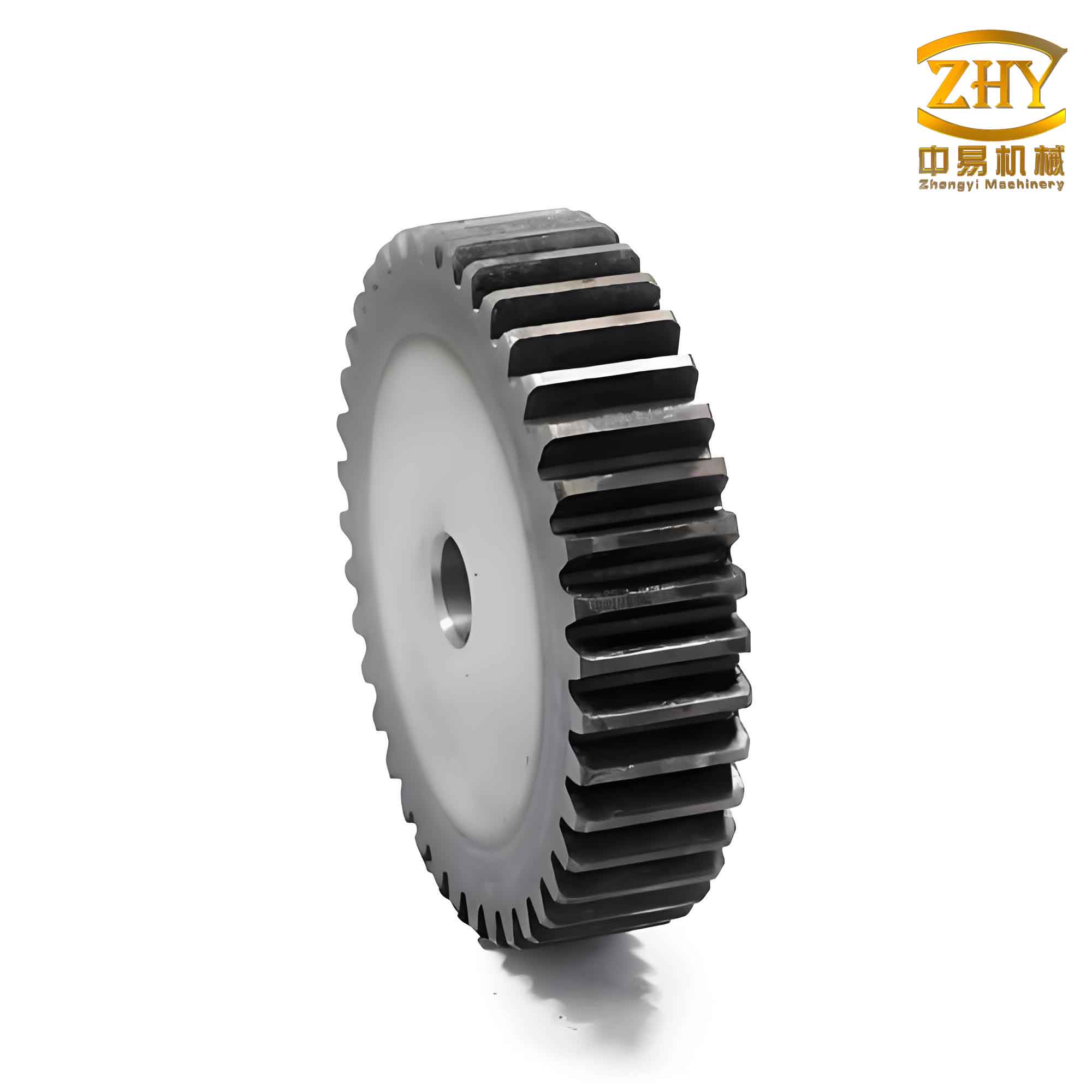
In the field of mechanical engineering, the accurate calculation of bending strength in spur and pinion gear systems is paramount for ensuring reliability and safety in transmission applications. The fundamental approach to analytical computation of gear bending strength involves simplifying the gear tooth as a cantilever beam and introducing form factor and stress correction factor to account for stress concentration at the fillet region. The stress correction factor, in particular, is critical for eliminating errors arising from stress concentration effects during load-bearing conditions. Traditionally, this factor is derived by comparing experimentally obtained bending stresses with analytically computed basic bending stresses. However, the precision of gear bending stress experiments directly influences the accuracy of the stress correction factor, thereby affecting the overall reliability of gear design. Common experimental methods include finite element analysis (FEA) numerical simulations, photoelastic experiments, and strain gauge measurements. While FEA is widely used by international standards organizations for determining stress correction factors, and photoelastic methods have been employed by associations like the American Gear Manufacturers Association, these approaches have limitations, especially for gears with module sizes below 6 mm. For such small-module spur and pinion gear, the non-meshing space at the tooth root restricts the use of strain gauges, making it challenging to measure bending stresses at the critical 30° tangent section under actual operating conditions. This gap in experimental data underscores the need for innovative measurement techniques.
Fiber Bragg Grating (FBG) sensors, with their small cross-sectional diameter, offer a promising solution for measuring bending stresses in spur and pinion gear with modules less than 6 mm. By粘贴 FBG sensors along the tooth width direction at the fillet region, it is possible to achieve more precise strain measurements. This paper presents a comprehensive study on optimizing the stress correction factor for spur and pinion gear based on FBG strain measurements. We begin by reviewing the theoretical foundations, including elastic plane assumptions, and propose a hypothesis that the stress in the tooth width direction at a point on the gear root surface relates to its distance from the end-face, following an exponential function distribution. Subsequently, we detail the experimental setup using FBG sensors to measure bending stresses in spur and pinion gear. Finally, we optimize the stress correction factor in analytical calculations based on the measurement results. Our findings indicate that the conventional analytical stress correction factor is overestimated by approximately 21.8% compared to the FBG-derived values, highlighting the potential for improved reliability in spur and pinion gear strength design through this optimization.
The core principle behind FBG strain measurement lies in the relationship between axial deformation and wavelength shift. Under constant temperature and pressure, the wavelength change of an FBG is given by:
$$ \Delta \lambda_B = k_\varepsilon \varepsilon $$
where \( \Delta \lambda_B \) is the wavelength shift, \( k_\varepsilon \) is the strain sensitivity coefficient of the FBG, and \( \varepsilon \) is the axial strain along the FBG direction. According to elastic theory, the strain in a given direction can be expressed through the physical equation:
$$ \varepsilon_x = \frac{1}{E} [\sigma_x – \mu (\sigma_y + \sigma_z)] $$
Here, \( \varepsilon_x \) is the normal strain along the FBG axial direction, \( E \) is the elastic modulus of the material, \( \mu \) is Poisson’s ratio, and \( \sigma_x \), \( \sigma_y \), and \( \sigma_z \) are the normal stresses in three mutually perpendicular directions. Combining these equations yields:
$$ \Delta \lambda_B = k_\varepsilon \frac{1}{E} [\sigma_x – \mu (\sigma_y + \sigma_z)] $$
This equation shows that measuring stress in one direction using FBG requires understanding the relationships between the three orthogonal stresses at a point. For spur and pinion gear, due to geometric constraints in the non-meshing region, FBG sensors are typically arranged along the tooth width direction, allowing measurement of strain in that direction (\( \varepsilon_y \)). To relate this to bending stress (\( \sigma_x \)), we hypothesize based on elastic plane problems that the ratio of stress in the tooth width direction to bending stress, \( \sigma_y / \sigma_x \), follows an exponential distribution along the tooth width. Specifically:
$$ \frac{\sigma_y}{\sigma_x} = \mu (1 – a^w) $$
where \( w \) is the tooth width (with \( w > 0 \)), and \( a \) is a constant related to the material’s elastic modulus (\( 0 < a < 1 \)). For a gear with fixed width, this ratio varies from the end-face to the center, approaching the material’s Poisson ratio \( \mu \) as the distance increases. Using FEA simulations for a spur and pinion gear with a 50 mm width, we validated this exponential trend, as summarized in Table 1.
| Tooth Width (mm) | \( \sigma_y / \sigma_x \) |
|---|---|
| 5 | 0.05 |
| 10 | 0.10 |
| 15 | 0.15 |
| 20 | 0.20 |
| 25 | 0.25 |
| 30 | 0.28 |
| 35 | 0.29 |
| 40 | 0.30 |
| 45 | 0.30 |
| 50 | 0.30 |
From the physical equation for strain in the y-direction:
$$ \varepsilon_y = \frac{1}{E} [\sigma_y – \mu (\sigma_x + \sigma_z)] $$
Assuming \( \sigma_z = 0 \) during bending and substituting the exponential relation, we derive:
$$ \sigma_x = -\frac{E}{a^w} \varepsilon_y $$
Thus, by measuring \( \varepsilon_y \) with FBG sensors, the bending stress \( \sigma_x \) can be computed. This forms the theoretical basis for our FBG-based measurement in spur and pinion gear.
For experimental validation, we selected a standard involute spur and pinion gear with parameters listed in Table 2. The gear was designed without load distribution irregularities, impact loads, or dynamic effects to isolate bending stress behavior.
| Parameter | Value |
|---|---|
| Module (m) [mm] | 4 |
| Pressure Angle [°] | 20 |
| Number of Teeth | 31 |
| Tooth Width (b) [mm] | 30 |
| Cutter Tip Radius (rf) [mm] | 0.38m (1.52 mm) |
| Elastic Modulus (E) [MPa] | 2 × 10⁵ |
| Poisson’s Ratio (μ) | 0.3 |
The analytical bending stress was calculated according to national standards (e.g., GB/T 3480-1997), using the form factor \( Y_F = 1.3981 \) and stress correction factor \( Y_S = 1.9387 \). The basic bending stress formula is:
$$ \sigma_{F0} = \frac{f_t}{b m} Y_F Y_S $$
where \( f_t \) is the equivalent tangential force. Loads were applied from 100 N·m to 600 N·m in increments of 100 N·m, and the computed stresses are shown in Table 3. For FBG measurement, sensors were粘贴 along the tooth width direction at the 30° tangent position of the fillet, with the sensitive point centered 10 mm from the end-face—a location determined optimal based on stress distribution analysis. Three gear teeth were instrumented to average results. The wavelength shifts were converted to strain changes, and bending stresses were derived using the exponential relation. Table 3 compares the FBG-measured stresses with analytical values.
| Load Torque (N·m) | FBG Measured Bending Stress (MPa) | Analytical Bending Stress (MPa) | Stress Correction Factor from FBG (Y_S, exp) |
|---|---|---|---|
| 100 | 30.291 | 36.43 | 1.612 |
| 200 | 60.582 | 72.86 | 1.612 |
| 300 | 90.873 | 109.29 | 1.612 |
| 400 | 116.115 | 145.72 | 1.545 |
| 500 | 146.406 | 182.15 | 1.558 |
| 600 | 181.746 | 218.58 | 1.612 |
The linear relationship between measured bending stress and applied torque, as depicted in the data, confirms the validity of FBG measurements for spur and pinion gear. The average experimental stress correction factor derived from FBG data is \( Y_{S,exp} = 1.592 \), calculated by comparing measured stresses with the basic bending stress \( \frac{f_t}{b m} Y_F \).
To optimize the stress correction factor, we investigated the influence of cutter tip radius on gear bending capacity. Using analytical formulas, we computed bending stresses for cutter radii ranging from 0.25m to 0.38m. The results, summarized in Table 4, show that increasing the cutter radius reduces analytical bending stresses, primarily due to changes in the stress correction factor \( Y_S \).
| Cutter Tip Radius (rf) [mm] | Form Factor (Y_F) | Stress Correction Factor (Y_S) | Analytical Bending Stress at 600 N·m (MPa) |
|---|---|---|---|
| 1.00 (0.25m) | 1.35 | 2.20 | 230.5 |
| 1.20 (0.30m) | 1.37 | 2.05 | 225.0 |
| 1.52 (0.38m) | 1.3981 | 1.9387 | 218.58 |
We performed FEA simulations for three cutter radii (0.25m, 0.30m, 0.38m) to obtain stress correction factors based on numerical results. The comparison between FEA-derived and analytical \( Y_S \) values revealed a linear proportionality, as expressed by:
$$ Y_{S,FEA} = k \cdot Y_{S,analytic} $$
where \( k \) is a constant. For the spur and pinion gear with \( rf = 0.38m \), we computed the optimization constant as:
$$ k = \frac{Y_{S,exp}}{Y_{S,analytic}} = \frac{1.592}{1.9387} = 0.821 $$
Thus, the optimized stress correction factor formula becomes:
$$ Y_S = 0.821 \cdot (1.2 + 0.13L) q_S^{\frac{1}{1.21 + 2.3/L}} $$
where \( L \) is the ratio of tooth thickness at the critical section to the bending moment arm, and \( q_S \) is the fillet parameter. This optimized factor reduces the overestimation in traditional calculations, enhancing accuracy for spur and pinion gear design.
The exponential stress distribution hypothesis was further validated through detailed FEA studies on spur and pinion gear with varying widths. We modeled gears from 10 mm to 50 mm width and extracted \( \sigma_y / \sigma_x \) ratios at points from the end-face to the center. The data fit an exponential curve with high correlation, confirming our theoretical assumption. This distribution is critical for FBG sensor placement—within 5–15 mm from the end-face, where measurable strain exists without stress relief effects. For practical applications in spur and pinion gear, this guides optimal FBG positioning.
Discussion of results highlights that traditional analytical methods for spur and pinion gear tend to overestimate bending stresses due to conservative stress correction factors. Our FBG-based approach provides a more accurate measurement, especially for small-module gears. The optimization constant of 0.821 suggests that existing standards may be overly cautious, potentially leading to over-designed spur and pinion gear systems. Future work could extend this methodology to helical and bevel gears, or to dynamic loading conditions. Additionally, FBG sensors enable real-time health monitoring of spur and pinion gear in operational environments, paving the way for predictive maintenance strategies.
In conclusion, this study demonstrates the efficacy of FBG strain measurement for optimizing the stress correction factor in spur and pinion gear. Key findings include: (1) The stress ratio \( \sigma_y / \sigma_x \) follows an exponential distribution along the tooth width, with FBG sensors best placed 5–15 mm from the end-face; (2) FBG measurements yield a stress correction factor of 1.592 for the tested spur and pinion gear, 21.8% lower than the analytical value of 1.9387; (3) The optimized stress correction factor, scaled by a constant of 0.821, improves the accuracy of bending strength calculations. These advancements contribute to more reliable and efficient design of spur and pinion gear, crucial for modern transmission systems. Further research should explore broader gear geometries and loading scenarios to generalize the optimization framework.