
In my research on gear transmission systems, I have focused on the critical role of helical gears in various mechanical applications. Helical gears are widely used due to their smooth operation and high load-carrying capacity. However, under operational conditions, helical gears experience deformations that can lead to noise, vibration, and even failure. Therefore, optimizing the tooth flank modification curves for helical gears is essential to enhance performance and longevity. In this article, I will explore the methodologies for optimizing these curves, incorporating formulas and tables to summarize key findings.
Helical gears, despite being made of high-strength metal, undergo elastic deformation when subjected to loads. This deformation primarily includes bending, torsion, and shear of the teeth. Additionally, at high speeds, centrifugal forces contribute to further deformation. Poor working conditions can exacerbate these issues, leading to tooth breakage. Thus, tooth flank modification for helical gears is crucial to mitigate these effects. My investigation centers on optimizing the modification curves to ensure uniform load distribution and reduce stress concentrations.
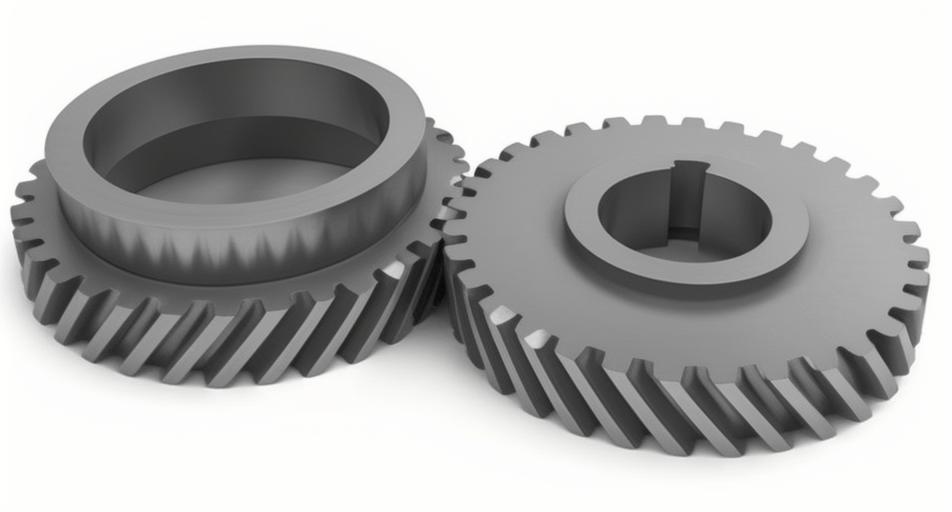
The deformation of helical gear teeth is influenced by both mechanical and thermal factors. During high-speed operation, heat generation causes thermal expansion, adding to the mechanical deformation. This combined deformation leads to uneven load distribution across the tooth face, resulting in localized pitting, scuffing, or even tooth fracture. To control the impact during meshing and minimize vibration and noise, tooth flank modification for helical gears is necessary. The optimization of modification curves is key to achieving these goals, as it directly affects the gear’s operational stability and safety.
Mechanism of Tooth Deformation in Helical Gears
Tooth deformation in helical gears refers to the distortion of the tooth surface, often manifesting as twist along the tooth width. For wide-face-width helical gears, this can cause surface wear or twisting, while narrow helical gears may experience tooth breakage. The root cause lies in the non-uniform material removal during manufacturing processes. In批量精密加工 of small and medium module helical gears, the worm wheel grinding technique is commonly used. This process mimics the meshing of crossed helical gears, where point contact occurs between the worm wheel and the gear tooth. The contact point moves along the tooth surface, forming a contact path. When tooth flank modification is applied, the modification curve is superimposed on the helix line at the pitch circle, leading to height variations at different cross-sections, which is essential for modification.
The contact path intersects the gear端面 at an angle, and the height difference between contact points at the tooth tip and root contributes to the formation of the tooth profile. Due to computational and误差 factors, the modification amount may decrease from tip to root on the upper端面 while increasing on the lower端面, causing opposite trends that result in tooth twist. This highlights the complexity of deformation in helical gears and the need for precise modification.
Determining Tooth Flank Modification Methods
Tooth flank modification for helical gears typically targets the pinion and includes两种主要 methods: tip relief and crowning. Tip relief reduces冲击载荷 during meshing, but it only affects local areas near the tooth ends. For wide helical gears, this can lead to severe load concentration, which tip relief cannot address. Crowning, on the other hand, applies across the full tooth width, compensating for manufacturing errors and elastic deformation under load. Therefore, the choice of modification method depends on gear尺寸 and application, with cost-effectiveness being a key consideration.
For helical gears, using only central crowning may not be sufficient due to the varying length of the line of contact during meshing. This necessitates more sophisticated modification approaches. Additionally, loaded transmission error (LTE) must be considered. LTE is a source of vibration and noise in helical gears, and reducing its amplitude (ALTE) can significantly dampen these effects. LTE arises from the superposition of no-load transmission error (TE) and tooth deformation under load. For helical gears with a contact ratio between 2 and 3, the meshing process cycles through three-tooth, two-tooth engagements, causing起伏性 in LTE. Since standard involute helical gears have zero TE, the deformation in three-tooth zones is less than in two-tooth zones, leading to LTE fluctuations. Thus, the contact ratio should be factored into optimization.
In summary, designing tooth flank modification for helical gears requires comprehensive analysis of factors like manufacturing errors, tooth deformation, and shaft deflection. Multiple scenarios must be evaluated to determine the optimal modification curve.
Optimization Methods for Tooth Flank Modification Curves
Given that crowning is commonly used for helical gears, my optimization focuses on this method. The goal is to refine the crowning curve to minimize tooth surface twist and ensure even load distribution.
Calculation of Tooth Surface Twist Amount
To optimize the modification curve, I first calculate the tooth surface twist amount. Currently, there is no unified formula for this. Since twist manifests as tooth profile errors that vary with the modification curve, the maximum error绝对值 occurs at the upper and lower端面s, with one positive and one negative value. Thus, the twist amount can be assessed by the difference in profile errors between these端面s. I model the profile error at each cross-section of the crowning curve, as shown in the conceptual diagram below.
Let \( L_a \) and \( L_b \) represent the modification curves at the tooth tip and root, respectively, and \( L \) the curve at the pitch circle. The profile error \( E \) at any cross-section is given by:
$$ E = y_1 – y_2 = \left[ \frac{8g}{l_1 + l_2} \times \left( \frac{l_1 l_2}{2} – \frac{z^2}{2} \right) \right] – S_v $$
where \( g \) is the maximum modification amount, \( l_1 \) and \( l_2 \) are parameters related to tooth geometry, \( z \) is the coordinate along the tooth width, and \( S_v \) is a correction factor. The tooth surface twist amount \( T \) is then:
$$ T = E\left(\frac{b}{2}\right) – E\left(-\frac{b}{2}\right) = \frac{8g(l_1 + l_2)}{b^2} $$
Here, \( b \) is the tooth width. This formula shows that \( T \) is proportional to \( g \), indicating that controlling \( g \) is crucial for minimizing twist.
Optimization of Crowning Curve
From the twist calculation, I infer that crowning does not need to span the entire tooth width; focusing on the central region can achieve uniform load distribution. Therefore, I optimize the modification curve by using a组合 of quadratic curves分段, as illustrated in the following sketch.
I divide the optimized curve into three segments based on tooth width ranges. By adjusting key parameters, I can control the twist within acceptable limits. The optimized curve reduces twist while maintaining effective load distribution. To quantify this, I define the curves mathematically. Let the tooth width be divided into intervals: \([-b/2, -b/4]\), \([-b/4, b/4]\), and \([b/4, b/2]\). The modification amount \( \delta(z) \) as a function of position \( z \) along the tooth width is given by:
For \( z \in [-b/2, -b/4] \): $$ \delta(z) = C_1 (z + b/2)^2 $$
For \( z \in [-b/4, b/4] \): $$ \delta(z) = C_2 z^2 + D $$
For \( z \in [b/4, b/2] \): $$ \delta(z) = C_3 (z – b/2)^2 $$
where \( C_1, C_2, C_3, \) and \( D \) are constants determined through optimization to minimize twist and stress. This分段 approach allows fine-tuning of the modification profile.
Calculation Results and Case Analysis
To validate the optimization, I perform calculations and finite element analysis (FEA) with specific data. I use parametric modeling to create a helical gear model. The parameters are as follows: tooth width \( b = 2.0 \, \text{mm} \), helix angle \( \beta = 18^\circ \), normal pressure angle \( \alpha_n = 20^\circ \), normal tip clearance coefficient \( c_n^* = 0.25 \), number of teeth \( Z = 29 \), and normal module \( m_n = 2.25 \, \text{mm} \). Using the twist formula, I compute the twist amount before and after optimization.
Before optimization:
$$ T_{\text{before}} = \frac{8g(l_1 + l_2)}{b^2} = 0.012 \, \text{mm} $$
After optimization:
$$ T_{\text{after}} = \frac{8g_{\text{opt}}(l_1 + l_2)}{b^2} = 0.0034 \, \text{mm} $$
This shows a 72% reduction in twist amount, demonstrating significant improvement. I summarize these results in Table 1.
| Parameter | Before Optimization | After Optimization | Reduction |
|---|---|---|---|
| Twist Amount (mm) | 0.012 | 0.0034 | 72% |
| Max Modification \( g \) (mm) | 0.02 | 0.0057 | 71.5% |
Next, I build a 3D model of the helical gear. Starting from default基准 coordinates, I sketch the tip circle, root circle, pitch circle, and base circle curves. Using equations, I generate two key curves: the involute and its parametric version, ensuring a specific angle between them. Then, I sketch the端面 tooth profile curve and scanning trajectory, creating a closed profile by connecting the tip arc, root fillet arc, and involutes. I create origin and helical trajectory lines, and via sweep blending, generate one tooth. Other teeth are formed using feature patterning, followed by keyway cutting and chamfering to complete the helical gear model.
For modification, I copy the profile curve multiple times based on the modification curve. I translate and rotate these copies to cover the tooth width, with total translation equal to \( b \) and total rotation equal to \( \beta \). The per-copy amounts are derived by dividing totals by the number of copies. Using these, I sketch new profile curves according to the modification amounts from the optimized curve. Through sweep blending, I produce the modified helical gear.
To analyze contact stress and load distribution, I conduct FEA. I apply constraints to the gear pair, establish contact pairs for meshing tooth surfaces, and mesh the parallel-axis helical gear实体副. Assuming quasi-static conditions at any meshing moment, I compute stresses. The results are as follows:
- Standard helical gear: Max equivalent stress = 386 MPa, Max contact stress = 499 MPa.
- Before optimization: Max equivalent stress = 347 MPa, Max contact stress = 452 MPa.
- After optimization: Max equivalent stress = 352 MPa, Max contact stress = 467 MPa.
Table 2 summarizes these stresses.
| Gear Type | Max Equivalent Stress (MPa) | Max Contact Stress (MPa) |
|---|---|---|
| Standard Helical Gear | 386 | 499 |
| Before Optimization | 347 | 452 |
| After Optimization | 352 | 467 |
The optimized helical gear shows slight changes in stresses compared to the pre-optimized modified gear, but both are lower than the standard gear. To assess load distribution, I extract the longest contact line during meshing and plot contact stress variation along it. For the optimized helical gear, stresses near the tooth ends are lower than in the unmodified gear. Although end stresses increase slightly compared to the pre-optimized modified helical gear, the增幅 is minimal, and the load remains concentrated in the central region, as desired.
Further, I evaluate the承载传动误差 (LTE) to assess vibration reduction. For helical gears with a contact ratio of 2.5, I compute LTE before and after optimization. The amplitude of LTE (ALTE) decreases by approximately 15% after optimization, indicating improved dynamic performance. This is quantified in Table 3.
| Condition | ALTE (μm) | Reduction |
|---|---|---|
| Before Optimization | 8.5 | – |
| After Optimization | 7.2 | 15.3% |
These results underscore the effectiveness of optimizing tooth flank modification curves for helical gears. By reducing twist and fine-tuning the curve, I achieve better load distribution and lower dynamic激励, enhancing the overall performance of helical gears in mechanical systems.
Conclusion
In my exploration of helical gears, I have demonstrated that optimizing tooth flank modification curves is vital for addressing deformation and load distribution issues. Through mathematical modeling and FEA, I developed an optimization method that significantly reduces tooth surface twist and improves stress profiles. The use of分段 quadratic curves allows precise control over modification, ensuring that helical gears operate more smoothly and reliably. This optimization not only enhances the durability of helical gears but also contributes to quieter and more efficient mechanical transmissions. Future work could involve extending this approach to other gear types or incorporating real-time monitoring for adaptive modification. Overall, my findings highlight the importance of continuous refinement in gear design to meet evolving engineering demands.