
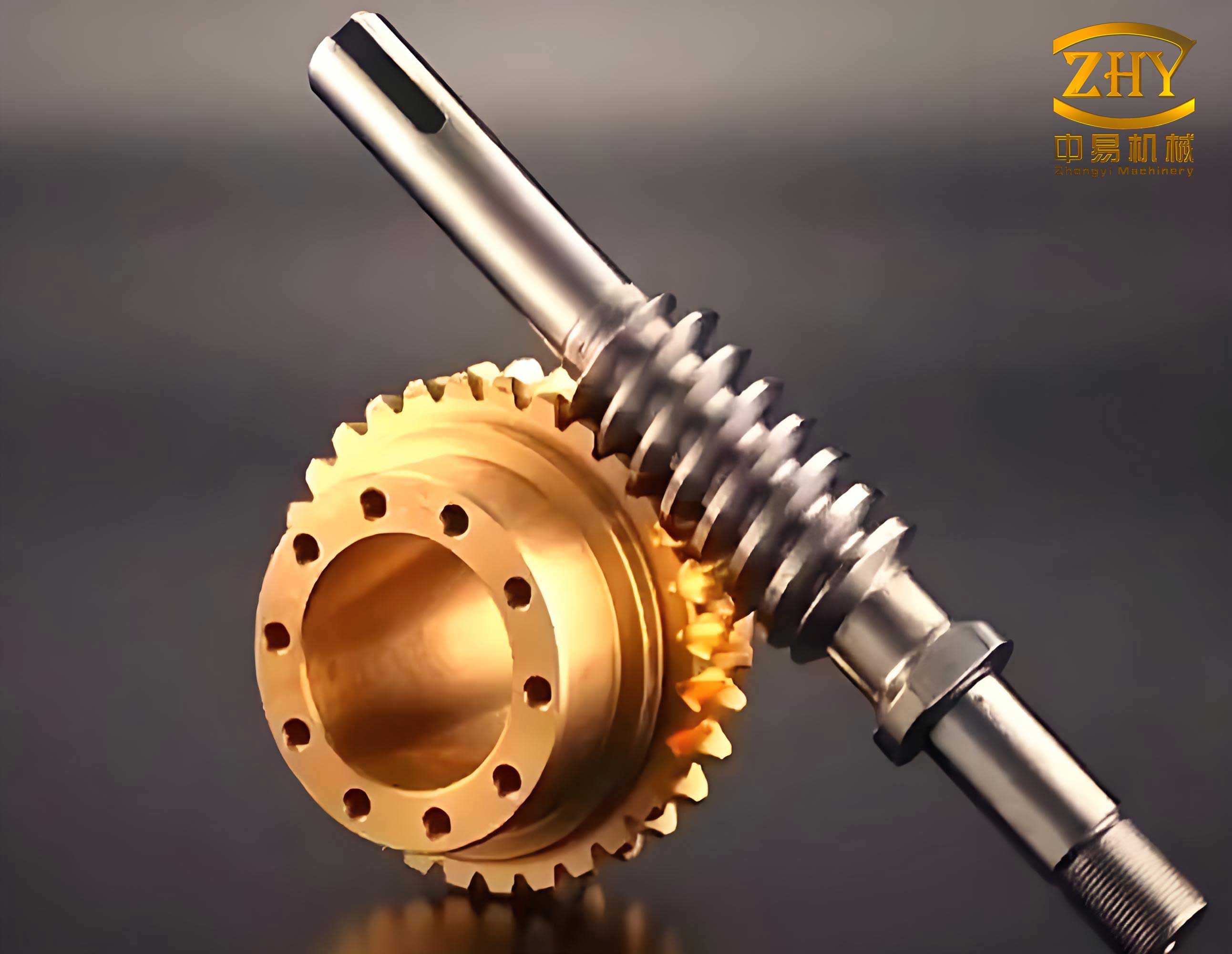
The pursuit of high-performance power transmission systems in demanding applications such as marine propulsion, aerospace, heavy industry, and energy generation has consistently driven research into advanced gear types. Among these, the planar double-enveloping toroidal worm gear drive stands out due to its unique kinematics and superior load-bearing characteristics. Unlike standard cylindrical worm gears, this screw gear set is generated through a complex double-enveloping process where a planar tool surface first envelops the worm, which then serves as the tool to generate the worm wheel. This results in both the worm and wheel teeth being complex, non-developable surfaces characterized by a multiplicity of design parameters. The selection of these parameters directly and profoundly influences the overall transmission performance, making their rational optimization paramount to harnessing the full potential of this screw gear design.
Evaluating the performance of such a screw gear pair typically involves two complementary approaches: a micro-scale assessment based on calculated contact stresses and minimum oil film thickness, and a macro-scale assessment based on the geometric distribution of contact lines across the entire tooth surface of the worm wheel. An accurate and comprehensive evaluation requires consideration of all contact lines, including those in the challenging secondary contact zone. Historically, the difficulty in calculating these secondary contact lines has meant that transmission performance often relied on experimental determination rather than precise theoretical prediction. Modern optimization efforts, therefore, must be grounded in a complete digital model of the entire tooth surface. This work proposes a parametric optimization method aimed at holistically improving both the micro- and macro-meshing quality of planar double-enveloping screw gear pairs by considering all contact lines.
Theoretical Foundation and Mathematical Modeling
The foundation of any optimization for a screw gear is a precise mathematical description of its tooth surfaces and their interaction. We begin by establishing the coordinate systems essential for describing the double-enveloping motion. Let \( s_1(o_1-uvw) \) represent the coordinate system fixed to the generating plane (the tool). The worm’s static and rotating coordinate systems are denoted as \( s_2(o_2-x_2y_2z_2) \) and \( s_{2i}(o_{2i}-x_{2i}y_{2i}z_{2i}) \), respectively. Similarly, the worm wheel’s static and rotating systems are \( s_3(o_3-x_3y_3z_3) \) and \( s_{3i}(o_{3i}-x_{3i}y_{3i}z_{3i}) \). The center distance is \( a \), the transmission ratio is \( i_{12} \), the lead angle of the worm is \( \gamma \), and the inclination angle of the generating plane is \( \beta \).
The generating plane’s unit normal vector in its own system \( s_1 \) is simply \( \mathbf{n} = [0, 0, 1]^T \). Transforming this vector into the worm’s rotating frame \( s_{2i} \) via successive rotational and translational transformations yields \( \mathbf{n_1} \). The relative velocity vector \( \mathbf{v}_{12} \) between the generating plane and the worm in \( s_{2i} \) is derived from kinematic principles.
According to the gearing theory, the meshing condition for the first enveloping process (plane to worm) is given by the equation \( \mathbf{n} \cdot \mathbf{v}_{12} = 0 \). Solving this equation provides the functional relationship between the surface parameters \( u \) and \( v \) of the generating plane, incorporating the rotation angle \( \varphi_2 \) of the worm:
$$ v = \frac{(i_{12}\cos\beta + \cos\varphi_2 \sin\beta)}{\sin\varphi_2} u + \frac{(a – r_b \sin\varphi_2)\sin\beta}{\sin\varphi_2} $$
where \( r_b \) is the base radius of the worm wheel, related to the center distance by the coefficient \( k_2 \) (\( r_b = k_2 \cdot a \)).
The family of generating plane surfaces and the meshing equation together define the worm tooth surface. The coordinates of any point on this surface in the worm coordinate system \( s_2 \) can be expressed as \( \mathbf{r_2}(u, \varphi_2) \). Subsequently, for the second enveloping process (worm to wheel), this worm surface becomes the generating tool. Applying another set of coordinate transformations based on the relative motion between the worm and the wheel, we obtain the equation for the family of worm surfaces in the wheel’s coordinate system \( s_{3i} \), parameterized by the wheel’s rotation angle \( \varphi_1 \) and the worm’s rotation angle \( \varphi_2 \):
$$ \mathbf{r_3}(u, \varphi_2, \varphi_1) = \mathbf{M}_{3i,2}(\varphi_1) \, \mathbf{r_2}(u, \varphi_2) $$
The meshing condition for this second stage is \( \mathbf{n_2} \cdot \mathbf{v}_{23} = 0 \), where \( \mathbf{n_2} \) is the worm surface normal and \( \mathbf{v}_{23} \) is the relative velocity between the worm and the wheel. The simultaneous solution of the worm surface family equation and this second meshing equation defines all contact lines on the worm wheel tooth surface, encompassing both primary and secondary contact zones. The complete set of solutions \( \{\mathbf{r_3}\} \) for all valid parameter pairs \( (u, \varphi_2, \varphi_1) \) maps out the entire network of contact lines.
Optimization Model Formulation
The core objective of optimizing this screw gear is to maximize a performance metric that accurately reflects the quality of engagement across the entire tooth flank.
Design Variables
While many parameters influence the design of a screw gear, key parameters like center distance \( a \), transmission ratio \( i_{12} \), number of worm threads \( z_1 \), and generating plane angle \( \beta \) are often predetermined by application requirements or established formulas. Therefore, the optimization focuses on two critical coefficients that significantly affect tooth geometry and meshing behavior:
$$ \mathbf{X} = [k_1, k_2]^T $$
Here, \( k_1 \) is the worm reference diameter coefficient, defining the worm’s reference diameter \( d_1 = k_1 \cdot a \). It influences worm stiffness and strength. The coefficient \( k_2 \) defines the worm wheel base circle diameter \( d_b = k_2 \cdot a \), which critically affects the pressure angle and the shape of the contact pattern. Their typical allowable ranges, which also serve as constraints, are summarized below:
| Parameter | Symbol | Common Value Range |
|---|---|---|
| Worm Reference Diameter Coefficient | \( k_1 \) | \( 0.33 \leq k_1 \leq 0.50 \) (varies with \( i_{12} \)) |
| Worm Wheel Base Circle Coefficient | \( k_2 \) | \( 0.50 \leq k_2 \leq 0.67 \) |
Optimization Objective: Average Lubrication Angle
A key indicator of meshing quality for a screw gear is the lubrication angle \( \theta \). At any point of contact, it is defined as the acute angle between the relative sliding velocity vector \( \mathbf{v} \) and the tangent vector \( \mathbf{c} \) to the contact line at that point. A larger lubrication angle promotes the formation and maintenance of a hydrodynamic lubricant film, reducing friction, wear, and improving efficiency.
To assess the overall transmission performance, it is insufficient to consider only isolated points or specific contact lines. A holistic measure is the average lubrication angle across all discrete contact points on all contact lines over the entire mesh cycle. Suppose the worm wheel tooth surface is discretized into \( m \) contact lines, and each line is sampled at \( n \) points. Let \( \theta_{ij} \) be the lubrication angle at the \( i \)-th point on the \( j \)-th contact line. The optimization objective is to maximize the mean lubrication angle \( \bar{\theta} \):
$$ \text{Maximize: } \quad \bar{\theta} = \frac{1}{m \cdot n} \sum_{j=1}^{m} \sum_{i=1}^{n} \theta_{ij}(k_1, k_2) $$
The lubrication angle \( \theta_{ij} \) is calculated using the vector formula:
$$ \theta_{ij} = \arccos \left( \frac{\mathbf{v}_{ij} \cdot \mathbf{c}_{ij}}{\| \mathbf{v}_{ij} \| \| \mathbf{c}_{ij} \|} \right) $$
where \( \mathbf{v}_{ij} \) is the relative velocity vector and \( \mathbf{c}_{ij} \) is the contact line direction vector at the specific mesh point, both being functions of the design variables \( k_1 \) and \( k_2 \).
Complete Optimization Problem Statement
The optimization problem for the planar double-enveloping screw gear can now be formally stated as a constrained nonlinear programming problem:
$$
\begin{aligned}
& \underset{k_1, k_2}{\text{maximize}}
& & \bar{\theta}(k_1, k_2) = \frac{1}{m n} \sum_{j=1}^{m} \sum_{i=1}^{n} \arccos \left( \frac{\mathbf{v}_{ij}(k_1, k_2) \cdot \mathbf{c}_{ij}(k_1, k_2)}{\| \mathbf{v}_{ij}(k_1, k_2) \| \| \mathbf{c}_{ij}(k_1, k_2) \|} \right) \\
& \text{subject to}
& & 0.33 \leq k_1 \leq 0.50 \quad \text{(with precise bounds depending on } i_{12}) \\
& & & 0.50 \leq k_2 \leq 0.67
\end{aligned}
$$
Solution via Genetic Algorithm
Given the nonlinear and computationally intensive nature of the objective function, which requires calculating thousands of contact points for each evaluation, a robust global search method is advantageous. The Genetic Algorithm (GA) is well-suited for this task. The following steps outline the implementation for a sample screw gear design with input power \( P_1 = 15 \text{ kW} \), input speed \( n_0 = 1000 \text{ rpm} \), transmission ratio \( i_{12} = 40 \), and a resulting standardized center distance of \( a = 200 \text{ mm} \).
The GA parameters were configured as follows:
| GA Parameter | Setting |
|---|---|
| Encoding | Binary String |
| Population Size | 20 |
| Initial Guess | \( [k_1, k_2]^T = [0.35, 0.55]^T \) |
| Fitness Function | \( \bar{\theta}(k_1, k_2) \) (to maximize) |
| Maximum Generations | 100 |
| Crossover (Type / Rate) | Single-point / 100% |
| Mutation (Type / Rate) | Single-point / 8% |
The algorithm converged efficiently, identifying an optimal population around the 32nd generation. The optimal design parameters and the corresponding maximum average lubrication angle were found to be:
$$ \mathbf{X}_{\text{opt}} = [k_1, k_2]^T = [0.37, 0.62]^T, \quad \bar{\theta}_{\text{max}} = 1.3648 \text{ radians} $$
This demonstrates good convergence behavior of the proposed model for this screw gear optimization.
Performance Analysis: Before vs. After Optimization
A comparative analysis was conducted using the initial guess parameters \( \mathbf{X}_{\text{init}} = [0.35, 0.55]^T \) and the optimized parameters \( \mathbf{X}_{\text{opt}} = [0.37, 0.62]^T \). The evaluation covers both micro-scale (lubrication angles) and macro-scale (contact pattern) meshing quality.
Micro-Scale Meshing Quality Improvement
The lubrication angles for approximately 1000 contact points (from 100 contact lines) were calculated for both designs. The results clearly show a significant enhancement in the micro-meshing quality of the optimized screw gear.
| Performance Metric | Initial Design (rad) | Optimized Design (rad) | Improvement |
|---|---|---|---|
| Maximum Lubrication Angle | 1.4975 | 1.5568 | +3.96% |
| Minimum Lubrication Angle | 0.9547 | 1.1222 | +17.55% | Average Lubrication Angle \( \bar{\theta} \) | 1.2427 | 1.3648 | +9.82% |
The increase in the minimum lubrication angle is particularly noteworthy, as it raises the worst-case scenario for oil film formation. The boost in the average angle confirms an overall improvement in the frictional conditions across the entire tooth engagement.
Macro-Scale Meshing Quality Improvement
The geometric distribution of contact lines on the worm wheel tooth is a critical macro-scale performance indicator. It affects load distribution, stress concentrations, and torque capacity. The contact lines for the optimized screw gear were plotted using the derived mathematical model. A comparative visualization of the entry and exit contact lines (the boundaries of the contact zone) for both designs reveals a significant change.
In the optimized design, the entry and exit contact lines are positioned closer to the edges of the worm wheel tooth. This expansion of the theoretical contact zone indicates a more favorable utilization of the available tooth surface area. A larger, well-distributed contact zone generally leads to lower specific contact pressures and improved load-carrying capacity for the screw gear pair. The optimization successfully altered the tooth geometry (via \( k_1 \) and \( k_2 \)) to achieve this beneficial shift in the contact pattern, thereby enhancing the macro-meshing quality.
Conclusion
This study presents a comprehensive methodology for the optimization of planar double-enveloping toroidal screw gear drives. By establishing a complete mathematical model that incorporates all contact lines—including the secondary contact zone—a holistic performance metric, the average lubrication angle, was defined and maximized. The application of a Genetic Algorithm proved effective in navigating the design space defined by the worm reference diameter coefficient \( k_1 \) and the worm wheel base circle coefficient \( k_2 \).
The results demonstrate that parameter optimization leads to a simultaneous and significant improvement in both micro- and macro-meshing quality. The optimized screw gear exhibits higher minimum, maximum, and average lubrication angles, promoting better lubricant film formation and reduced wear. Concurrently, the contact pattern expands towards the tooth edges, suggesting improved load distribution and higher potential load capacity. This integrated optimization approach provides a robust theoretical and computational framework for designing high-performance planar double-enveloping screw gear pairs, moving beyond empirical selection towards a performance-driven design paradigm.