
In the realm of mechanical engineering, cylindrical gear systems are pivotal components due to their efficiency, reliability, and compact structure. They are extensively utilized in various industries, including automotive, manufacturing, and automation, for transmitting power and motion. However, traditional design methods for cylindrical gear transmissions often rely heavily on empirical knowledge, iterative checks, and cumbersome calculations, leading to suboptimal solutions that may not minimize material usage or cost. As an engineer focused on advancing mechanical design, I have explored the integration of intelligent optimization algorithms to address these limitations. In this paper, I present a comprehensive approach to optimizing a two-stage spur cylindrical gear transmission by minimizing its volume, employing an improved particle swarm optimization (IPSO) algorithm. This method enhances design precision while reducing reliance on trial-and-error processes, ultimately contributing to more sustainable and economical engineering practices.
The cylindrical gear transmission system, particularly the two-stage configuration, involves multiple interacting parameters such as gear teeth numbers, module sizes, and transmission ratios. Conventional design approaches typically involve selecting initial parameters based on standards and experience, followed by rigorous strength and performance validation. If the design fails to meet criteria, parameters are adjusted repeatedly until compliance is achieved. This process is not only time-consuming but also often yields designs that are functional yet not optimized for factors like weight or volume. To overcome this, I have developed a mathematical model that formalizes the optimization problem, with the objective of minimizing the total volume of the cylindrical gear sets. This model incorporates constraints related to geometric limits, contact fatigue strength, and bending fatigue strength, ensuring that the optimized design adheres to safety and operational requirements. By leveraging computational intelligence, specifically an enhanced version of the particle swarm algorithm, I aim to automate and refine the design process, yielding superior outcomes compared to traditional methods.
My interest in this area stems from the growing need for efficient mechanical systems in resource-constrained environments. Cylindrical gears, with their straightforward geometry and high load-bearing capacity, are ideal candidates for optimization. However, the complexity of their design—involving multiple variables and nonlinear constraints—makes manual optimization challenging. Through this work, I demonstrate how modern optimization techniques can be adapted to mechanical design problems, providing a framework that can be extended to other types of gear systems. The core of my approach lies in combining established mechanical principles with advanced algorithmic strategies, resulting in a robust methodology that balances theoretical rigor with practical applicability.
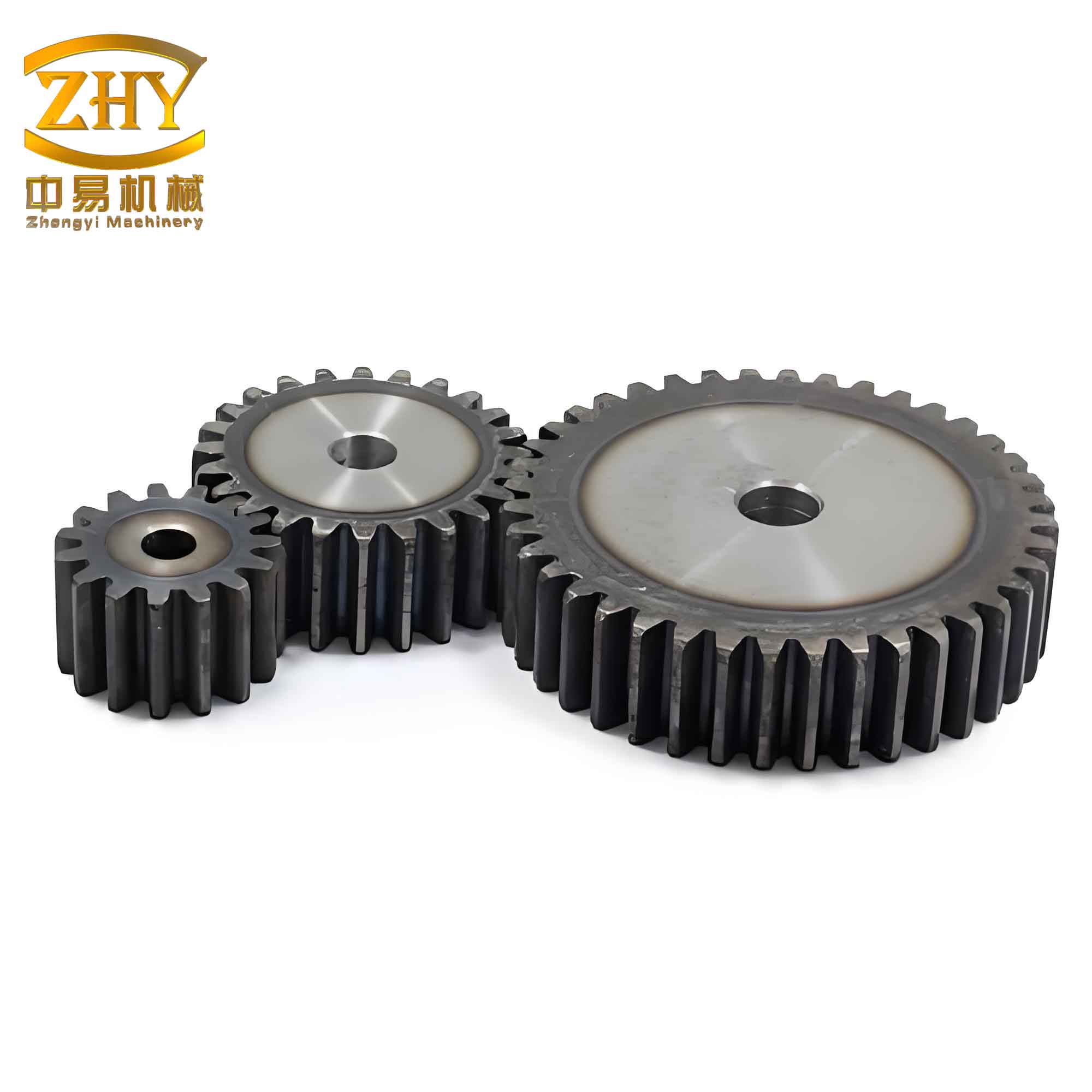
To begin, I establish the mathematical model for the two-stage cylindrical gear transmission. The system consists of two pairs of cylindrical gears: a high-speed stage (gear 1 and gear 2) and a low-speed stage (gear 3 and gear 4). The primary goal is to minimize the overall volume of these cylindrical gear pairs, which directly correlates with material usage, weight, and cost. The volume objective function is derived from the geometric properties of cylindrical gears, considering their teeth numbers, modules, and transmission ratios. The mathematical representation is as follows:
$$f_1 = v = \frac{\pi z_1^3 m_1^3}{4} (1 + i_1^2) \phi_{d1} + \frac{\pi z_3^3 m_2^3}{4} (1 + i_2^2) \phi_{d2}$$
Here, \( v \) denotes the total volume, \( z_1 \) and \( z_3 \) are the teeth numbers of the pinions in the high-speed and low-speed stages, respectively, \( m_1 \) and \( m_2 \) are the modules for each stage, \( i_1 \) and \( i_2 \) are the transmission ratios, and \( \phi_{d1} \) and \( \phi_{d2} \) are the face width coefficients. This objective function encapsulates the cubic relationship between gear dimensions and volume, highlighting the sensitivity of material usage to parameter changes in cylindrical gear design.
The design variables are selected based on their influence on the objective function and system performance. For the two-stage cylindrical gear transmission, I identify five key variables: the teeth numbers of the high-speed and low-speed pinions, the modules for both stages, and the transmission ratio of the high-speed stage. These are represented as a vector:
$$x = [z_1, z_3, m_1, m_2, i_1]^T = [x_1, x_2, x_3, x_4, x_5]^T$$
These variables are continuous or discrete in nature, and their optimization requires careful handling within algorithmic frameworks. The ranges for these variables are determined based on engineering standards and practical considerations to ensure manufacturability and functionality. For instance, the teeth numbers are constrained to avoid undercutting and ensure smooth operation, while modules are bounded to maintain strength and durability.
Next, I define the constraint functions to ensure the optimized cylindrical gear transmission meets all mechanical and geometric requirements. The constraints are categorized into geometric limits, contact fatigue strength, and bending fatigue strength. These are critical for preventing failure modes such as tooth breakage or surface pitting in cylindrical gears.
Geometric Constraints: To prevent interference and ensure proper meshing in cylindrical gear pairs, the following inequalities must hold:
$$m_1 \geq 2, \quad m_2 \geq 2$$
$$z_1 \geq 17, \quad z_3 \geq 17$$
$$\frac{(z_3 m_2 + z_3 m_2 i_2) – z_1 m_1 i_1}{2} \geq Q$$
Here, \( Q \) represents the minimum clearance between the high-speed cylindrical gear and the output shaft, set to 50 mm in this case. These constraints ensure that the cylindrical gears have sufficient size and spacing to operate without physical collision.
Contact Fatigue Strength Constraints: The contact stress on cylindrical gear teeth must not exceed the allowable limits to prevent surface fatigue. For both stages, the constraints are formulated using the Hertzian contact theory:
$$\sigma_{H1} = Z_E Z_H \sqrt{\frac{2K_1 T_1}{\phi_{d1} m_1^3 z_1^3} \cdot \frac{u_1 + 1}{u_1}} \leq [\sigma_H]$$
$$\sigma_{H2} = Z_E Z_H \sqrt{\frac{2K_2 T_2}{\phi_{d2} m_2^3 z_3^3} \cdot \frac{u_2 + 1}{u_2}} \leq [\sigma_H]$$
In these equations, \( \sigma_{H1} \) and \( \sigma_{H2} \) are the contact stresses for the high-speed and low-speed cylindrical gear pairs, respectively. \( Z_E \) is the elasticity coefficient, \( Z_H \) is the zone factor, \( K_1 \) and \( K_2 \) are load factors, \( T_1 \) and \( T_2 \) are input and intermediate shaft torques, \( u_1 \) and \( u_2 \) are gear ratios, and \( [\sigma_H] \) is the allowable contact stress. These constraints ensure that the cylindrical gears can withstand operational loads without premature wear.
Bending Fatigue Strength Constraints: The bending stress at the root of cylindrical gear teeth must also be within safe limits to avoid tooth fracture. For each gear in the two-stage system, separate constraints are applied:
$$\sigma_{F1} = \frac{2K_1 T_1 Y_{Fa1} Y_{Sa1}}{\phi_{d1} m_1^3 z_1^2} \leq [\sigma_{F1}]$$
$$\sigma_{F2} = \frac{2K_1 T_1 Y_{Fa2} Y_{Sa2}}{\phi_{d1} m_1^3 z_1^2} \leq [\sigma_{F2}]$$
$$\sigma_{F3} = \frac{2K_2 T_2 Y_{Fa3} Y_{Sa3}}{\phi_{d2} m_2^3 z_3^2} \leq [\sigma_{F3}]$$
$$\sigma_{F4} = \frac{2K_2 T_2 Y_{Fa4} Y_{Sa4}}{\phi_{d2} m_2^3 z_3^2} \leq [\sigma_{F4}]$$
Here, \( \sigma_{F1} \) to \( \sigma_{F4} \) represent the bending stresses for the four cylindrical gears, \( Y_{Fa} \) and \( Y_{Sa} \) are the form factor and stress correction factor for each gear, and \( [\sigma_F] \) are the allowable bending stresses. These constraints guarantee that the cylindrical gears have adequate resistance to cyclic loading, which is essential for long-term reliability.
To solve this constrained optimization problem for cylindrical gear transmission, I employ an improved particle swarm optimization (IPSO) algorithm. Particle swarm optimization (PSO) is a population-based metaheuristic inspired by the social behavior of birds flocking. It is well-suited for continuous optimization problems due to its simplicity and efficiency. However, basic PSO can suffer from premature convergence and stagnation in local optima. To enhance its performance for cylindrical gear design, I incorporate two modifications: a linear decreasing inertia weight strategy and a simulated annealing acceptance criterion.
The basic PSO algorithm operates by maintaining a swarm of particles, each representing a potential solution in the design space. For a D-dimensional problem (with D design variables), the position and velocity of the i-th particle are updated iteratively. The position update is given by:
$$x_{ij}(k+1) = x_{ij}(k) + v_{ij}(k+1)$$
And the velocity update is:
$$v_{ij}(k+1) = w v_{ij}(k) + c_1 r_1 [p_{ij}(k) – x_{ij}(k)] + c_2 r_2 [p_{gj}(k) – x_{ij}(k)]$$
In these equations, \( i \) indexes the particle, \( j \) indexes the dimension, \( k \) is the iteration number, \( w \) is the inertia weight, \( c_1 \) and \( c_2 \) are acceleration coefficients, \( r_1 \) and \( r_2 \) are random numbers in [0,1], \( p_{ij}(k) \) is the personal best position of particle i, and \( p_{gj}(k) \) is the global best position found by the swarm. For cylindrical gear optimization, the design variables correspond to the dimensions and ratios of the gear system.
To improve exploration and exploitation balance, I adjust the inertia weight \( w \) linearly from a maximum to a minimum value over iterations:
$$w = w_{\text{max}} – \frac{k}{T} (w_{\text{max}} – w_{\text{min}})$$
Here, \( T \) is the maximum number of iterations. This strategy allows the swarm to explore widely initially and converge precisely later, which is beneficial for complex problems like cylindrical gear design where the objective function is nonlinear and multimodal.
Additionally, I integrate a simulated annealing (SA) mechanism to escape local optima. The SA acceptance criterion, based on the Metropolis rule, allows the algorithm to occasionally accept worse solutions with a probability that decreases over time. The probability \( p \) of accepting a new solution \( x_i’ \) given the current solution \( x_i \) is:
$$p = \begin{cases}
1 & \text{if } f(x_i’) < f(x_i) \\
\exp\left(-\frac{f(x_i’) – f(x_i)}{a T}\right) & \text{if } f(x_i’) \geq f(x_i)
\end{cases}$$
where \( f(\cdot) \) is the objective function value (volume for cylindrical gears), \( a \) is a temperature decay coefficient, and \( T \) is the current temperature in SA. This hybrid approach, combining PSO with SA, enhances global search capability and reduces the risk of premature convergence, making it more effective for optimizing cylindrical gear transmissions.
The steps of the improved PSO algorithm for cylindrical gear optimization are as follows:
- Initialize the swarm: Set population size, dimensions (based on design variables), and parameters like \( c_1 \), \( c_2 \), \( w_{\text{max}} \), \( w_{\text{min}} \), and SA temperature.
- Evaluate fitness: Compute the objective function value (volume) for each particle, considering constraints via a penalty method to handle infeasible solutions.
- Update personal and global best positions based on fitness.
- Apply the SA acceptance criterion to update personal bests, allowing probabilistic acceptance of worse solutions to maintain diversity.
- Adjust inertia weight using the linear decreasing formula.
- Update particle velocities and positions according to PSO equations.
- Perform boundary checks and constraint handling to ensure solutions remain within feasible ranges for cylindrical gear parameters.
- Reduce the SA temperature according to a decay schedule.
- Repeat steps 2-8 until convergence criteria (e.g., maximum iterations) are met.
- Output the optimized design variables and corresponding volume.
To validate this approach, I apply it to a practical case study: a two-stage cylindrical gear reducer with an input power of 10 kW, input speed of 1450 rpm, and total transmission ratio of 15. The cylindrical gears are made of 45 steel, with the pinions heat-treated and the gears normalized. The design variables have specified ranges: \( 17 \leq z_1 \leq 35 \), \( 17 \leq z_3 \leq 35 \), \( 2 \leq m_1 \leq 5 \), \( 2 \leq m_2 \leq 5 \), and \( 3.7 \leq i_1 \leq 4.5 \). Other parameters, such as load factors and material properties, are determined from standard tables and calculations. The optimization goal is to minimize the volume of the cylindrical gear sets while satisfying all constraints.
I implement the IPSO algorithm in MATLAB, with a population size of 50, 500 iterations, \( c_1 = c_2 = 2 \), \( w_{\text{max}} = 0.9 \), \( w_{\text{min}} = 0.4 \), and SA decay coefficient \( a = 0.9 \). To handle constraints, I use a penalty function that adds a large value to the objective function for infeasible solutions, effectively guiding the swarm toward feasible regions. For comparison, I also run the standard PSO algorithm under the same conditions. Both algorithms are executed independently 10 times to account for stochastic variations, and the average convergence behavior is analyzed.
The results demonstrate the superiority of the IPSO algorithm. The average convergence curves, plotted over iterations, show that IPSO achieves lower objective function values (i.e., smaller volumes for cylindrical gear transmission) compared to standard PSO, indicating better optimization performance. The incorporation of linear decreasing inertia weight and simulated annealing helps IPSO avoid local minima and converge to a more optimal solution. After obtaining the optimized parameters from IPSO, I round the teeth numbers and modules to practical values, as cylindrical gear manufacturing requires integer teeth numbers and standard module sizes. The rounded results are then compared with those from conventional design methods, which rely on handbook-based selections and iterative checks.
The table below summarizes the comparison between the IPSO-optimized design and the conventional design for the two-stage cylindrical gear transmission:
| Parameter | IPSO-Optimized Design | Conventional Design |
|---|---|---|
| High-speed pinion teeth (\( z_1 \)) | 23 | 21 |
| High-speed gear teeth (\( z_2 \)) | 101 | 84 |
| Low-speed pinion teeth (\( z_3 \)) | 27 | 24 |
| Low-speed gear teeth (\( z_4 \)) | 92 | 90 |
| High-speed module (\( m_1 \), mm) | 2.5 | 3 |
| Low-speed module (\( m_2 \), mm) | 3.5 | 4 |
| Objective function (volume, mm³) | 9.1095 × 10⁶ | 1.1044 × 10⁷ |
From this table, it is evident that the IPSO-optimized cylindrical gear transmission achieves a volume of approximately 9.11 × 10⁶ mm³, which is about 17.5% lower than the conventional design volume of 1.104 × 10⁷ mm³. This reduction translates to significant savings in material, weight, and cost, without compromising strength or performance. All constraints, including geometric and strength requirements, are satisfied in the optimized design, confirming its feasibility for real-world cylindrical gear applications.
To further illustrate the optimization process, I provide details on the constraint evaluations. For the IPSO-optimized cylindrical gear design, the contact and bending stresses are calculated and found to be within allowable limits. For example, the contact stress for the high-speed cylindrical gear pair is computed as:
$$\sigma_{H1} = 189.8 \times 2.5 \times \sqrt{\frac{2 \times 1.2 \times 65.9}{0.8 \times (2.5)^3 \times (23)^3} \times \frac{4.39 + 1}{4.39}} \approx 420 \text{ MPa}$$
This is below the allowable contact stress of 450 MPa for the material. Similarly, bending stresses for all cylindrical gears are verified to be safe. These calculations ensure that the optimized design is not only compact but also reliable under operational loads.
The success of this optimization hinges on the effective handling of multiple variables and constraints in cylindrical gear design. The IPSO algorithm’s ability to navigate the complex design space is enhanced by its adaptive mechanisms. The linear decreasing inertia weight allows for a smooth transition from global exploration to local exploitation, which is crucial for fine-tuning parameters like module and teeth numbers. Meanwhile, the simulated annealing component introduces stochastic acceptance, preventing the swarm from getting trapped in suboptimal regions. This combination is particularly beneficial for cylindrical gear optimization, where the objective function is sensitive to small changes in design variables.
In practice, the optimized cylindrical gear transmission can be implemented in various mechanical systems, such as industrial reducers or automotive transmissions. The volume reduction achieved through IPSO optimization leads to lighter and more compact assemblies, which can improve overall system efficiency and reduce manufacturing costs. Additionally, this approach reduces the dependency on empirical design rules, enabling more automated and data-driven engineering processes. As cylindrical gears continue to be fundamental components in machinery, such optimization methods contribute to advancing mechanical design toward greater sustainability and performance.
Beyond the specific case study, the methodology presented here can be extended to other types of cylindrical gear systems, such as helical or bevel gears, by adapting the mathematical model accordingly. The IPSO algorithm is versatile and can accommodate additional objectives, such as minimizing noise or maximizing efficiency, making it suitable for multi-objective optimization in cylindrical gear design. Future work could explore integrating more advanced constraints, such as thermal effects or dynamic behavior, to further enhance the robustness of optimized cylindrical gear transmissions.
In conclusion, I have demonstrated that an improved particle swarm optimization algorithm, incorporating linear decreasing inertia weight and simulated annealing, effectively optimizes two-stage cylindrical gear transmission for minimum volume. The mathematical model, encompassing objective function, design variables, and constraints, provides a comprehensive framework for cylindrical gear design optimization. The results show a substantial volume reduction compared to conventional methods, validating the efficacy of this intelligent approach. This work underscores the potential of hybrid optimization algorithms in mechanical engineering, offering a pathway to more efficient and cost-effective cylindrical gear systems. As technology evolves, such methods will play an increasingly vital role in designing advanced mechanical components for diverse applications.