
In modern automotive and industrial applications, hyperboloidal gears play a critical role in power transmission systems, particularly in drive axles where high torque and speed are required. However, as hyperboloidal gears operate under increasingly demanding conditions, issues related to vibration and noise have become significant bottlenecks affecting performance and durability. This paper presents an optimization design method for vibration reduction in hyperboloidal gears through ease-off flank modification. We focus on improving the dynamic behavior by tailoring the tooth surface geometry, which directly influences meshing stiffness and excitation forces. The approach integrates tooth contact analysis (TCA), loaded tooth contact analysis (LTCA), and a coupled dynamic model to minimize vibration responses. Throughout this work, we emphasize the importance of hyperboloidal gears in high-performance systems and explore how ease-off modifications can enhance their operational smoothness.
The geometry of hyperboloidal gears is complex due to their non-parallel and non-intersecting axes, which leads to challenging contact patterns and stress distributions. Traditional design methods often result in excessive mismatch or edge-loading, exacerbating vibration issues. Therefore, advanced modification techniques like ease-off flank modification are essential to control the contact path and reduce dynamic excitations. In this context, we propose a method where the pinion tooth surface is modified by superimposing an ease-off surface onto a conjugate gear pair, allowing precise control over transmission error and load distribution. This method is particularly relevant for hyperboloidal gears, as their skewed tooth surfaces require careful optimization to balance strength and noise characteristics.
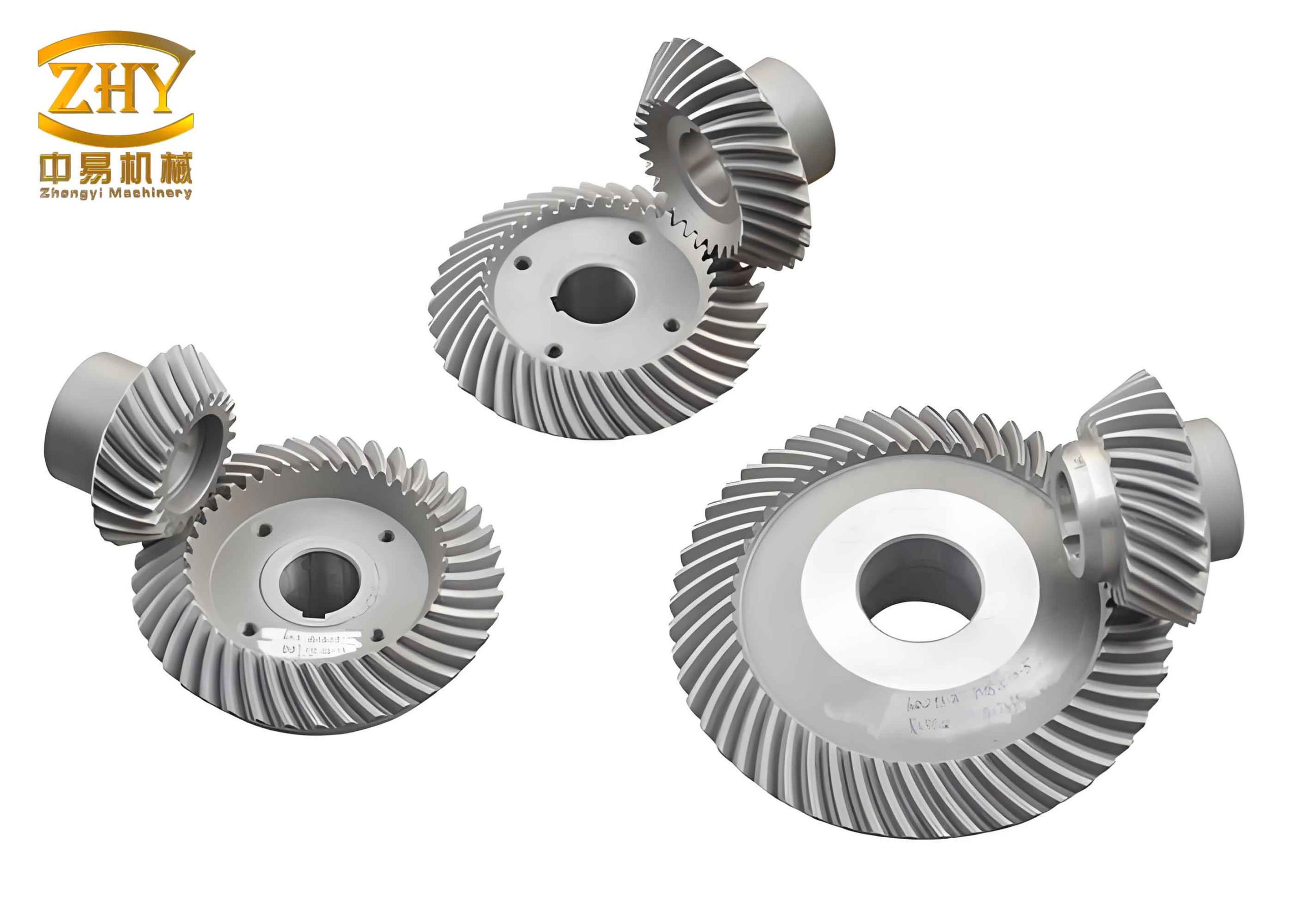
The core of our approach lies in the mathematical representation of the ease-off modification surface. For hyperboloidal gears, the pinion tooth surface is derived from a conjugate gear pair based on the gear meshing theory and assembly relationships. The ease-off surface is defined as the normal deviation between the modified pinion surface and the conjugate pinion surface, expressed in terms of preset transmission error parameters and parabolic modification parameters. Let the conjugate pinion surface be represented by position vector $$ \mathbf{R}_{10}(u, \beta) $$ and unit normal vector $$ \mathbf{N}_{10}(u, \beta) $$, where $$ u $$ and $$ \beta $$ are the tooth surface parameters. The modified pinion surface $$ \mathbf{R}_{1\gamma}(u, \beta) $$ is then given by:
$$ \mathbf{R}_{1\gamma}(u, \beta) = \mathbf{R}_1(u, \beta) + \delta_1(x_1, y_1) \mathbf{N}_1(u, \beta) $$
where $$ \mathbf{R}_1(u, \beta) $$ is the pinion surface with only transmission error, $$ \mathbf{N}_1(u, \beta) $$ is its unit normal, and $$ \delta_1(x_1, y_1) $$ is the normal contact gap function defined by modification curves. The ease-off value $$ \delta(u, \beta) $$ is computed as:
$$ \delta(u, \beta) = (\mathbf{R}_{1\gamma}(u, \beta) – \mathbf{R}_{10}(u, \beta)) \cdot \mathbf{N}_{10}(u, \beta) $$
This formulation allows us to control both the tooth-to-tooth clearance and the flank normal clearance, which are crucial for managing the contact pattern in hyperboloidal gears. The modification parameters include tooth contact gap parameters (e.g., $$ \epsilon_0 $$ to $$ \epsilon_4 $$ and $$ \lambda_1, \lambda_2 $$) and flank normal contact gap parameters (e.g., $$ d_1, d_2, q_1, q_2, \theta_a $$), as summarized in Table 1. These parameters define the shape and magnitude of the ease-off surface, directly affecting the meshing stiffness and dynamic response of hyperboloidal gears.
| Parameter Type | Symbol | Description | Typical Range |
|---|---|---|---|
| Tooth Contact Gap | $$ \epsilon_0 $$ to $$ \epsilon_4 $$ | Transmission error coefficients defining polynomial curve | -20″ to 20″ (arc seconds) |
| Tooth Contact Gap | $$ \lambda_1, \lambda_2 $$ | Phase angles for contact line adjustment | 0 to 2π radians |
| Flank Normal Gap | $$ d_1, d_2 $$ | Modification depths along tooth profile | 0 to 3 mm |
| Flank Normal Gap | $$ q_1, q_2 $$ | Parabolic coefficients for crowning | 0 to 0.05 mm |
| Flank Normal Gap | $$ \theta_a $$ | Angle of modification orientation | 0° to 30° |
To evaluate the dynamic performance, we establish a coupled bending-torsional-axial vibration model for hyperboloidal gear pairs. The model considers eight degrees of freedom, including translational vibrations along x, y, z axes and rotational vibrations about the gear axes. The equations of motion are derived using a lumped mass approach, with the generalized displacement vector represented as $$ \{\mathbf{x}_p, \mathbf{y}_p, \mathbf{z}_p, \theta_p, \mathbf{x}_g, \mathbf{y}_g, \mathbf{z}_g, \theta_g\} $$ for the pinion (p) and gear (g). The dynamic equations are:
$$ m_p \ddot{x}_p + c_{px} \dot{x}_p + k_{px} x_p = -F_n n_{px} $$
$$ m_p \ddot{y}_p + c_{py} \dot{y}_p + k_{py} y_p = -F_n n_{py} $$
$$ m_p \ddot{z}_p + c_{pz} \dot{z}_p + k_{pz} z_p = -F_n n_{pz} $$
$$ I_p \ddot{\theta}_p = -F_n r_p + T_p $$
$$ m_g \ddot{x}_g + c_{gx} \dot{x}_g + k_{gx} x_g = -F_n n_{gx} $$
$$ m_g \ddot{y}_g + c_{gy} \dot{y}_g + k_{gy} y_g = -F_n n_{gy} $$
$$ m_g \ddot{z}_g + c_{gz} \dot{z}_g + k_{gz} z_g = -F_n n_{gz} $$
$$ I_g \ddot{\theta}_g = F_n r_g – T_g $$
where $$ m_i $$ and $$ I_i $$ are mass and moment of inertia, $$ c_{ij} $$ and $$ k_{ij} $$ are damping and stiffness coefficients, $$ n_{ij} $$ are components of the mesh point normal vector, $$ r_i $$ are mesh point radii, $$ T_i $$ are torques, and $$ F_n $$ is the normal mesh force. For hyperboloidal gears, the mesh point radius is computed as:
$$ r_l = \mathbf{R}_l \times \mathbf{e}_l \cdot \mathbf{n}_l \quad (l = p, g) $$
with $$ \mathbf{R}_l $$ as position vector, $$ \mathbf{e}_l $$ as axis direction unit vector, and $$ \mathbf{n}_l $$ as unit normal vector. The normal mesh force $$ F_n $$ incorporates time-varying mesh stiffness $$ K_n $$ and damping $$ C_n $$, along with displacement excitation $$ e_n $$ due to errors:
$$ F_n = K_n s_n – C_n \dot{s}_n $$
$$ K_n = F_{sn} / Z $$
$$ s_n = [n_{px}, n_{py}, n_{pz}, r_p] \cdot [x_p, y_p, z_p, \theta_p] – [n_{gx}, n_{gy}, n_{gz}, r_g] \cdot [x_g, y_g, z_g, \theta_g] – e_n $$
$$ e_n = A \sin(\omega t + \phi_0) $$
Here, $$ F_{sn} $$ is the static normal force, $$ Z $$ is the normal deformation from LTCA, $$ A $$ is error amplitude, $$ \omega $$ is angular velocity, and $$ \phi_0 $$ is initial phase. The mesh stiffness $$ K_n $$ is obtained from LTCA simulations for one mesh cycle and fitted via Fourier series for dynamic analysis. This model captures the essential dynamics of hyperboloidal gears, including the effects of ease-off modification on stiffness variations.
The optimization objective is to minimize the root mean square (RMS) of the normal vibration acceleration, which directly correlates with noise and fatigue in hyperboloidal gears. The objective function is defined as:
$$ G(\mathbf{y}) = \min\left\{ \frac{a}{a_0} \right\} $$
where $$ \mathbf{y} $$ is the vector of modification parameters (e.g., $$ \epsilon_1 $$ to $$ \epsilon_4 $$, $$ \lambda_1, \lambda_2, d_1, d_2, q_1, q_2, \theta_a $$), $$ a $$ is the RMS vibration acceleration for the modified hyperboloidal gear pair, and $$ a_0 $$ is that for the conjugate pair. The optimization process involves iterative TCA, LTCA, and dynamic simulations, forming a nonlinear problem with multiple local minima. We employ a particle swarm optimization (PSO) algorithm due to its global search capability, ensuring convergence to an optimal ease-off surface for hyperboloidal gears.
To illustrate the method, we consider a case study of hyperboloidal gears used in an automotive drive axle. The basic parameters are listed in Table 2, highlighting key geometric and operational details. The pinion is designed with 8 teeth and the gear with 41 teeth, featuring a spiral angle of 48.93° and 30.63°, respectively. The gear pair operates under a rated torque of 1000 N·m and pinion speed of 5000 rpm, with a maximum error amplitude of 3 μm. These parameters are typical for high-performance hyperboloidal gears, where vibration reduction is critical.
| Parameter | Pinion | Gear |
|---|---|---|
| Number of Teeth | 8 | 41 |
| Midpoint Spiral Angle (°) | 48.93 | 30.63 |
| Hand of Spiral | Left | Right |
| Addendum (mm) | 5.77 | 1.05 |
| Dedendum (mm) | 1.16 | 5.73 |
| Pitch Cone Angle (°) | 12.53 | 76.82 |
| Face Cone Angle (°) | 17.45 | 77.73 |
| Root Cone Angle (°) | 11.67 | 71.68 |
| Outer Cone Distance (mm) | 97.19 | 84.72 |
| Face Width (mm) | 28 | 24 |
| Offset (mm) | 23 | — |
| Radial Support Stiffness (N/m) | 5.0 × 10⁸ | 5.0 × 10⁸ |
| Axial Support Stiffness (N/m) | 2.5 × 10⁸ | 2.5 × 10⁸ |
Through optimization, we obtain an optimal ease-off modification surface with parameters as shown in Table 3. These parameters result in a modified pinion tooth surface that reduces vibration while maintaining adequate contact pressure. The TCA simulation for the optimal hyperboloidal gear pair shows a contact pattern near the inner diagonal with moderate modification at the entry and exit points, ensuring smooth meshing transitions. In contrast, the theoretical tooth surface without optimization exhibits excessive modification, leading to inner diagonal contact and higher vibration sensitivity.
| Parameter | Value |
|---|---|
| $$ \epsilon_0 $$ (arc seconds) | -7.9 |
| $$ \epsilon_1 $$ (arc seconds) | -2.3 |
| $$ \epsilon_2 $$ (arc seconds) | -2.3 |
| $$ \epsilon_3 $$ (arc seconds) | -10.3 |
| $$ \epsilon_4 $$ (arc seconds) | -12.3 |
| $$ \lambda_1 $$ (radians) | 0.44 |
| $$ \lambda_2 $$ (radians) | 0.61 |
| $$ d_1 $$ (mm) | 1.73 |
| $$ d_2 $$ (mm) | 2.03 |
| $$ q_1 $$ (mm) | 0.019 |
| $$ q_2 $$ (mm) | 0.022 |
| $$ \theta_a $$ (°) | 10 |
The dynamic response analysis reveals significant improvements with ease-off modification. For the optimal hyperboloidal gear pair, the normal vibration acceleration RMS is reduced to 15% of that for the conjugate pair, while the amplitude of loaded transmission error (ALTE) is reduced to 65%. The mesh stiffness curve for the optimal modification shows minimal harmonic components, primarily featuring the mesh frequency (666.67 Hz), whereas excessive modification introduces higher harmonics and reduces average stiffness, increasing vibration. Table 4 compares different modification cases, illustrating how stiffness curve shape and amplitude affect vibration in hyperboloidal gears. For instance, when modification is too large, average mesh stiffness drops substantially, leading to higher vibration despite similar ALTE values. This underscores the sensitivity of hyperboloidal gear dynamics to both stiffness magnitude and waveform.
| Modification Case | ALTE Relative to Conjugate (%) | Normal Vibration Acceleration RMS Relative to Conjugate (%) | Average Mesh Stiffness Change | Key Observations |
|---|---|---|---|---|
| Optimal Ease-Off | 65 | 15 | Small decrease | Minimal harmonics, dominant mesh frequency |
| Theoretical Tooth Surface | 105 | 126 | Large decrease | Excessive modification, increased vibration |
| Case 1 Modification | 106 | 22 | Moderate decrease | Stiffness curve shape favorable |
| Case 2 Modification | 49 | 96 | Small decrease | High harmonic content in stiffness |
| Case 3 Modification | 56 | 33 | Small decrease | Reduced ALTE but some harmonics |
The vibration reduction mechanism can be further analyzed through frequency domain studies. For the optimal hyperboloidal gear pair, the vibration spectrum is dominated by the mesh frequency and its third harmonic, with amplitudes significantly lower than for other cases. The dynamic mesh force also shows reduced fluctuations, primarily at the mesh frequency, indicating smoother power transmission. These findings highlight the effectiveness of ease-off modification in tailoring the dynamic characteristics of hyperboloidal gears.
Moreover, we investigate the performance under varying loads and speeds. For multi-load conditions, the ALTE curve generally reflects vibration trends: as load increases, vibration tends to rise, but the optimal modification mitigates this effect. For instance, at loads above 1400 N·m, the ALTE for the optimal hyperboloidal gear pair increases gradually, whereas the theoretical surface shows erratic behavior due to varying contact ratios. Under multi-speed conditions, resonance peaks occur at specific speeds (e.g., 3200 rpm and 5600 rpm) for the conjugate pair, but the optimal modification shifts or dampens these resonances, reducing dynamic mesh forces across the speed range. This robustness is crucial for hyperboloidal gears in automotive applications where operating conditions vary widely.
The mathematical formulation of the ease-off surface and dynamic model involves several equations that ensure accuracy. For example, the normal vector of the modified pinion surface $$ \mathbf{N}_{1\gamma} $$ is derived as:
$$ \mathbf{N}_{1\gamma} = \left( \frac{\partial \mathbf{R}_1}{\partial u} + \frac{\partial \delta_1}{\partial u} \mathbf{N}_1 + \frac{\partial \mathbf{N}_1}{\partial u} \delta_1 \right) \times \left( \frac{\partial \mathbf{R}_1}{\partial \beta} + \frac{\partial \delta_1}{\partial \beta} \mathbf{N}_1 + \frac{\partial \mathbf{N}_1}{\partial \beta} \delta_1 \right) $$
with partial derivatives of $$ \delta_1 $$ computed via chain rule. This level of detail ensures precise representation of hyperboloidal gear tooth surfaces, which is essential for reliable TCA and LTCA results.
In conclusion, the ease-off modification method presents a powerful approach for vibration reduction in hyperboloidal gears. By optimizing modification parameters, we achieve significant improvements in dynamic performance, including lower vibration acceleration, reduced ALTE, and favorable mesh stiffness characteristics. The key insights are: (1) Excessive modification can degrade stiffness and increase vibration, even if ALTE is controlled; (2) The shape of the stiffness curve, particularly harmonic content, is more sensitive than amplitude in influencing vibration; (3) Optimal ease-off modification yields minimal harmonic excitation, primarily at the mesh frequency; and (4) Multi-load ALTE curves can serve as indicators of vibration trends, but direct dynamic optimization is necessary for best results. These findings advance the design of hyperboloidal gears for high-performance applications, ensuring smoother operation and longer service life.
Future work could explore the integration of manufacturing constraints into the optimization process, as ease-off surfaces must be feasible for production using existing gear cutting machines. Additionally, experimental validation on physical hyperboloidal gear sets would further confirm the effectiveness of this method. Overall, the proposed framework enhances the understanding and design of hyperboloidal gears, contributing to quieter and more efficient transmission systems.