
The pursuit of manufacturing efficiency and component performance has driven the advancement of precision forging technologies for gear production. Among these, precision gear forging aims to produce net-shape or near-net-shape tooth forms directly from a blank, offering significant advantages over traditional machining, including superior material utilization, higher production rates, and enhanced mechanical properties due to the continuous grain flow. The classification of this process into cold, hot, and warm forging is based on the workpiece temperature. For high-modulus components, cold forging faces prohibitive forming loads and poor die life, while hot forging suffers from dimensional inaccuracy and surface oxidation. Consequently, a hybrid process of warm forging for pre-forming followed by cold finishing has gained prominence as a viable route for producing high-precision spur and pinion gears.
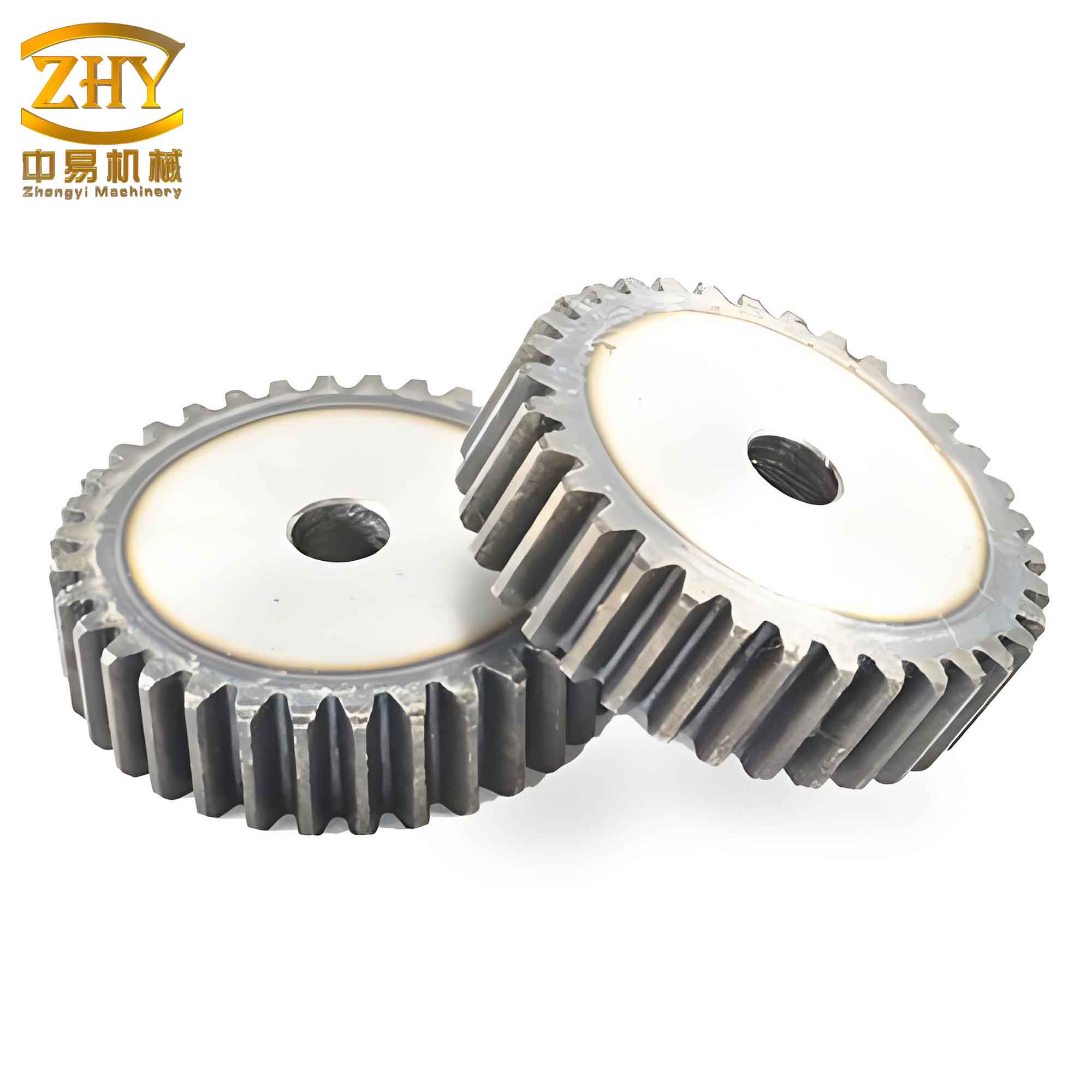
Warm forging strikes a critical balance, reducing flow stress compared to cold forging while mitigating the severe scaling issues of hot forging. For a final cold finishing operation to be successful, the warm-forged pre-form must achieve complete tooth fill. This article delves into the numerical simulation and process optimization for the warm forging of a high-modulus spur gear, addressing key defects and proposing innovative solutions to ensure complete cavity filling and reduce forming loads, thereby contributing to the practical application of this technology for robust spur and pinion gear manufacturing.
Challenges in Conventional Closed-Die Forging
The study focuses on a specific spur gear with a module of 3 mm and 18 teeth. The conventional closed-die forging process, analogous to an upsetting operation, involves placing a cylindrical billet inside a die cavity containing the negative tooth profile and applying axial pressure. A finite element model was established using a 20CrMnTi billet at an initial temperature of 800°C, with a friction coefficient of 0.3. Due to symmetry, a model of a single tooth was simulated to analyze metal flow and forming load.
The simulation revealed a fundamental issue in metal flow uniformity. The central region of the billet undergoes severe deformation, while the metal at the top and bottom corners, hindered by frictional forces against the flat die faces, flows slower radially. This results in a non-uniform strain distribution, where the final areas to fill are the top and bottom fillets of the tooth profile, leading to an underfilled “flash-free” corner defect. The forming load curve exhibits three distinct phases: initial upsetting, tooth filling, and final corner filling, where the load increases drastically due to the high hydrostatic pressure required to force metal into the last unfilled corners.
Optimization with Broken Line-Shaped Punch Faces
To rectify the uneven metal flow, the geometry of the punch faces was modified from flat surfaces to angled, broken-line profiles. The core idea is to apply a radial force component during the initial stages of forging, actively promoting radial flow in the corner regions from the start.
Scheme 1: Both the upper and lower punch faces featured a flat section at the center and an angled section aligned with the tooth profile.
Scheme 2: An improved version where the entire face of the upper punch was angled, while the lower punch retained the broken-line design from Scheme 1. In this scheme, the upper punch remains stationary, and the lower punch moves upward.
The finite element analysis demonstrated a marked improvement. In Scheme 1, the rigid zones at the billet ends were reduced, and more material participated in deformation at the corners due to the radial pressure from the angled faces. However, a slight asymmetry persisted, with the lower corner remaining less filled. Scheme 2 effectively solved this by ensuring both ends experienced accelerated radial flow, leading to highly uniform plastic deformation and, crucially, complete filling of the entire tooth profile without defects. The forming load was also significantly reduced compared to the conventional process.
The effectiveness of these designs can be summarized by analyzing the change in radial flow velocity. The radial velocity component $v_r$ induced by an angled punch face with inclination $\alpha$ can be related to the axial punch velocity $v_z$ by:
$$ v_r = v_z \cdot \tan(\alpha) $$
This component directly promotes material flow into the tooth cavity, counteracting the frictional restraint at the corners.
| Process Scheme | Punch Face Geometry | Metal Flow Uniformity | Tooth Fill Completion | Peak Load Reduction |
|---|---|---|---|---|
| Conventional Closed-Die | Flat faces | Poor (Large rigid zones at corners) | Incomplete (Corner underfill) | Baseline (0%) |
| Scheme 1 | Broken-line (both punches) | Improved (Reduced rigid zones) | Nearly Complete (Minor lower corner defect) | ~15% (Estimated) |
| Scheme 2 | Broken-line (upper: full angle, lower: partial) | Excellent (Uniform deformation) | Complete | ~28.6% |
Further Load Reduction via Constrained Axial Shunt Flow
While the broken-line punch design ensures filling, the final forming load can be further optimized to extend die life. The principle of constrained shunt flow is introduced. This involves designing the process so that at the moment the tooth cavity is completely filled, a free surface still exists on the workpiece, allowing material to flow into a designated “shunt” area. This relieves the steep pressure rise characteristic of the final filling stage in a fully constrained die.
In this study, an axial shunt was implemented alongside the optimized punch geometry from Scheme 2. A central recess or a slight increase in the billet height creates an escape path for excess material along the axis, effectively controlling the pressure build-up.
The simulation results were conclusive. The load-stroke curve for the shunt-aided process showed a dramatic reduction in the peak load during the final stage. The peak forming force dropped by an additional 25% compared to the optimized Scheme 2, resulting in a total load reduction of approximately 47% from the original conventional process. This is critical for the practical forging of high-modulus spur and pinion gears, where load reduction directly translates to lower press capacity requirements and increased tooling longevity.
The condition for effective shunt flow can be expressed by ensuring the volume of the shunt $V_s$ is greater than or equal to the volumetric error $\Delta V$ between the billet and the fully filled cavity at the point of complete tooth fill:
$$ V_s \geq \Delta V = V_{billet} – V_{cavity}(t_{fill}) $$
Where $t_{fill}$ is the time or stroke at which the tooth profile is completely filled. This ensures the pressure does not spike unnecessarily.
| Performance Metric | Conventional Process | Scheme 2 (Broken-Line Punch) | Scheme 2 + Axial Shunt |
|---|---|---|---|
| Peak Forming Load (kN) | 465.7 | 332.1 | 249.8 |
| Load Reduction vs. Baseline | 0% | 28.6% | 46.4% |
| Tooth Fill Quality | Underfilled corners | Completely filled | Completely filled |
| Process Robustness for Finishing | Poor (requires significant finishing) | Good (suitable for light finishing) | Excellent (ideal for precision finishing) |
Mechanisms and Practical Implications for Gear Production
The success of the combined optimization lies in fundamentally altering the stress state and flow patterns. The broken-line punch face transforms a purely compressive axial stress $\sigma_z$ into a stress state with a deliberate radial component $\sigma_r$:
$$ \sigma_r^{induced} \propto \sigma_z \cdot \sin(\alpha) $$
This active “pushing” of material into the corners combats die friction and minimizes stagnant zones.
Concurrently, the constrained axial shunt acts as a pressure relief valve. It maintains a lower hydrostatic pressure $p$ in the deforming body during the final stages:
$$ p_{shunt} = \frac{1}{3}(\sigma_z + \sigma_r + \sigma_\theta) < p_{closed-die} $$
This lower mean stress directly correlates to a lower required forging force $F$:
$$ F = \int_A \sigma_z \, dA $$
where $A$ is the projected contact area. By preventing the sharp rise in $\sigma_z$ at the end of the stroke, the shunt keeps $F$ within a manageable range.
For the mass production of transmission components like spur and pinion gears, this optimized warm forging process offers a compelling route. It ensures a precise, fully-filled pre-form that minimizes the subsequent cold finishing effort, maintains excellent grain structure for fatigue resistance, and does so with significantly lower equipment wear and energy consumption. The principles are equally applicable to various axisymmetric forged components requiring complete filling of complex peripheral features.
Conclusion
This investigation into the warm forging of high-modulus spur gears successfully identified and solved the primary defects of incomplete tooth fill and excessive forming load inherent in the conventional closed-die process. Through systematic finite element analysis, a two-stage optimization strategy was developed and validated.
First, the introduction of a broken-line shaped punch face, particularly the configuration with a fully angled upper punch, was proven to homogenize plastic flow by imparting a beneficial radial stress component. This modification guarantees complete cavity filling, producing a pre-form ideally suited for a final cold calibration step.
Second, incorporating the principle of constrained axial shunt flow into the optimized die design resulted in a dramatic reduction of the peak forming load—by nearly 50% compared to the baseline. This reduction is paramount for economic and practical manufacturing, extending die life and reducing press tonnage requirements.
The synergistic combination of geometric die optimization (broken-line faces) and process optimization (shunt flow) establishes a robust and efficient warm forging route for high-quality spur and pinion gear pre-forms. This approach provides a solid foundation for the industrial adoption of precision forging techniques, leading to stronger, more reliable gears manufactured with greater material and energy efficiency.