
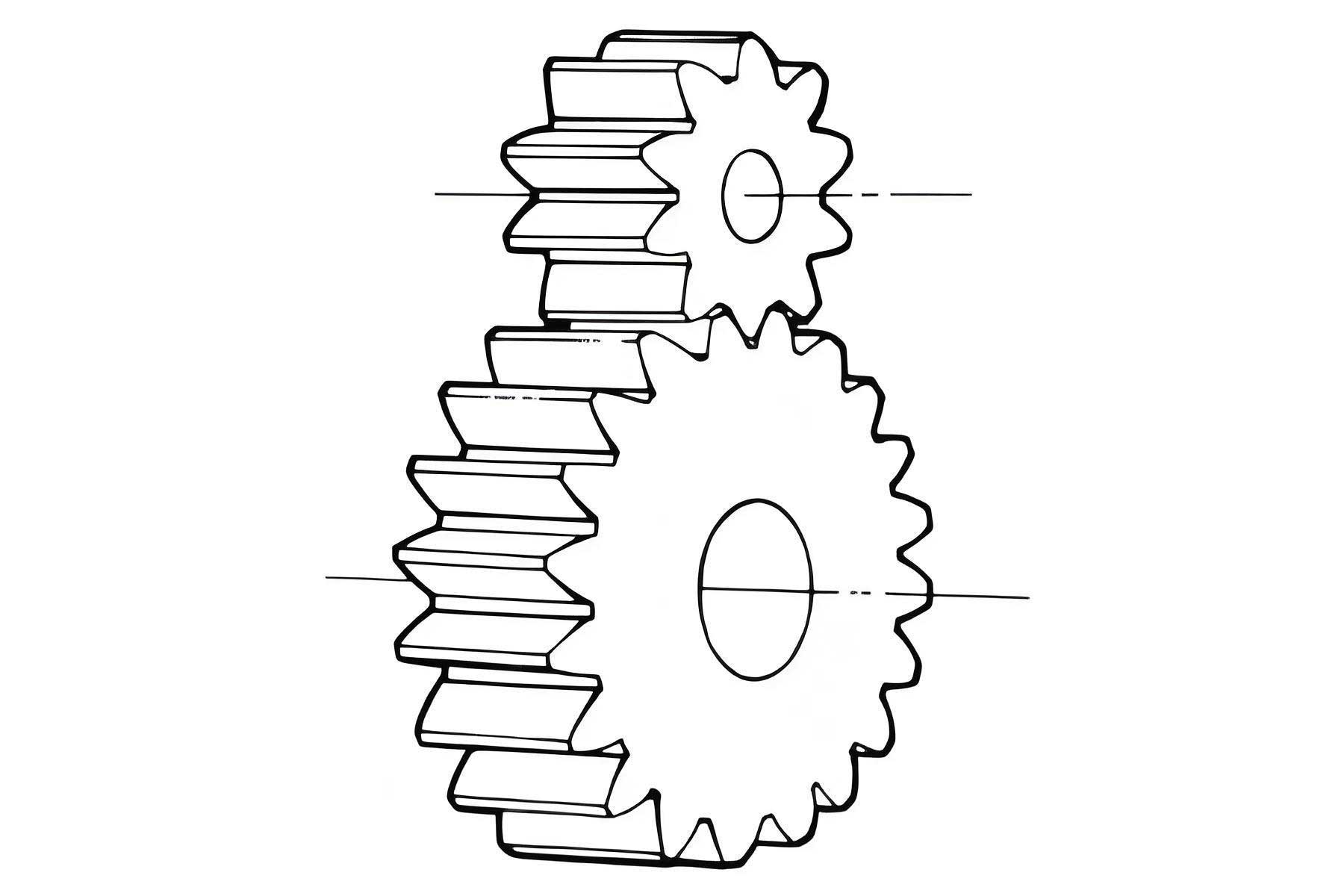
The pursuit of efficient and high-performance manufacturing for power transmission components consistently drives innovation in metal forming. Among these components, the spur gear remains a fundamental and widely used element due to its simplicity and effectiveness in transmitting motion and force between parallel shafts. Traditional manufacturing of spur gears, especially those with high (large) modulus, heavily relies on machining processes like hobbing or shaping. While precise, these methods are characterized by significant material waste, lower production rates, and the potential disruption of favorable grain flow lines in the material. Precision forging, or net-shape forging, has emerged as a compelling alternative, offering superior material utilization, enhanced mechanical properties from work hardening and continuous grain flow, and higher productivity. The successful forging of a spur gear is a complex interplay of material flow, die design, and process parameters.
Forging processes for spur gears are broadly categorized into cold, hot, and warm forging. Each presents distinct trade-offs. Cold forging of a spur gear offers excellent dimensional accuracy and surface finish but encounters prohibitively high forming loads and severe die stresses for high-modulus gears, leading to potential die failure and incomplete tooth filling. Hot forging significantly reduces flow stress but introduces challenges like scale formation, decarburization, and poorer dimensional control due to thermal contraction. Warm forging, conducted at an intermediate temperature range (typically 700°C – 850°C for steels), strikes a critical balance. It substantially lowers the flow stress compared to cold forging while minimizing the oxidation and dimensional inaccuracies associated with hot forging. For high-precision, high-modulus spur gears, a hybrid approach of warm forging followed by a cold finishing (sizing) operation is often considered optimal. This strategy relies on the warm forging stage to achieve near-net shape with complete tooth cavity filling, leaving minimal and predictable stock for the final cold calibration. Therefore, the primary objective in the warm forging stage is not ultimate surface finish, but ensuring complete and sound filling of the complex tooth profile, particularly at the corner radii, while managing the forming load to ensure die life and press capacity suitability.
Challenges in Conventional Closed-Die Forging of Spur Gears
The most straightforward approach for forging a spur gear is closed-die upsetting. In this conventional method, a cylindrical billet is placed inside a die cavity containing the negative impression of the spur gear teeth. Axial force is applied by upper and lower punches, causing the material to flow radially outward into the tooth spaces. While conceptually simple, this process suffers from inherent limitations when applied to a high-modulus spur gear.
The central challenge lies in the non-uniformity of material flow. Due to frictional constraints at the interfaces between the billet and the flat punch faces, a state of inhomogeneous deformation develops. The material in the central zone of the billet flows more freely, while the material at the top and bottom regions, adjacent to the punches, experiences restricted flow—these are often termed “dead metal zones” or rigid zones. This flow pattern leads to a critical defect: incomplete filling at the top and bottom corners (fillet regions) of the gear teeth. The corners are the last areas to fill, often resulting in a visible “collapse” or underfill, known as a flash or an unfilled radius. This defect is unacceptable for a preform destined for cold sizing, as the subsequent operation cannot compensate for missing material.
Furthermore, as the forging progresses and the material completely fills the die cavity, the pressure required rises dramatically. The final stage of filling the sharp corners subjects the tooling to extreme pressure, leading to high forming loads. This not only demands higher capacity presses but also accelerates die wear and risk of fatigue failure. The relationship between flow stress, friction, and geometry can be conceptually summarized. The average forging pressure \( p_{avg} \) in a simplified upsetting model can be expressed as:
$$ p_{avg} = Y’ \left(1 + \frac{\mu D}{3h}\right) $$
where \( Y’ \) is the constrained yield stress of the material (dependent on temperature and strain), \( \mu \) is the coefficient of friction, \( D \) is the workpiece diameter (or a characteristic dimension related to the gear’s root circle), and \( h \) is the instantaneous height. This shows that pressure increases with friction and the \(D/h\) ratio. In the final stages of spur gear forging, the effective \(D\) related to the contacting surface becomes large while \(h\) at the corners becomes very small, leading to a pressure spike. A finite element simulation of a conventional process for a spur gear with 18 teeth and a 3 mm module clearly demonstrates these issues, showing high strain concentration in the root area and low strain in the end zones, confirming the poor filling at the corners.
Optimization Strategy I: Broken-Line Punch Face Design
To address the problem of inhomogeneous flow and incomplete corner filling, the geometry of the tooling, specifically the punch faces, can be intelligently modified. The goal is to actively encourage metal flow in the problematic end regions. A flat punch face applies primarily axial force. A broken-line or profiled punch face introduces a radial component of force, promoting outward flow where it is most needed.
The proposed design involves replacing the traditional flat punch face with one featuring inclined surfaces aligned with the tooth spaces of the spur gear. Two specific schemes were developed and analyzed:
Scheme 1: Partial Inclination. Both the upper and lower punch faces are modified. The regions of the punch face corresponding to the locations above and below the tooth valleys of the spur gear are machined as inclined planes. The remaining areas above the tooth tips remain flat. This design applies a direct radial pushing force on the material destined for the tooth valleys from the very beginning of the stroke.
Scheme 2: Full Upper Inclination. Building on Scheme 1, further optimization is achieved by modifying the entire upper punch face into a single inclined plane, while the lower punch retains the partial-inclination design of Scheme 1. During forging, the upper punch is stationary, and the lower punch moves upward. This asymmetry in tooling compensates for the natural tendency of the upper material (near the stationary punch) to flow slower due to less relative motion and higher friction stickiness.
The effect of these designs is profound. The inclined surfaces act as “active feeders” for the tooth corners. They convert a portion of the axial punch motion into a radial squeezing action precisely at the critical zones. The dead metal zones are significantly reduced or eliminated, as material in the end regions is forced to participate in deformation earlier and more vigorously. Numerical simulation results confirm a more uniform strain distribution throughout the spur gear preform. Scheme 2, in particular, shows nearly simultaneous filling of the top and bottom tooth corners, achieving complete cavity fill without collapse. The table below summarizes the key geometric parameters and effects of the different punch designs.
| Punch Design Scheme | Upper Punch Face Profile | Lower Punch Face Profile | Primary Effect on Material Flow | Corner Filling Result |
|---|---|---|---|---|
| Conventional | Flat | Flat | Creates large rigid end zones; central material flows first. | Incomplete; collapse at top and bottom. |
| Scheme 1 (Partial Inclination) | Inclined over valleys, flat over tips | Inclined over valleys, flat over tips | Reduces rigid zones; promotes radial flow at valley regions. | Improved but bottom fill may still lag. |
| Scheme 2 (Full Upper Inclination) | Fully inclined plane | Inclined over valleys, flat over tips | Actively forces upper material flow; balances flow from top and bottom. | Complete and simultaneous filling achieved. |
The improvement is also quantifiable in terms of forming load. Compared to the conventional closed-die forging process for the same spur gear, the implementation of the optimized broken-line punch face (Scheme 2) resulted in a significant reduction of approximately 28.6% in the peak forming load. This reduction directly translates to lower press tonnage requirements and reduced stress on the forging die, enhancing its service life.
Optimization Strategy II: Constrained Axial Split-Flow Principle
While the punch face optimization solves the filling problem, the goal of minimizing the overall forming load remains critical for economic and practical production. A powerful concept to achieve this is the “constrained split-flow” or “flow relief” principle. The core idea is to design the process so that at the exact moment the tooth cavity is completely filled, the workpiece still possesses a free surface somewhere else. This free surface acts as a pressure relief valve, preventing the steep pressure rise associated with confining all material in a sealed cavity.
For the spur gear, this is implemented by incorporating an axial split-flow feature. The design involves creating a central through-hole or a pronounced depression in the billet/die setup, which remains unfilled until the very end of the stroke. As the punches compress the material, metal flows in two directions: radially outward to form the teeth and axially inward/outward into this designated relief zone. This bifurcation of flow paths reduces the resistance to radial flow. The process can be visualized as a combination of forward extrusion (into the tooth gaps) and backward extrusion (into the central hole).
The mechanics can be approximated by considering the total forming load \( F_{total} \) as a superposition of the loads required for different deformation modes:
$$ F_{total} \approx F_{filling} + F_{relief} $$
Where \( F_{filling} \) is the force needed to fill the gear teeth, and \( F_{relief} \) is the force for the material flowing into the relief zone. Critically, by providing an easier path (the relief zone), the pressure in the main cavity (the teeth) is capped. The pressure required for backward extrusion into a central hole, for instance, is generally lower than that for fully confined compression once a certain strain is reached. The relationship for ideal plastic work gives insight:
$$ W_{total} = \int V \cdot \bar{\sigma} \cdot d\bar{\epsilon} $$
where \( V \) is volume, \( \bar{\sigma} \) is mean flow stress, and \( \bar{\epsilon} \) is mean strain. By allowing some material to undergo a different, potentially less constrained strain path (into the relief), the overall work, and hence the peak load, for a given final spur gear shape is reduced.
When this constrained axial split-flow principle is combined with the optimized broken-line punch face design (Scheme 2), the benefits are synergistic. The punch face ensures complete and uniform filling, while the split-flow feature manages the forming load. Simulation results demonstrate this combined effect powerfully. The table below compares the peak loads from the different process routes for forging the target high-modulus spur gear.
| Process Route | Key Features | Peak Forming Load (kN) | Load Reduction vs. Conventional | Tooth Fill Quality |
|---|---|---|---|---|
| 1. Conventional Closed-Die | Flat punches, no relief | 465.7 | Baseline (0%) | Incomplete (Collapse) |
| 2. Optimized Punch Only | Broken-line punches (Scheme 2), no relief | 332.1 | 28.6% | Complete |
| 3. Combined Optimized Process | Broken-line punches + Constrained Axial Split-Flow | 249.8 | 46.4% (vs. Baseline) 24.8% (vs. Route 2) | Complete |
The data is striking. The combined optimized process reduces the peak load by nearly half compared to the traditional method and by a further 25% compared to using the optimized punch face alone. This dramatic reduction is achieved without compromising the goal of producing a fully filled spur gear preform. The load-stroke curve for the combined process shows a more gradual rise and lacks the final sharp spike characteristic of a fully confined process, indicating effective pressure management via the split-flow design.
Conclusion and Process Implications
The warm forging of high-modulus spur gears presents distinct technical challenges, primarily incomplete tooth filling and excessively high forming loads when using conventional closed-die forging methods. Through systematic analysis and numerical simulation, two interconnected optimization strategies have been established to overcome these hurdles.
First, the design of the punch faces is critical for controlling material flow. Replacing flat faces with broken-line profiles featuring strategic inclinations actively promotes radial flow into the critical tooth corner regions. This eliminates the dead metal zones, ensures uniform deformation, and guarantees complete filling of the spur gear tooth profile. The specific design with a fully inclined upper punch face combined with a partially inclined lower face proved most effective in balancing the flow from both ends of the billet.
Second, the principle of constrained axial split-flow is essential for load management. By incorporating a designed relief zone, such as a central hole, the metal is given an alternative flow path. This prevents the formation of a fully constrained, high-pressure state at the end of the stroke, thereby capping the maximum required forming load. When applied in conjunction with the optimized punch geometry, this strategy yields a preform for a spur gear that is both geometrically sound (fully filled) and produced with significantly lower force.
The synergy of these optimizations—geometric control of flow via tooling profile and thermodynamic management of pressure via flow relief—provides a robust foundation for the practical and economical warm forging of high-modulus spur gears. The resulting preform, with its complete tooth form and minimized internal stresses, is ideally suited for a subsequent cold finishing operation to achieve final dimensional and surface finish tolerances. This integrated approach advances the viability of precision forging as a competitive manufacturing route for critical power transmission components like the spur gear, offering benefits in material savings, mechanical performance, and production efficiency.