
In the field of mechanical power transmission, herringbone gears have garnered significant attention due to their unique double-helical structure, which effectively balances axial forces and enables smoother operation under heavy loads. As an engineer specializing in gear design, I have often faced the challenge of enhancing the performance of herringbone gear systems, particularly in applications demanding high reliability and longevity, such as aerospace and heavy machinery. One critical performance metric is the contact ratio, which directly influences load distribution, noise, vibration, and overall durability. A higher contact ratio ensures that multiple tooth pairs are engaged simultaneously, reducing stress on individual teeth and improving transmission stability. However, achieving a high contact ratio while maintaining strength and safety factors is a complex multi-objective optimization problem, as design parameters like tooth number, helical angle, addendum coefficient, and modification coefficient interact in non-linear ways. Traditional trial-and-error methods are inefficient and often yield suboptimal solutions. In this article, I will explore a systematic approach using advanced genetic algorithms to optimize herringbone gear design for high contact ratio, ensuring that safety and performance constraints are met. Through detailed analysis, mathematical modeling, and a case study, I aim to demonstrate how modern computational techniques can revolutionize the design process for herringbone gears, making it faster and more effective.
The fundamental advantage of herringbone gears lies in their ability to operate with high contact ratios. In a herringbone gear pair, the double-helical arrangement allows for larger helical angles without inducing net axial thrust, as the opposing helices cancel each other’s forces. This enables significant increases in axial overlap, contributing to the total contact ratio. The total contact ratio (εγ) for a herringbone gear is the sum of the transverse contact ratio (εα) and the axial contact ratio (εβ). Mathematically, these are expressed as:
$$ \varepsilon_{\alpha} = \frac{1}{2\pi} \left[ z_1 (\tan \alpha_{at1} – \tan \alpha’_t) + z_2 (\tan \alpha_{at2} – \tan \alpha’_t) \right] $$
and
$$ \varepsilon_{\beta} = \frac{b \sin \beta}{\pi m_n} $$
where \(z_1\) and \(z_2\) are the numbers of teeth on the pinion and gear, respectively; \(\alpha_{at1}\) and \(\alpha_{at2}\) are the transverse pressure angles at the tooth tips; \(\alpha’_t\) is the operating transverse pressure angle; \(\beta\) is the helical angle; \(b\) is the face width; and \(m_n\) is the normal module. For herringbone gears, the axial contact ratio can be substantial due to the typically large \(\beta\) values (often between 25° and 40°). However, simply increasing the helical angle or other parameters may compromise other aspects like bending strength, contact stress, or geometric constraints. Therefore, a balanced optimization is essential. To understand the trade-offs, let’s analyze the key design parameters affecting the contact ratio and strength of herringbone gears.
Several parameters influence the contact ratio and mechanical performance of herringbone gears. Below is a summary table highlighting the effects of each parameter:
| Parameter | Effect on Contact Ratio | Effect on Strength and Other Factors |
|---|---|---|
| Addendum Coefficient (\(h^*_{an}\)) | Increasing \(h^*_{an}\) raises tooth height, enhancing \(\varepsilon_{\alpha}\) by extending the path of contact. | May reduce tooth tip thickness, risking bending failure or tooth pointing. Increases sliding velocity, raising scuffing risk. |
| Pressure Angle (\(\alpha\)) | Decreasing \(\alpha\) increases \(\varepsilon_{\alpha}\) by widening the contact zone. | Reduces tooth thickness and root curvature radius, increasing bending and contact stresses. |
| Number of Teeth (\(z\)) | Higher \(z\) increases \(\varepsilon_{\alpha}\) and improves smoothness. | Enhances bending and contact strength but may increase gear size and weight. |
| Helical Angle (\(\beta\)) | Larger \(\beta\) significantly boosts \(\varepsilon_{\beta}\), a key advantage for herringbone gears. | Improves load sharing and quietness; herringbone design allows high \(\beta\) without axial thrust issues. |
| Modification Coefficient (\(x_n\)) | Affects tooth profile; proper modification can optimize \(\varepsilon_{\alpha}\) and load distribution. | Equal modification (pinion +ve, gear -ve) balances strength, maintains center distance, and prevents undercutting. |
From this analysis, it is clear that optimizing a herringbone gear for high contact ratio involves balancing multiple, often conflicting, objectives. For instance, while a high addendum coefficient boosts contact ratio, it may weaken the tooth tip. Similarly, a large helical angle improves axial overlap but could complicate manufacturing or affect dynamic behavior. Therefore, a multi-objective optimization framework is necessary to find Pareto-optimal solutions that offer the best compromises. In my work, I employ the Fast Elitist Non-dominated Sorting Genetic Algorithm (NSGA-II), a robust evolutionary algorithm well-suited for such problems. NSGA-II efficiently explores the design space, maintaining a diverse set of solutions without requiring weight assignments for different objectives. This is particularly useful for herringbone gear design, where designers may prioritize contact ratio, safety factors, or geometric constraints differently based on application needs.
To formalize the optimization problem, I define the design variables, objective functions, and constraints. The goal is to maximize both the total contact ratio and the overall safety factor of the herringbone gear transmission, while adhering to practical limitations. The design variables selected are those most influential on contact ratio and strength: pinion tooth number (\(z_1\)), helical angle (\(\beta\)), normal modification coefficient for the pinion (\(x_{n1}\)), and normal addendum coefficient (\(h^*_{an}\)). Note that for a fixed transmission ratio, the gear tooth number \(z_2\) is determined, and equal modification is applied (i.e., \(x_{n2} = -x_{n1}\)) to maintain center distance and balance strength. The objective functions are formulated as minimization problems for algorithmic convenience:
Objective 1: Maximize total contact ratio (\(\varepsilon_{\gamma}\))
$$ \min f_1 = -\varepsilon_{\gamma} = -(\varepsilon_{\alpha} + \varepsilon_{\beta}) $$
Objective 2: Maximize overall safety factor (\(S_{\Sigma}\))
$$ \min f_2 = -S_{\Sigma} = -[\min(S_{F1}, S_{F2}) + \min(S_{H1}, S_{H2})] $$
Here, \(S_{F1}\) and \(S_{F2}\) are the bending safety factors for pinion and gear, and \(S_{H1}\) and \(S_{H2}\) are the contact safety factors. These safety factors are computed based on ISO or AGMA standards, involving stress calculations and material properties. For example, the contact stress (\(\sigma_H\)) and bending stress (\(\sigma_F\)) can be calculated using:
$$ \sigma_H = Z_H Z_E Z_{\varepsilon} Z_{\beta} \sqrt{ \frac{F_t}{d_1 b} \cdot \frac{u+1}{u} \cdot K_A K_v K_{H\beta} K_{H\alpha} } $$
and
$$ \sigma_{F0} = \frac{F_t}{b m_n} Y_F Y_S Y_{\beta} $$
where \(Z_H\), \(Z_E\), \(Z_{\varepsilon}\), \(Z_{\beta}\) are contact stress factors; \(Y_F\), \(Y_S\), \(Y_{\beta}\) are bending stress factors; \(F_t\) is tangential load; \(d_1\) is pinion pitch diameter; \(u\) is gear ratio; and \(K\) factors account for application, dynamic, and load distribution effects. The safety factors are then derived as:
$$ S_H = \frac{\sigma_{Hlim} Z_{NT} Z_L Z_v Z_R Z_W Z_X}{\sigma_H} $$
$$ S_F = \frac{\sigma_{Flim} Y_{ST} Y_{NT} Y_{\delta relT} Y_{RrelT} Y_X}{\sigma_F} $$
with material endurance limits and life factors. The overall safety factor \(S_{\Sigma}\) combines the minimum bending and contact safety factors to ensure both failure modes are addressed.
The optimization is subject to numerous constraints to ensure practical feasibility and reliability. These constraints are listed below in a table for clarity:
| Constraint Type | Mathematical Expression | Description |
|---|---|---|
| Contact Strength | \(g_1 = S_{H1} – S_{Hmin} \geq 0\), \(g_2 = S_{H2} – S_{Hmin} \geq 0\) | Safety factors must exceed minimum allowable values (e.g., 1.2). |
| Bending Strength | \(g_3 = S_{F1} – S_{Fmin} \geq 0\), \(g_4 = S_{F2} – S_{Fmin} \geq 0\) | Bending safety must be sufficient. |
| Tooth Tip Thickness | \(g_5 = s_{a1} – 0.4 m_t \geq 0\), \(g_6 = s_{a2} – 0.4 m_t \geq 0\) | Tip thickness must prevent pointing; calculated via gear geometry. |
| Undercut Prevention | \(g_7 = x_{n1} – \left(h^*_{an} – \frac{z_1 \sin^2 \alpha_t}{2 \cos \beta}\right) \geq 0\) \(g_8 = x_{n2} – \left(h^*_{an} – \frac{z_2 \sin^2 \alpha_t}{2 \cos \beta}\right) \geq 0\) |
Modification must avoid root undercutting. |
| Interference Avoidance | \(g_9, g_{10}\): based on involute geometry | Ensure no tooth interference during meshing. |
| Center Distance Error | \(g_{11} = 0.1 – |a’ – a| \geq 0\) | Actual center deviation within 0.1 mm. |
| Sliding Ratio Balance | \(g_{12} = 2.0 – |\eta_1 – \eta_2| \geq 0\) | Limit difference in sliding ratios to reduce wear. |
| Scuffing Resistance | \(g_{13} = S_B – S_{Bmin} \geq 0\) | Scuffing safety factor must be adequate. |
With the model established, the NSGA-II algorithm is applied to search for Pareto-optimal solutions. NSGA-II works by initializing a population of design vectors, evaluating their objectives and constraints, and then iteratively applying selection, crossover, and mutation operators to evolve better solutions. Its fast non-dominated sorting and crowding distance mechanisms preserve diversity and push the population toward the Pareto front. For herringbone gear optimization, I typically set parameters like population size = 250, generations = 200, crossover probability = 0.8, and mutation probability = 0.3. The algorithm efficiently handles the mixed-integer nature (e.g., tooth numbers are integers) and nonlinear constraints.
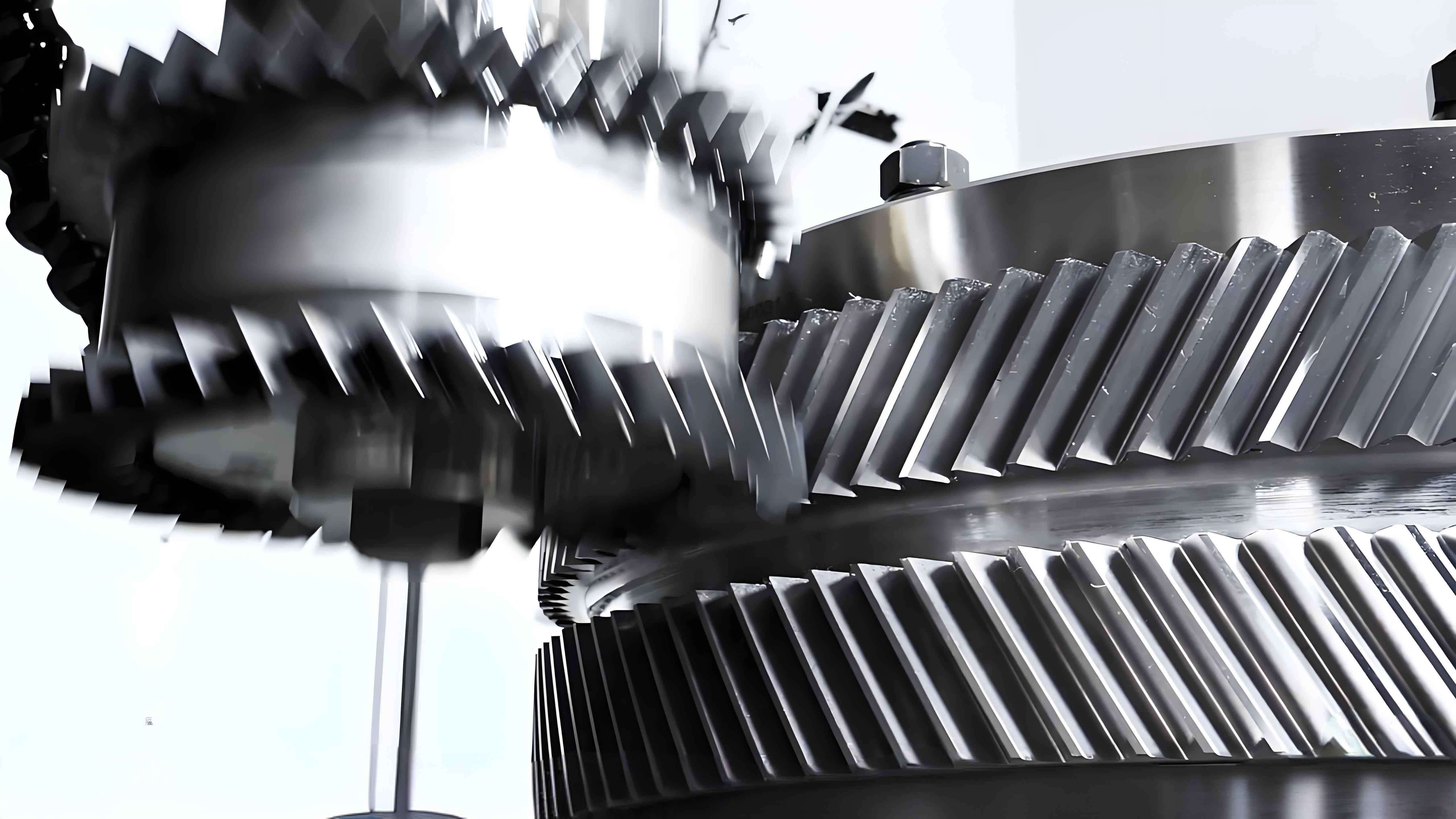
To illustrate the effectiveness of this approach, I present a case study based on a high-power transmission application. Consider a single-stage herringbone gear reducer with input power \(P = 1000\) kW, input speed \(n_1 = 2584\) rpm, gear ratio \(u = 10\), and center distance \(a = 621\) mm. Both pinion and gear are made of carburized steel with hardness 58-62 HRC, bending endurance limit \(\sigma_{Flim} = 550\) MPa, and contact endurance limit \(\sigma_{Hlim} = 1700\) MPa. The initial design has \(z_1 = 23\), \(z_2 = 231\), \(\beta = 31^\circ\), \(m_n = 4.193\) mm, \(h^*_{an} = 1.0\), and no modification (\(x_{n1} = 0\)). Running the NSGA-II optimization yields a set of Pareto-optimal solutions after 200 generations. The evolution of solutions can be visualized in objective space (contact ratio vs. safety factor), showing convergence from scattered points to a clear Pareto front. From this front, designers can select a solution based on priorities. For instance, if maintaining the same tooth numbers is desired to control gear size, one can choose an optimized solution with identical \(z_1\) and \(z_2\). Below is a comparison table between the initial design and a selected optimized design:
| Parameter | Initial Design | Optimized Design |
|---|---|---|
| \(z_1 / z_2\) | 23 / 231 | 23 / 231 |
| Normal Pressure Angle \(\alpha_n\) | 20° | 20° |
| Helical Angle \(\beta\) | 31° | 34.096° |
| Normal Module \(m_n\) (mm) | 4.193 | 4.051 |
| Addendum Coefficient \(h^*_{an}\) | 1.0 | 1.297 |
| Modification Coefficients \(x_{n1} / x_{n2}\) | 0 / 0 | -0.2709 / 0.2709 |
| Transverse Contact Ratio \(\varepsilon_{\alpha}\) | 1.394 | 1.727 |
| Axial Contact Ratio \(\varepsilon_{\beta}\) | 4.399 | 4.956 |
| Total Contact Ratio \(\varepsilon_{\gamma}\) | 5.793 | 6.683 |
| Overall Safety Factor \(S_{\Sigma}\) | 3.981 | 4.658 |
The optimized herringbone gear design shows significant improvements: the total contact ratio increases from 5.793 to 6.683 (about 15% gain), and the overall safety factor rises from 3.981 to 4.658. This is achieved by increasing the helical angle (from 31° to 34.096°) and the addendum coefficient (from 1.0 to 1.297), along with applying equal modification. The modification helps balance bending strengths while keeping the center distance unchanged. Importantly, all constraints, such as tip thickness and interference, are satisfied. This case demonstrates the power of multi-objective optimization in enhancing herringbone gear performance without compromising reliability.
Beyond this example, the optimization framework can be adapted to various herringbone gear applications. For instance, in aerospace reducers where weight is critical, one might add objectives like minimizing gear mass or volume. The NSGA-II algorithm can handle such extensions seamlessly. Moreover, sensitivity analysis can be performed to understand how each design variable affects the objectives. For herringbone gears, the helical angle and addendum coefficient are often the most sensitive parameters for contact ratio, while tooth number and modification coefficient strongly influence strength. These insights guide designers in making informed trade-offs.
In conclusion, the pursuit of high contact ratio in herringbone gear transmission is a multifaceted challenge that benefits greatly from computational optimization. By employing the NSGA-II algorithm, we can efficiently explore the design space and obtain Pareto-optimal solutions that balance contact ratio and safety factors. The method eliminates the inefficiencies of manual iteration and provides a set of viable designs for selection based on application-specific needs. For herringbone gears, key strategies include utilizing larger helical angles (made possible by the double-helical structure), increasing addendum coefficients cautiously, and applying equal modification to enhance strength without altering center distance. This approach not only improves performance but also ensures reliability and manufacturability. As gear technology advances, such optimization techniques will become indispensable in designing next-generation herringbone gear systems for demanding industries.