
In the pursuit of advancing automotive transmission technology, the localization of high-performance gear manufacturing has become a critical endeavor. As a researcher deeply involved in material science and thermal processing, I embarked on a comprehensive study to develop and validate carburizing heat treatment processes for domestically produced ZF steel, specifically aimed at meeting the stringent requirements of ZF transmission gears. The primary objective was to devise a set of simple, reliable, and cost-effective heat treatment protocols that not only achieve the desired mechanical properties but also minimize potential heat treatment defects such as excessive carbon concentration, insufficient hardening depth, microstructural irregularities, and distortion. Heat treatment defects can severely compromise gear performance, leading to premature failure, noise, and reduced reliability. Therefore, this research focuses on optimizing carburizing parameters to ensure consistency and quality, thereby addressing common heat treatment defects prevalent in industrial settings.
The ZF company, a global leader in transmission systems, utilizes a specialized low-alloy steel treated with chromium, manganese, and boron for its gears. This steel is renowned for its simple alloy composition, excellent processability, narrow hardenability band, fine grain size, and scientifically tailored purity levels. However, the adaptation of domestic ZF steel to replicate these attributes requires meticulous heat treatment design. The technical specifications for ZF gears, as exemplified by the AK6-90 transmission, encompass surface carbon concentration, surface hardness, effective case depth, and core strength, categorized into three groups based on application. Any deviation in these parameters can introduce heat treatment defects, underscoring the need for precise control.
| Steel Grade | Surface Carbon Concentration (%) | Surface Hardness (HRC) | Core Strength (N/mm²) | Effective Case Depth (mm) | Primary Applications |
|---|---|---|---|---|---|
| ZF7 | 0.65–0.85 | 59–63 | 1000–1400 | 0.7–1.0 | Intermediate shafts, gears |
| ZF6 | 0.65–0.85 | 59–63 | 800–1400 | 0.4–0.7 | Clutch sleeves, coupling sleeves |
| ZF6 | 0.65–0.85 | 59–63 | 900–1300 | 0.2–0.5 | Engaging tooth seats |
Note: The cutoff hardness for effective case depth is 610 HV1. Achieving these targets without inducing heat treatment defects necessitates a profound understanding of carburizing media and process dynamics.
In the selection of carburizing agents, traditional methods using kerosene were deemed inadequate due to their complex molecular structure and instability, leading to poor carbon potential control and slow carburizing rates. Such inconsistencies are direct contributors to heat treatment defects like non-uniform case depth and erratic surface carbon levels. To circumvent these issues, we explored a modern approach employing methanol as a carrier and ethyl acetate as an enriching agent. This combination offers enhanced process stability, facile carbon potential adjustment, and accelerated carburizing speed, all critical for reducing heat treatment defects. The decomposition reactions at carburizing temperatures are as follows:
$$ \text{CH}_3\text{OH} \rightarrow \text{CO} + 2\text{H}_2 $$
$$ \text{CH}_3\text{COOC}_2\text{H}_5 \rightarrow 2[\text{C}] + 2\text{CO} + 4\text{H}_2 $$
These reactions yield identical gas compositions, allowing seamless integration without interference, thus enabling continuous carbon potential control with ethyl acetate. The high carbon transfer coefficient of ethyl acetate (β = 2.8 × 10⁻⁵) compared to kerosene-methanol mixtures (β = 2.0 × 10⁻⁵) further enhances diffusion kinetics, reducing processing time and associated heat treatment defects. However, ethyl acetate decomposition also produces methane, carbon dioxide, and water vapor, which must be managed to avoid sooting or decarburization—common heat treatment defects.
To quantify carbon potential, we conducted measurements in an RJJ-35 kW pit-type gas carburizing furnace under empty conditions. Using foil analysis, we determined carbon potentials at 920°C and 930°C with varying drip rates. For instance, methanol at 80 drops/min (0.35 ml/drop) yielded a carbon potential of 0.97%, while ethyl acetate at 80 drops/min (0.034 ml/drop) gave 1.12%. At 120 drops/min, ethyl acetate reached 1.31%. When both agents were dripped simultaneously at 930°C, different ratios produced carbon potentials ranging from 1.20% to 1.40%. These data are pivotal for designing processes that avoid heat treatment defects like excessive carbon uptake, which can lead to brittle carbide networks and reduced fatigue strength.
| Methanol Drip Rate (drops/min) | Ethyl Acetate Drip Rate (drops/min) | Furnace Temperature (°C) | Carbon Potential (%) |
|---|---|---|---|
| 80 | 0 | 920 | 0.97 |
| 0 | 80 | 920 | 1.12 |
| 0 | 120 | 920 | 1.31 |
| 46 | 42 | 930 | 1.25 |
| 25 | 69 | 930 | 1.40 |
| 64 | 20 | 930 | 1.20 |
Based on these findings and accounting for carbon potential shifts when loading gears, we formulated three distinct carburizing heat treatment processes for domestic ZF steel, each tailored to specific case depth requirements while proactively mitigating heat treatment defects. The processes, denoted as I, II, and III, involve precise temperature and drip rate profiles to achieve target surface carbon concentrations and hardening depths. For all processes, quenching was performed in No. 20 engine oil maintained at 90–120°C to minimize distortion and cracking—key heat treatment defects in gear manufacturing. The test specimens, including gear blanks and carbon concentration bars, had a chemical composition (wt%): 0.18 C, 0.25 Si, 1.10 Mn, 0.02 P, 0.009 S, 1.01 Cr, and 0.003 B.
The heat treatment cycles were designed with careful consideration of diffusion kinetics to prevent heat treatment defects. Process I targets a surface carbon concentration of 0.75–0.85% and an effective case depth of 0.7–1.0 mm, equivalent to 1.0–1.5 mm by metallographic methods. Process II aims for 0.70–0.80% surface carbon and 0.4–0.7 mm case depth (0.8–1.1 mm metallographic), while Process III is for 0.65–0.75% surface carbon and 0.2–0.5 mm case depth (0.5–0.9 mm metallographic). Each process incorporates stages for heating, carburizing, diffusion, and quenching, with controlled cooling to reduce residual stresses that contribute to heat treatment defects.
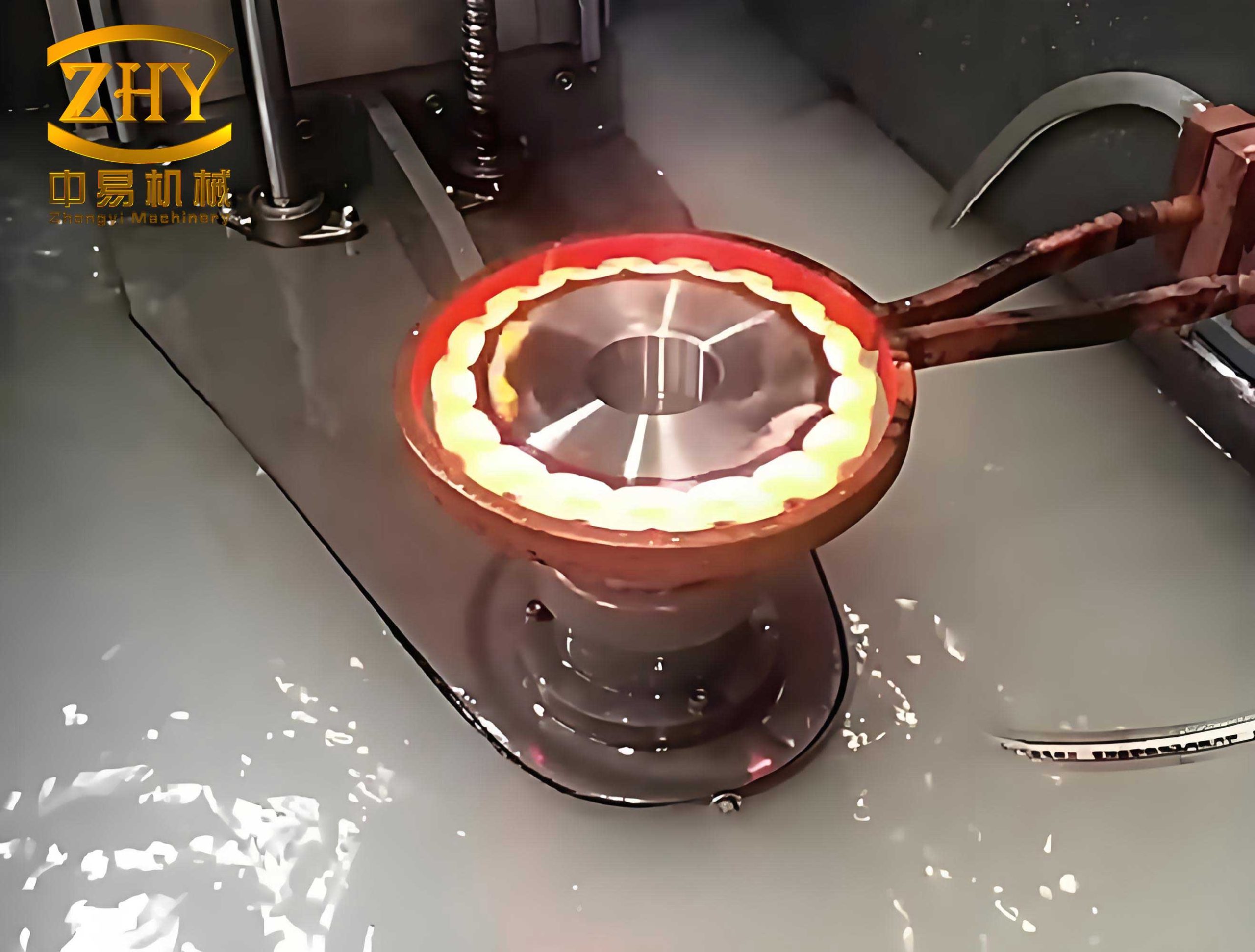
To illustrate the importance of microstructural control in avoiding heat treatment defects, consider the following image depicting common issues in heat-treated gears:
In our experimental trials, we conducted four runs for each process, totaling twelve furnace batches, to ensure statistical reliability and assess consistency in mitigating heat treatment defects. The results, summarized in tables below, reveal that all processes met the technical specifications with minimal variability, indicating robustness against heat treatment defects. Microstructural examination showed fine martensite, minimal carbide precipitation, controlled retained austenite, and absence of ferrite, all within acceptable grades. This refinement is crucial because coarse microstructures or excessive retained austenite are typical heat treatment defects that impair hardness and wear resistance.
| Process | Martensite (Grade) | Carbides (Grade) | Retained Austenite (Grade) | Ferrite (Grade) |
|---|---|---|---|---|
| I | 3–5 | 1 | 3–4 | 1 |
| II | 2–3 | 1 | 2–3 | 1 |
| III | 2–4 | 1 | 1–3 | 1 |
The surface carbon concentration, hardness, and case depth measurements further confirm the efficacy of our processes in preventing heat treatment defects. For Process I, surface carbon ranged from 0.72% to 0.86%, surface hardness from 59 to 62 HRC, effective case depth from 1.05 to 1.15 mm, and core hardness from 39 to 45 HRC. Process II yielded 0.69–0.82% carbon, 59–61 HRC hardness, 0.65–0.85 mm case depth, and 38–42 HRC core hardness. Process III achieved 0.68–0.76% carbon, 59–60 HRC hardness, 0.40–0.65 mm case depth, and 38–41 HRC core hardness. These tight tolerances demonstrate successful avoidance of heat treatment defects like shallow case depth or soft spots, which are detrimental to gear durability.
| Process | Surface Carbon Concentration (%) at 0.05 mm | Surface Hardness (HRC) | Effective Case Depth (mm) | Total Case Depth (mm) | Core Hardness (HRC) |
|---|---|---|---|---|---|
| I | 0.72–0.86 | 59–62 | 1.05–1.15 | 1.20–1.47 | 39–45 |
| II | 0.69–0.82 | 59–61 | 0.65–0.85 | 1.05–1.30 | 38–42 |
| III | 0.68–0.76 | 59–60 | 0.40–0.65 | 0.74–0.98 | 38–41 |
To delve deeper into the mechanisms behind defect prevention, we analyzed carbon concentration and microhardness profiles across the case depth for each process. The curves, plotted from experimental data, exhibit gradual gradients, indicating optimal diffusion and minimal risk of heat treatment defects such as abrupt hardness drops or excessive carbon buildup at the surface. The carbon concentration profile can be modeled using Fick’s second law of diffusion:
$$ \frac{\partial C}{\partial t} = D \frac{\partial^2 C}{\partial x^2} $$
where \( C \) is carbon concentration, \( t \) is time, \( D \) is the diffusion coefficient, and \( x \) is depth. For our processes, the boundary conditions were set to achieve target surface carbon levels while ensuring a smooth transition to the core, thereby avoiding heat treatment defects like spalling or case crushing. The hardness gradient correlates with carbon content, following a relationship approximated by:
$$ HV = f(C, \text{microstructure}) $$
where \( HV \) is Vickers hardness. In Process I, with longer carburizing times, the gradient is flatter, enhancing toughness and resistance to heat treatment defects like fatigue cracking. The effective case depth, defined by the 610 HV1 cutoff, was consistently within specifications, underscoring the reliability of our approach in mitigating heat treatment defects related to depth inconsistency.
The economic implications are also significant. While methanol and ethyl acetate are costlier than kerosene, their faster carburizing rates reduce overall cycle times, lowering energy consumption and labor costs. Moreover, the superior process stability diminishes scrap rates due to heat treatment defects, yielding substantial long-term savings. For instance, ethyl acetate reduces carburizing time by approximately one-third compared to kerosene, directly cutting exposure to potential heat treatment defects like grain growth or oxidation. This aligns with industrial goals of efficiency and quality assurance, where minimizing heat treatment defects is paramount for competitiveness.
In summary, the three carburizing heat treatment processes developed for domestic ZF steel have proven effective in meeting ZF transmission gear requirements while systematically addressing and preventing heat treatment defects. The use of methanol and ethyl acetate as carburizing media, coupled with precise drip rate control, enables consistent carbon potential management, rapid processing, and fine microstructures. By adhering to these protocols, manufacturers can achieve gears with desired surface carbon concentration, hardness, case depth, and core properties, all while mitigating common heat treatment defects. Future work could explore advanced carbon control systems or alternative quenching mediums to further enhance defect reduction. Ultimately, this research contributes to the localization of high-quality gear production, fostering innovation in automotive transmission technology and setting a benchmark for heat treatment excellence.