
In my extensive experience with gear manufacturing, particularly focusing on spiral bevel gears and miter gears, I have consistently observed that the quality of tooth contact patterns is paramount for ensuring optimal performance, longevity, and noise reduction in power transmission systems. A miter gear, specifically a bevel gear with a 1:1 ratio and typically a 90-degree shaft angle, presents unique challenges in achieving a perfect contact pattern. The contact pattern, or the area where the teeth of the mating gears actually make contact under load, directly influences load distribution, stress levels, wear characteristics, and acoustic emissions. Therefore, refining the machining processes to control and improve this contact zone is a critical endeavor. This article delves into several practical machining methods I have employed and refined over the years to correct common contact pattern issues in miter gears and spiral bevel gears, with a particular emphasis on techniques applicable to miter gear sets. The principles discussed are fundamental to high-precision gear manufacturing.
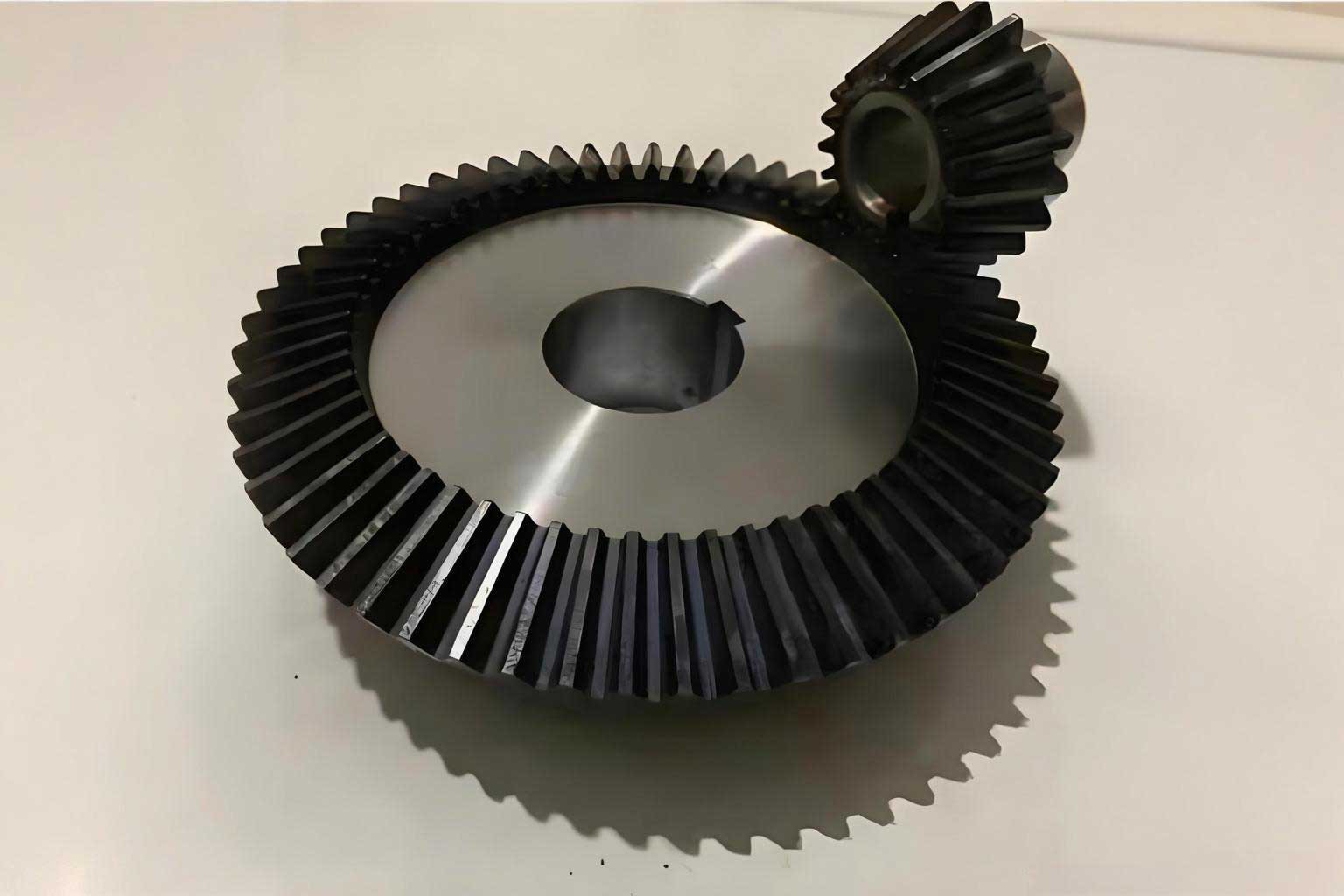
The pursuit of a perfect contact pattern for any miter gear begins with understanding the basic geometry and the machining setup. Spiral bevel gears, including those configured as miter gears, offer superior performance compared to straight bevel gears due to their gradual tooth engagement, higher load capacity, and increased overlap ratio. However, this complexity in tooth geometry—characterized by a curved tooth trace and varying pressure angles along the tooth profile—makes the control of the contact pattern during machining significantly more delicate. The primary machining method for these gears is face milling or face hobbing using a cutter head (刀盘). The setup parameters on the gear cutting machine, such as the machine root angle, cutter head tilt (swivel angle), radial distance (床位), rotational ratio (滚比 or roll), and horizontal and vertical offsets of the workpiece, all interact to define the final tooth form and, consequently, the contact pattern. Even minor deviations in these settings can lead to undesirable contact patterns like “I-shaped” (工字形) or diagonal contact, which compromise the miter gear’s functionality. The core of my methodology revolves around systematic adjustment of these machine settings based on rolling test results to iteratively converge on the ideal pattern.
One of the first significant improvements I implemented involved the machining of zero spiral angle spiral bevel gears, which are often used as replacements for straight bevel miter gears to reduce noise. These gears, while having a nominal zero degree spiral angle at the mid-point of the tooth, still possess a slight curvature. Initially, using large-diameter cutter heads (e.g., 12-inch) for cutting these gears resulted in contact patterns that were extremely sensitive and difficult to adjust, often requiring dozens of hours of trial and error. The breakthrough came from switching to a smaller diameter cutter head, such as a 6-inch one. The fundamental reason is that the effective spiral angle along the tooth length is influenced by the cutter radius. A smaller diameter cutter increases the spiral angle at both the toe (小端) and heel (大端) of the tooth while keeping the midpoint spiral angle largely unchanged. This alteration in the tooth flank curvature makes the contact pattern less sensitive to machine adjustments. In practical terms, for a set of miter gears (typically a pair), the adjustment time for achieving a satisfactory contact pattern was reduced from over 40 hours to approximately 8 hours. This approach has been successfully applied for over a decade in producing various zero-spiral miter gear sets, consistently yielding easier setup and better, more stable contact patterns. The relationship between cutter diameter (D_c) and the local spiral angle (β_local) at a point distance ‘x’ from the tooth center can be conceptually described, though the exact calculation depends on the gear geometry and machine kinematics. A simplified view is that the tooth curvature is more pronounced with a smaller cutter, which beneficially alters the mismatch between the mating flanks. This is a crucial technique for anyone machining this specific type of miter gear.
A common and problematic contact pattern is the “I-shaped” or “barrel-shaped” contact, where the pattern is excessively wide at the center of the tooth and narrows at the top and bottom, resembling the letter “I”. This condition arises when the relative curvature of the two mating tooth surfaces in the profile direction (tooth height direction) is too small. Essentially, the flanks are too flat against each other. To correct this, we need to modify the curvature mismatch. The most effective adjustment is to alter the rolling ratio on the cutting machine, which changes the generated gear tooth profile. The required change in rolling ratio (Δi) can be derived from the observed change in the vertical offset (ΔV) on a gear rolling tester that produces the desired pattern narrowing. The governing formula is:
$$ \Delta i = \frac{\Delta V \cdot i}{R \cdot \sin \beta} $$
Where:
\( \Delta i \) = Required change in the machine rolling ratio (滚比改变量).
\( \Delta V \) = Change in vertical offset on the rolling tester that improved the pattern (垂直轮位改变量).
\( i \) = Original machine rolling ratio (原切齿机床滚比值).
\( R \) = Cone distance at the mid-point of the tooth (中点锥距).
\( \beta \) = Spiral angle at the mid-point of the tooth (中点螺旋角).
For instance, when working on a large module spiral bevel miter gear (模数 12), the pinion’s convex side exhibited a severe I-shaped contact. On the rolling tester, lowering the vertical offset by 1.2 mm successfully eliminated the pattern. The original parameters were: \( i = 1.284 \), \( \beta = 35^\circ \), \( R = 320 \, \text{mm} \). Plugging into the formula:
$$ \Delta i = \frac{-1.2 \, \text{mm} \times 1.284}{320 \, \text{mm} \times \sin 35^\circ} \approx \frac{-1.5408}{320 \times 0.5736} \approx \frac{-1.5408}{183.552} \approx -0.0084 $$
The new rolling ratio became \( i_{\text{new}} = 1.284 – 0.0084 = 1.2756 \). Applying this modified ratio on the cutting machine produced a perfect, centered contact pattern in a single trial. This formula provides a direct, quantitative link between testing corrections and production machine adjustments, saving immense time. It is universally applicable for correcting width-related issues in miter gear contact patterns.
Another frequent issue is diagonal contact, where the contact patch runs along the diagonal of the tooth flank instead of being centered. This is inherent to the geometry of spiral bevel and miter gears because the cutter head axis is typically set perpendicular to the root line, causing the pressure angle to vary along the tooth length—increasing on one flank and decreasing on the other. There are two types: inner diagonal contact (from heel-top to toe-root on the convex side, and heel-root to toe-top on the concave side) and outer diagonal contact (the reverse). A slight diagonal contact can be acceptable and even beneficial for noise reduction and accommodating heat treatment distortion, but severe cases require correction. The root cause is a mismatch between the gear’s kinematic roll motion and the cutter head position. The standard diagnostic method involves a rolling test with combined vertical (ΔV) and horizontal (ΔH) displacements of the gears. The ratio \( \Delta V / \Delta H \) indicates the tendency. For a gear with a 35° spiral angle, typical threshold ratios might be around 0.7 for the concave side and 1.4 for the convex side. If the measured ratio is higher, inner diagonal contact occurs; if lower, outer diagonal contact occurs.
To eliminate unwanted diagonal contact, a coordinated adjustment of four machine settings is necessary: the rolling ratio (i), the horizontal workpiece offset (水平轮位), the cutter head tilt or eccentric angle (刀位/偏心角), and the radial distance or床位. The adjustments must be applied in a specific sequence and direction depending on the gear flank (concave or convex) and the type of diagonal contact. The following table summarizes the adjustment directions for common gear cutting machines (like the Russian 528 models or Chinese Y2250) to correct diagonal contact in a miter gear set.
| Type of Diagonal Contact | Gear Flank | Rolling Ratio (i) | Horizontal Offset | Cutter Tilt (Eccentric Angle) | Radial Distance (Bed) |
|---|---|---|---|---|---|
| Inner Diagonal | Concave | Increase | Decrease | Decrease | Increase |
| Convex | Decrease | Increase | Increase | Decrease | |
| Outer Diagonal | Concave | Decrease | Increase | Increase | Decrease |
| Convex | Increase | Decrease | Decrease | Increase |
The procedure is systematic: First, adjust the rolling ratio and horizontal offset together to reposition the contact pattern to the desired height on the tooth profile. This change will affect the tooth depth, which must then be compensated by adjusting the radial distance (bed). Finally, adjust the cutter head tilt (eccentric angle) to shift the pattern along the tooth length (from toe to heel) to center it. This sequence ensures that corrections are decoupled as much as possible. For example, when correcting an inner diagonal contact on the convex side of a pinion in a miter gear pair, I would decrease the rolling ratio, increase the horizontal offset, increase the cutter tilt, and decrease the radial distance. Each adjustment is made in small, measured increments, followed by a trial cut and rolling check. This method has proven highly effective in producing high-precision miter gears with centered, elliptical contact patterns ideal for high-load, low-noise applications.
Beyond these specific corrections, the overall philosophy for machining a high-quality miter gear involves a deep integration of theory and practice. The initial machine setup is calculated using standard generation methods (like the Gleason or Klingelnberg systems). However, these calculations are based on nominal geometries and assume ideal conditions. In reality, machine tool errors, cutter wear, and material properties introduce variations. Therefore, the rolling test is the indispensable final arbiter. Establishing a direct correlation between rolling test adjustments and machine setting changes, as encapsulated in the formula and table above, transforms the process from an art into a controlled science. For complex miter gear designs, such as those with high spiral angles or modified tooth profiles, these principles still apply, but the adjustment magnitudes may need empirical calibration. Furthermore, the choice of cutter head design—blade profile, pressure angle, and diameter—is a foundational decision that pre-influences the contact pattern’s sensitivity. My consistent recommendation for miter gears is to consider smaller diameter cutter heads where applicable, as they offer greater flexibility in controlling the pattern’s shape and size.
The economic and performance implications of mastering these techniques are substantial for any manufacturer of miter gears. Reduced setup and debugging time directly lower production costs. More importantly, a correctly tailored contact pattern ensures that the miter gear set operates with even load distribution, minimizing stress concentrations that lead to premature pitting, spalling, or tooth breakage. This translates to higher reliability, longer service life, and reduced downtime for the machinery in which these gears are installed. In high-speed applications, such as in aerospace or precision machine tools, the reduction in noise and vibration achieved through optimal contact patterning is a critical selling point. The miter gear, though a specific subset of bevel gears, exemplifies the precision required in all gear manufacturing. The methods described—addressing zero-spiral gears, I-shaped patterns, and diagonal contact—form a core toolkit. They underscore the fact that producing a superior miter gear is not merely about precise cutting; it is about precise correction and optimization based on systematic feedback. As manufacturing technology evolves with CNC gear cutters offering direct compensation inputs, the underlying principles of contact pattern analysis and the adjustment logic remain unchanged and ever more relevant. The pursuit of the perfect contact pattern is, ultimately, the pursuit of perfection in power transmission, with the humble yet critical miter gear standing as a testament to that engineering endeavor.
To further elaborate on the mathematical foundation, let’s consider the geometry of contact. The tooth surface of a generated spiral bevel or miter gear can be represented as a complex parametrized surface. The contact pattern is the projection of the contact ellipse under load onto the tooth flank. The size and orientation of this ellipse are governed by the principal curvatures and relative curvature of the two mating surfaces. The machine adjustments essentially modify these curvatures. For instance, changing the rolling ratio ‘i’ alters the lengthwise curvature (in the profile direction), while changing the cutter tilt modifies the profile curvature (in the lengthwise direction). The combined effect is described by the mismatch in curvature tensors. A simplified expression for the resulting relative normal curvature (κ_rel) in a given direction can be derived from the machine kinematics. While the full derivation is extensive, a key relationship for the change in profile curvature due to a change in roll (Δi) is proportional to Δi / (R * sinβ), as seen in our earlier formula. Similarly, the change in lengthwise curvature due to a change in horizontal offset (ΔH) is proportional to ΔH / R. These relationships guide the qualitative adjustments in the table. For a miter gear pair, ensuring a slight mismatch (or “ε” mismatch) rather than perfect conjugacy is often desired to localize the contact and allow for deflection under load. The goal is to achieve a controlled, centered ellipse. The contact condition can be modeled using the equation of meshing and the elasticity equations (Hertzian contact), but for practical machining, the empirical adjustments linked to rolling tests are most efficient.
In conclusion, the art and science of improving the tooth contact pattern in miter gears through machining methods revolve around a few powerful, interconnected techniques. The strategic use of smaller diameter cutter heads for certain gear types, the application of a precise formula to correct pattern width via rolling ratio adjustment, and the systematic, four-parameter method to eliminate diagonal contact form the backbone of this process. Each step is aimed at manipulating the microscopic geometry of the gear tooth to produce a macroscopic performance improvement. As a practitioner, I have found that investing time in understanding and applying these methods pays exponential dividends in the quality of the final miter gear product. The miter gear, with its demanding requirement for precise 90-degree motion transfer, serves as an excellent platform for demonstrating these universal gear finishing principles. Whether for automotive differentials, industrial machinery, or precision instruments, the quest for the ideal contact pattern remains a central, challenging, and rewarding aspect of advanced gear manufacturing.