
In the pursuit of superior NVH (Noise, Vibration, and Harshness) performance and the prevention of gear tooth flank burnishing within passenger vehicle transmissions, power gear honing has become the predominant final machining process for gear teeth surfaces. This widespread adoption is a testament to its effectiveness in achieving the high surface finish and geometric accuracy required. However, the inherent characteristics of the gear honing process, particularly its constrained material removal rate, impose stringent requirements on the pre-machined gear blank’s condition and the allowance left for honing. In practical applications, these constraints often lead to a significant challenge: fluctuations in grinding resistance during the cycle. These fluctuations can induce various types of vibrations within the machining system. The consequence is the formation of periodic amplitudes, or fixed-order excitations, on the finished gear flank. Ironically, instead of improving NVH, this can degrade the actual acoustic performance of the component, introducing complex and difficult-to-control quality issues that are detrimental to the final product’s refinement.
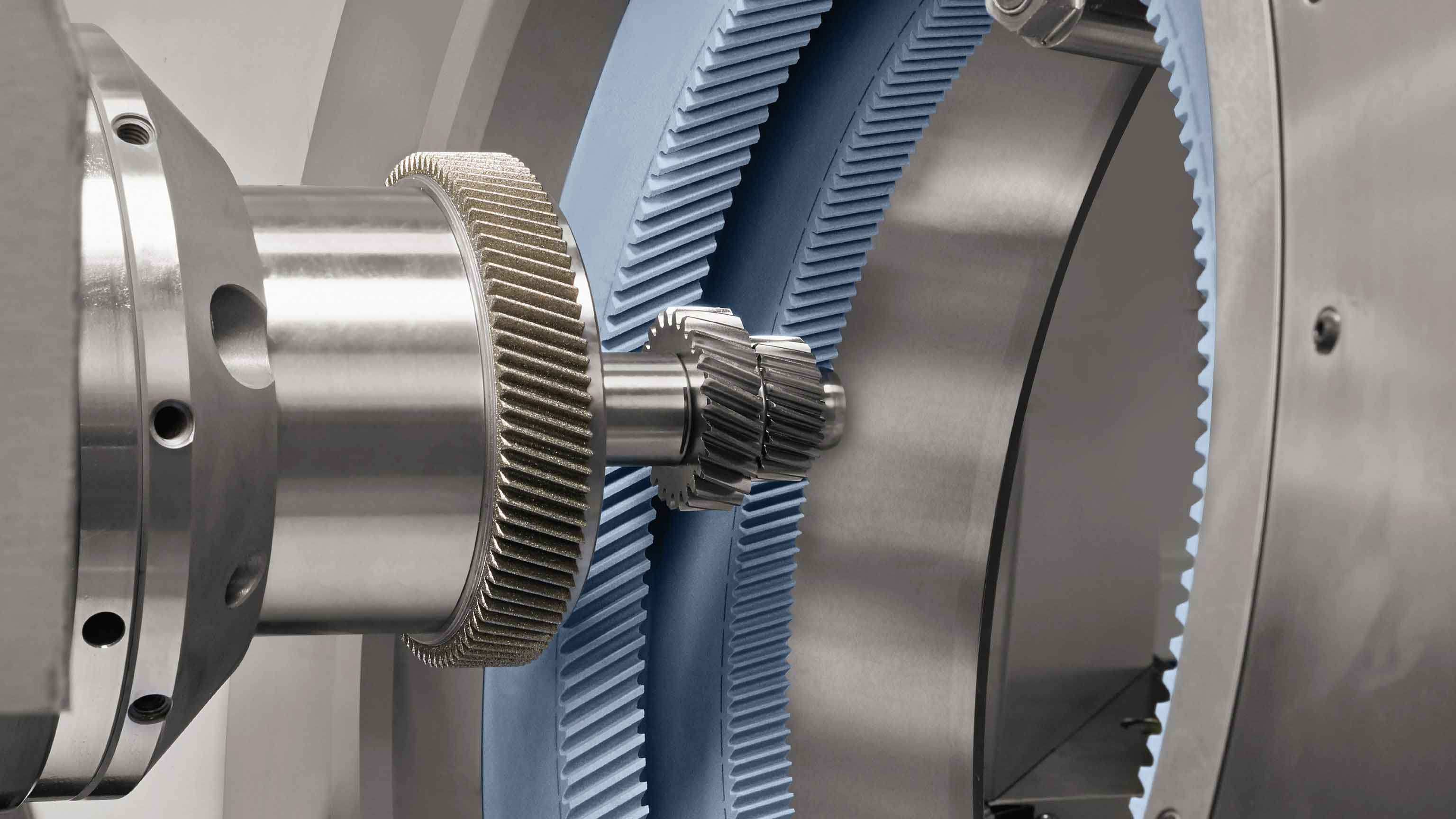
To combat this, modern gear honing machines are equipped with sophisticated monitoring systems. One such system, the Hybrid Reactive Index (HRI) vibration monitoring featured on widely used platforms like PRAWEMA, provides a critical window into the dynamic state of the machining process. By capturing and analyzing vibration data in real-time, this system shifts gear honing from a purely empirical process to a data-driven one, enabling proactive quality assurance and facilitating root-cause analysis for surface finish defects.
Principles of In-Process Vibration Monitoring in Gear Honing
The foundation of effective vibration analysis in gear honing lies in strategic data acquisition. To capture the dynamic behavior of the machine tool during the critical gear honing operation, accelerometers or other vibration sensors are installed on the machine’s primary rapid-motion components. These components are the primary sources and carriers of vibrational energy during the machining cycle. In a typical vertical gear honing machine configuration, the three key axes instrumented are:
- Workpiece Spindle (C-axis): Responsible for clamping and rotating the gear component.
- Honing Wheel Spindle (B-axis): Responsible for clamping and driving the honing worm (the abrasive tool).
- Tailstock / Quill Axis (U-axis): Provides axial support and rotation (if applicable) to the workpiece from the opposite end.
The sensors mounted on these axes collect real-time vibration signals. These analog signals are then conditioned and digitized by data acquisition hardware before being streamed to a PC-based processing unit. Here, the continuous time-domain signal is transformed into the frequency domain using Fast Fourier Transform (FFT) algorithms. This transformation is crucial, as it decomposes the complex vibration waveform into its constituent frequencies and their corresponding amplitudes, revealing the characteristic “fingerprint” of the machining process and any aberrant excitations.
The Power Gear Honing Process: Stages and Challenges
Understanding the vibration data requires context from the gear honing process itself. Power gear honing is a continuous, synchronous machining operation. The honing worm and the workpiece gear are driven by independent, synchronized spindles. The process involves simultaneous axial reciprocation of the workpiece (or the tool) and a controlled radial infeed. Material removal occurs through the relative sliding motion at the meshing point between the abrasive honing worm and the gear teeth, under a defined pressure. The process is typically segmented into distinct, programmable stages, each with a specific objective. The table below outlines these primary phases:
| Process Stage Name | Primary Objective & Description |
|---|---|
| Approach / Contact | The initial movement bringing the honing worm from a safe position into full, controlled contact with the workpiece gear teeth. No significant material removal occurs. |
| Infeed / Working Stroke | The primary material removal phase. The tool radially feeds into the workpiece at a specified rate while axial stroking continues, removing stock to achieve the target gear geometry and size. |
| Spark-out / Dwell | The final finishing phase. Radial infeed stops, but axial stroking and synchronous rotation continue. This stage allows for the removal of any remaining microscopic peaks, improving surface finish and roundness through a gentle polishing action without changing the major dimensions. |
To facilitate targeted analysis of vibration data, each of these machining stages is assigned a unique numerical code during data logging. This allows analysts to filter and examine vibrations specific to a particular phase of the gear honing cycle. For instance, vibrations during the infeed stage are most critical for geometric accuracy and waviness formation, while vibrations during spark-out directly impact the final surface roughness.
| Stage Code | Process Stage |
|---|---|
| 3, 7 | Approach / Plunge Paths |
| 4, 10 | Main Infeed / Working Paths |
| 5 | Spark-out / Dwell |
The very nature of gear honing—characterized by lower specific cutting forces and a distributed cutting action across multiple teeth—makes it susceptible to dynamic instability. Periodic variations in cutting resistance, often stemming from pre-machining errors like residual radial runout or tooth spacing errors from the previous process (e.g., hobbing or shaping), can excite the structural natural frequencies of the machine-workpiece-tooling system. This resonance leads to forced vibrations that are imprinted onto the gear flank as a periodic surface texture, commonly referred to as waviness. When this waviness has a spatial periodicity that aligns with specific gear mesh harmonics, it acts as a potent source of gear whine or tonal noise, directly undermining the NVH goals the gear honing process is meant to achieve.
Analyzing the Vibrational Signature: The HRI Methodology
The HRI system provides two primary interfaces for vibration analysis: a real-time monitoring spectrum and a post-process analytical software suite (HRI Analyze+).
The real-time spectrum displays live FFT data from each instrumented axis (C, B, U). The horizontal axis can be toggled between frequency (Hz) and order. The relationship between order and frequency is fundamental to gear honing analysis and is given by:
$$ f = \frac{O \times n}{60} $$
where $f$ is the frequency in Hz, $O$ is the order (a dimensionless unit representing cycles per revolution), and $n$ is the rotational speed of the relevant axis (workpiece C-axis or honing wheel B-axis) in revolutions per minute (RPM). The vertical axis displays the amplitude of vibration in milligravitational units (mg). Analyzing vibrations in the order domain is particularly powerful for gear honing, as it directly correlates excitations to the rotation of the workpiece or tool. For example, a vibration at the 1st order of the workpiece spindle indicates unbalance, while a vibration at the tooth-mesh frequency (equal to the number of gear teeth) would indicate an issue related to individual tooth engagement.
Over years of application, characteristic frequencies and orders associated with common machine tool issues have been cataloged. This empirical knowledge base serves as a first-reference diagnostic guide when analyzing HRI data.
| Frequency / Order Range | Potential Associated Issue |
|---|---|
| 240 – 300 Hz | Natural frequency of the machine’s guideway system. |
| ~1040 Hz | Natural frequency of the spindle housing assembly. |
| 1050 – 1850 Hz | Natural frequency of the workpiece clamping/chucking system. |
| 3000 – 4000 Hz | Natural frequency of the clamping system when the tailstock is engaged. |
| 1st Order (Workpiece) | Unbalance in the workpiece or its mounting. |
| 2nd / 3rd Order | Misalignment, such as a tilted workpiece or incorrect tailstock center alignment. |
| 3rd / 4th Order | Potential wear or issues with the X or Z-axis guideways affecting motion straightness. |
Post-Process Deep Dive with HRI Analyze+
While the real-time display is valuable for immediate oversight, the true power for root-cause analysis lies in the post-process data. The system continuously logs detailed vibration data for every single gear honing cycle in comma-separated value (CSV) format. The most critical files for quality analysis are the FFTlog files, which contain the full spectral data for each axis at each stage of the process for every part produced.
HRI Analyze+ software is designed to parse and visualize this vast dataset. The initial data import presents a list of all FFT files. The first step in analysis is data filtering. One typically filters the data to show only the most critical axes (usually the workpiece C-axis) and the most critical gear honing stages (typically the main working infeed, codes 4/10, and the spark-out stage, code 5). This focuses the analysis on the phases that determine the final flank topography.
The filtered list data, while comprehensive, is not intuitively diagnostic. The next step is to generate a spectrogram (or colormap). This visualization plots sequential parts on the vertical axis, frequency/order on the horizontal axis, and uses a color gradient (e.g., from light yellow to dark red) to represent vibration amplitude. This view is exceptionally powerful. It transforms numerical data into a visual “landscape” where abnormal patterns—vertical stripes of high amplitude at a specific frequency/order, or horizontal bands indicating a problem affecting a batch of parts—immediately stand out. This allows for the rapid identification of both sporadic and systematic issues in the gear honing process.
Once an anomaly is spotted on the spectrogram, the analyst can use the slice analysis function. This extracts a detailed amplitude-vs.-part graph for a specific frequency or order band, alongside the corresponding machining stage data. By correlating spikes in vibration amplitude with the exact moment in the gear honing cycle (e.g., mid-infeed), one can begin to hypothesize the physical cause, such as a tool wear phenomenon or a clash with a specific part feature.
Practical Application: From Diagnosis to Preventive Control
The ultimate goal of vibration monitoring in gear honing is to ensure consistent, high-quality output. This is achieved through a two-pronged approach: diagnosing existing problems and preventing the outflow of defective parts.
Case Study: Diagnosing a Waviness Problem
A practical scenario involved a gear honing cell producing parts with an unacceptable “S-shaped” profile error on the tooth flank. Analysis began by loading FFTlog data from the problematic production period into HRI Analyze+ and generating a spectrogram for the workpiece C-axis during the working infeed stage. The visualization revealed a prominent, consistent band of high vibration amplitude in the order range of 32 to 36. For context, with the workpiece spindle rotating at approximately 5770 RPM during infeed, this order range corresponds to a frequency range of:
$$ f = \frac{32 \times 5770}{60} \approx 3077 \text{ Hz} \quad \text{to} \quad \frac{36 \times 5770}{60} \approx 3462 \text{ Hz} $$
Referring to the empirical knowledge base, this frequency range (3000–4000 Hz) is known to be associated with the natural frequency of the clamping system when the tailstock is engaged. This immediately directed the investigation toward the tailstock and workpiece alignment. A subsequent check revealed a slight misalignment in the tailstock center. After recalibration and realignment of the tailstock, the high-amplitude vibration band in the 32-36 order range disappeared from the spectrogram, and the subsequent gear honing process produced parts within the required profile tolerance, eliminating the S-shape error.
Implementing Preventive Monitoring Limits
To prevent the recurrence of known issues or to catch new ones before they affect a large batch, the HRI system allows for the setting of real-time monitoring limits. These are threshold values for vibration amplitude at specific frequencies/orders and during specific gear honing stages. If a part is being honed and the vibration exceeds the predefined limit, the machine control system can trigger an alarm and automatically divert that part to a quarantine or re-inspection station.
For instance, based on the diagnosis above and historical process capability data, one might configure the following preventive rule in the HRI monitoring window:
| Parameter | Setting | Rationale |
|---|---|---|
| Axis: | Workpiece (C-axis) | Primary source of the problematic vibration. |
| Stage: | Working Infeed (Code 10) | Critical phase for geometry and waviness formation. |
| Order Band: | 32 – 36 | The identified problematic order range linked to tailstock clamp resonance. |
| Amplitude Limit: | 60 mg | A safe threshold below which part quality is historically assured, but above which risk increases. |
| Action: | Divert Part for Inspection | Prevents a potentially non-conforming part from proceeding to assembly. |
This transforms the gear honing process from an open-loop operation into a closed-loop, controlled system. It ensures that any deviation in the dynamic process signature—a precursor to quality loss—is immediately flagged, enabling corrective maintenance or process adjustment before scrap is generated.
Conclusion: A Data-Driven Future for Gear Finishing
The integration of advanced vibration monitoring systems like HRI represents a significant leap forward in the precision and reliability of power gear honing. The methodology described—from strategic sensor placement and data acquisition through spectral analysis to practical diagnosis and preventive control—provides a robust framework for managing the complex dynamics of this critical finishing process. While the specific frequencies and orders will vary between machine models, workpiece geometries, and tooling setups, the core analytical principle remains universal: correlate vibrational excitations with physical system properties and process stages.
Successfully leveraging this technology is an iterative process of building a historical database. One must establish a baseline of “normal” vibration signatures for a stable, capable gear honing process. This baseline spectrogram becomes the reference against which all future production is compared. Deviations from this baseline, especially in the critical infeed and spark-out stages, are not merely data points but direct indicators of changes in the machine-tool-workpiece system—be it tool wear, bearing degradation, loss of alignment, or issues with the incoming part quality from previous operations.
The principles of using vibration analysis to ensure surface integrity, particularly waviness control, extend beyond gear honing. They are equally applicable to other high-precision gear finishing processes like continuous generating grinding or form grinding. In an industry where micron-level imperfections can lead to unacceptable acoustic performance, the ability to monitor and control the machining process in the dynamic domain is no longer a luxury but a necessity for achieving and sustaining world-class quality in transmission manufacturing. The systematic approach to vibration monitoring ensures that the gear honing process consistently delivers on its promise of superior NVH performance, turning a potential source of variability into a pillar of quality assurance.