
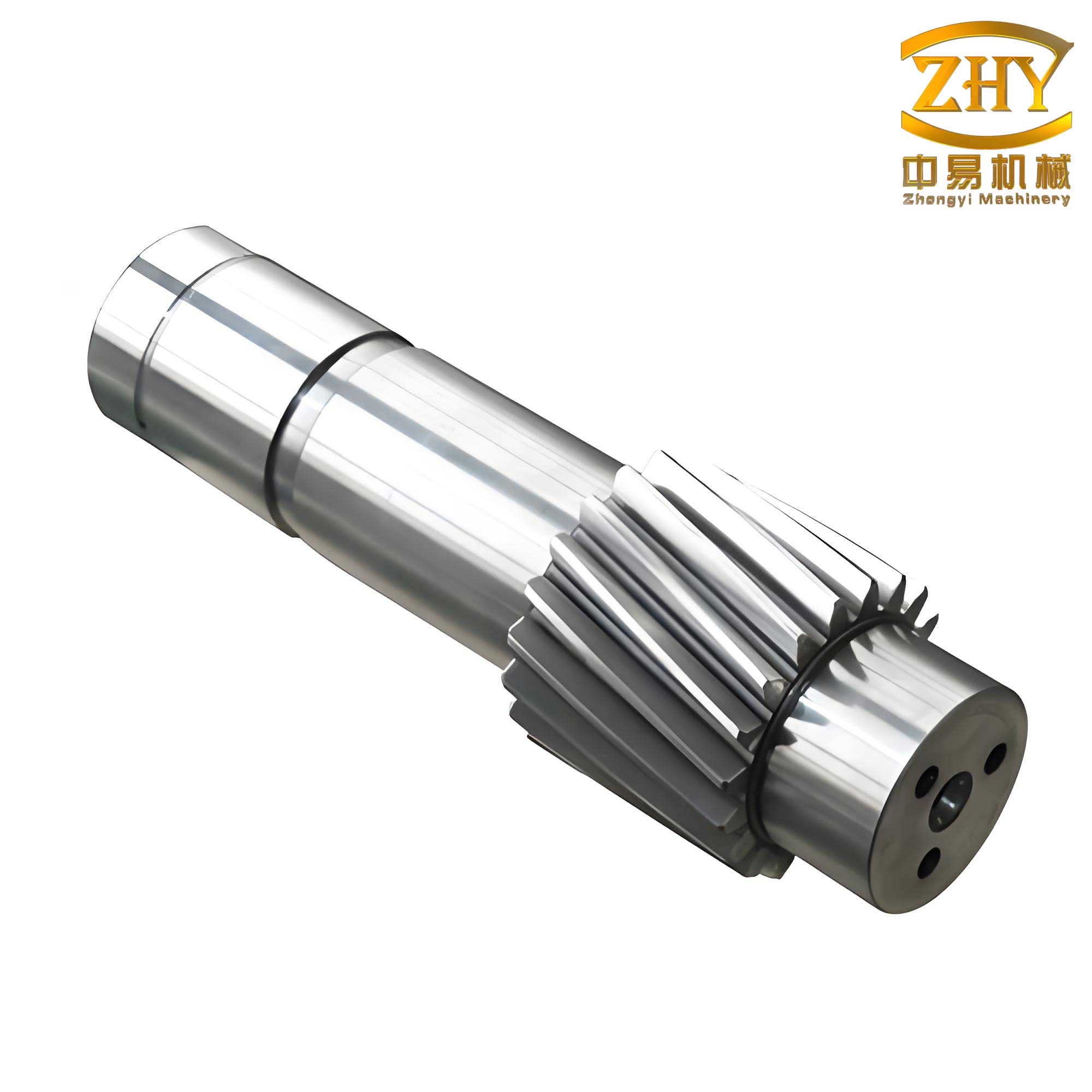
In the design and manufacturing of power transmission systems, the performance and reliability of gear shafts are paramount. These critical components are subjected to complex stresses including bending, torsion, and contact fatigue. For cost-effective applications, medium-carbon steels like AISI 1045 (45 steel) are frequently chosen for gear shafts. However, achieving an optimal balance of high strength for load-bearing capacity and sufficient toughness to resist shock loads and crack propagation with conventional heat treatment can be challenging. My exploration into enhancing the mechanical properties of 45 steel for gear shafts led me to investigate subcritical quenching (intercritical quenching), a process conducted within the ferrite-austenite two-phase region (between Ac1 and Ac3). This method promises superior strength-toughness combinations, reduced processing costs, and lower distortion compared to conventional hardening.
The fundamental principle of subcritical quenching involves heating steel with a balanced or normalized microstructure to a temperature where austenite and ferrite coexist. Upon quenching, the austenite transforms to martensite, while a controlled amount of undissolved, fine ferrite is retained. This dual-phase structure is key to the enhanced properties. For gear shafts, this can translate to longer service life, potential for downsizing, and improved resistance to failure. The core of my work was to systematically map the effect of subcritical quenching temperature and subsequent tempering on the microstructure and mechanical properties of 45 steel, aiming to define an optimized thermal processing window specifically for gear shaft applications.
Experimental Methodology: From Material to Testing
The investigation began with hot-rolled 45 steel bar stock. To establish a consistent and refined initial microstructure and eliminate material history variations, all samples underwent a normalization pretreatment at 800°C for 8 minutes, followed by air cooling. This resulted in a uniform, near-equilibrium microstructure of fine pearlite and ferrite, providing a reliable baseline for all subsequent heat treatments.
The subcritical quenching experiments were designed to probe the critical temperature range. Samples were austenitized at various temperatures from 750°C to 840°C (encompassing both subcritical and conventional full hardening temperatures) for 6 minutes, followed by water quenching. To study the tempering response, quenched samples were tempered at different temperatures (450°C, 500°C, 550°C, and 600°C) for 2 hours and air-cooled. For comparison, a conventional quenching and tempering (Q&T) process (840°C quench + 600°C temper) was also performed, yielding the baseline properties shown in Table 1.
| Tensile Strength (MPa) | Elongation (%) | Reduction of Area (%) | Impact Absorbed Energy (J) | Hardness (HRC) |
|---|---|---|---|---|
| 796.2 | 19.6 | 63.4 | 107.1 | 19.1 |
Following heat treatment, samples were machined into standard tensile specimens (6 mm diameter) and Charpy V-notch impact specimens. Mechanical testing was conducted to measure tensile strength, elongation, impact toughness, and hardness. Microstructural analysis was performed using optical microscopy on polished and etched (4% nital) samples to correlate mechanical properties with the observed phases—martensite (and its tempered products) and undissolved ferrite.
Mechanical Performance: The Strength-Toughness Dance
The effect of subcritical quenching temperature, particularly when combined with medium-temperature tempering, revealed a fascinating interplay between strength and toughness. Figure 1 summarizes the key trends for samples tempered at 550°C. The tensile strength initially increases with rising quenching temperature, peaks around 790-800°C, and then shows a slight decline at 810°C and above. This peak strength significantly surpasses that achieved by conventional Q&T (796 MPa), reaching levels above 900 MPa. The initial increase is attributed to the decreasing volume fraction of softer, undissolved ferrite and the formation of finer martensite. The subsequent slight drop at higher subcritical temperatures may be linked to the very low ferrite content approaching full hardening, which alters the overall strengthening mechanism.
Conversely, the impact toughness generally shows an inverse relationship with strength in this range, yet remains at a respectably high level. More intriguing behavior was observed at a lower tempering temperature of 500°C, as illustrated in Figure 2. While the tensile strength remained consistently high (between 900-1100 MPa) across the quenching range from 750°C to 810°C, the impact toughness exhibited a clear and valuable trend: as the subcritical quenching temperature decreased, the impact toughness increased. This presents a unique processing advantage for gear shafts where high strength is non-negotiable, but a margin of toughness is crucial for overload scenarios.
The tempering temperature universally governs the final balance. As expected, lower tempering temperatures (450-500°C) yield higher strength and lower toughness, while higher temperatures (550-600°C) increase toughness at the expense of strength. This relationship can be conceptually modeled for a fixed quenching condition:
$$ S_T = S_0 – k_s \cdot (T – T_0) $$
$$ K_T = K_0 + k_k \cdot (T – T_0) $$
where \( S_T \) and \( K_T \) are strength and toughness at tempering temperature \( T \), \( S_0 \) and \( K_0 \) are the initial quenched state values, \( T_0 \) is a reference temperature, and \( k_s \), \( k_k \) are positive material constants. The innovation of subcritical quenching is that it elevates the \( S_0 \) and \( K_0 \) baseline compared to conventional quenching, allowing access to superior property combinations.
| Target Priority | Quenching Temperature Range | Tempering Temperature Range | Expected Tensile Strength | Expected Impact Energy | Key Microstructural Feature |
|---|---|---|---|---|---|
| Peak Strength & Good Toughness | 790°C – 810°C | 450°C – 550°C | 900 – 1100 MPa | 70 – 110 J | Fine, dispersed ferrite in tempered martensite |
| Enhanced Toughness & High Strength | 770°C – 790°C | 475°C – 525°C | 900 – 1050 MPa | 90 – 110 J | Slightly higher volume of fine, dispersed ferrite |
Microstructural Evolution: The Role of Undissolved Ferrite
The mechanical behavior is directly governed by the microstructure. After subcritical quenching and tempering, the microstructure consists of tempered martensite (appearing as dark-etching tempered troostite or sorbite) and undissolved ferrite. The morphology, distribution, and volume fraction of this ferrite are critical.
At lower subcritical quenching temperatures (e.g., 750-780°C), a significant amount of proeutectoid ferrite remains. If this ferrite forms a continuous network along prior austenite grain boundaries (as seen at 780°C), it can act as a preferred path for crack propagation, compromising strength and sometimes toughness. However, as the quenching temperature increases within the optimal window (790-810°C), the volume fraction of ferrite decreases and, crucially, its morphology changes. It becomes finely dispersed as discrete particles or a broken network, homogeneously distributed within the tempered martensite matrix.
This refined, dispersed ferrite confers multiple benefits for gear shaft performance:
- Grain Refinement: The presence of second-phase ferrite particles pins austenite grain boundaries during heating, inhibiting grain growth. This results in a finer prior austenite grain size, which transforms into finer martensite packets/plates upon quenching. The Hall-Petch relationship underscores the strengthening contribution:
$$ \sigma_y = \sigma_0 + k_y \cdot d^{-1/2} $$
where \( \sigma_y \) is yield strength, \( \sigma_0 \) and \( k_y \) are constants, and \( d \) is the grain diameter. Finer grains simultaneously enhance toughness by increasing the grain boundary area that impedes crack propagation. - Carbon Redistribution: The austenite formed in the two-phase region has a lower carbon content than the nominal steel composition because carbon preferentially partitions into the austenite. This results in lower-carbon martensite after quenching, which is inherently less brittle and produces finer carbides during tempering, further improving toughness.
- Impurity Segregation: It is suggested that harmful impurities like phosphorus can be trapped within the undissolved ferrite phase, reducing their segregation to prior austenite grain boundaries and thereby lowering the risk of temper embrittlement, a vital consideration for the long-term reliability of gear shafts.
Thus, the optimal microstructure for gear shafts is not a single-phase hardened state, but a fine, homogeneous dual-phase structure of soft, ductile ferrite islands in a strong, tough tempered martensite matrix.
Defining the Optimal Process for Gear Shafts
Synthesizing the mechanical and microstructural data, an optimized heat treatment schedule for 45 steel gear shafts can be established. The process flow is as follows:
1. Normalization: 800°C for 8 minutes, air cool. (Establishes uniform, fine starting microstructure).
2. Subcritical Quenching: Heat to 770-810°C, hold for sufficient time (approx. 6 min for section sizes relevant to gear shafts), water quench.
3. Tempering: Temper at 450-550°C for 2 hours, air cool.
The specific choice within these ranges depends on the primary design goal for the gear shaft:
- For peak strength with good toughness: Quench at 790-810°C and temper at 500-550°C.
- For enhanced toughness while maintaining high strength: Quench at 770-790°C and temper at 475-525°C. This leverages the positive toughness trend observed at lower subcritical temperatures with 500°C tempering.
This optimized subcritical quenching and tempering (SQ&T) process offers distinct advantages over conventional Q&T for gear shaft production, summarized in Table 3.
| Aspect | Subcritical Quenching & Tempering (SQ&T) | Conventional Quenching & Tempering (Q&T) |
|---|---|---|
| Strength-Toughness Balance | Superior. Achieves higher strength (900-1100 MPa) with comparable or better toughness. | Limited. Higher toughness (at 600°C temper) comes with significantly lower strength (~800 MPa). |
| Processing Temperature | Lower (770-810°C). Reduces energy consumption, furnace wear, and scaling. | Higher (840-850°C typical). Higher energy input and distortion potential. |
| Quenching Stress & Distortion | Potentially lower due to smaller thermal gradient and presence of soft ferrite, reducing cracking risk for complex gear shaft geometries. | Higher thermal stress, increasing risk of distortion and quench cracking. |
| Microstructural Stability | Fine, stable dispersion of ferrite may improve resistance to property degradation. | Fully martensitic structure is more homogeneous but may have different tempering kinetics. |
Conclusion
The investigation into subcritical quenching of 45 steel presents a compelling case for its adoption in manufacturing high-performance gear shafts. By precisely controlling the heat treatment to operate within the intercritical region, a unique microstructure comprising tempered martensite and finely dispersed undissolved ferrite is achieved. This structure delivers a remarkable synergy of properties: tensile strengths exceeding 900 MPa coupled with Charpy impact energies consistently above 90 J, a combination difficult to attain with conventional hardening and high-temperature tempering of this grade.
The key findings that form the basis for an optimized industrial process are:
- The optimal subcritical quenching temperature for 45 steel lies between 770°C and 810°C. Quenching near 790-800°C maximizes strength, while quenching at the lower end of this range (770-790°C) can enhance toughness when paired with a ~500°C temper.
- The subsequent tempering temperature should be selected between 450°C and 550°C to fine-tune the final strength-toughness balance according to the specific service requirements of the gear shaft.
- The mechanical superiority is fundamentally linked to microstructural refinement (grain size control via ferrite pinning) and the beneficial role of the undissolved ferrite phase in modifying matrix carbon content and fracture behavior.
Implementing this subcritical quenching and tempering process offers a path to produce more durable, reliable, and potentially more compact gear shafts from cost-effective 45 steel, translating into improved performance and efficiency for a wide range of mechanical transmission systems.