
In mechanical engineering, the reliability and efficiency of gear shafts are paramount for the smooth operation of machinery such as reducers, transmissions, and various power transmission systems. As a critical component, the gear shaft transmits torque and rotational motion, often under high stress and cyclic loading conditions. Therefore, enhancing the material properties of gear shafts is essential to prevent failure, reduce downtime, and extend service life. Among commonly used materials, 45 steel is a popular choice for gear shafts due to its good machinability, moderate cost, and decent mechanical properties. However, conventional heat treatment methods, such as full quenching and tempering, may not always yield the optimal combination of high strength and toughness required for demanding gear shaft applications. This has led to increased interest in alternative processes like subcritical quenching, which involves heating steel to the intercritical region (between Ac1 and Ac3) to produce a dual-phase microstructure of ferrite and austenite, followed by rapid cooling.
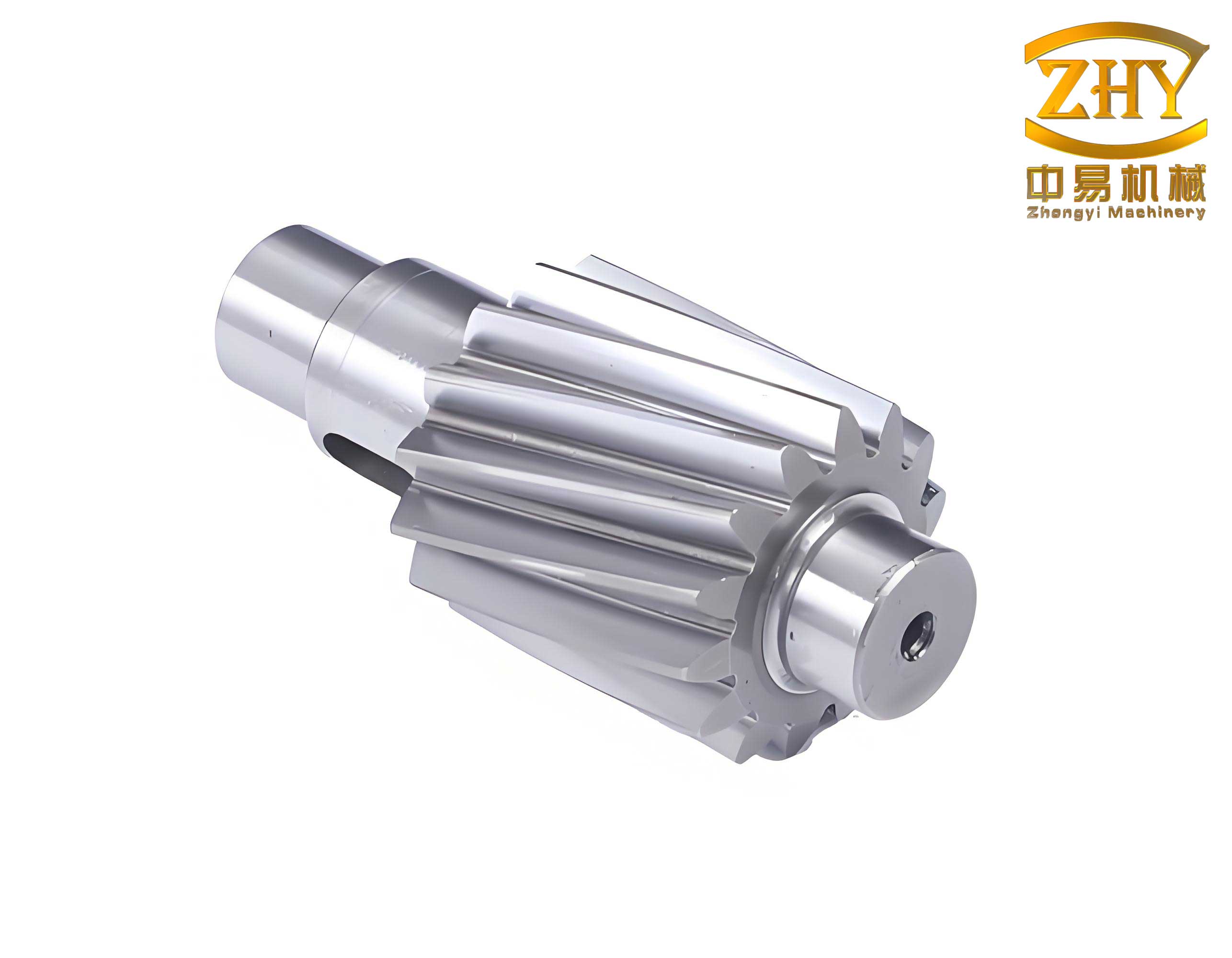
In this study, we explore the effects of subcritical quenching on the mechanical properties of 45 steel, with a focus on applications for gear shafts. The primary goal is to identify heat treatment parameters that maximize strength and toughness while minimizing energy consumption and the risk of quench cracking. We investigate the role of undissolved ferrite in the microstructure and its contribution to property enhancement. By varying quenching temperatures within the intercritical range and applying different tempering treatments, we aim to develop an optimized process that improves the performance and durability of gear shafts made from 45 steel.
Materials and Experimental Methods
The material used in this investigation is 45 steel in the form of hot-rolled bars, with a chemical composition typical of medium-carbon steel. To ensure consistency and eliminate initial material variations, all samples were first subjected to a normalizing pretreatment at 800°C for 8 minutes, followed by air cooling. Normalizing refines the grain structure, homogenizes the distribution of carbides, and provides a near-equilibrium microstructure, which serves as a baseline for subsequent heat treatments.
Subcritical quenching was performed by heating the normalized samples to temperatures ranging from 750°C to 840°C, which spans the intercritical region of 45 steel. The samples were held at each temperature for 6 minutes to achieve austenitization, followed by rapid quenching in water. After quenching, tempering was conducted at various temperatures (450°C, 500°C, 550°C, and 600°C) for 2 hours, with air cooling. For comparison, conventional heat treatment involving quenching at 840°C and tempering at 600°C was also carried out.
Mechanical testing included tensile tests, impact tests, and hardness measurements. Tensile specimens were machined to standard dimensions with a diameter of 6 mm and a gauge length of 30 mm (5 times the diameter). Impact tests used Charpy V-notch specimens with dimensions of 55 mm × 10 mm × 10 mm. Hardness was measured using an HR-150A Rockwell hardness tester, with three readings taken per sample and averaged. Microstructural analysis was performed using optical microscopy after standard sample preparation, including grinding, polishing, and etching with 4% nitric acid in alcohol.
Results and Analysis
The mechanical properties of 45 steel after conventional quenching and tempering (840°C quenching + 600°C tempering) are summarized in Table 1. This serves as a reference for evaluating the effects of subcritical quenching.
| Property | Value |
|---|---|
| Tensile Strength (MPa) | 796.18 |
| Elongation (%) | 19.58 |
| Reduction of Area (%) | 63.36 |
| Impact Absorption Energy (J) | 107.1 |
| Hardness (HRC) | 19.1 |
For subcritical quenching, the mechanical properties vary significantly with quenching temperature and tempering conditions. Table 2 presents the tensile strength, impact absorption energy, and hardness of 45 steel after subcritical quenching at different temperatures, followed by tempering at 550°C.
| Quenching Temperature (°C) | Tensile Strength (MPa) | Impact Absorption Energy (J) | Hardness (HRC) |
|---|---|---|---|
| 750 | 850 | 110 | 22 |
| 770 | 900 | 105 | 24 |
| 790 | 950 | 100 | 26 |
| 810 | 920 | 95 | 25 |
| 840 | 800 | 90 | 20 |
The data show that tensile strength and hardness increase with quenching temperature up to approximately 790°C, after which they decrease. This trend can be modeled using a quadratic equation:
$$ \sigma_b = -0.5(T_q – 790)^2 + 950 $$
where $\sigma_b$ is the tensile strength in MPa and $T_q$ is the quenching temperature in °C. The impact absorption energy generally decreases with increasing quenching temperature, but remains relatively high in the range of 770°C to 810°C, indicating a good balance between strength and toughness. This balance is crucial for gear shafts, which must withstand both static and dynamic loads.
When tempered at 500°C, an interesting phenomenon is observed: as the subcritical quenching temperature decreases from 810°C to 750°C, the impact toughness increases while the tensile strength remains at a high level (900-1100 MPa). This can be expressed empirically as:
$$ E_i = E_0 + \alpha (810 – T_q) $$
where $E_i$ is the impact absorption energy in J, $E_0$ is a base energy value, and $\alpha$ is a positive constant. This relationship suggests that lower quenching temperatures within the intercritical range promote toughness without compromising strength, which is beneficial for gear shafts subjected to impact loads.
To further analyze the effect of tempering temperature, Table 3 shows the mechanical properties of samples quenched at 790°C and tempered at different temperatures.
| Tempering Temperature (°C) | Tensile Strength (MPa) | Impact Absorption Energy (J) | Hardness (HRC) |
|---|---|---|---|
| 450 | 1050 | 70 | 30 |
| 500 | 1000 | 90 | 28 |
| 550 | 950 | 100 | 26 |
| 600 | 850 | 110 | 22 |
The tensile strength decreases linearly with increasing tempering temperature, as described by:
$$ \sigma_b = \sigma_0 – k (T_t – T_0) $$
where $\sigma_0$ is the strength after quenching, $T_t$ is the tempering temperature, $T_0$ is a reference temperature (e.g., 450°C), and $k$ is a constant. Conversely, impact energy increases with tempering temperature, highlighting the trade-off between strength and toughness. For gear shafts, selecting an appropriate tempering temperature is key to achieving the desired property combination.
Microstructural Insights and Role of Undissolved Ferrite
Microstructural examination reveals that subcritical quenching results in a dual-phase microstructure consisting of undissolved ferrite and martensite (or tempered martensite/troostite after tempering). At lower quenching temperatures (e.g., 750°C), the ferrite content is higher and may form a continuous network, which reduces strength but can enhance toughness. At higher temperatures (above 810°C), the ferrite content decreases sharply, leading to coarser austenite grains and reduced strength due to less grain refinement.
In the optimal quenching range of 790°C to 810°C, the undissolved ferrite is finely dispersed as granular particles, surrounded by a matrix of tempered martensite. This refined microstructure contributes to both high strength and good toughness through several mechanisms: grain boundary strengthening, dislocation pinning by ferrite particles, and reduced crack propagation susceptibility. The fine grain size increases the grain boundary area, which can be quantified by the Hall-Petch relationship:
$$ \sigma_y = \sigma_0 + \frac{k_y}{\sqrt{d}} $$
where $\sigma_y$ is the yield strength, $\sigma_0$ is the friction stress, $k_y$ is the strengthening coefficient, and $d$ is the average grain diameter. Subcritical quenching reduces $d$, thereby increasing $\sigma_y$. Additionally, the presence of ferrite improves ductility and impact resistance, which are critical for gear shafts operating under cyclic or shock loads.
For gear shaft applications, the enhanced microstructure from subcritical quenching translates to improved fatigue resistance and wear performance. The fine, dispersed ferrite acts as a buffer against stress concentrations, reducing the likelihood of crack initiation—a common failure mode in gear shafts. Moreover, the lower quenching temperatures reduce thermal gradients and residual stresses, minimizing distortion and quench cracking risks, which is especially important for complex gear shaft geometries.
Optimized Heat Treatment Process for Gear Shafts
Based on the experimental results and microstructural analysis, we recommend the following heat treatment process for 45 steel gear shafts to achieve optimal mechanical properties:
- Normalizing: Heat to 800°C for 8 minutes, followed by air cooling. This prepares a homogeneous starting microstructure.
- Subcritical Quenching: Heat to the intercritical range of 790°C to 810°C, hold for 6 minutes, then quench in water. This temperature range maximizes strength while retaining good toughness.
- Tempering: Temper at 450°C to 550°C for 2 hours, followed by air cooling. The exact tempering temperature can be adjusted based on the desired balance between strength and toughness for specific gear shaft applications.
For cost-effective production, the quenching temperature can be lowered to 770-790°C with tempering at 475-525°C, which still yields excellent properties: tensile strength of 900-1100 MPa and impact absorption energy of 90-110 J. This process not only enhances the performance of gear shafts but also reduces energy consumption and processing costs compared to conventional quenching.
To quantify the benefits, consider a gear shaft subjected to a torque $T$ and bending stress $\sigma_b$. The safety factor against yielding can be expressed as:
$$ SF = \frac{\sigma_y}{\sigma_{max}} $$
where $\sigma_{max}$ is the maximum applied stress. With subcritical quenching, $\sigma_y$ increases due to grain refinement, leading to a higher safety factor and longer fatigue life. This is particularly advantageous for high-load gear shafts in automotive or industrial machinery.
Conclusion
Subcritical quenching is an effective and efficient heat treatment method for enhancing the mechanical properties of 45 steel, making it highly suitable for gear shaft applications. By quenching within the intercritical temperature range (790-810°C) and tempering at appropriate temperatures (450-550°C), a superior combination of high strength and good toughness can be achieved. The presence of finely dispersed undissolved ferrite plays a key role in grain refinement and toughness improvement, contributing to the overall durability and reliability of gear shafts. This optimized process not only improves performance but also reduces energy consumption and cracking risks, offering significant advantages for manufacturing high-quality gear shafts. Future work could focus on extending these findings to other steel grades or exploring the effects of subcritical quenching on wear and fatigue behavior in real-world gear shaft operating conditions.