
The pursuit of higher power density, smoother torque transmission, and improved load capacity in precision gearing systems has led to the development of sophisticated transmission mechanisms. Among these, the harmonic drive gear principle stands out for its compactness, high reduction ratio, and zero-backlash potential. A specific and powerful variant of this principle is the double-sided or bilateral transmission configuration of the oscillating-teeth end-face harmonic drive gear. This article delves into the structural nuances of this mechanism, analyzes a critical performance characteristic—the fluctuation of the total meshing area—and proposes an optimized design strategy to enhance its operational smoothness and load distribution. The core of the solution involves a deliberate circumferential offset between the gear teeth on the two sides of the assembly, a concept we will explore in depth, complete with derivations for the optimal offset angle and the resulting meshing area calculations.
The double-sided oscillating-teeth end-face harmonic drive gear is an elegant mechanical system comprising four primary components: two end-face gears, a dual-wave generator, multiple oscillating teeth (or “live teeth”), and two slotted wheels (or “grooved wheels”). The fundamental operational principle involves converting the high-speed rotation of the input shaft into a low-speed, high-torque output through controlled axial oscillation of the teeth. In the bilateral configuration, the two end-face gears are fixed to the housing at opposite ends. The wave generator, rigidly mounted on the input shaft, features two end-face cams, one on each side. These cams engage with the oscillating teeth housed in radial slots within their respective slotted wheels. The slotted wheel on the input side is typically mounted on the input shaft via a bearing, allowing free rotation. In contrast, the slotted wheel on the output side is fixed to the output shaft. Critically, these two slotted wheels are connected into a single rigid unit by a coupling sleeve, which is itself supported by plain bearings. This linkage ensures synchronous motion of both slotted wheels.
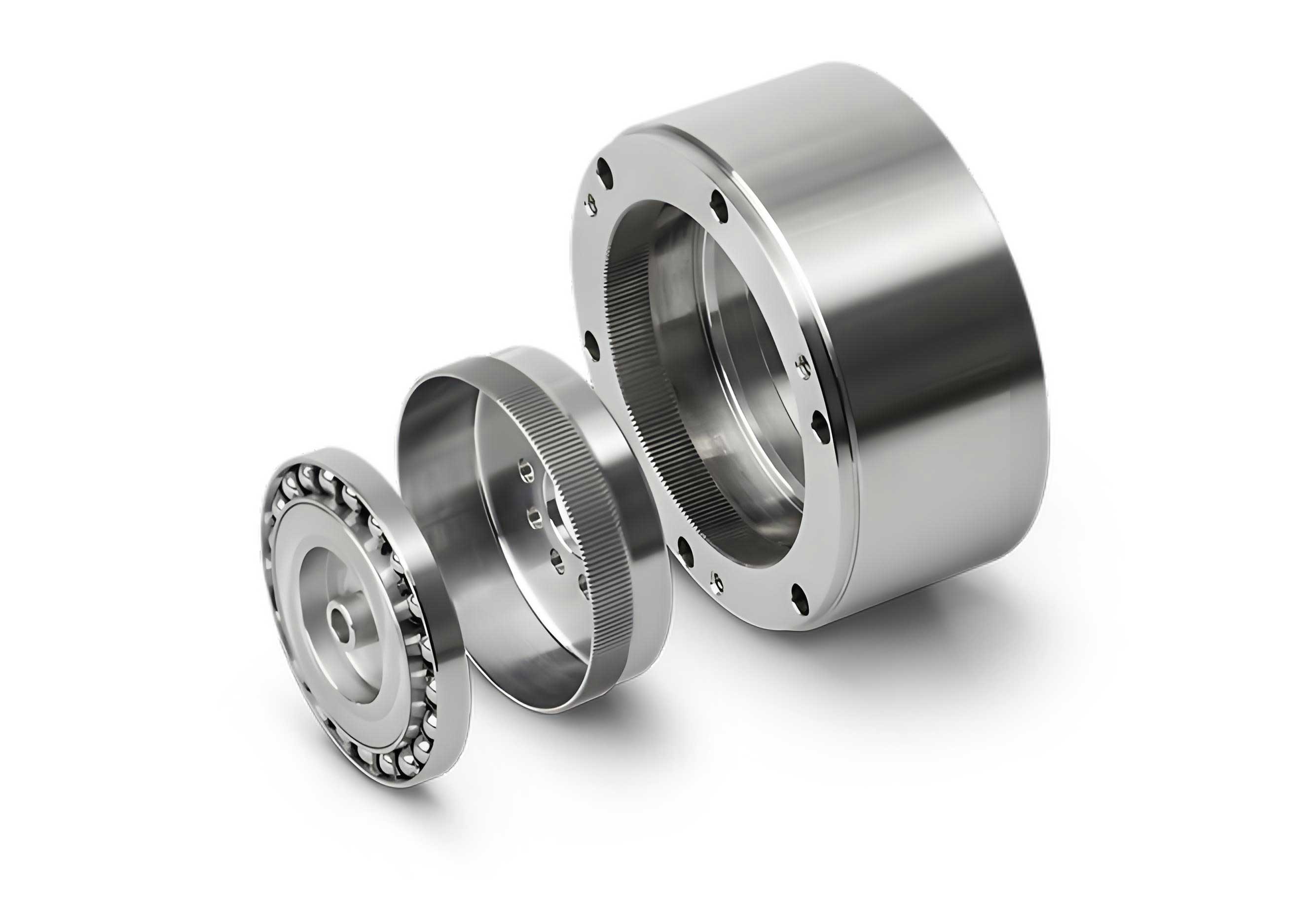
When the input shaft rotates the wave generator, the profile of the dual end-face cams imparts a synchronized, reciprocating axial motion to the oscillating teeth on both sides. As these teeth move axially, they mesh with the fixed teeth of the respective end-face gears. This meshing action forces the slotted wheels, and consequently the connected output shaft, to rotate at a significantly reduced speed. The primary advantages of this double-sided harmonic drive gear over its single-sided counterpart are twofold. First, the axial forces exerted on the wave generator by the two sets of teeth are symmetrical and opposite, effectively canceling each other out. This eliminates the need for thrust bearings to handle axial loads, simplifying the bearing arrangement. Second, and more significantly, the configuration acts as two single-sided harmonic drive gear units operating in parallel. This effectively doubles the number of teeth in simultaneous contact, thereby substantially increasing the torque and power transmission capacity for a given size.
To accurately assess the load capacity, contact stress, and overall strength of the meshing pairs in such a harmonic drive gear, a detailed analysis of the total meshing area during operation is paramount. The meshing area directly influences the contact pressure (Hertzian stress); a larger area results in lower stress for a given load. However, in a conventional, perfectly symmetrical double-sided harmonic drive gear, a specific challenge arises.
The Challenge of Simultaneous Area Fluctuation
In a standard bilateral design, the two end-face cams of the wave generator are mirror images, and the teeth of the two fixed end-face gears are aligned circumferentially. Consequently, the meshing state and the variation of the total meshing area for the working pairs on the left and right sides are identical and perfectly in phase. The total meshing area for the entire double-sided harmonic drive gear is simply twice that of a single side at any given instant. Let us define key variables:
- $$Z_O$$: Number of oscillating teeth on one side.
- $$\Sigma S_{E}^{max}$$, $$\Sigma S_{E}^{min}$$: Maximum and minimum total meshing area for a single-side harmonic drive gear.
- $$\Sigma S_{E2}^{max}$$, $$\Sigma S_{E2}^{min}$$: Maximum and minimum total meshing area for the double-side harmonic drive gear.
- $$T$$: Period of meshing area variation for a single-side gear with a fixed end-face gear, given by $$T = 2\pi / Z_O$$.
For the symmetrical double-sided case:
$$
\Sigma S_{E2}^{max} = 2 \cdot \Sigma S_{E}^{max}, \quad \Sigma S_{E2}^{min} = 2 \cdot \Sigma S_{E}^{min}
$$
While the absolute load capacity is higher, the range of fluctuation, defined as $$\Delta \Sigma S_{E2} = \Sigma S_{E2}^{max} – \Sigma S_{E2}^{min}$$, also doubles compared to the single-side range: $$\Delta \Sigma S_{E2} = 2 \cdot (\Sigma S_{E}^{max} – \Sigma S_{E}^{min})$$. This large fluctuation means the contact pressure on the teeth varies significantly during each cycle. A high peak pressure can lead to accelerated wear, pitting, and reduced fatigue life. Therefore, minimizing this fluctuation is desirable for smoother operation and improved durability of the harmonic drive gear.
The Concept of Circumferential Offset (Phase Shift)
The proposed solution to mitigate this issue is ingeniously simple: introduce a controlled circumferential offset (or phase shift) between the teeth of the two end-face gears. Correspondingly, the crests of the two end-face cams on the wave generator must also be offset by a related angle (which depends on the gear ratio). This offset desynchronizes the meshing cycles on the two sides. When the meshing area on one side is near its minimum, the area on the other side is intentionally positioned to be nearer its maximum, and vice-versa. The goal is to find the optimal offset angle, denoted $$\theta_E$$ for the end-face gears, that maximizes the minimum total combined area ($$\Sigma S_{E2}^{min}$$) while simultaneously minimizing the difference between the maximum and minimum total combined area ($$\Delta \Sigma S_{E2}$$).
To find $$\theta_E$$, consider the meshing area variation curve for one side as a periodic function with period $$T$$. Keep this curve fixed. The curve for the other side is shifted along the horizontal axis (representing the rotational angle of the slotted wheel, $$\phi_H$$) by an amount $$T_\phi$$, where $$0 \le T_\phi \le T$$. The total meshing area at any angle is the sum of the two curves at that angle. By analyzing how the minimum and maximum of this sum change as $$T_\phi$$ varies from 0 to $$T$$, we can find the optimum.
- Minimum Total Area ($$\Sigma S_{E2}^{min}$$): When $$T_\phi = 0$$ (aligned), the minimum is at its lowest point, $$2 \cdot \Sigma S_{E}^{min}$$. As $$T_\phi$$ increases, the two minima no longer coincide, causing the global minimum of the sum to rise. It reaches its absolute maximum value when $$T_\phi = T/2$$. As $$T_\phi$$ increases further towards $$T$$, the global minimum decreases again, returning to its original low value at $$T_\phi = T$$.
- Maximum Total Area ($$\Sigma S_{E2}^{max}$$): Conversely, the global maximum of the sum starts at its highest ($$2 \cdot \Sigma S_{E}^{max}$$) when $$T_\phi = 0$$. It decreases as $$T_\phi$$ increases, reaching its absolute minimum when $$T_\phi = T/2$$, before increasing back to the original high at $$T_\phi = T$$.
The trends are perfectly complementary. The condition that maximizes the minimum total area also minimizes the maximum total area. This is the ideal scenario for minimizing contact pressure fluctuation. Therefore, the optimal offset for the end-face gears is:
$$
\theta_E = \frac{T}{2} = \frac{\pi}{Z_O}
$$
Since the wave generator cams must maintain proper kinematic relationship with their respective gears, the required offset angle between the two cams, $$\theta_W$$, is determined by the transmission ratio. If $$U$$ is the wave number (number of lobes on the cam), then the optimal cam offset is:
$$
\theta_W = \frac{\pi}{U}
$$
This phase-shifted design ensures that the peaks and troughs of the meshing area from the two sides compensate for each other most effectively.
Meshing Area Characteristics with Optimal Offset
With the end-face gears offset by $$\theta_E = \pi / Z_O$$, the total meshing area variation of the double-sided harmonic drive gear undergoes a significant transformation. Its period is halved compared to the single-side period, becoming $$T’ = \pi / Z_O$$. More importantly, the expressions for the maximum and minimum total meshing area change. Let the single-side areas be $$\Sigma S_{E}^{max}$$ and $$\Sigma S_{E}^{min}$$. The double-sided areas with optimal offset become:
$$
\Sigma S_{E2}^{max} = \frac{3}{2} \Sigma S_{E}^{max} + \frac{1}{2} \Sigma S_{E}^{min}
$$
$$
\Sigma S_{E2}^{min} = \frac{1}{2} \Sigma S_{E}^{max} + \frac{3}{2} \Sigma S_{E}^{min}
$$
Comparing this to the aligned case ($$\Sigma S_{E2}^{max} = 2\Sigma S_{E}^{max}$$, $$\Sigma S_{E2}^{min} = 2\Sigma S_{E}^{min}$$), it is clear that the offset has raised the minimum and lowered the maximum, thereby compressing the fluctuation range. The new range is:
$$
\Delta \Sigma S_{E2}^{offset} = \Sigma S_{E2}^{max} – \Sigma S_{E2}^{min} = \Sigma S_{E}^{max} – \Sigma S_{E}^{min}
$$
This is exactly equal to the fluctuation range of a single side, and is half the range of the aligned double-sided harmonic drive gear. This represents a major improvement in smoothness.
Calculation of Meshing Area for the Phase-Shifted Double-Sided Harmonic Drive Gear
To compute the actual values of $$\Sigma S_{E2}^{max}$$ and $$\Sigma S_{E2}^{min}$$ for the optimized design, we need the expressions for $$\Sigma S_{E}^{max}$$ and $$\Sigma S_{E}^{min}$$ for a single-side harmonic drive gear. These depend on the relationship between the number of oscillating teeth $$Z_O$$ and the wave number $$U$$. Assuming non-modified (theoretical) tooth profiles, the calculations fall into four distinct cases. Let $$S_E$$ represent the nominal contact area for a single tooth pair under full engagement.
| Case (Single-Side Relationship) | Single-Side Meshing Area | Double-Side (Offset) Meshing Area |
|---|---|---|
| 1. $$Z_O / U$$ is an even integer. | $$ \Sigma S_{E}^{max} = \frac{Z_O + 2U}{4} S_E, \quad \Sigma S_{E}^{min} = \frac{Z_O – 2U}{4} S_E $$ |
Substituting into the offset formulas yields: $$ \Sigma S_{E2}^{max} = \frac{Z_O + 2U}{4} S_E, \quad \Sigma S_{E2}^{min} = \frac{Z_O – 2U}{4} S_E $$ Note: For this specific case, the offset double-sided areas are numerically identical to the single-side areas, but the fluctuation period is still halved. |
| 2. $$Z_O / U$$ is an odd integer. | $$ \Sigma S_{E}^{max} = \frac{(Z_O + U)^2}{4 Z_O} S_E, \quad \Sigma S_{E}^{min} = \frac{(Z_O – U)^2}{4 Z_O} S_E $$ |
Applying the offset transformation: $$ \Sigma S_{E2}^{max} = \frac{Z_O^2 + U^2 + Z_O U}{2 Z_O} S_E $$ $$ \Sigma S_{E2}^{min} = \frac{Z_O^2 + U^2 – Z_O U}{2 Z_O} S_E $$ |
| 3. $$Z_O / U$$ is not an integer, and $$Z_O$$ is even. | $$ \Sigma S_{E}^{max} = \frac{Z_O + 2}{4} S_E, \quad \Sigma S_{E}^{min} = \frac{Z_O – 2}{4} S_E $$ |
Applying the offset transformation: $$ \Sigma S_{E2}^{max} = \frac{Z_O + 1}{2} S_E, \quad \Sigma S_{E2}^{min} = \frac{Z_O – 1}{4} S_E $$ |
| 4. $$Z_O / U$$ is not an integer, and $$Z_O$$ is odd. | $$ \Sigma S_{E}^{max} = \frac{(Z_O + 1)^2}{4 Z_O} S_E, \quad \Sigma S_{E}^{min} = \frac{(Z_O – 1)^2}{4 Z_O} S_E $$ |
Applying the offset transformation: $$ \Sigma S_{E2}^{max} = \frac{Z_O^2 + 1 + Z_O}{2 Z_O} S_E $$ $$ \Sigma S_{E2}^{min} = \frac{Z_O^2 + 1 – Z_O}{2 Z_O} S_E $$ |
These formulas provide the designer with precise tools to calculate the extreme values of the total meshing area for any configuration of the phase-shifted double-sided harmonic drive gear. This information is critical for subsequent stress analysis, life prediction, and torque rating of the transmission system.
Implications and Design Advantages
The implementation of a circumferential offset in a double-sided harmonic drive gear system offers profound benefits. First, by maximizing the minimum total contact area, the peak contact pressure experienced by the oscillating teeth and end-face gear teeth under load is minimized. This directly translates to higher permissible transmitted torque for a given material and size, or longer service life for a given load. Second, by minimizing the range of area fluctuation, the variation in contact pressure throughout the engagement cycle is significantly reduced. This leads to smoother torque transmission, less vibration, and lower acoustic noise—highly desirable properties in precision applications such as robotics, aerospace actuators, and medical equipment. Third, the halving of the effective fluctuation period contributes to a more uniform load distribution over time, further enhancing smoothness.
In conclusion, the double-sided oscillating-teeth end-face harmonic drive gear represents a potent architecture for high-capacity, compact speed reduction. The inherent challenge of synchronized, large-amplitude meshing area fluctuation in a symmetrical design can be elegantly solved by introducing a specific circumferential phase shift between the two sides. The optimal offset angle for the end-face gears is $$\theta_E = \pi / Z_O$$, with a corresponding wave generator cam offset of $$\theta_W = \pi / U$$. This optimization strategy dramatically improves the performance envelope of the harmonic drive gear by raising the minimum load-bearing area, lowering the maximum contact pressure, and smoothing out operational dynamics. The derived formulas for the total meshing area under this optimized configuration provide essential analytical tools for engineers to reliably design and deploy these advanced transmission systems in demanding mechanical applications.