
Advancements in gear technology demand precise forming processes to minimize defects like underfilling, folding, and material scraping. Traditional forging struggles with complex geometries, necessitating preform optimization. This work integrates electromagnetic field simulation with a novel hybrid bee colony algorithm to optimize preform shapes and process parameters, significantly enhancing forging efficiency and product quality in gear manufacturing.
Electromagnetic Field-Based Preform Design in Gear Technology
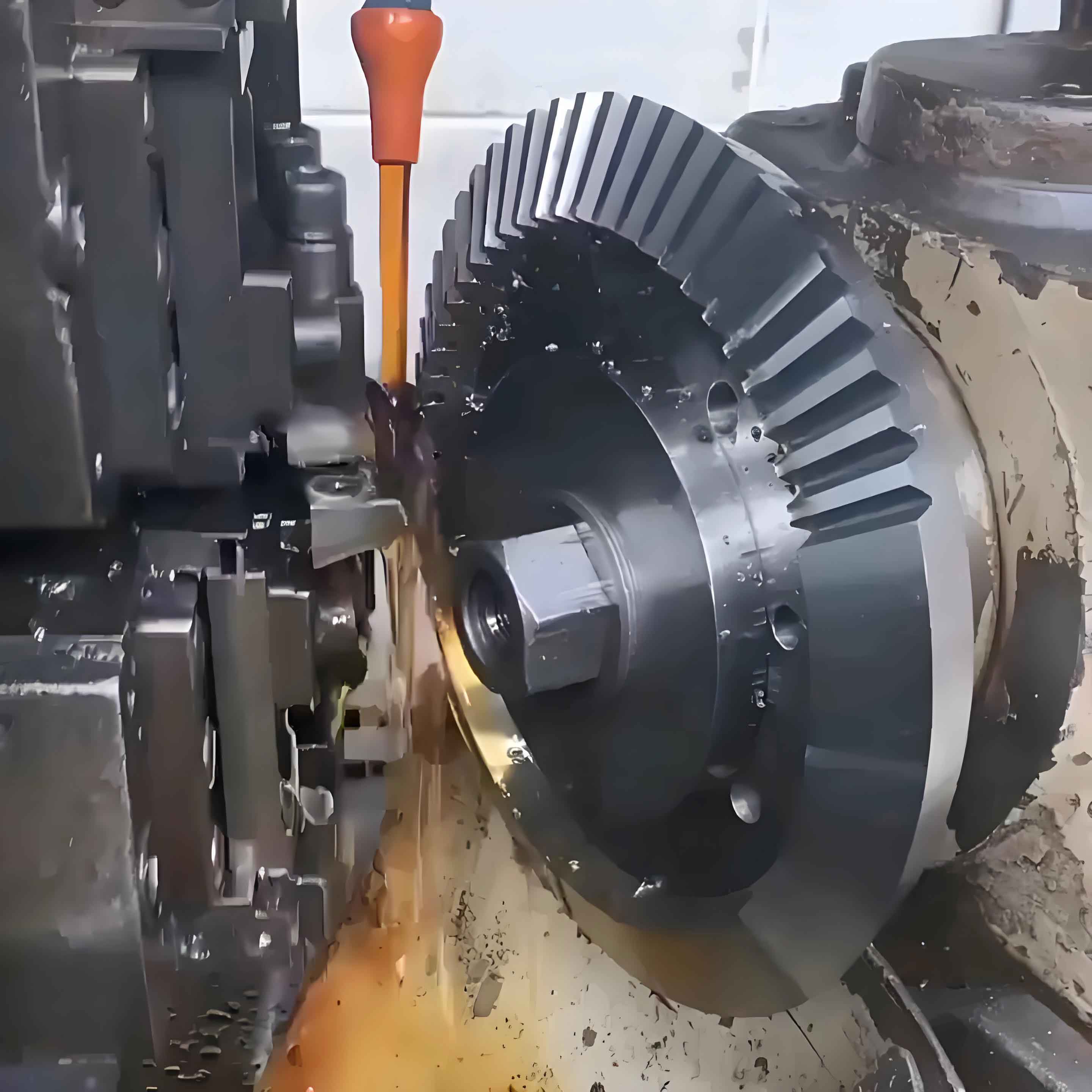
In gear technology, the electromagnetic field method maps metal flow by treating the billet and final gear as electrodes. For a case-study gear (Figure 1), a cylindrical billet (Φ60 mm × 30 mm) of AISI4120 steel was scaled 2.6× to encapsulate the final profile. Voltage boundaries of 1 V (billet) and 0 V (final gear) were applied, generating equipotential lines via ANSYS electrostatic simulation. Equipotentials between 0.05 V and 0.45 V yield viable preform candidates, excluding extremes resembling raw billets or final gears. Mimics software extracts these contours, scaled volumetrically for forging consistency. The 0.4 V equipotential preform is shown below:
Material composition critically influences flow behavior. AISI4120’s chemistry enables uniform deformation:
| C | Mn | P | S | Si | Cr | Mo |
|---|---|---|---|---|---|---|
| 0.18-0.23 | 0.90-1.20 | ≤0.035 | ≤0.040 | 0.15-0.35 | 0.40-0.60 | 0.13-0.20 |
Multi-Objective Optimization Framework
Gear technology requires minimizing forming loads (reducing energy/tool wear) and maximizing fill rates (ensuring dimensional accuracy). Objectives are defined mathematically:
Forming Load Minimization: Total vertical force during final forging:
$$\psi_1 = \sum_{n=1}^{N} \sigma_{ny}$$
where $\sigma_{ny}$ is the vertical stress on contact element $n$, and $N$ is the total elements.
Fill Rate Maximization: Ratio of actual-to-ideal contact surface area:
$$\psi_2 = \frac{S_1}{S_0} \quad \text{transformed to} \quad \psi_3 = \frac{S_0}{S_1}$$
for unified minimization ($S_1$: simulated contact area, $S_0$: ideal area).
Decision Variables: Preform shape (equipotential voltage $\xi$), press speed $V$, friction coefficient $\mu$, and billet temperature $T$:
| Parameter | Equipotential (V) | Press Speed (mm/s) | Friction Factor | Billet Temp. (°C) |
|---|---|---|---|---|
| Range | 0.050 – 0.450 | 40 – 100 | 0.10 – 0.30 | 800 – 1200 |
A 4-7-2 BP neural network regressed 100 Latin Hypercube samples (Deform-3D simulations), achieving <3% prediction error for objectives.
Hybrid Bee Colony Algorithm with Metropolis-Complex Synergy
Overcoming premature convergence in traditional Artificial Bee Colony (ABC) algorithms is vital for robust gear technology solutions. Our Hybrid Bee Colony (HBC) algorithm integrates:
1. Metropolis Selection Criterion: Replaces greedy selection to preserve solution diversity:
$$P(o_b \rightarrow o_a) = \begin{cases}
1 & \text{if } f(o_a) \geq f(o_b) \\
\exp\left(\frac{f(o_a) – f(o_b)}{T(t)}\right) & \text{if } f(o_a) < f(o_b)
\end{cases}$$
where $T(t) = T(t-1) \cdot \sigma$ ($\sigma=0.8$) is the annealing temperature, $o_b$ is current solution, and $o_a$ is new solution. This accepts inferior solutions probabilistically early in optimization.
2. Complex-Type Optimization Guidance: After ABC iterations, the top $u$ solutions form a ‘complex’:
- Centroid Calculation: $x_c = \frac{1}{u} \sum_{h=1}^{u} x_h$
- Reflection: $x_r = x_c + \alpha(x_c – x_u)$ ($\alpha=1.3$), replacing $x_u$ if $f(x_r) > f(x_u)$
- Expansion: If reflection succeeds, $x_e = x_r + \beta(x_r – x_c)$ ($\beta=0.6$)
- Contraction: $x_s = x_u + \chi(x_c – x_u)$ ($\chi=0.7$) if reflection fails
HBC Workflow:
1. Initialize bee population (positions: $x = \{\xi, V, \mu, T\}$)
2. Employed bees conduct neighborhood searches
3. Onlooker bees select solutions via Metropolis probability
4. Scouts randomize stagnant solutions
5. Apply Complex-Type operations to elite solutions
6. Repeat until convergence
Simulation and Experimental Validation
HBC (60 bees, 300 iterations) outperformed ABC, converging to $\xi = 0.076$ V, $V = 55.7$ mm/s, $\mu = 0.25$, $T = 1005^\circ \text{C}$ with fitness $f = 0.5 \cdot \frac{1600}{\psi_1} + 0.5 \cdot \frac{100}{\psi_2 \times 100}$:
- Forming Load: $\psi_1 = 1560$ kN (Preform: 1550 kN, Final: 1430 kN)
- Fill Rate: $\psi_2 = 100\%$
Deform simulations confirmed complete rib and corner filling. Production trials (20 gears) validated results:
| Metric | Baseline | Optimized | Improvement |
|---|---|---|---|
| Forming Load (kN) | 1960 | 1550 | 20.91% ↓ |
| Yield Rate (%) | 91.7 | 100.0 | 9.05% ↑ |
Conclusion
Integrating electromagnetic field-based preform design with the HBC algorithm significantly advances gear technology. The Metropolis criterion maintains solution diversity, while Complex-Type operations refine convergence. This synergy reduced forming loads by 20.91% and achieved 100% yield in gear forging, demonstrating profound implications for industrial gear manufacturing efficiency and tool longevity.