
The critical role of chemical fertilizers in enhancing crop yields and ensuring global food security is undeniable. Their precise and uniform application is paramount, not only for maximizing agricultural productivity but also for minimizing environmental impact through the reduction of nutrient runoff and waste. This precision is fundamentally dependent on the performance of the fertilization machinery, with the fertilizer distributor being its core component. The uniformity of discharge directly dictates the final distribution pattern on the field. Among various types, the external fluted-wheel distributor has seen widespread use due to its simplicity and cost-effectiveness. However, inherent design limitations often lead to suboptimal discharge uniformity, resulting in inefficient fertilizer use, economic loss, and potential soil degradation. Therefore, the quest for distributor mechanisms offering superior consistency is a significant research focus in agricultural engineering.
This investigation centers on a reverse-meshing spur gear fertilizer distributor. Its operational principle hinges on the interaction of two spur gears rotating in opposite directions. As the driving hexagonal shaft transmits power, typically from the machinery’s ground wheel or a dedicated motor, the left spur gear rotates counterclockwise. Through their meshing action, this forces the right spur gear to rotate clockwise. The volumetric pockets formed between the teeth of these spur gears—the gear spaces—act as chambers that collect fertilizer from the hopper above. As the gears rotate, these filled chambers are transported to the discharge outlet, where the fertilizer is released by gravity and the motion of the gears. The design’s effectiveness relies on the precise geometry and meshing of the spur gears to create consistent, discrete volumes for fertilizer transport.
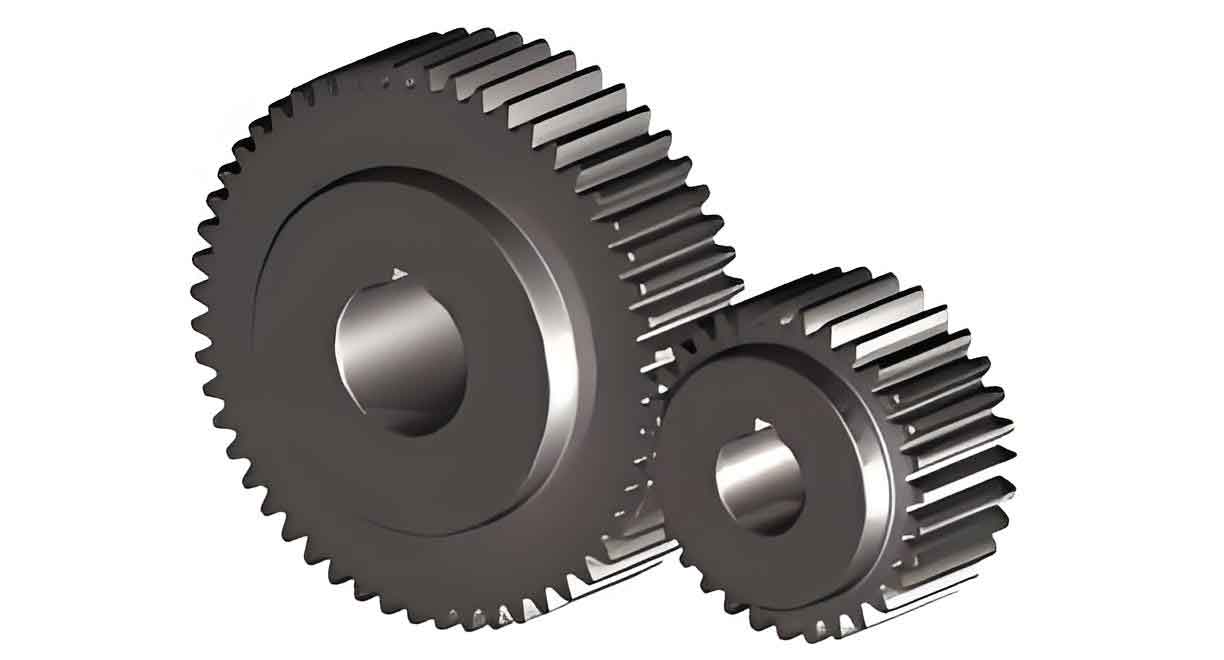
The theoretical discharge capacity of this spur gear system is intrinsically linked to the volume of a single tooth space. For a standard spur gear, this volume is not a simple geometric primitive. To determine it accurately, computer-aided design (CAD) software was utilized. A three-dimensional model of the spur gear was created, and the “Mass Properties” tool was employed to calculate the volume of a solid body representing one tooth space extruded along the gear’s face width. This method provides a highly accurate value for the volume $v$ (in mm³). The total mass of fertilizer discharged $M$ (in grams) can then be derived from the following relationship:
$$M = \frac{8 n t v \rho \gamma}{3} \times 10^{-4}$$
Where $n$ is the rotational speed of the spur gears (in rpm), $t$ is the total operating time (in seconds), $\rho$ is the bulk density of the fertilizer (in g/cm³), and $\gamma$ is the filling coefficient of the spur gear spaces, accounting for the fact that they are not perfectly packed. The factor 8 arises from the number of teeth on each spur gear, and the divisor 3 is a constant related to the unit conversions in the derivation. Based on common agronomic requirements—a maximum operational speed of 3 m/s, a row spacing of 65 cm, a fertilizer bulk density of 1.2 g/cm³, a filling coefficient of 0.7, and a target maximum application rate of 750 kg/ha—the critical parameters for the spur gears were set. The design specifications were: face width = 30 mm, number of teeth = 8, and module = 6 mm. Using the volume calculated from the CAD model and the formula above, the required rotational speed to meet the target application rate was determined to be approximately 160 rpm.
To analyze the performance of the spur gear distributor without the need for costly and time-intensive physical prototypes, the Discrete Element Method (DEM) was employed. DEM simulation is a powerful computational technique for modeling the behavior of granular materials, such as fertilizer granules. The simulation model was constructed using EDEM software. The three-dimensional CAD assembly of the distributor, comprising the housing and the two spur gears, was imported. The contact model governing the interactions between fertilizer particles and between particles and the distributor’s steel surfaces was selected as the Hertz-Mindlin (no slip) model. The parameters required for this model, including material properties and contact coefficients, were defined based on literature values for a common compound fertilizer (e.g., Stanley compound fertilizer) and structural steel. A summary of the key simulation parameters is presented in the table below.
| Category | Property | Value |
|---|---|---|
| Fertilizer Particle | Poisson’s Ratio | 0.25 |
| Shear Modulus (Pa) | 1.0×10⁷ | |
| Density (kg/m³) | 1861 | |
| Spur Gears & Housing (Steel) | Poisson’s Ratio | 0.39 |
| Shear Modulus (Pa) | 3.18×10⁸ | |
| Density (kg/m³) | 1240 | |
| Fertilizer-Fertilizer Contact | Restitution Coefficient | 0.11 |
| Static Friction Coefficient | 0.30 | |
| Rolling Friction Coefficient | 0.10 | |
| Fertilizer-Steel Contact | Restitution Coefficient | 0.41 |
| Static Friction Coefficient | 0.32 | |
| Rolling Friction Coefficient | 0.18 |
In the simulation setup, a particle factory generated 10,000 spherical fertilizer granules with an average radius of 1.64 mm above the spur gears. The spur gears were set to rotate at a constant speed of 60 rpm. Beneath the discharge outlet, a horizontal collection plate was configured to move at a constant speed of 0.5 m/s, simulating the relative ground speed of the machinery. The total simulation time was 3.8 seconds. To evaluate discharge uniformity, a critical performance metric, the “grid method” was applied virtually. A rectangular evaluation zone (denoted as Zone A) with a length of 250 mm was defined on the moving collection plate, positioned to capture the falling fertilizer stream. This zone was subdivided into 10 equal contiguous segments. The mass of fertilizer deposited in each segment was recorded upon completion of the simulation run. The uniformity of discharge was quantified by calculating the coefficient of variation (CV) of these 10 mass values. The relevant formulas are:
The average mass $\bar{m}$ across the grids:
$$\bar{m} = \frac{\sum_{i=1}^{10} m_i}{n} \quad (i = 1, 2, …, 10; \, n=10)$$
The standard deviation $s$ of the grid masses:
$$s = \sqrt{ \frac{\sum_{i=1}^{10} (m_i – \bar{m})^2}{n – 1} }$$
The coefficient of variation $\sigma$ (expressed as a percentage):
$$\sigma = \frac{s}{\bar{m}} \times 100\%$$
A lower $\sigma$ value indicates more uniform fertilizer distribution along the travel direction, signifying better performance of the spur gear distributor. Additionally, a second monitoring zone (Zone B) was placed directly at the discharge outlet to record the real-time mass flow rate, which typically shows a pulsating pattern due to the alternating discharge from the tooth spaces of the two meshing spur gears.
The primary factor investigated in this study was the deflection angle of the distributor unit relative to the direction of travel. This angle, denoted as $\theta$, is defined as the angle between the central axis of the spur gear shaft (aligned with the gear teeth) and the direction of motion of the collection plate (simulating machine travel). In practical mounting, the angle between the distributor and the actual machine travel direction, $\alpha$, is related by $\alpha = 180^\circ – \theta$. The initial velocity imparted to fertilizer granules as they exit the spur gear spaces has a direction influenced by the rotational motion of the gears. The angle between this ejection velocity vector and the machine’s travel vector critically affects the lateral spread and ultimate longitudinal distribution pattern of the fertilizer on the ground. Consequently, varying $\theta$ should significantly impact the measured uniformity coefficient $\sigma$. Given the geometrical symmetry of the spur gear distributor housing, the variation in performance for $\theta$ across the four quadrants (0°–90°, 90°–180°, etc.) is expected to be identical. Therefore, the experimental domain was logically confined to $\theta$ ranging from 0° to 90°. A single-factor experiment was designed with seven levels for $\theta$: 0°, 15°, 30°, 45°, 60°, 75°, and 90°. For each level, a complete EDEM simulation was run, and the resulting discharge uniformity coefficient $\sigma$ was calculated. The results are summarized in the following table.
| Deflection Angle, $\theta$ (°) | Coefficient of Variation, $\sigma$ (%) | Practical Mounting Angle, $\alpha$ (°) |
|---|---|---|
| 0 | 28.5 | 180 |
| 15 | 25.1 | 165 |
| 30 | 21.8 | 150 |
| 45 | 18.3 | 135 |
| 60 | 14.7 | 120 |
| 75 | 10.4 | 105 |
| 90 | 8.1 | 90 |
The data reveals a clear and strong trend: the coefficient of variation $\sigma$ decreases monotonically as the deflection angle $\theta$ increases from 0° to 90°. The most uniform discharge, corresponding to the minimum $\sigma$ value of 8.1%, is achieved when $\theta = 90^\circ$. In practical terms, this optimal configuration corresponds to the spur gear distributor being mounted such that its axis (and the teeth of the spur gears) is perpendicular to the direction of machine travel ($\alpha = 90^\circ$). This result can be explained by analyzing the discharge dynamics of the two spur gears. When $\theta$ is less than 90°, the ejection velocity vectors from the left and right spur gears form different angles with the travel direction of the collection plate. One gear’s discharge tends to project fertilizer more forward along the plate’s motion, while the other’s projects it more backward. This leads to two distinct, overlapping distribution patterns from the two spur gears, which may not perfectly align, causing a higher variation in the longitudinal mass distribution. However, when $\theta = 90^\circ$, the ejection velocity vectors for granules from both spur gears are symmetrically oriented at 90 degrees to the travel direction. Essentially, both gears contribute identical lateral projection patterns, and the fertilizer from each is deposited with the same longitudinal distribution characteristic relative to the point of release. The superposition of these two identical patterns results in the smoothest and most consistent overall distribution along the length of the collection plate, thereby minimizing the coefficient of variation. This finding highlights that even a well-designed volumetric metering device like the spur gear distributor has its performance highly sensitive to its orientation relative to the machine’s motion, an often-overlooked installation parameter.
The implications of this study are direct and valuable for the design and operation of fertilization equipment utilizing spur gear distributors. It conclusively demonstrates that to maximize application uniformity, the distributor should be installed with its spur gear shaft perpendicular to the direction of travel. This optimal alignment ensures that the inherent pulsation from the alternating spur gears is translated into the most uniform possible line distribution. While the core mechanism of the spur gear distributor is mechanically simple and robust, its interaction with the machine kinematics is crucial. Future work could investigate the interaction of this optimal deflection angle with other operational parameters such as spur gear rotational speed, fertilizer physical properties (size, shape, moisture), and gear tooth geometry (module, pressure angle). Furthermore, field validation of these simulation results would be a necessary step to confirm the practical benefits. Nonetheless, this analysis provides a solid foundation for optimizing the performance of spur gear-based fertilizer delivery systems, contributing to the broader goal of precise and efficient agricultural input management.