
In the realm of power transmission systems, particularly within automotive drive axles, the spiral bevel gear pair stands as the most critical component. Its role in efficiently transferring power between non-parallel, intersecting shafts is fundamental. Among these, the hypoid variant of the spiral bevel gear is especially prized for its exceptional smoothness of operation, superior load-bearing capacity, and compact design that facilitates easier packaging within vehicle architectures. As the core transmission element, its performance and durability directly influence the reliability and longevity of the entire axle system. Consequently, a deep understanding and systematic optimization of its fatigue load capacity are paramount for advancing driveline technology.
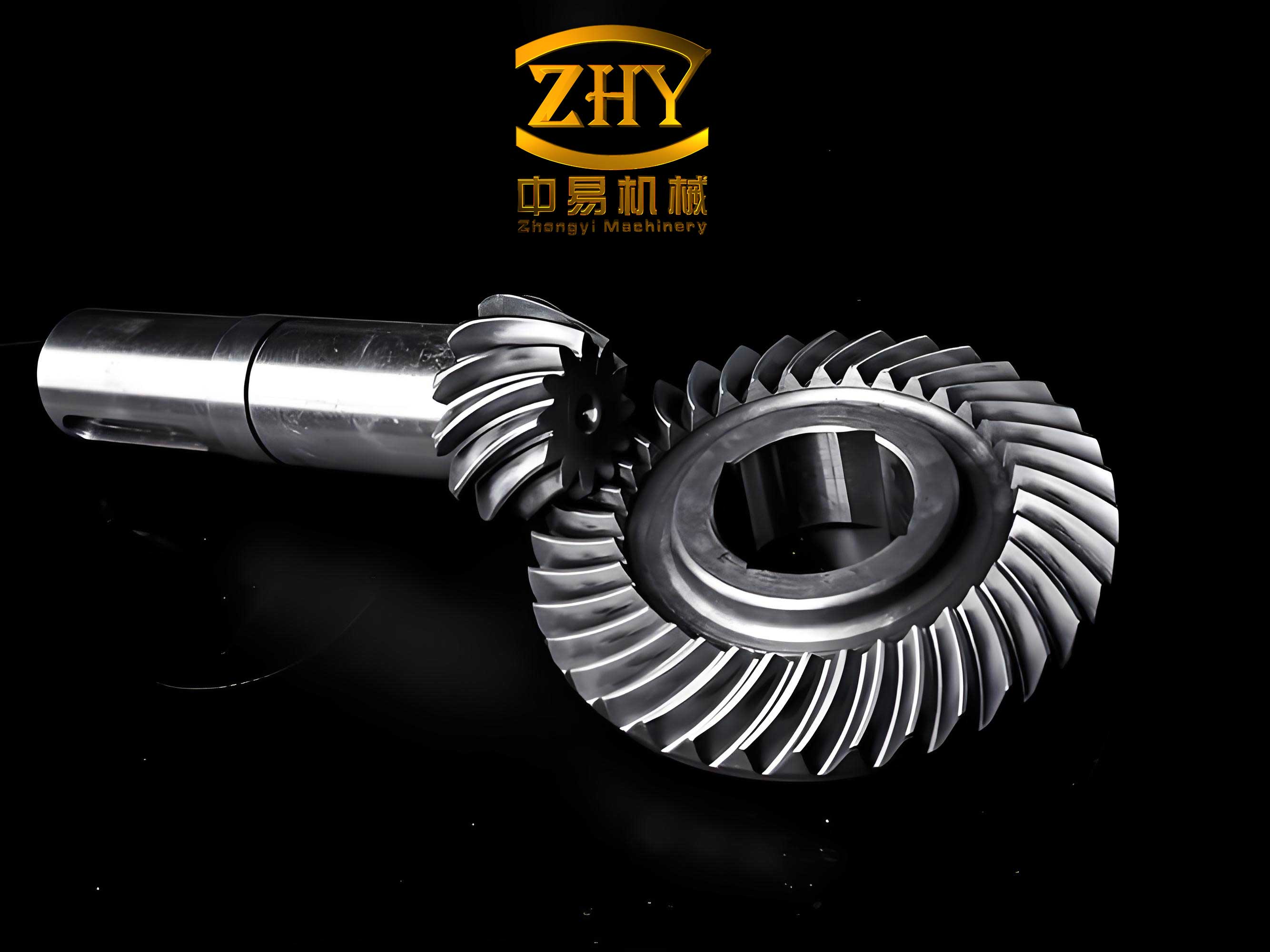
The pursuit of optimizing spiral bevel gear performance centers on preemptively addressing the primary failure modes observed in service: tooth bending fatigue fracture and surface contact fatigue pitting/spalling. This article delves into a holistic methodology for enhancing the fatigue life of spiral bevel gears, focusing on the analytical foundations, parametric influences, and practical implementation strategies. The analysis and recommendations presented here stem from extensive research and application in the field of spiral bevel gear design.
1. Foundational Analysis of Spiral Bevel Gear Fatigue Capacity
To strategically improve the life of a spiral bevel gear set, one must first establish a clear understanding of the governing stress equations for bending and contact fatigue. These formulas provide the mathematical framework that reveals the influence of various design parameters.
1.1 Bending Fatigue Strength
Tooth breakage originating from the root fillet region is a classic bending fatigue failure. The maximum bending stress at the root of a spiral bevel gear tooth can be evaluated using a refined version of the fundamental Lewis equation, adapted for the complex geometry of spiral bevel gears. The stress calculation for the pinion (gear 1) and the gear (gear 2) is given by:
$$σ_{F1} = \frac{W_t}{b m_t} K_A K_V K_{Fβ} \frac{1}{Y_{J1} Y_X}$$
$$σ_{F2} = \frac{W_t}{b m_t} K_A K_V K_{Fβ} \frac{1}{Y_{J2} Y_X}$$
Where:
- $W_t$ is the transmitted tangential load at the mean cone distance.
- $b$ is the face width.
- $m_t$ is the transverse module at the mean section.
- $K_A$ is the application factor accounting for external load dynamics.
- $K_V$ is the dynamic factor for internal load increments due to vibrations.
- $K_{Fβ}$ is the face load distribution factor for bending.
- $Y_{J1}$, $Y_{J2}$ are the geometry factors for bending strength for the pinion and gear, respectively. This factor incorporates the tooth form, stress concentration at the root, and the location of the highest load application.
- $Y_X$ is the size factor for bending stress.
A more practical form commonly used in industry relates stress directly to input torque. For a hypoid gear set, the bending stress formula is often expressed as:
$$σ_F = \frac{T_p K_A K_V K_{Fβ}}{b d_p m_t J Y_X}$$
In this format, $T_p$ is the pinion input torque, $d_p$ is the pinion mean pitch diameter, and $J$ is the composite geometry factor that amalgamates load sharing, effective face width, and tooth form effects. The fundamental relationship clearly shows that to minimize bending stress ($σ_F$), one should aim to maximize the product of face width ($b$), module ($m_t$ or $m$), and pitch diameter ($d$). The geometry factor $J$ is a key target for optimization, as it can be improved through careful tooth profile design.
1.2 Contact Fatigue Strength
Surface failures, such as pitting, originate from repeated Hertzian contact stresses exceeding the material’s endurance limit. The maximum contact pressure for spiral bevel gears is calculated using an adapted Hertzian contact stress formula:
$$σ_H = Z_E Z_ε \sqrt{ \frac{W_t}{b d_p} \frac{u+1}{u} K_A K_V K_{Hβ} Z_X Z_R }$$
Where:
- $Z_E$ is the elasticity factor, depending on the material properties (Young’s modulus and Poisson’s ratio) of both gears.
- $Z_ε$ is the contact ratio factor.
- $u$ is the gear ratio ($z_g / z_p$).
- $K_{Hβ}$ is the face load distribution factor for contact stress.
- $Z_X$ is the size factor for contact stress.
- $Z_R$ is the surface condition factor accounting for roughness and lubrication.
Again, the relationship indicates that contact stress ($σ_H$) is inversely proportional to the square root of the face width ($b$) and the pinion pitch diameter ($d_p$). Therefore, increasing these macro-geometry parameters directly reduces contact pressure, enhancing pitting resistance. The contact ratio factor $Z_ε$ highlights the beneficial effect of a higher transverse contact ratio, which distributes the load over more tooth pairs.
The overarching goal is not merely to reduce stress but to maximize the number of load cycles the spiral bevel gear can withstand before failure. This requires a balanced optimization of both bending and contact stress equations, often focusing on the pinion, which experiences more load cycles than the gear.
2. Macro-Geometry Optimization: The Role of Tooth Depth Coefficients
The macro-geometry of a spiral bevel gear set, defined by parameters like number of teeth, module, face width, and tooth depth, forms the foundation for its performance. Among these, the coefficients defining tooth depth—specifically the working depth coefficient and the addendum coefficient—profoundly influence the load distribution and meshing characteristics of the spiral bevel gear pair.
2.1 Influence of the Working Depth Coefficient
The working depth ($h_k$) is the radial distance from the addendum circle to the dedendum circle of the mating gear at their deepest point of engagement. It is typically defined as $h_k = k \cdot m$, where $k$ is the working depth coefficient. This coefficient directly controls the active portion of the tooth profile and is a primary lever for adjusting the transverse contact ratio ($ε_α$).
A higher working depth coefficient increases the potential path of contact along the tooth profile. The effect on key performance metrics is systematic, as illustrated in the table below for a case study spiral bevel gear set (all other parameters held constant):
| Working Depth Coefficient (k) | Transverse Contact Ratio (ε_α) | Pinion Bending Stress (MPa) | Gear Bending Stress (MPa) | Contact Stress (MPa) |
|---|---|---|---|---|
| 3.7 | 0.894 | 525 | 490 | 2150 |
| 4.0 | 0.945 | 512 | 480 | 2110 |
| 4.3 | 1.019 | 498 | 468 | 2075 |
The data demonstrates a clear trend: increasing $k$ from 3.7 to 4.3 raises the contact ratio from 0.894 to over 1.0. This signifies a transition from single-pair to double-pair contact for portions of the mesh cycle. The benefits are twofold. First, the load is shared between two tooth pairs more frequently, reducing the load per tooth and consequently lowering both bending and contact stresses. Second, a smoother transfer of load from one tooth pair to the next reduces meshing impacts, which contributes to lower noise and vibration levels. The optimization of the working depth coefficient is therefore a highly effective method for boosting the overall fatigue capacity of a spiral bevel gear.
2.2 Influence of the Addendum Coefficient
The addendum coefficient ($c$) defines the addendum height, typically as $h_a = c \cdot m$. In a spiral bevel gear set, particularly a hypoid set with a pinion offset, adjusting the gear addendum (while keeping the working depth constant) shifts the pitch line relative to the tooth profiles. This affects the load application point and the bending leverage on the pinion tooth.
Increasing the gear addendum coefficient moves the pitch line closer to the pinion root. This increases the bending moment arm for loads applied to the pinion tooth, potentially raising its bending stress. However, it also contributes to a larger active profile and can increase the contact ratio. The trade-off is summarized below:
| Gear Addendum Coefficient (c_g) | Transverse Contact Ratio (ε_α) | Pinion Bending Stress (MPa) | Gear Bending Stress (MPa) | Contact Stress (MPa) |
|---|---|---|---|---|
| 0.10 | 0.924 | 505 | 495 | 2080 |
| 0.20 | 0.968 | 514 | 480 | 2095 |
| 0.30 | 1.015 | 519 | 467 | 2110 |
As shown, increasing $c_g$ from 0.10 to 0.30 successfully increases the contact ratio to over 1.0, which is beneficial for noise. However, it comes at the cost of a ~14 MPa increase in pinion bending stress and a slight increase in contact stress. The gear bending stress decreases significantly (by 28 MPa) because its tooth becomes stronger (more material at the root) as its addendum increases. The challenge is to balance the NVH benefit of a higher contact ratio against the penalty of higher pinion stress. This often necessitates complementary adjustments, such as increasing pinion tooth thickness, to rebalance the bending strength between the pinion and gear of the spiral bevel gear pair.
3. Optimization via Tooling and Manufacturing Parameters
The theoretical macro-geometry of a spiral bevel gear is realized through a precise machining process using dedicated cutting tools. The parameters of these tools offer a second, powerful layer of optimization to fine-tune stress distribution and balance fatigue life.
3.1 Balancing Life via Tooth Thickness (Tool Point Width)
In spiral bevel gear generation, the tooth thickness is controlled by the tool point width (or blade point width) on the gear cutter. Adjusting the gear cutter point width ($W_2$) directly changes the space width it cuts, thereby altering the mating pinion’s tooth thickness. The basic relationship for the pinion space width $s_{1}$ is governed by:
$$ s_{1} \approx p_n – (W_2 + 2 h_{f2} \tan α_{t} + j_{min}) $$
Where $p_n$ is the normal circular pitch, $h_{f2}$ is the gear dedendum, $α_{t}$ is the tool pressure angle, and $j_{min}$ is the minimum backlash.
Increasing $W_2$ results in a narrower pinion space ($s_{1}$), meaning a thicker, stronger pinion tooth. This is a direct and effective method to balance the bending fatigue life, as the pinion typically undergoes more load cycles than the gear. The effect is substantial and primarily one-directional for bending stress, as illustrated below for a representative spiral bevel gear set. The baseline is defined at the theoretical point width where pinion and gear have equal tooth strength.
| Change in Gear Tool Point Width, ΔW₂ (mm) | Effect on Pinion Tooth Thickness | Pinion Bending Stress (MPa) | Gear Bending Stress (MPa) | Contact Stress (MPa) |
|---|---|---|---|---|
| -0.5 | Thinner by ~1.0 mm | +55.2 | -80.6 | Unchanged |
| 0.0 (Baseline) | Theoretical | 500 | 475 | 2100 |
| +0.5 | Thicker by ~1.0 mm | -55.2 | +80.6 | Unchanged |
This manipulation does not alter the basic tooth profile or the contact pattern geometry significantly; therefore, the contact stress and contact ratio remain largely unaffected. It is a potent tool specifically for bending life balancing in spiral bevel gear design.
3.2 Stress Concentration Control via Tool Tip Radius
The radius at the tip of the cutting tool ($ρ_t$) directly generates the fillet radius at the root of the spiral bevel gear tooth. This fillet radius is critical in determining the stress concentration factor. A larger, smoother fillet radius reduces stress concentration and significantly lowers the maximum bending stress.
However, the tool tip radius is constrained by three main factors:
- Geometric Clearance: It must provide sufficient clearance to avoid interference with the mating gear’s tip during operation.
- Manufacturability: The radius must be physically producible and maintainable on the cutting tool.
- Tool Non-Working Flank: It must not cause scraping or undercutting on the opposite flank of the generated tooth.
Optimizations that increase pinion tooth thickness (via $W_2$) or decrease the pinion dedendum (via depth coefficients) can reduce the space width at the pinion root, potentially forcing the use of a smaller tool tip radius. This creates a critical trade-off: a thicker tooth is inherently stronger, but a smaller root fillet increases stress concentration. The optimal design for a spiral bevel gear is found at the intersection where the combined effect of increased tooth thickness and an acceptably large fillet radius minimizes the nominal bending stress multiplied by the stress concentration factor.
3.3 Refined Load Distribution via Tool Modifications (Profile Modifications)
To achieve optimal contact patterns and stress distributions, the cutting tools are often modified from their theoretical profiles. One common modification is “tip relief” or “root relief” on the pinion tool. By relieving the tip of the pinion cutter (making it slightly convex or removing material), the generated pinion tooth has a slight easing at its root area.
The strategic application of this modification serves two key purposes for the spiral bevel gear pair:
- Eliminates Edge Loading: It prevents the contact ellipse from extending to the very edge of the gear tooth tip (toe), avoiding high stress concentrations and potential spalling.
- Optimizes Bending Stress Profile: It allows the designer to position the highest contact pressure away from the most critical region of the pinion tooth root, creating a more favorable gradient of bending stress from the root to the working area.
The amount of relief ($δ_a$) is crucial. Excessive relief shortens the effective contact pattern, wastes potential contact area, and can lead to high localized stress at the new edge of contact. Insufficient relief fails to prevent edge loading. The optimal relief parameters are determined through advanced simulation tools like Loaded Tooth Contact Analysis (LTCA) to ensure the contact ellipse is centrally located on the tooth flank, maximizing contact area and minimizing both contact and root bending stresses in the spiral bevel gear.
4. Integrated Optimization Case Study
The practical application of these principles is best demonstrated through a case study. A hypoid spiral bevel gear set designed for medium-duty truck applications was initially failing to meet its target durability life of 300,000 cycles in accelerated rig tests. The average failure life was 189,000 cycles, with the primary failure mode being pinion bending fatigue originating near the mid-face width, slightly toward the toe end.
4.1 Initial Analysis & Optimization Strategy
Analysis of the initial design’s stress state revealed opportunities for improvement. A multi-pronged optimization strategy was implemented, targeting the parameters discussed:
| Design Parameter | Initial Design Value | Optimized Design Value | Primary Objective of Change |
|---|---|---|---|
| Working Depth Coefficient, k | 3.8 | 4.2 | Increase Transverse Contact Ratio |
| Gear Addendum Coefficient, c_g | 0.15 | 0.25 | Increase Transverse Contact Ratio |
| Gear Tool Point Width, W₂ | Theoretical | Theoretical + 0.4 mm | Increase Pinion Tooth Thickness |
| Pinion Tool Tip Radius, ρ_t | 1.2 mm | 1.6 mm | Reduce Root Stress Concentration |
| Pinion Tool Tip Relief | None | Optimized Profile | Center Contact Pattern, Avoid Edge Load |
4.2 Predicted Performance Improvement
The integrated effect of these changes on the calculated stress state was significant:
- Pinion Bending Stress: Reduced by 11.1%.
- Gear Bending Stress: Reduced by 12.3%.
- Contact Stress: Reduced by 4.5%.
- Transverse Contact Ratio: Increased from ~0.91 to over 1.05.
The contact pattern shifted from being biased toward the toe with edge contact to a well-centered pattern with a safe margin from all edges, as intended by the tool modifications.
4.3 Validation through Rig Testing
The optimized spiral bevel gear set was subjected to the same rigorous durability test protocol. The results confirmed the effectiveness of the holistic optimization approach.
| Gear Set Sample | Test Cycles to Failure | Observed Failure Mode |
|---|---|---|
| Optimized Sample 1 | 482,000 | Surface Contact Pitting (Initiation) |
| Optimized Sample 2 | 503,000 | Pinion Bending Fatigue |
| Optimized Sample 3 | 506,000 | Pinion Bending Fatigue |
The average fatigue life of the optimized spiral bevel gear sets was approximately 497,000 cycles. This represents an improvement factor of over 2.6x compared to the initial design. Notably, the first failure mode shifted to initial surface pitting, indicating that the pinion bending strength was no longer the primary limiting factor. The optimization successfully enhanced the overall system’s fatigue capacity, bringing it well above the target life requirement.
5. Conclusion
The fatigue load capacity of spiral bevel gears, especially hypoid gears, can be systematically and significantly enhanced through a structured, multi-level optimization process. This process moves beyond simple scaling of dimensions and engages with the fundamental relationships governing gear performance.
Key conclusions from this analysis are:
- Macro-Geometry Foundation: The initial gear blank design should maximize the module, face width, and pitch diameter within spatial constraints to establish a low-stress baseline, as dictated by the fundamental bending and contact stress equations for spiral bevel gears.
- Strategic Use of Depth Coefficients: Increasing the working depth and addendum coefficients is a highly effective method to raise the transverse contact ratio. This distributed load sharing can reduce both bending and contact stresses by 5-10%, simultaneously improving fatigue life and NVH characteristics. The trade-off with pinion bending stress from addendum changes must be managed.
- Precision Tooling Adjustments: Tool parameters offer critical fine-tuning controls. Adjusting the tool point width is a direct method for balancing bending life between the pinion and gear. Maximizing the tool tip radius within geometric limits is essential to minimize root stress concentration. Purposeful tool profile modifications are necessary to optimize the contact pattern, prevent destructive edge loading, and create favorable stress gradients.
- Integrated Optimization is Essential: The parameters of depth, thickness, and tool geometry are interdependent. An increase in depth or thickness may constrain the feasible tool tip radius. Therefore, the optimal design of a high-performance spiral bevel gear pair is found not by optimizing parameters in isolation, but through a holistic, integrated approach that simultaneously considers their combined effect on bending stress, contact stress, and geometric constraints. Advanced simulation tools like Finite Element Analysis (FEA) and Loaded Tooth Contact Analysis (LTCA) are indispensable in this iterative process to predict performance and validate designs before physical prototyping and testing.
By adhering to these principles, engineers can transition from a reactive, test-fail-fix cycle to a proactive, simulation-driven design process for spiral bevel gears. This leads to more robust, reliable, and longer-lasting drive axle components, ultimately contributing to the advancement of vehicular transmission systems.