
The cold forging of spur gears represents a significant technological advancement over traditional machining methods. This process offers substantial benefits, including superior material utilization, energy efficiency, high production rates, and reduced overall cost. More importantly, it enhances the micro-structure and mechanical properties of the forged spur gear, leading to improved impact strength and extended service life. Consequently, the application of cold forging for spur gear production is becoming increasingly widespread. The core of this technology lies in the die system, which must withstand extreme pressures during the forming of the complex spur gear profile.
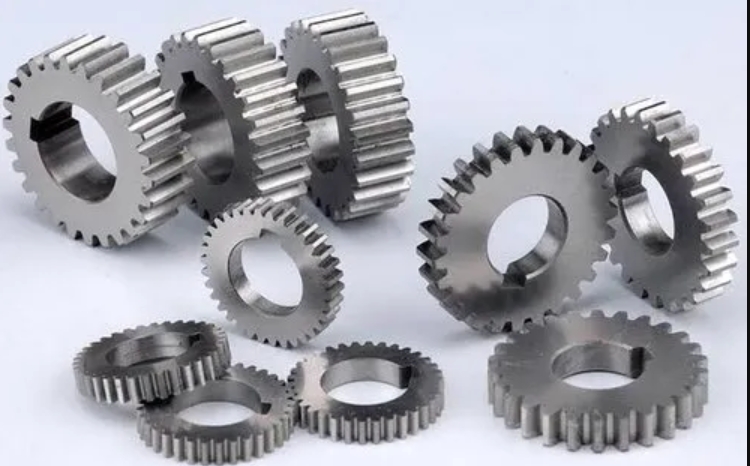
A critical component in spur gear extrusion is the female die, which contains the precise negative of the spur gear teeth. Under the immense working pressure of cold forging, a monolithic die cavity is highly susceptible to longitudinal cracking. To combat this, a prestressed combined die assembly is universally employed. This assembly typically consists of two or three concentric rings shrink-fitted together. The interference at the mating surfaces induces beneficial compressive pre-stresses in the inner die ring. When the internal working pressure is applied during spur gear extrusion, these pre-stresses counteract the tensile stresses generated at the inner wall, thereby preventing crack initiation and significantly enhancing the die’s load-bearing capacity and fatigue life. This design also allows the use of an expensive, high-strength material (like carbide) for the inner ring while using more economical materials for the outer supporting rings.
However, the optimum design of such a combined die for a spur gear presents a unique challenge. Classical optimization formulas for combined dies are derived from the theory of thick-walled cylinders under internal and external pressure. These formulas assume the inner cavity is a simple, smooth cylinder. For a spur gear die, the inner ring features a complex, periodic tooth profile, rendering the direct application of these standard formulas invalid. The stress concentration at the root of the spur gear teeth drastically alters the stress distribution compared to a smooth bore. This paper details a systematic methodology that integrates classical thick-cylinder theory for preliminary dimensioning with advanced finite element analysis (FEA) and an iterative optimization algorithm to achieve the optimum design for a spur gear extrusion die.
Preliminary Design Based on Thick-Walled Cylinder Theory
Although not directly applicable for final stress analysis, the Lame equations for thick-walled cylinders provide an excellent starting point for determining the radial dimensions of the die rings. The design philosophy is to configure the rings such that the tangential stress at the bore of the carbide inner ring is zero or compressive under the combined action of working pressure and shrink-fit pressures. This ensures the brittle carbide material is not subjected to tensile loading during spur gear extrusion.
We consider a three-ring combined die for the spur gear. The inner ring (Ring 1) is carbide, the middle ring (Ring 2) is a hot-work tool steel like H13, and the outer ring (Ring 3) is a high-strength alloy steel like 40Cr. The geometry and pressures are defined as follows:
- $r_1$: Inner radius of the spur gear die (based on the gear tip diameter).
- $r_2$: Outer radius of the inner ring / Inner radius of the middle ring.
- $r_3$: Outer radius of the middle ring / Inner radius of the outer ring.
- $r_4$: Outer radius of the outer ring.
- $p_1$: Internal working pressure during spur gear extrusion.
- $p_2$: Contact pressure at the interface between Ring 1 and Ring 2.
- $p_3$: Contact pressure at the interface between Ring 2 and Ring 3.
- $p_4$: External pressure (usually atmospheric, $p_4 = 0$).
We define the diameter ratios for optimization:
$$Q_1 = \frac{r_1}{r_2}, \quad Q_2 = \frac{r_2}{r_3}, \quad Q_3 = \frac{r_3}{r_4}, \quad Q = \frac{r_1}{r_4} = Q_1 Q_2 Q_3$$
The tangential stress $\sigma_{\theta}$ at any radius $r$ in a cylinder under internal pressure $p_i$ and external pressure $p_o$ is given by:
$$\sigma_{\theta} = \frac{r_i^2 p_i – r_o^2 p_o}{r_o^2 – r_i^2} + \frac{(p_i – p_o) r_i^2 r_o^2}{r^2 (r_o^2 – r_i^2)}$$
Applying this to the inner ring (carbide) and enforcing the condition of zero tangential stress at its bore ($r = r_1$) yields a relation between $p_1$ and $p_2$:
$$p_1 = \frac{2p_2}{1 + Q_1^2}$$
For the middle and outer rings, the maximum shear stress theory (Tresca) is applied to relate the interface pressures to the material’s allowable stress $[\sigma]$. Assuming $p_4=0$:
$$p_2 – p_3 = \frac{[\sigma]_2}{2}(1 – Q_2^2)$$
$$p_3 = \frac{[\sigma]_3}{2}(1 – Q_3^2)$$
The optimum design aims to maximize the sustainable working pressure $p_1$ by finding the optimal ratios $Q_1$, $Q_2$, and $Q_3$. This leads to the relationships:
$$Q_2 = \frac{p_1}{[\sigma]_2} Q_1, \quad Q_3 = \frac{p_1}{[\sigma]_3} Q_1$$
The total ratio $Q = r_1/r_4$ is typically chosen between 1/4 and 1/6 for heavy-duty forging dies. For the high-pressure spur gear extrusion, we select $Q = 1/6$. Using the working pressure $p_1$ obtained from initial FEA of the spur gear forming process (e.g., 2283 MPa) and the allowable stresses for the materials (e.g., $[\sigma]_2 = 1750$ MPa for H13, $[\sigma]_3 = 1600$ MPa for 40Cr), the optimal $Q_1$, $Q_2$, $Q_3$ can be solved from the above system of equations.
Subsequently, the required interference fits are calculated. The diametral interference $\Delta d_2$ between the carbide inner ring and the steel middle ring is:
$$\Delta d_2 = d_2 \cdot p_1 \frac{(1+Q_2)(1-Q_1^2)}{2(1-Q_2)} \cdot \left[ \frac{1}{E_1}\left(\frac{1+Q_1^2}{1-Q_1^2} – \mu_1\right) + \frac{1}{E_2}\left(\frac{1+Q_2^2 Q_3^2}{1-Q_2^2 Q_3^2} + \mu_2\right) \right]$$
where $E_1, \mu_1$ and $E_2, \mu_2$ are the Young’s modulus and Poisson’s ratio for the inner and middle ring materials, respectively. The interference $\Delta d_3$ between the middle and outer rings is:
$$\Delta d_3 = d_3 \cdot \frac{ [\sigma]_3 – p_1 Q_2^2}{E_2}$$
Using these formulas, preliminary dimensions for the spur gear die assembly can be established.
| Component | Inner Diameter (mm) | Outer Diameter (mm) | Material | Allowable Stress [σ] (MPa) |
|---|---|---|---|---|
| Inner Ring (Spur Gear Profile) | 66.0 (Tip Dia.) | 133.0 | Carbide (YG20) | 3300 |
| Middle Ring | 133.0 | 234.6 | H13 Steel | 1750 |
| Outer Ring | 234.6 | 400.0 | 40Cr Steel | 1600 |
| Calculated Diametral Interference: Δd₂ = 0.585 mm, Δd₃ = 0.580 mm | ||||
Iterative Optimization of Interference Fits Using FEA and Golden-Section Search
The preliminary design based on smooth-bore theory provides a rational starting point for the radial dimensions of the die rings for the spur gear. However, the calculated interference values are likely non-optimal due to the severe stress concentrations caused by the spur gear tooth profile. Applying the theoretical interferences in a detailed FEA model of the actual spur gear die assembly often reveals that the maximum von Mises stress in the carbide inner ring exceeds its allowable stress, indicating potential failure or over-conservative design.
Therefore, a second-stage optimization is necessary to fine-tune the interference fits. The goal is to adjust the interferences so that under the combined pre-stress and working load during spur gear extrusion, the maximum equivalent stress in the critical carbide ring reaches, but does not exceed, its allowable stress (e.g., 3300 MPa for YG20). This ensures the material’s strength is fully utilized without risking failure. The Golden-Section search method is an efficient, single-variable optimization algorithm ideal for this task. The sequence is as follows:
- Define Search Interval: The theoretical interference value (e.g., 0.585 mm for Δd₂) serves as a reasonable upper bound. The lower bound is set to zero (no interference). The middle ring to outer ring interference Δd₃ can be proportionally adjusted or optimized in a coupled manner, but for simplicity, it is often linked to Δd₂ in this stage.
- Build FEA Models: Create a series of 2D axisymmetric or 3D FEA models of the complete spur gear die assembly with different interference fit values within the search interval. The model must include the precise spur gear tooth geometry in the inner ring. A sequentially coupled analysis is performed: first a static analysis to simulate the shrink-fitting process, followed by applying the internal working pressure $p_1$ to simulate the spur gear extrusion load.
- Evaluate Objective Function: For each model, the key output is the maximum von Mises stress within the carbide inner ring after applying both pre-stress and working load.
- Iterate Using Golden-Section Search: The algorithm systematically narrows the search interval [a, b] by evaluating the stress at two interior points, $x_1 = a + 0.382(b-a)$ and $x_2 = a + 0.618(b-a)$. The stress values at these points are compared to the target allowable stress. The sub-interval that contains the optimal value is retained, and the process repeats until the interval is sufficiently small or the stress converges to the target.
| Iteration | Search Interval [a, b] (mm) | Evaluation Point (mm) | Max von Mises Stress in Carbide Ring (MPa) | Updated Interval |
|---|---|---|---|---|
| 0 (Initial) | [0.000, 0.585] | – | – | – |
| 1 | [0.000, 0.585] | x₁=0.224, x₂=0.361 | Stress(x₁)=1980, Stress(x₂)=2308 | [0.361, 0.585] |
| 2 | [0.361, 0.585] | x₁=0.447, x₂=0.499 | Stress(x₁)=2990, Stress(x₂)=3166 | [0.447, 0.585] |
| 3 | [0.447, 0.585] | x₁=0.499, x₂=0.533 | Stress(x₁)=3166, Stress(x₂)=3360 | [0.499, 0.533] |
| 4 | [0.499, 0.533] | x₁=0.514, x₂=0.518 | Stress(x₁)=3294, Stress(x₂)=3315 | [0.499, 0.518] |
| Result | Optimal Interference Δd₂ ≈ 0.514 mm (Max Stress ≈ 3294 MPa). Rounded to 0.510 mm for manufacturing. | |||
The table above illustrates the convergence of the process. After four iterations, an optimal interference of 0.514 mm is found, resulting in a maximum stress of 3294 MPa in the carbide spur gear die ring, which is very close to the 3300 MPa allowable limit. For practical manufacturing, this value is rounded to 0.510 mm. A final FEA verification with the rounded value confirms the stress (e.g., 3268 MPa) remains within the safe limit. The interference Δd₃ is adjusted accordingly, maintaining a similar proportional relationship as in the preliminary design or re-calculated based on the new pressure $p_2$ from the optimized model.
Comprehensive Optimum Design Methodology and Results
The complete, integrated methodology for the optimum design of a combined extrusion die for cylindrical spur gears can be summarized in a three-step procedure:
- Theoretical Pre-dimensioning: Treat the spur gear die inner ring as an equivalent smooth cylinder. Use classical thick-walled cylinder optimization formulas to determine the preliminary optimal radial dimensions ($r_2$, $r_3$, $r_4$) for the die rings and the theoretical interference fits ($\Delta d_{2, theor}$, $\Delta d_{3, theor}$). This provides a mechanically sound baseline design.
- Iterative Refinement via FEA: Recognize that the spur gear tooth profile invalidates the theoretical interferences. Use the theoretical interference value as an upper bound in a Golden-Section search algorithm. Build a parameterized FEA model of the actual spur gear die assembly. Iteratively adjust the interference values to minimize the difference between the maximum von Mises stress in the carbide inner ring and its allowable stress. This yields the optimized, profile-corrected interferences ($\Delta d_{2, opt}$, $\Delta d_{3, opt}$).
- Final Design Synthesis: Combine the optimal radial dimensions from Step 1 with the optimized interference values from Step 2. This final design specification ensures the spur gear extrusion die operates at its maximum safe load capacity, fully utilizing the strength of the carbide insert while preventing fatigue failure.
| Parameter | Preliminary Theoretical Value | Optimized Final Value | Notes |
|---|---|---|---|
| Inner Ring (Carbide) | Spur Gear Profile, Tip Dia. = 66.0 mm | ||
| – Outer Diameter | 133.0 mm | 133.0 mm | From theoretical optimization |
| Middle Ring (H13) | |||
| – Inner Diameter | 133.0 mm | 133.0 mm | From theoretical optimization |
| – Outer Diameter | 234.6 mm | 234.6 mm | From theoretical optimization |
| Outer Ring (40Cr) | |||
| – Inner Diameter | 234.6 mm | 234.6 mm | From theoretical optimization |
| – Outer Diameter | 400.0 mm | 400.0 mm | From theoretical optimization ($Q=1/6$) |
| Diametral Interference Δd₂ | 0.585 mm | 0.510 mm | Optimized via FEA & Golden-Section Search |
| Diametral Interference Δd₃ | 0.580 mm | ~0.530 mm | Adjusted proportionally from optimized state |
| Max Stress in Carbide | > Allowable (from FEA) | ~3268 MPa | Within Allowable Stress (3300 MPa) |
Conclusion
The cold extrusion of cylindrical spur gears demands robust and optimized die systems. The design of a prestressed combined die for a spur gear is complicated by the non-cylindrical, stress-concentrating geometry of the tooth profile. A direct application of classical optimization formulas for thick-walled cylinders leads to non-optimal interference fits. The proposed hybrid methodology successfully addresses this challenge. It leverages the efficiency of analytical formulas for the initial sizing of the die rings, establishing a rational structural layout. It then employs the precision of finite element analysis, guided by the Golden-Section search algorithm, to fine-tune the critical interference values. The objective is to tailor the pre-stress state so that under operational load, the maximum stress in the costly carbide spur gear insert reaches its allowable limit. This process ensures a safe, reliable, and cost-effective die design that maximizes performance and longevity for the high-pressure extrusion of spur gears. This integrated approach of simulation and iteration is universally applicable for optimizing complex-profile combined dies in metal forming.