
In the field of mechanical transmission, involute straight bevel gears are widely used for intersecting shaft drives, particularly in applications such as automotive differentials. The performance of these gears directly impacts the overall efficiency and reliability of mechanical systems. As demands for higher speeds and heavier loads increase, it becomes essential to enhance the accuracy of motion transmission, smoothness of operation, and uniformity of load distribution. However, straight bevel gears often face challenges such as meshing interference, impact during engagement and disengagement, and stress concentration at the tooth ends, commonly referred to as “end contact” or “edge effect.” These issues arise due to elastic deformations, manufacturing errors, assembly inaccuracies, and thermal effects, which deviate the actual working conditions from theoretical expectations. To address these problems, gear modification techniques are employed. This study focuses on isometric modification of straight bevel gears, utilizing orthogonal design and finite element analysis to optimize modification parameters for improved performance.
Isometric modification involves creating a parallel offset surface from the original tooth flank in the normal direction, maintaining the involute characteristics. This approach aims to compensate for elastic deformations and reduce dynamic impacts. The modification process can be implemented through chemical milling (chem-milling) on the electrode gear used in precision forging, which allows for precise control over modification parameters while improving surface quality and gear accuracy. The key parameters influencing the effectiveness of isometric modification include the amount of modification, modification height, and modification position. These factors are optimized using orthogonal experimental design to minimize meshing interference and stress concentration.
The orthogonal design method is employed to systematically evaluate the effects of different modification parameters. This approach reduces the number of experiments required while providing comprehensive insights into the influence of each factor. For this study, three factors are considered: modification amount (ranging from 20 to 45 μm), modification height (expressed as a percentage of the tooth height at the mid-width, with levels at 50%, 60%, and 70%), and modification position (along the tooth width, from the small end to the large end). An L9(3^4) orthogonal array is used, with nine experimental combinations. The response variable is the maximum contact stress at the tooth tip of the driven gear during meshing engagement, as obtained from dynamic finite element analysis.
| Factor | Level 1 | Level 2 | Level 3 |
|---|---|---|---|
| A: Modification Amount (μm) | 25 | 35 | 45 |
| B: Modification Height (%) | 50 | 60 | 70 |
| C: Modification Position | Near Small End (1/3 from center) | Center | Near Large End (1/3 from center) |
The theoretical basis for isometric modification lies in the geometry of the spherical involute surface. The parametric equations for the spherical involute curve in a Cartesian coordinate system are given by:
$$ x = l (\sin \phi \sin \psi + \cos \phi \cos \psi \sin \theta) $$
$$ y = l (\sin \phi \cos \psi \sin \theta – \cos \phi \sin \psi) $$
$$ z = l \cos \phi \cos \theta $$
where \( l \) is the radial distance from the origin, \( \theta \) is the base cone angle, \( \phi \) is the roll angle, and \( \psi = \phi \sin \theta \). These equations are used to generate precise tooth profiles for straight bevel gears in 3D modeling software like SolidWorks. The modification shape is defined by a contour bounded by lines parallel to the gear axis and connected by arcs, which is then offset to create the modified surface.
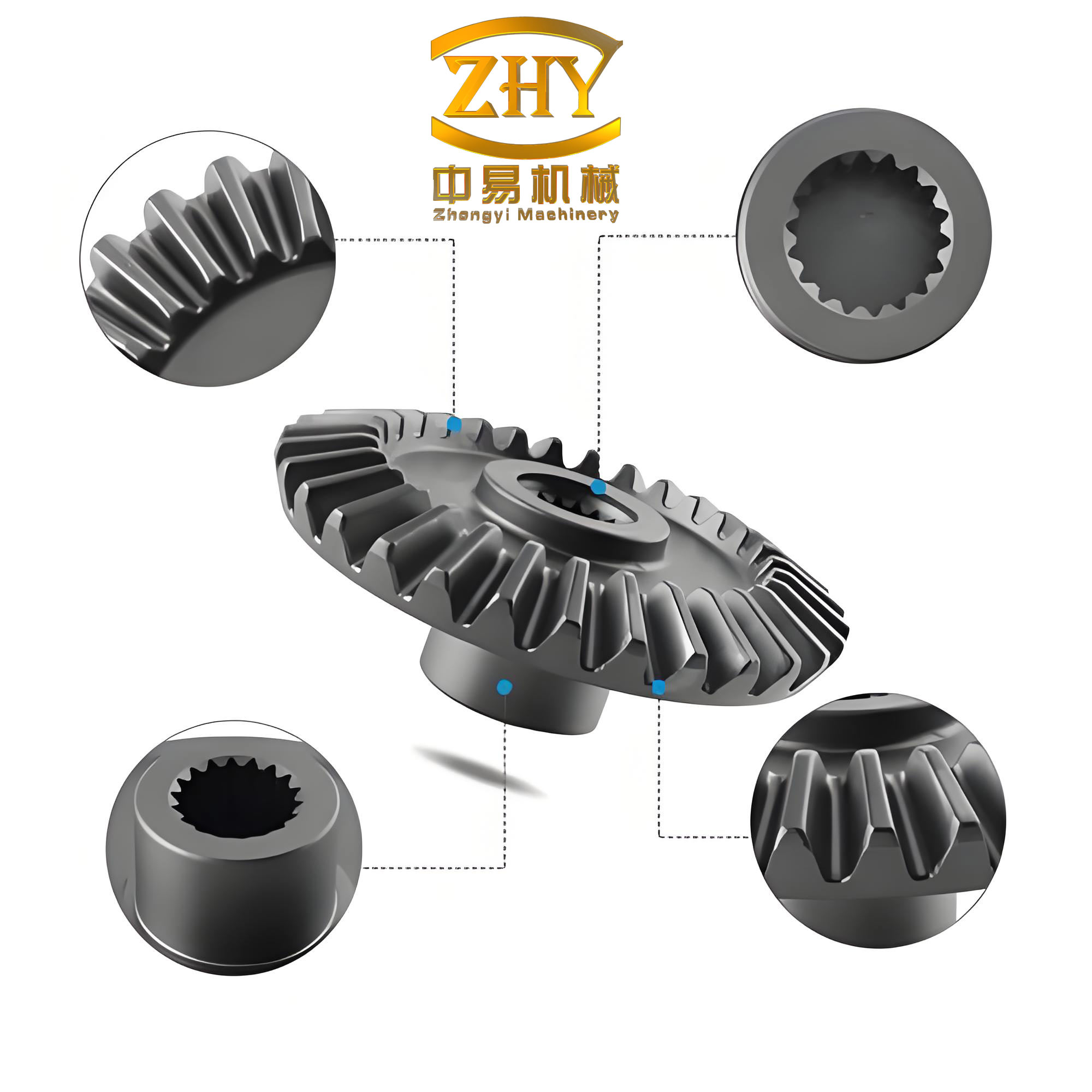
To assess the performance of modified straight bevel gears, dynamic contact finite element analysis (FEA) is conducted using ANSYS/LS-DYNA. The gears are modeled as elastic bodies with material properties of 20CrMnTiH (elastic modulus 207 GPa, density 7800 kg/m³, Poisson’s ratio 0.3). The finite element model includes SOLID164 elements for the gear teeth and SHELL163 elements for the rigid inner ring to facilitate rotation. Boundary conditions apply an angular velocity to the driving gear and a resisting torque to the driven gear. The analysis captures dynamic responses, such as contact stresses and angular accelerations, during meshing.
The orthogonal experimental results are analyzed to determine the optimal combination of modification parameters. The table below summarizes the maximum contact stress values for each experimental run:
| Experiment | A: Modification Amount (μm) | B: Modification Height (%) | C: Modification Position | Max Contact Stress (MPa) |
|---|---|---|---|---|
| 1 | 25 | 50 | Near Small End | 3091.2 |
| 2 | 25 | 60 | Center | 2521.8 |
| 3 | 25 | 70 | Near Large End | 3120.3 |
| 4 | 35 | 50 | Center | 2642.8 |
| 5 | 35 | 60 | Near Large End | 3761.6 |
| 6 | 35 | 70 | Near Small End | 3502.9 |
| 7 | 45 | 50 | Near Large End | 2920.5 |
| 8 | 45 | 60 | Near Small End | 2290.8 |
| 9 | 45 | 70 | Center | 3720.2 |
Range analysis is performed to evaluate the influence of each factor on the contact stress. The ranges (R) for factors A, B, and C are calculated as follows:
$$ R_A = 385.9 \, \text{MPa}, \quad R_B = 590.9 \, \text{MPa}, \quad R_C = 309.2 \, \text{MPa} $$
This indicates that modification height (B) has the greatest impact on reducing meshing impact, followed by modification amount (A), and then modification position (C). The optimal combination is identified as A1B2C1 (modification amount 25 μm, modification height 60%, and position near the small end). Verification through FEA shows that this combination reduces the maximum contact stress to 1928.8 MPa, a significant improvement compared to the unmodified gear stress of 4068.5 MPa.
Further analysis of dynamic responses reveals that isometric modification effectively mitigates vibration and impact. The angular acceleration of the driven gear decreases from \( 0.872 \times 10^6 \, \text{rad/s}^2 \) for unmodified gears to \( 0.186 \times 10^6 \, \text{rad/s}^2 \) for optimized modified gears, representing a reduction of approximately 78.6%. This demonstrates the enhanced smoothness of operation. Additionally, stress distribution along the tooth width becomes more uniform, eliminating the edge effect and concentrating stresses in the modified region, which corresponds to the optimal contact area for straight bevel gears.
The benefits of isometric modification extend to both profile and longitudinal corrections, providing a comprehensive solution for improving straight bevel gear performance. By compensating for elastic deformations, this method ensures better load distribution and increased load-carrying capacity. The use of orthogonal optimization combined with finite element analysis offers a systematic approach to determining the best modification parameters, reducing the need for extensive experimental trials.
In conclusion, isometric modification is a highly effective technique for enhancing the performance of straight bevel gears. Through orthogonal design and dynamic FEA, we have identified that modification height is the most critical factor, followed by modification amount and position. The optimal parameters significantly reduce meshing interference, impact, and vibration, while promoting uniform stress distribution. This approach not only improves the durability and reliability of straight bevel gears but also provides a reference for further research into gear modification theories. Future work could explore the effects of other factors, such as material variations and operating conditions, to refine the modification process for straight bevel gears in diverse applications.