
In the field of power transmission, the design and manufacturing of bevel gears with standard tooth counts are well-established processes. However, a significant and often daunting challenge arises when confronted with the task of producing miter gears possessing an extremely low number of teeth. My recent involvement in a critical project underscored this challenge, where the successful replication of an imported impact drill hinged entirely on manufacturing a specific pinion gear. This pinion was a straight bevel gear, functioning as part of a miter gear pair with a 1:1 ratio, featuring a mere 6 teeth and, complicating matters further, an integral shaft shoulder at its major end. This combination rendered conventional gear-cutting methods impractical, necessitating the development and validation of a novel hybrid manufacturing process combining specialized gear milling, EDM, and cold extrusion.
The core of the problem lay in the geometric and physical constraints. A 6-tooth bevel pinion has a very steep root cone angle and thin tooth profile at the minor end, pushing it beyond the standard capability range of most dedicated bevel gear generators. A comprehensive survey of available machinery confirmed the limitation: typical bevel gear milling machines, gear planers, and gear generators have minimum tooth count limits of 10, 8, and 6 respectively. Only a specific model of milling machine with a No. 3 indexing head was theoretically capable of cutting a 6-tooth gear, but such equipment was unavailable. Furthermore, the presence of the shaft shoulder at the major end physically obstructed the tool path of any standard generating or form-cutting machine. Therefore, a non-conventional, multi-stage process was the only viable solution. The conceptual geometry of such a challenging miter gear is illustrated below.
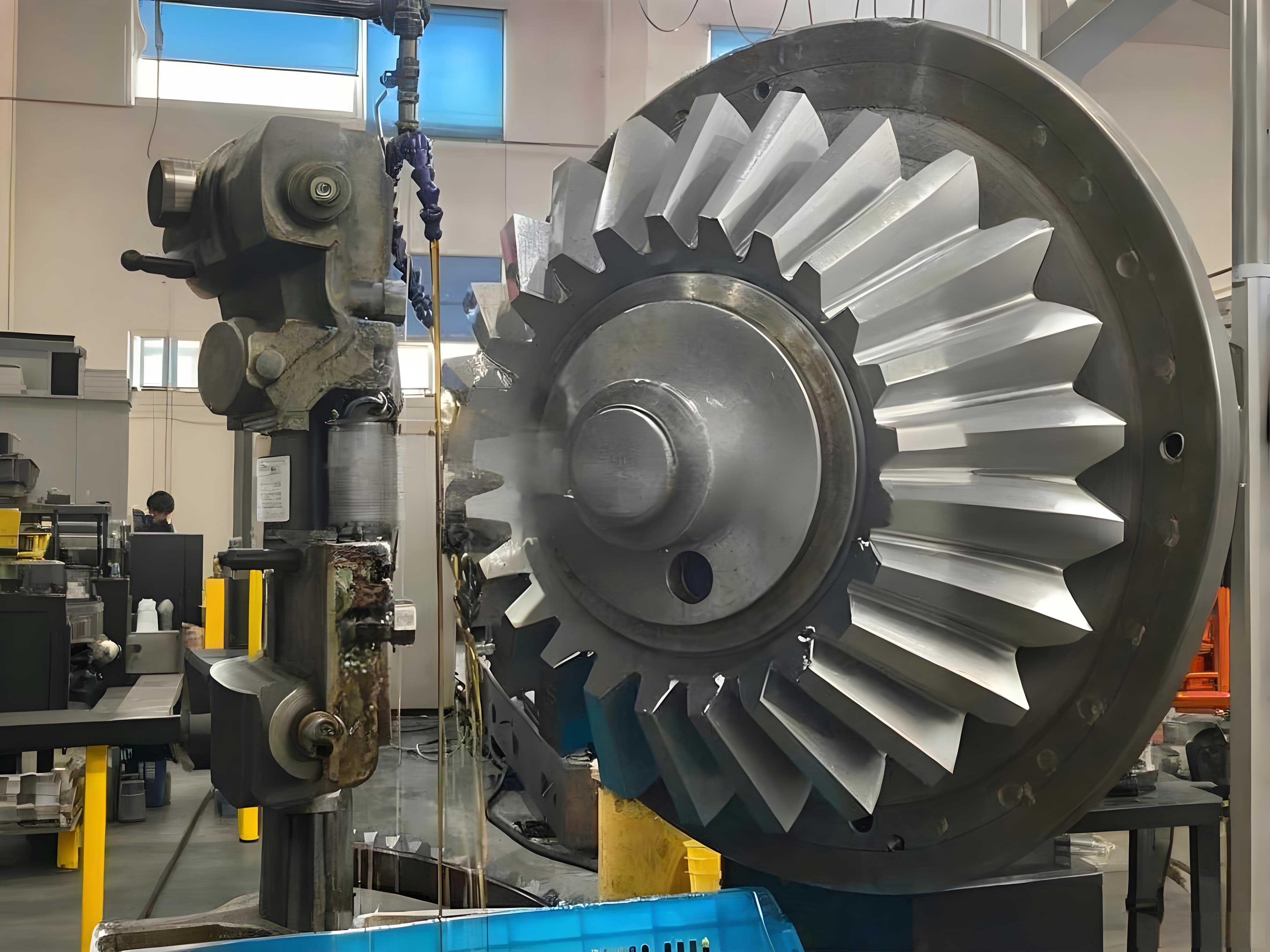
The proposed and ultimately successful process chain was: Modular Process Flow
- Forging and Annealing of the gear blank.
- Rough turning of all external features.
- Finish turning of the conical section where teeth are to be formed.
- Cold Extrusion (Gear Forming) of the teeth using an EDM-fabricated die.
- Heat Treatment (Carburizing and Quenching).
- Finish turning of the cylindrical sections and faces to correct minor extrusion distortion.
- Center hole grinding for final precision.
- Grinding of critical outer diameters and faces.
- Paired lapping of the pinion and its mating gear for optimal contact pattern.
The pivotal step in this sequence is the cold extrusion of the teeth. Since a cutting tool could not access the gear blank directly, a forming die was required. This die cavity was machined via Electrical Discharge Machining (EDM). The EDM electrode itself, which must possess the precise inverse (female) form of the desired gear teeth, was machined on a standard straight bevel gear milling machine. This was possible because the electrode, made of readily machinable copper-tungsten alloy, was a separate component without the shaft shoulder, allowing it to be mounted and cut conventionally. The machine was set up to cut a gear with the conjugate geometry to the desired final pinion.
Fundamental Calculations for the Miter Gear Pair
The starting point for all manufacturing calculations is the basic gear geometry. For the 1:1 ratio miter gear pair, the key parameters and derived dimensions are calculated as follows. Let $z$ be the number of teeth, $m$ the module, and $\Sigma$ the shaft angle (90° for miter gears).
1. Basic Parameters:
| Parameter | Symbol | Value |
|---|---|---|
| Number of Teeth (Pinion & Gear) | $z_1 = z_2 = z$ | 6 |
| Shaft Angle | $\Sigma$ | 90° |
| Module (Major End) | $m$ | 3.5 mm |
| Pressure Angle | $\alpha$ | 20° |
| Face Width | $b$ | 16 mm |
| Addendum Coefficient | $h_a^*$ | 1.0 |
| Dedendum Coefficient | $c^*$ | 0.25 |
2. Derived Geometry (For Pinion):
For a 1:1 miter gear pair, the pitch cone angle for both members is half the shaft angle.
$$ \delta_1 = \arctan\left(\frac{z_1}{z_2}\right) = \arctan(1) = 45^\circ $$
The pitch diameter at the major end:
$$ d_1 = m \cdot z_1 = 3.5 \times 6 = 21.0 \text{ mm} $$
The cone distance (pitch cone radius), $R_m$, is crucial for all subsequent calculations:
$$ R_m = \frac{d_1}{2 \sin \delta_1} = \frac{21.0}{2 \sin 45^\circ} \approx \frac{21.0}{2 \times 0.7071} \approx 14.85 \text{ mm} $$
The whole depth of the tooth at the major end:
$$ h = (2h_a^* + c^*)m = (2 \times 1.0 + 0.25) \times 3.5 = 7.875 \text{ mm} $$
The addendum and dedendum for the pinion (assuming no addendum modification for simplicity in this case):
$$ h_{a1} = h_a^* m = 3.5 \text{ mm}, \quad h_{f1} = (h_a^* + c^*)m = (1.0 + 0.25) \times 3.5 = 4.375 \text{ mm} $$
The tip and root cone angles:
$$ \delta_{a1} = \delta_1 + \theta_{a1} = \delta_1 + \arctan(h_{a1}/R_m) \approx 45^\circ + \arctan(3.5 / 14.85) \approx 45^\circ + 13.25^\circ \approx 58.25^\circ $$
$$ \delta_{f1} = \delta_1 – \theta_{f1} = \delta_1 – \arctan(h_{f1}/R_m) \approx 45^\circ – \arctan(4.375 / 14.85) \approx 45^\circ – 16.42^\circ \approx 28.58^\circ $$
The major end tip and root diameters:
$$ d_{a1} = d_1 + 2h_{a1} \cos \delta_1 = 21.0 + 2 \times 3.5 \times \cos 45^\circ \approx 21.0 + 4.95 \approx 25.95 \text{ mm} $$
$$ d_{f1} = d_1 – 2h_{f1} \cos \delta_1 = 21.0 – 2 \times 4.375 \times \cos 45^\circ \approx 21.0 – 6.19 \approx 14.81 \text{ mm} $$
Electrode Design and Machine Adjustment
The electrode must be the exact conjugate mate to the final pinion. Therefore, its theoretical geometry is that of the mating gear in the miter gear pair. The milling machine setup for cutting the electrode is the most calculation-intensive preparatory step. The data for the machine adjustment is summarized below:
| Adjustment Parameter | Symbol/Formula | Calculated Value / Setting |
|---|---|---|
| Pitch Cone Angle (Electrode as Gear) | $\delta_2$ | 45° |
| Cutter Selection & Cutter Blade Angle | $\theta_0$ | Based on $h_{a2}$, $h_{f2}$ |
| Machine Center to Cradle Center | $X$ | Specific to machine kinematics |
| Workpiece Installation Angle | $\beta$ | $\beta = \delta_2 – \theta_0$ |
| Cutter Tilt Angle | $\alpha_t$ | Set to pressure angle $\alpha$ (20°) |
| Indexing Change Gears Ratio | $i_{index} = \frac{A}{B} \times \frac{C}{D}$ | Calculated based on machine constant $N$ and $z_2$. |
| Generating (Roll) Change Gears Ratio | $i_{roll} = \frac{a}{b} \times \frac{c}{d}$ | Calculated based on desired roll ratio and pitch cone generation. |
| Cutting Speed Gears | – | Set for appropriate SFM for copper-tungsten. |
| Feed Rate Gears | – | Set for fine finish on electrode. |
The indexing gear calculation for a machine with a constant $N=30$ and a 6-tooth gear would typically yield a simple ratio:
$$ i_{index} = \frac{N}{z_2} = \frac{30}{6} = 5 $$
This would translate to specific gear teeth counts, e.g., $\frac{100}{20} \times \frac{100}{20}$. The generating gear ratio ensures the cradle rotation is synchronized with the workpiece rotation to correctly generate the involute-based bevel gear profile. The machine’s manual provides the foundational formula, which is adapted for the specific cone angle and number of teeth of this ultra-low-count miter gear electrode.
Preform Design for Cold Extrusion
This is arguably the most critical step for ensuring successful forming without defects. The volume of the final forged and finish-turned conical preform must exactly match the volume of the finished gear’s conical section (teeth + core) to prevent underfill or excessive flash and to control forming forces. The calculation proceeds by determining the volume of the finished gear cone.
1. Volume of Finished Gear Cone:
The conical section of the gear is defined by its major and minor end diameters and its length (face width $b$). We know the major end tip diameter $d_{a1}$ and root diameter $d_{f1}$, and their corresponding cone angles $\delta_{a1}$ and $\delta_{f1}$. The minor end diameters can be found using the cone geometry:
$$ d_{a1}^{minor} = d_{a1} – 2b \tan(90^\circ – \delta_{a1}) $$
$$ d_{f1}^{minor} = d_{f1} – 2b \tan(90^\circ – \delta_{f1}) $$
Let $R_{tip}$ be the slant height of the tip cone and $R_{root}$ be the slant height of the root cone. Their approximate values are derived from the cone distance and addendum/dedendum.
The volume of the tip cone frustum (including tooth space volume) is:
$$ V_{tip} = \frac{\pi b}{3} \left[ \left(\frac{d_{a1}}{2}\right)^2 + \frac{d_{a1}}{2} \cdot \frac{d_{a1}^{minor}}{2} + \left(\frac{d_{a1}^{minor}}{2}\right)^2 \right] $$
Similarly, the volume of the root cone frustum is:
$$ V_{root} = \frac{\pi b}{3} \left[ \left(\frac{d_{f1}}{2}\right)^2 + \frac{d_{f1}}{2} \cdot \frac{d_{f1}^{minor}}{2} + \left(\frac{d_{f1}^{minor}}{2}\right)^2 \right] $$
The volume of the teeth themselves (approximated as the difference) for $z$ teeth is complex, but the volume of the solid conical preform $V_{preform}$ before extrusion must equal the volume of the finished gear’s metal cone $V_{gear-cone}$.
$$ V_{gear-cone} \approx V_{root} + \eta \cdot (V_{tip} – V_{root}) $$
Where $\eta$ is a factor (less than 1) accounting for the space taken by the tooth gaps. A simplified, practical approach equates $V_{preform}$ to $V_{root}$ plus a percentage for tooth material. Through empirical testing, it was found that the major end diameter of the preform cone $D_{pre-major}$ needed to be slightly larger than the pitch diameter but smaller than the tip diameter. Assuming a preform cone angle $\delta_{pre}$ close to the root cone angle $\delta_{f1}$, and applying the volume constancy principle:
$$ V_{preform} = \frac{\pi b}{3} \left[ \left(\frac{D_{pre-major}}{2}\right)^2 + \frac{D_{pre-major}}{2} \cdot \frac{D_{pre-minor}}{2} + \left(\frac{D_{pre-minor}}{2}\right)^2 \right] = V_{gear-cone} $$
Given $D_{pre-minor} = D_{pre-major} – 2b \tan(90^\circ – \delta_{pre})$, this equation can be solved for the critical dimension $D_{pre-major}$. For the 6-tooth gear in question, iterative calculation and trial yielded an optimal preform major end diameter of approximately 23.5 mm with a cone angle of about 30°.
| Description | Symbol | Calculated/Determined Value (mm) |
|---|---|---|
| Preform Major End Diameter | $D_{pre-major}$ | ~23.5 |
| Preform Cone Angle | $\delta_{pre}$ | ~30° |
| Finished Major End Tip Diameter | $d_{a1}$ | ~25.95 |
| Finished Major End Root Diameter | $d_{f1}$ | ~14.81 |
Die Structure and Extrusion Process
The extrusion die, fabricated from high-grade tool steel, has a central cavity that is the negative of the final pinion, including the shaft shoulder relief. Its structure is designed for robust support and precise alignment. The die assembly typically consists of a lower die with the forming cavity, an upper punch, and a floating ejector system. During operation, the cylindrical preform is placed in the die, located axially against a stop. The upper punch descends, forcing the metal to flow plastically into the tooth cavities. The high pressures involved ensure good surface finish and work hardening of the gear teeth surfaces. The floating ejector then assists in removing the formed miter gear pinion. Careful design of the die’s approach angles and fillets is essential to facilitate metal flow and prevent laps or cracks in the thin sections of the 6-tooth form. Post-extrusion, minor distortions on the shoulder face and outer diameter are easily corrected in the subsequent finish turning operation, as the critical tooth form is now fully shaped and hardened near the surface.
Conclusion
The manufacturing of ultra-low-tooth-count straight bevel gears, particularly miter gears with integral features like shaft shoulders, presents a unique set of challenges that fall outside the scope of standard gear production technology. By adopting a hybrid manufacturing strategy—utilizing conventional bevel gear milling for creating a precision electrode, EDM for producing a complex forming die, and cold extrusion for the final net-shape forming of the challenging gear—these obstacles can be successfully overcome. This process chain effectively decouples the geometric complexity of the final part from the limitations of machine tool interference and minimum tooth count capabilities. The rigorous application of gear geometry calculations, combined with volumetric analysis for preform design and empirical adjustment, ensures dimensional accuracy and functional integrity. This methodology has proven to be a reliable and effective solution for producing high-quality, low-tooth-count miter gears for critical applications, offering a viable alternative when direct machining is impossible. The principles outlined here can be adapted to other non-standard gear manufacturing challenges where conventional cutting reaches its limits.