
The harmonic gear drive, also known as a strain wave gear, represents a paradigm shift in precision motion control. As an engineer deeply involved in the field of advanced mechanical transmissions, I have witnessed its evolution from a novel concept to a critical component in high-tech industries. This unique mechanism, fundamentally different from conventional gear systems, offers unparalleled advantages in compactness, precision, and high reduction ratios, making it indispensable in applications ranging from aerospace robotics to medical devices.
The core principle revolves around the controlled elastic deformation of a flexible component. A typical harmonic drive gear system consists of three primary elements: the Circular Spline (CS), a rigid internal gear; the Flexspline (FS), a thin-walled, flexible external gear cup; and the Wave Generator (WG), an elliptical bearing assembly inserted into the Flexspline. The magic lies in the interaction: as the Wave Generator rotates, it deforms the Flexspline into an elliptical shape, causing its teeth to engage with those of the Circular Spline at two diametrically opposite regions. Due to the difference in tooth count between the Flexspline and the Circular Spline (usually by 2 teeth), a small relative motion occurs with each revolution of the Wave Generator. This kinematic relationship yields a high gear reduction ratio in a single stage, given by:
$$ i = -\frac{N_g}{N_g – N_f} $$
where \( i \) is the reduction ratio, \( N_g \) is the number of teeth on the Circular Spline (rigid gear), and \( N_f \) is the number of teeth on the Flexspline. The negative sign indicates that the output rotation is opposite to the input when the Circular Spline is fixed.
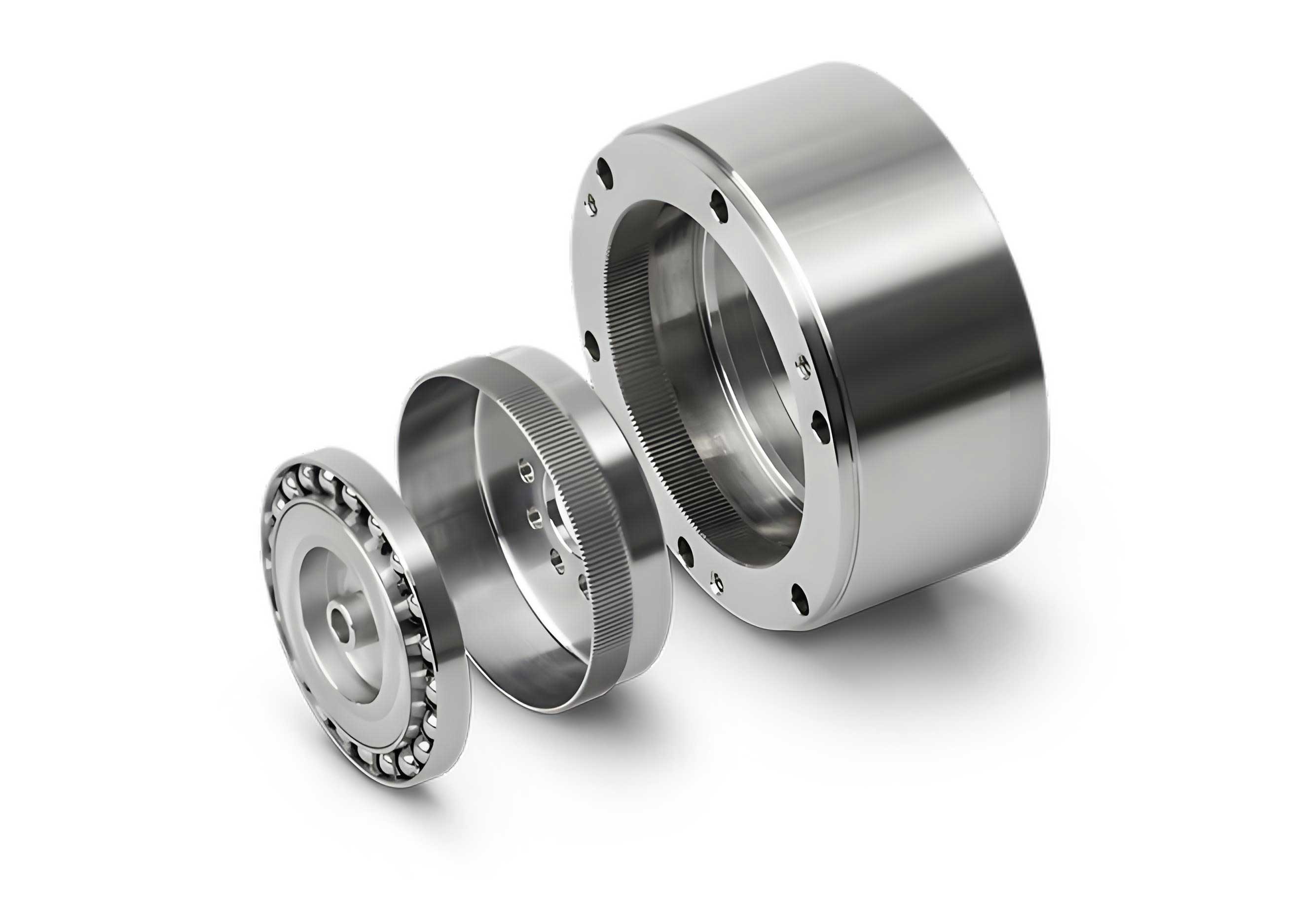
The development journey of the harmonic drive gear is a testament to international engineering collaboration and competition. The foundational concept emerged in the mid-1950s, largely driven by the demanding requirements of aerospace and defense technologies. In the United States, significant research and development efforts were concentrated within organizations like NASA’s Lewis Research Center, USM Corporation, and Bell Aerospace. Parallelly, the Soviet Union embarked on systematic research in the 1960s, with institutions like the Bauman Moscow State Technical University making substantial contributions to the theory and application of harmonic drives. Japan’s entry, marked by the establishment of the Harmonic Drive Systems Inc. after licensing technology from USM in 1970, led to the commercialization and successful series production of standardized units. European nations, including Germany and France, also actively pursued research, integrating harmonic drive gears into satellite mechanisms, robotics, and precision machine tools.
The global proliferation of harmonic drive gear technology underscores its revolutionary impact. In my analysis, the appeal of the harmonic drive gear system stems from a compelling set of inherent advantages juxtaposed with specific engineering challenges that continue to drive innovation.
Principles, Advantages, and Inherent Challenges
To fully appreciate the harmonic drive gear, one must understand its operational mechanics beyond the basic kinematic equation. The elliptical wave generator induces a traveling wave in the Flexspline wall. The meshing process is not a simple rolling action but involves a complex interplay of conjugate tooth profiles sliding against each other. This results in a multi-tooth engagement; typically, 10-30% of the total teeth are in contact at any given time, distributing the load and contributing to high torque capacity and smooth operation. The design allows for precise control over backlash. By slightly adjusting the wave generator’s ellipse or using specialized tooth profiles, near-zero or even negative backlash (preload) can be achieved, which is crucial for servo systems requiring high positional accuracy and stiffness.
The primary benefits of the harmonic drive gear are transformative:
- Exceptional Compactness and High Reduction Ratio: The coaxial design and the ability to achieve single-stage ratios from 50:1 to over 160:1 allow for incredibly space-efficient actuators. The volumetric and weight savings compared to equivalent planetary or cycloidal drives can exceed 30-50%.
- High Precision and Repeatability: The multi-tooth engagement minimizes error averaging, leading to exceptional positional accuracy (often measured in arc-minutes or even arc-seconds) and low cyclic error.
- High Torque-to-Weight Ratio: The distributed load across many teeth enables these compact units to transmit significant torque, making them ideal for robotic joints where size and weight are constrained.
- Zero-Backlash Operation: As mentioned, the unique meshing allows for precise elimination of backlash, a critical feature for closed-loop control systems in robotics and aerospace.
- Sealed Environment Operation: The Flexspline can act as a hermetic seal, allowing the wave generator and bearings to be isolated from external environments like vacuum, corrosive media, or clean rooms.
However, the very mechanism that bestows these advantages also introduces distinct challenges for the harmonic drive gear:
- Flexspline Fatigue: The cyclic elastic deformation of the Flexspline is its fundamental operational mode, but this leads to high-cycle fatigue stress. The material, heat treatment, and surface finish of the Flexspline are therefore paramount to its lifespan. The mean and alternating stress components must be carefully managed through design. The stress state in the critical cup region can be approximated by:
$$ \sigma_{total} = \sigma_{bending} + \sigma_{membrane} + \sigma_{torsional} $$
where the bending stress is dominant and highly dependent on the cup’s wall thickness and deflection. - Limited Low-Ratio Capability: The kinematic principle dictates a minimum tooth difference, typically 2, which sets a practical lower limit for single-stage ratios (usually around 30:1). Obtaining lower ratios requires compound or differential designs.
- Thermal Management: Under high torque and speed, sliding friction in the tooth mesh and hysteresis losses from the Flexspline’s deformation can generate significant heat, affecting efficiency and requiring careful thermal design.
- Torque Ripple and Vibration: At very high precision levels, imperfections in tooth profile, wave generator geometry, or bearing runout can cause slight variations in output torque, perceived as ripple, and may excite structural vibrations.
Comparative Analysis and Global Manufacturing Landscape
A critical examination of the global market reveals significant disparities in the technological maturity and product performance of harmonic drive gear units. While the basic principle is universally understood, the execution—particularly in miniaturization, precision, and power density—varies greatly. The following table contrasts the state-of-the-art in leading international products with the conventional offerings that have been prevalent in many domestic markets, focusing on a standard ratio of 100:1 at an input speed of 1500 RPM.
| Parameter | International Leading Design (Short Cup FS) | Conventional Cup Design (Legacy Standard) |
|---|---|---|
| Typical Flexspline Profile | Short, cylindrical cup | Long, cup-shaped with diaphragm |
| Housing Outer Diameter (mm) | 70, 85, 110, 135, 170 | 70, 85, 110, 135, 170 |
| Axial Length (mm) | ~14, ~17, ~22, ~27, ~33 | ~50, ~55, ~70, ~95, ~110 |
| Rated Output Torque (Nm) | 57, 110, 233, 398, 686 | 33, 55, 132, 265, 495 |
| Key Metric: Torque/Volume | High | Significantly Lower |
| Positional Accuracy (Backlash) | Often ≤ 1 arc-min, can be < 10 arc-sec | Typically 3-6 arc-min |
The data is striking. For the same outer diameter, the advanced harmonic drive gear utilizing a short cup Flexspline achieves a reduction in axial length of approximately 60-70%. More importantly, despite its smaller volume, it delivers 40% to over 100% more output torque. This translates to a dramatically higher torque density. The performance gap extends to precision, where leading manufacturers guarantee sub-arc-minute backlash, a level of performance essential for modern industrial robots and semiconductor manufacturing equipment. The conventional long-cup design, while mechanically sound and easier to manufacture, suffers from greater compliance, larger inertia, and lower structural resonance frequencies, all of which limit its performance in dynamic, high-precision applications.
The pursuit of the short-cup Flexspline is technologically demanding. Reducing the cup length increases the stress concentration and complicates the deformation mode. It requires advanced materials (e.g., high-strength managing steels or maraging steels), ultra-precision machining of tooth profiles on a thin-walled cylinder, and sophisticated finite element analysis (FEA) for stress optimization and fatigue life prediction. The governing equations for a short cylinder under elliptical deformation become more complex, often requiring numerical solutions. The contact mechanics between the Flexspline and Circular Spline teeth also changes, affecting load distribution, which can be modeled as:
$$ p(x) = \frac{F}{\sum_{i=1}^{n} K_i \cdot \delta_i(x)} $$
where \( p(x) \) is the contact pressure distribution along the mesh line, \( F \) is the total transmitted force, \( K_i \) is the mesh stiffness of the i-th tooth pair, and \( \delta_i(x) \) is the deformation compatibility function.
Diverse Applications Across Civilian and Defense Sectors
The unique attributes of the harmonic drive gear have led to its pervasive adoption across a breathtakingly wide spectrum of industries. Its role is no longer that of a niche component but a foundational technology enabling modern automation and precision engineering.
Industrial Robotics and Automation: This remains the largest application domain, accounting for the majority of harmonic drive gear production. In articulated robot arms, harmonic drive gears are the preferred solution for axis drives (especially in the smaller, wrist axes) due to their compactness, zero-backlash, high stiffness, and high torque capacity. They enable robots to perform precise assembly, welding, painting, and packaging tasks with speed and repeatability. Collaborative robots (cobots) particularly benefit from their smooth operation and high torque density.
Aerospace and Satellite Systems: The reliability, vacuum compatibility, and high precision of harmonic drive gears make them ideal for spacecraft. They are used in solar array deployment mechanisms, antenna pointing systems, camera gimbals, and reaction wheel assemblies. Their ability to operate in the extreme temperature and vacuum of space, often without lubrication or with special solid lubricants, is critical. The reduction in weight and volume directly translates to lower launch costs.
Medical and Laboratory Equipment: In this sensitive field, the smooth, precise, and clean operation of harmonic drive gears is invaluable. They are found in surgical robots (e.g., for minimally invasive and orthopedic surgery), MRI-guided therapy systems, laboratory automation (pipetting, sample handling), and advanced diagnostic imaging devices like CT and PET scanner gantries.
Semiconductor Manufacturing: The production of integrated circuits requires nanometer-scale precision. Harmonic drive gears are used in wafer handling robots, stepper and scanner stages for photolithography, and mask alignment systems. Their low particle generation (when properly sealed) and exceptional accuracy are mandatory.
Defense and Security Systems: Beyond traditional aerospace, harmonic drive gears are integral to modern defense technology. They are used in radar and optoelectronic tracking systems, turret drives for armored vehicles, stabilization platforms for naval vessels, guidance systems for missiles, and actuation systems in unmanned aerial and ground vehicles (UAVs/UGVs). The trend towards miniaturized, portable, and smart weapons systems further drives the need for ultra-compact, high-performance harmonic drive gear actuators.
Precision Machine Tools and Optical Systems: Rotary tables, indexers, and CNC rotary axes increasingly employ direct-drive motors coupled with harmonic drive gear reducers for high-precision angular positioning. In telescopes and laser steering systems, they provide the smooth, precise motion required for tracking and alignment.
The versatility of the harmonic drive gear is further demonstrated by its various configurations, summarized below:
| Configuration Type | Description | Typical Application |
|---|---|---|
| Standard Cup Type | Flexspline is a cup with a diaphragm. Output is taken from the Flexspline bottom. | General-purpose industrial robots, rotary stages. |
| Short Cup / Hat Type | Flexspline is a short cylinder (“hat”). Output is taken from the Flexspline flange. Highest torque density. | High-performance collaborative robots, aerospace actuators. |
| Pancake Type | Ultra-flat design with a very low axial profile. Sacrifices some torque for minimal space. | Joint drives in humanoid robots, compact gimbals. |
| Solid Shaft (S-Type) | The Flexspline has a solid output shaft passing through the wave generator. Allows for through-hole cabling. | Robotic wrists requiring internal wiring/pneumatics. |
Future Trajectories and Persistent Research Challenges
The evolution of the harmonic drive gear is far from static. Market demands for higher performance, greater reliability, and lower cost are pushing research and development along several clear trajectories. The overarching trend is the relentless pursuit of miniaturization, enhanced precision, and improved reliability.
1. Advanced Materials and Manufacturing: The Flexspline remains the critical life-limiting component. Research into new high-strength, high-fatigue-resistant alloys, composites, and even engineered ceramics is ongoing. Additive manufacturing (3D printing) is being explored to create optimized, topology-optimized Flexspline structures with internal lattice supports or graded material properties that would be impossible to machine. Furthermore, the production of ultra-small module gears (e.g., module 0.1 or smaller) for micro-harmonic drives requires novel micro-machining or etching techniques.
2. Sophisticated Modeling and Design Optimization: The nonlinear, contact-rich mechanics of the harmonic drive gear demand high-fidelity simulation. Multiphysics FEA models that couple structural deformation, dynamic contact, thermal effects, and fatigue analysis are becoming standard tools. These models are used to optimize tooth profile geometry (moving beyond simple involute to S-tooth, double-arc, or other conjugate profiles), Flexspline wall thickness distribution, and wave generator contour to minimize stress, maximize stiffness, and optimize load distribution. The goal is to solve the fundamental trade-off in short-cup design: minimizing length without inducing unacceptable stress concentrations. An optimization objective function might look like:
$$ \min_{t(x), h(x)} \left( \omega_1 \cdot \sigma_{max} + \omega_2 \cdot L + \omega_3 \cdot \Delta \theta_{compliance} \right) $$
subject to fatigue life and manufacturing constraints, where \( t(x) \) and \( h(x) \) describe the wall thickness and cup height profiles, \( \sigma_{max} \) is peak stress, \( L \) is length, \( \Delta \theta_{compliance} \) is torsional deflection, and \( \omega_i \) are weighting factors.
3. Integration and Mechatronic Design: The future harmonic drive gear is not an isolated component but an integrated mechatronic module. This includes the tight integration of high-performance rare-earth magnet motors (often frameless types), high-resolution feedback sensors (encoders/resolvers), and the gear unit into a single, sealed “actuator package.” Advanced control algorithms are being developed to compensate for residual nonlinearities like torque ripple and friction, using the sensor feedback to achieve even higher levels of dynamic performance and precision.
4. Addressing Specific Technical Hurdles: Several persistent challenges continue to occupy researchers:
- Loss Mechanisms and Efficiency: Quantifying and reducing power losses from tooth friction, hysteresis, and bearing drag, especially at high speeds and temperatures, to improve overall system efficiency and thermal performance.
- Torsional Stiffness Modeling: Accurately predicting the nonlinear torsional stiffness (which is a function of load and angle) is crucial for servo system stability and bandwidth. The stiffness \( K_t \) is not constant and can be modeled as:
$$ K_t(\theta, T) = K_{t0} + \frac{\partial K_t}{\partial \theta} \Delta \theta + \frac{\partial K_t}{\partial T} \Delta T $$ - Lubrication for Extreme Environments: Developing and qualifying lubrication strategies (oils, greases, or solid films) for long-life operation in vacuum, high radiation, extreme temperatures, or corrosive atmospheres.
- Standardization of Performance Metrics: Moving beyond basic torque and backlash specifications to standardized metrics for stiffness, cyclic error, torque ripple, starting torque, and lifetime under defined load spectra.
In conclusion, the harmonic drive gear stands as a brilliant engineering innovation that has matured into a cornerstone of modern precision machinery. Its journey from aerospace curiosity to industrial ubiquity highlights its profound utility. While significant performance gaps between cutting-edge and conventional designs persist, the trajectory is clear: through relentless innovation in materials science, precision manufacturing, and multiphysics design optimization, the harmonic drive gear will continue to shrink in size, grow in power and precision, and expand its role as the enabling technology for the next generation of robots, spacecraft, medical devices, and intelligent machines. The ongoing research into its fundamental mechanics and limitations ensures that this unique strain wave principle will continue to evolve, meeting the ever-more demanding challenges of future technological landscapes.