
In mechanical transmission systems, the straight bevel gear plays a critical role in transferring motion and power between intersecting shafts. Traditional manufacturing methods for straight bevel gears often rely on specialized machinery, which limits flexibility and universality. To address this, I explore a parameterized design approach using Autolisp programming within the AutoCAD environment, simulating the forming method of gear machining. This method enables rapid 3D modeling of straight bevel gears by inputting basic parameters such as module, number of teeth, and pressure angle, thereby enhancing design efficiency and laying a foundation for broader engineering applications.
The forming method for machining straight bevel gears involves using a forming cutter, like a disk-type milling cutter, to carve out tooth profiles on a gear blank. This process is particularly advantageous for small-module gears, as it can be performed on general-purpose milling machines, offering high precision and versatility. In this article, I detail the theoretical foundations, parameter calculations, and dynamic simulation steps for creating a parameterized model of a straight bevel gear. The design leverages the concept of an equivalent spur gear derived from the back cone projection, which approximates the spherical involute profile of the straight bevel gear with minimal error.
Theoretical Analysis of Straight Bevel Gear Tooth Profile
The ideal tooth profile of a straight bevel gear is composed of spherical involutes, but due to the complexity of manufacturing spherical surfaces, a conical involute approximation is used. By projecting the back cone onto a plane, we obtain an equivalent spur gear, whose tooth profile closely matches that of the straight bevel gear. This equivalent gear simplifies calculations and modeling. The key parameters are derived from this equivalence, ensuring accuracy in the parameterized design of straight bevel gears.
The forming process employs a cutter whose profile is based on the involute curve of the equivalent gear. The cutter moves along a predefined path to machine the tooth slots on the gear blank. The dynamic simulation replicates this process in AutoCAD, using Autolisp to automate the generation of the cutter and blank, followed by Boolean operations to create the gear teeth. This approach allows for efficient modeling of straight bevel gears with varying specifications.
Design Parameters and Mathematical Model
To establish a parameterized model, I define key input parameters and their relationships through mathematical formulas. The primary parameters include the module (M), number of teeth (Z1 and Z2 for the mating gear), face width (B), pressure angle (α), addendum coefficient (Hax), and clearance coefficient (Cx). Using these, I calculate derived dimensions essential for modeling the straight bevel gear. Below is a summary of the formulas used:
| Parameter | Formula |
|---|---|
| Pitch Angle (δ) | $$ \delta = \arctan\left(\frac{Z_1}{Z_2}\right) $$ |
| Addendum (ha) | $$ h_a = (1 + X_1) \times M $$ |
| Outer Cone Distance (R) | $$ R = \frac{M}{2} \times \sqrt{Z_1^2 + Z_2^2} $$ |
| Equivalent Number of Teeth (Zy1) | $$ Z_{y1} = \frac{Z_1}{\cos \delta} $$ |
| Pitch Diameter of Equivalent Gear (d) | $$ d = M \times Z_{y1} $$ |
| Base Diameter of Equivalent Gear (db) | $$ d_b = d \times \cos \alpha $$ |
| Root Diameter of Equivalent Gear (df) | $$ d_f = d – 2 \times (1.2 \times X) \times M $$ |
These formulas enable the creation of a dialog-based interface in AutoCAD using Autolisp, where users can input parameters to generate custom straight bevel gears. The interface facilitates rapid modifications, supporting the parameterized design of straight bevel gears for diverse applications.
Dynamic Simulation of Straight Bevel Gear Machining
The core of the parameterized design lies in the dynamic simulation of the machining process. I program the cutter profile and its motion trajectory in Autolisp, based on the forming method. The cutter’s tooth profile is generated using the involute curve equation. For a point A on the involute, the parametric equations in Cartesian coordinates are:
$$ X_a = R_c (\cos \alpha + \alpha \sin \alpha) $$
$$ Y_a = R_c (\sin \alpha – \alpha \cos \alpha) $$
where \( R_c \) is the base circle radius and \( \alpha \) is the pressure angle. By calculating multiple points along this curve and connecting them with a polyline, I create the cutter’s tooth profile. The cutter is then extruded and arrayed to form the complete tool. The motion path consists of four segments: approach (1→2), cutting (2→3), retraction (3→4), and reset (4→1). This path ensures accurate machining of each tooth slot on the straight bevel gear blank.
The simulation involves nested loops in Autolisp to repeatedly execute commands like “rotate”, “copy”, “region”, and “subtract”. For each iteration, the cutter moves along the trajectory, and the gear blank rotates by an angle \( \Psi = \frac{2\pi}{Z_1} \) after each tooth is machined. This process continues until all teeth are formed, resulting in a complete 3D model of the straight bevel gear. Below is a simplified code snippet illustrating the dynamic simulation:
(defun zhuicl ()
  (setq j 1)
  (setq jd2 (/ (* pi 2) Z1))
  (while (<= j Z1)
    (command "rotate" f1 "" t0 jd2) ; Rotate gear blank
    (command "copy" f2 "" t1 t2) ; Move cutter
    (command "region" "l" "")
    (setq f3 (entlast))
    (setq i 1)
    (while (<= i 8)
      (command "rotate" f2 "" t2 jd1) ; Rotate cutter
      (command "copy" f2 "" t2 t3) ; Move cutter
      (command "region" "l" "")
      (setq f3 (entlast))
      (command "subtract" f1 "" f3 "") ; Cut gear tooth
      (setq t2 t3)
      (setq i (+ i 1))
    )
    (setq j (+ j 1))
  )
)
This code demonstrates how the straight bevel gear is incrementally machined, with the cutter performing Boolean operations to remove material from the blank. The parameterized design allows for easy adaptation to different gear specifications, making it efficient for modeling various straight bevel gears.
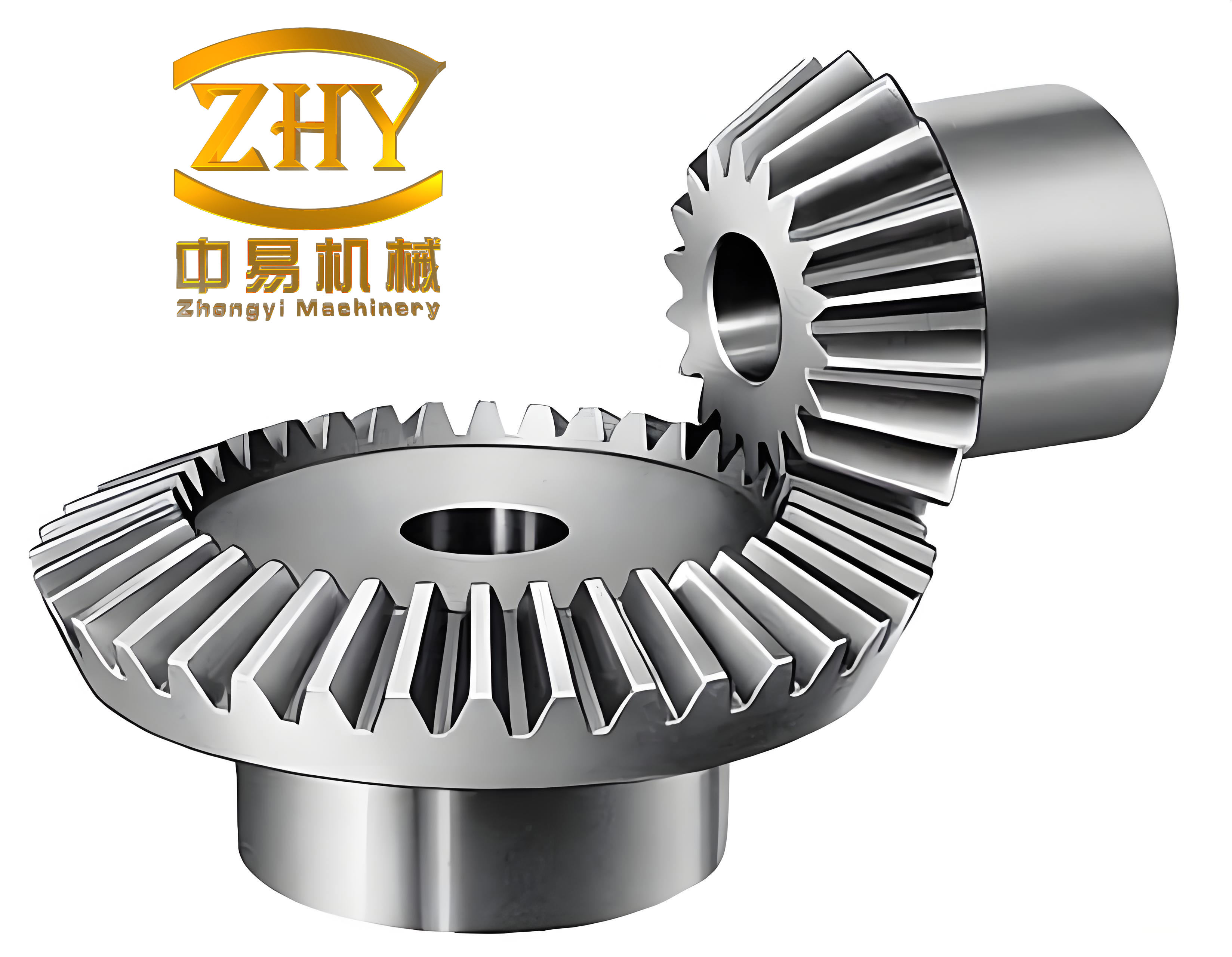
Implementation and Results
By integrating the parameterized design module into AutoCAD, users can generate 3D models of straight bevel gears by simply inputting values through a dialog box. The Autolisp program handles all calculations and simulations, producing accurate gear geometries. For instance, inputting a module of 2 mm, 20 teeth, a face width of 10 mm, and a pressure angle of 20 degrees yields a fully detailed straight bevel gear model. This method significantly reduces design time and ensures consistency, as changes to parameters automatically update the model.
The output includes features like keyways and bore holes, which are added via subroutines. The entire process emphasizes the versatility of the forming method for straight bevel gears, enabling applications in industries such as automotive and aerospace. The parameterized approach not only streamlines design but also supports further analysis, such as finite element simulations, by providing a reliable geometric base.
Conclusion
In summary, the parameterized design of straight bevel gears using Autolisp and the forming method offers a practical solution for rapid and accurate 3D modeling. By leveraging mathematical relationships and dynamic simulation, this approach enhances design efficiency and adaptability. The ability to quickly generate straight bevel gears with varying parameters makes it invaluable for engineering projects, demonstrating the broader potential of parameterized systems in mechanical design. Future work could extend this methodology to other gear types, further expanding its utility in the field of straight bevel gear applications.