
In mechanical engineering, spiral gears, particularly involute cylindrical helical gears, play a critical role in power transmission systems due to their smooth engagement and high load-bearing capacity. Accurate finite element (FE) modeling of these spiral gears is essential for stress analysis, fatigue prediction, and design optimization. However, creating precise geometric models that capture complex features like the involute profile and root fillet curve can be challenging. In this study, I develop a parameterized modeling approach for spiral gears based on the ANSYS Parametric Design Language (APDL). This method enables the generation of exact FE models with controlled geometry, regular mesh patterns, and independent graph units, facilitating efficient analysis of arbitrary spiral gears. The core innovation lies in combining dialog-based external parameter control with internal parameter recording of points, lines, and areas, alongside a bottom-up, divide-and-copy modeling strategy.
The geometric accuracy of spiral gears hinges on mathematically defining their tooth profiles. An involute spiral gear’s cross-section consists of four key curves: the dedendum circle, the root transition curve, the involute profile, and the addendum circle. Additionally, the base circle (generating circle for the involute) and pitch circle are reference geometries. The three-dimensional tooth surface is a helical extrusion of this profile along the gear axis.
First, the involute curve in the transverse plane is described by parametric equations. Using a polar coordinate system originating at the gear center, the coordinates of any point on the involute are given by:
$$x = \pm r_K \sin\theta, \quad y = r_K \cos\theta$$
where:
$$r_K = \frac{r_b}{\cos\alpha_K} = \frac{r \cos\alpha}{\cos\alpha_K}$$
$$\theta = \frac{\pi + 4x_m \tan\alpha_n}{2Z} + \text{inv}\alpha_n – \text{inv}\alpha_K$$
In these equations, \(Z\) is the number of teeth, \(\alpha_n\) is the normal pressure angle at the reference pitch circle, \(\alpha_K\) is the pressure angle at the arbitrary point on the involute (ranging from the intersection with the root curve to the tip), \(r\) is the pitch radius, \(r_b\) is the base radius, and \(x_m\) is the profile shift coefficient. The involute function is defined as \(\text{inv}\alpha = \tan\alpha – \alpha\) (in radians). The parameter \(\alpha_K\) is related to the radius \(r_K\) by \(\cos\alpha_K = r_b / r_K\).
Second, the root transition curve, which connects the dedendum circle to the involute, significantly influences bending strength. For gears generated by a rack-type cutter with a rounded tip, the transition curve is derived from the tool geometry and gear generation kinematics. Its parametric equations are:
$$x = \pm (\rho \cos\theta_t – r \phi) \cos\eta + (r – h_a + x_m m – \rho – \rho \sin\theta_t) \sin\eta$$
$$y = – (\rho \cos\theta_t – r \phi) \sin\eta + (r – h_a + x_m m – \rho – \rho \sin\theta_t) \cos\eta$$
where:
$$\eta = \phi – \zeta$$
$$\phi = \frac{-h_a + x_m m + \rho}{r \tan\theta_t}$$
$$\zeta = \frac{\pi m/4 + h_{a0}^* m \tan\alpha_n + \rho \cos\alpha_n}{r}$$
Here, \(\rho\) is the tip radius of the cutter, \(h_a\) is the addendum height, \(m\) is the module, \(h_{a0}^*\) is the tool addendum coefficient, and \(\theta_t\) is the pressure angle at the contact point, varying from \(\alpha_n\) to \(\pi/2\).
Third, the helical nature of spiral gears means that the intersection of the tooth surface with any cylinder (e.g., pitch cylinder) is a helix. The parametric equation for a helix on the pitch cylinder is:
$$x = r \cos\theta_h, \quad y = r \sin\theta_h, \quad z = \frac{r \theta_h}{\tan\beta}$$
where \(\beta\) is the helix angle at the pitch circle and \(\theta_h\) is the angular parameter.
To summarize these geometric parameters and equations, I present the following tables for clarity.
| Symbol | Description | Typical Range/Value |
|---|---|---|
| \(Z\) | Number of teeth | 20-100 |
| \(m_n\) | Normal module (mm) | 1-10 |
| \(\beta\) | Helix angle at pitch circle (°) | 0-45 |
| \(\alpha_n\) | Normal pressure angle (°) | 20 |
| \(h_a^*\) | Addendum coefficient | 1.0 |
| \(c^*\) | Clearance coefficient | 0.25 |
| \(x_m\) | Profile shift coefficient | -0.5 to 0.5 |
| \(B\) | Face width (mm) | 10-100 |
| \(\rho\) | Cutter tip radius (mm) | 0.38\(m_n\) |
| Component | Equation Type | Key Formulas |
|---|---|---|
| Involute Curve | Parametric (Polar) | \(x = r_K \sin\theta\), \(y = r_K \cos\theta\), with \(\theta = \frac{\pi + 4x_m \tan\alpha_n}{2Z} + \text{inv}\alpha_n – \text{inv}\alpha_K\) |
| Root Transition Curve | Parametric (Cartesian) | \(x, y\) as functions of \(\theta_t\), \(\eta\), \(\phi\), \(\zeta\) defined above |
| Helical Path | Parametric (Cylindrical) | \(x = r \cos\theta_h\), \(y = r \sin\theta_h\), \(z = (r \theta_h)/\tan\beta\) |
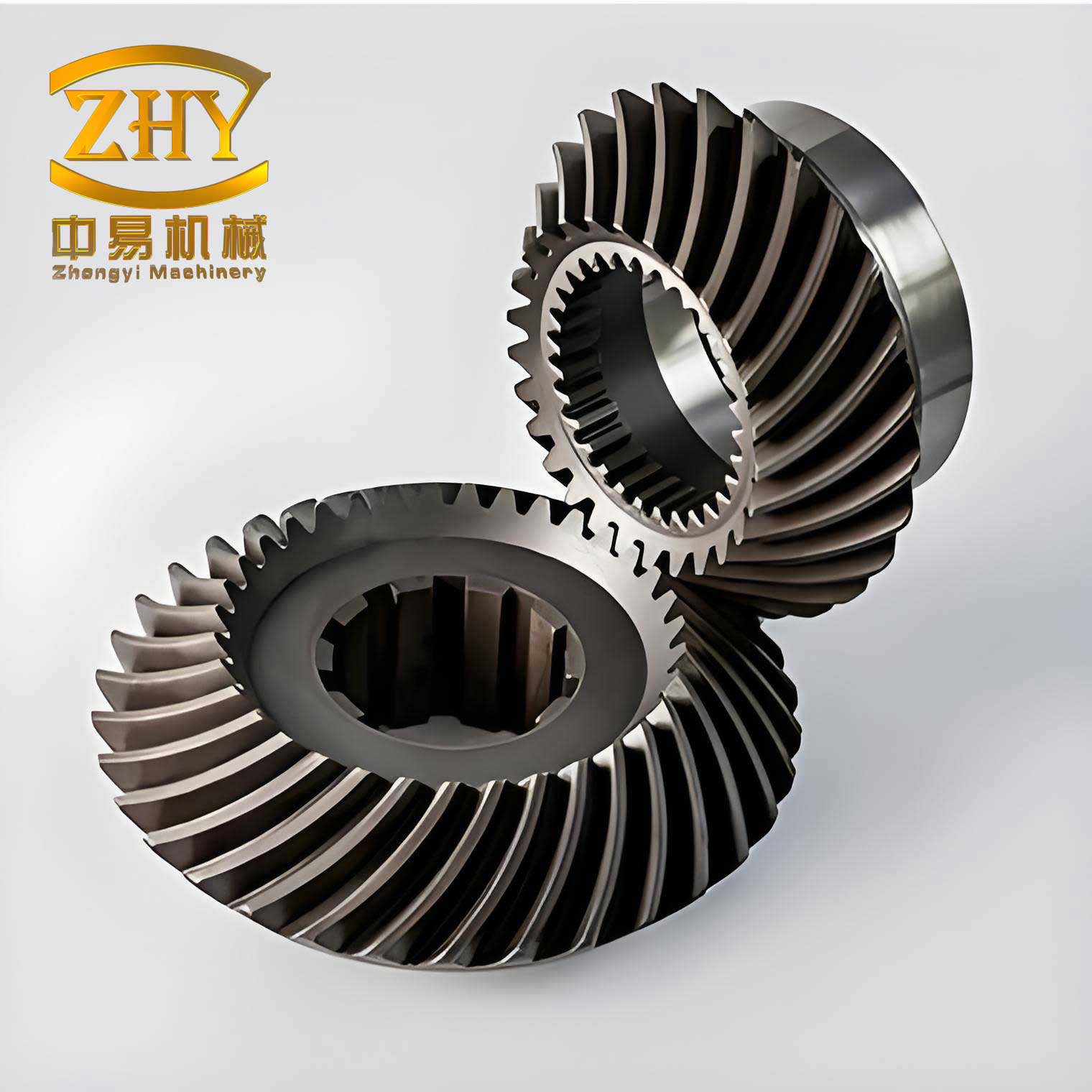
My parameterized modeling methodology for spiral gears in ANSYS using APDL follows a systematic bottom-up approach. This ensures precise control over geometry and mesh quality. The process begins by creating user-friendly dialogs to input external parameters, such as gear dimensions and material properties. Internally, the APDL code records the entity numbers (points, lines, areas, volumes) generated at each step, enabling robust parameter control and subsequent operations like copying and meshing.
The step-by-step procedure is as follows:
- Parameter Input via Dialogs: I design APDL multiparameter dialogs to capture key spiral gear parameters. For example, the primary gear dialog prompts for \(Z\), \(m_n\), \(\beta\), \(h_a^*\), \(c^*\), \(\alpha_n\), \(B\), \(x_m\), and \(\rho\). A secondary dialog defines the modeling plane orientation and gear center location. Additional dialogs set material properties (Young’s modulus, Poisson’s ratio, density) and element types (e.g., SOLID185 for 3D solids).
- Variable Definition and Storage: I define arrays to store the entity numbers of points, lines, areas, and volumes created during modeling. This is crucial for referencing entities in later steps. For instance, I use commands like
*DIM, k_points,, nto create an array for point numbers, and*GETto retrieve entity numbers after creation. - Generation of a Single Segmented Tooth Slice: Due to the helical geometry, I divide the tooth along the face width into \(n\) equal slices to facilitate mapped meshing. For each slice (typically with a thickness \(B_n = B/n\), where \(n\) is chosen such that \(B_n \leq 20\) mm for large helix angles), I build the model from points upward.
- Point Creation: Using the geometric equations, I calculate and generate points on the bottom face of the slice for the dedendum circle, root transition curve, involute, and addendum circle. I ensure points are densely spaced for accurate curve fitting. Each point is created with
K, x, y, z, and its number is stored. - Curve Fitting: I connect these points using spline curves (
BSPLIN) for the involute and transition curves, and straight lines or arcs for circular segments. The line numbers are stored. - Top Face Generation: The bottom face points are copied to the top face by translating them axially by \(B_n\) and rotating them circumferentially by an angle \(\Delta\theta = B_n / (r \tan\beta)\). This accounts for the helix twist. The same curve-fitting process creates the top face curves.
- Side Curves and Area Creation: I generate helical side curves by creating intermediate points between corresponding bottom and top points (using linear interpolation in cylindrical coordinates) and fitting splines. Then, I form the bounding areas: the bottom face, top face, and multiple side faces. Since ANSYS requires areas to be bounded by 3 or 4 lines, I carefully partition complex regions. Area numbers are stored.
- Volume Generation: All areas enclosing the slice are selected, and a volume is created using
VA, ALL. The volume number is stored.
- Point Creation: Using the geometric equations, I calculate and generate points on the bottom face of the slice for the dedendum circle, root transition curve, involute, and addendum circle. I ensure points are densely spaced for accurate curve fitting. Each point is created with
- Meshing of the Single Slice: Before meshing, I define element attributes and mesh controls. For high-quality hexahedral elements, I use mapped meshing on the bottom and top faces simultaneously with identical settings (e.g.,
AMESHwith specified line divisions). This ensures node compatibility. Then, I sweep the volume to generate a solid mesh (VSWEEP). The result is a finely meshed slice of the spiral gear tooth. - Replication to Form Complete Spiral Gear: The meshed slice is copied \(n-1\) times along the axis and circumferentially (using
VGENwith rotation and translation) to form a single full tooth. Subsequently, this tooth is copied \(Z\) times around the gear axis to create the entire gear rim. Finally, I merge coincident nodes and elements (NUMMRGcommands) to ensure a continuous FE model. The gear body (e.g., web and hub) can be added using simple geometries and boolean operations.
This APDL-driven process is encapsulated in a macro that can be executed in ANSYS. The dialog-based input makes it user-friendly, while the internal parameter recording ensures flexibility. The method produces independent graph units, meaning the spiral gear model does not interfere with other entities in the ANSYS database, allowing it to be used as a modular component in larger assemblies.
To illustrate the parameter control flow, here is a table summarizing the key APDL commands and variables used in the modeling process.
| Step | APDL Command / Variable Type | Purpose |
|---|---|---|
| Parameter Input | multipro, *cset |
Create dialogs for user input of gear parameters. |
| Variable Storage | *DIM, *GET |
Define arrays to store entity numbers (points, lines, etc.). |
| Point Generation | KSEL, K, , x, y, z |
Generate points with coordinates from equations; store numbers. |
| Curve Creation | BSPLIN, L, , , |
Create spline curves through stored points; record line numbers. |
| Area Formation | AL, L1, L2, ... |
Define areas from lines; store area numbers. |
| Volume Creation | VA, ALL |
Generate volume from enclosing areas; store volume number. |
| Meshing | AMESH, VSWEEP |
Map-mesh faces and sweep volume for hexahedral elements. |
| Replication | VGEN, , , , , , , |
Copy volumes with rotation/translation to build full gear. |
| Model Completion | NUMMRG, ALL |
Merge duplicate nodes and elements for continuity. |
Once the parameterized model of the spiral gear is established, I proceed to finite element analysis to evaluate its mechanical behavior under operational loads. The accuracy of the geometric model directly impacts the reliability of the FE results, making the aforementioned precise modeling crucial.
The analysis setup involves defining boundary conditions, applying loads, solving, and reviewing results. For spiral gears in mesh, such as in crossed-axis helical gear sets, the contact is theoretically point-like but becomes a small elliptical area due to elastic deformation. I simulate this by calculating the contact point location and ellipse dimensions based on gear geometry and load, then distributing the contact force over the corresponding nodes on the tooth surface.
Key steps in the FE analysis:
- Boundary Conditions: I constrain the inner bore surface of the spiral gear to simulate mounting on a shaft. All nodes on this surface are fixed in radial, tangential, and axial directions (UX=UY=UZ=0 for cylindrical coordinate systems, or appropriate constraints in Cartesian coordinates).
- Loading: The total transmitted load \(F_t\) is calculated from power and speed. For a spiral gear pair, the normal load \(F_n = F_t / (\cos\alpha_n \cos\beta)\). The contact ellipse dimensions (semi-major axis \(a\), semi-minor axis \(b\)) are derived from Hertzian contact theory for crossed cylinders, considering the local curvatures. The contact pressure is assumed elliptical:
$$p(x,y) = p_0 \sqrt{1 – \left(\frac{x}{a}\right)^2 – \left(\frac{y}{b}\right)^2}$$
where \(p_0\) is the maximum contact pressure. I apply equivalent nodal forces over the ellipse area on the tooth flank. - Solving: I use a static analysis with sparse direct solver (e.g.,
SOLVEwith appropriate settings). Material linear elasticity is assumed, though nonlinearities could be added for advanced studies. - Post-processing: I review stress contours (von Mises, contact pressure), deformation plots, and strain energy. The results reveal stress concentrations at the root and contact zone, guiding design improvements.
To quantify the geometric and mechanical parameters involved in the analysis, I provide the following table.
| Parameter | Symbol | Calculation/Value |
|---|---|---|
| Transmitted Torque | \(T\) | From power \(P\) and angular speed \(\omega\): \(T = P/\omega\) |
| Tangential Force | \(F_t\) | \(F_t = 2T / d\), where \(d\) is pitch diameter |
| Normal Force | \(F_n\) | \(F_n = F_t / (\cos\alpha_n \cos\beta)\) |
| Contact Ellipse Semi-axes | \(a, b\) | From Hertz theory: \(a = m_a \sqrt[3]{\frac{3F_n E’}{2\Sigma \rho}}\), \(b = m_b \sqrt[3]{\frac{3F_n E’}{2\Sigma \rho}}\) with \(E’\) effective modulus, \(\Sigma \rho\) sum of curvatures, \(m_a, m_b\) coefficients. |
| Maximum Contact Pressure | \(p_0\) | \(p_0 = \frac{3F_n}{2\pi a b}\) |
| Material Properties | \(E, \nu\) | Young’s modulus (e.g., 210 GPa for steel), Poisson’s ratio (e.g., 0.3) |
Through this FE analysis, I observed that the spiral gear model exhibits realistic stress distributions. The maximum von Mises stress occurs at the contact ellipse (e.g., 22.7 MPa in a sample case), indicative of contact stresses, while significant bending stresses appear at the root (e.g., 15.6 MPa). Deformations are minimal (e.g., 0.0012 mm at the contact point), validating the rigidity of the design. The regular hexahedral mesh ensures numerical stability and accurate stress gradients.
The parameterized modeling approach for spiral gears using APDL offers several advantages. First, it enables the creation of geometrically exact FE models with controlled accuracy, capturing intricate details like the involute and root fillet. Second, the bottom-up, segmentation, and replication strategy ensures high-quality mapped and swept meshes, which are computationally efficient and reduce discretization errors. Third, the dialog-based parameter control makes the method accessible for users to model arbitrary spiral gears by simply inputting geometric parameters. Fourth, the model exists as independent graph units in ANSYS, allowing easy integration into larger assemblies or repeated use in parametric studies.
In conclusion, my development of a comprehensive APDL-based parameterized modeling technique for spiral gears provides a robust tool for precise finite element analysis. The method seamlessly integrates geometric definition, automated model generation, and FE setup, ensuring that spiral gears of any specification can be analyzed accurately. This capability is vital for optimizing gear designs in industries such as automotive, aerospace, and machinery, where reliability and performance are paramount. Future enhancements could include incorporating thermal effects, dynamic loading, and advanced contact algorithms to further expand the applicability of this spiral gear modeling framework.
The flexibility and precision of this approach underscore its value in modern engineering simulations. By leveraging APDL’s scripting power, I have created a reusable module that significantly reduces the time and effort required for spiral gear analysis, while maintaining high fidelity to physical geometry. This contributes to more reliable and efficient design processes for spiral gear systems.