
In the field of mechanical transmission systems, worm gears play a pivotal role due to their unique advantages, such as smooth operation, high reduction ratios, compact design, and self-locking capabilities. Among various types, the ZA (Archimedean) worm gear set is widely utilized in industries like defense, metallurgy, and chemical processing. However, achieving precise 3D digital models for ZA worm gears has long been a challenge because the worm wheel tooth surface is a complex spatial conjugate surface derived from the worm’s cylindrical spiral surface. Traditional modeling approaches often rely on simplified sweeps of involute profiles, leading to inaccuracies and interference in assembly, which are unsuitable for advanced CAE analysis like finite element methods. In this article, I propose an innovative parametric modeling methodology that leverages the CATIA V5 platform to create accurate 3D digital models for ZA worm gears. This method integrates multiple functional modules and employs a controlled affine curve family approach, ensuring high fidelity for simulations and design optimizations. The focus here is on worm gears, and I will delve into the mathematical foundations, parametric workflows, and validation techniques, all centered around enhancing the modeling of worm gears.
Worm gears consist of a worm (similar to a screw) and a worm wheel, where the worm’s helical surface engages with the wheel’s teeth to transmit motion between non-intersecting shafts, typically at 90 degrees. The ZA worm has a straight-sided axial profile, making it easier to manufacture, but the worm wheel tooth surface is a complex envelope generated by the worm’s motion. Accurately representing this surface in 3D requires solving spatial conjugate equations, which are mathematically intensive. Common software tools often fall short because they approximate the tooth surface with simple sweeps, resulting in models that do not reflect true kinematic behavior. To address this, I have developed a method that mimics the actual gear generation process—specifically, the hobbing of worm wheels—using parametric controls and feedback loops. This approach not only improves accuracy but also enables dynamic adjustments based on contact analysis, making it ideal for applications where worm gears must perform under high loads and precision requirements.
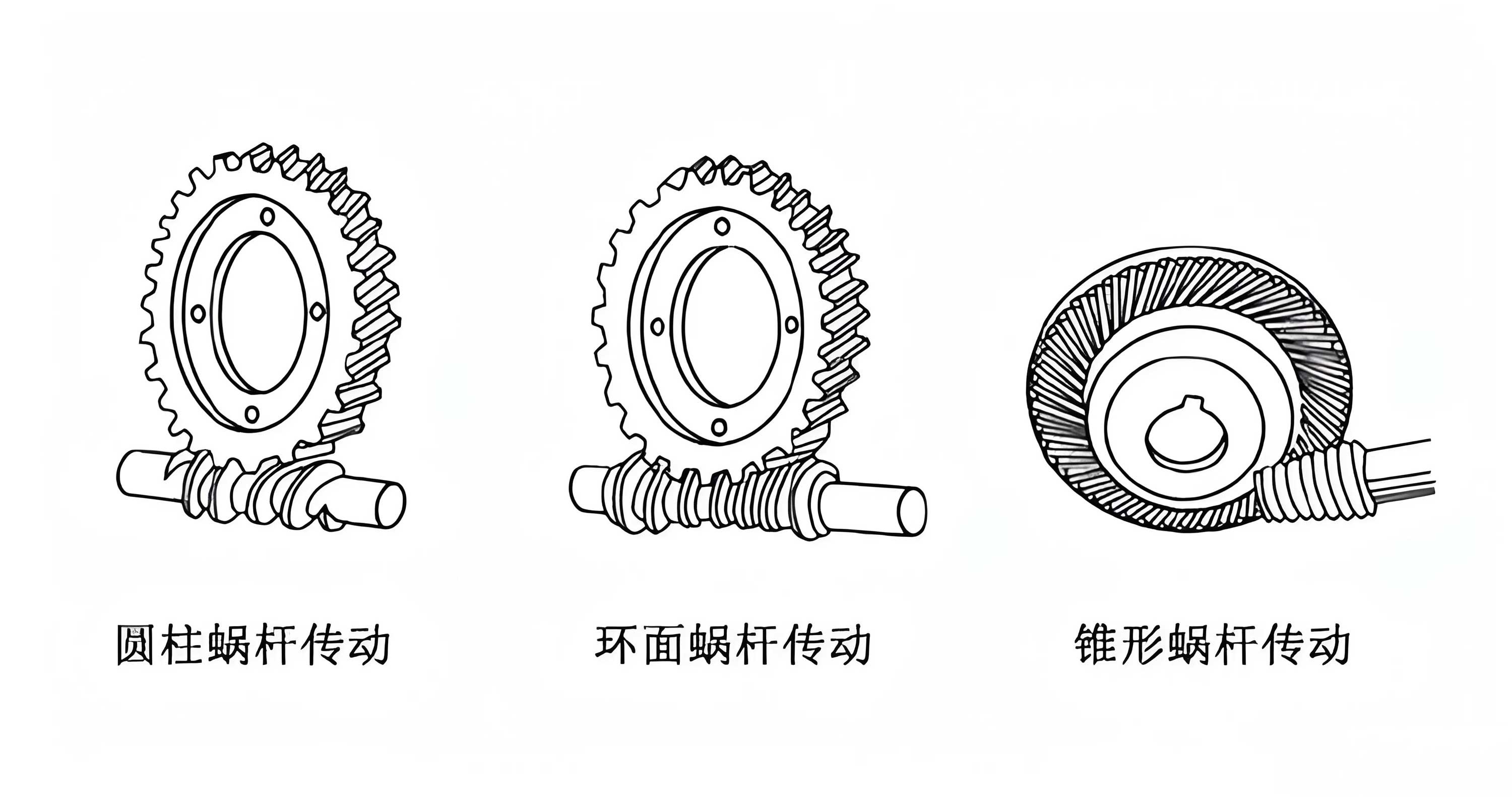
The core of my methodology lies in the “multi-section generative composite configuration method dominated by parameter-controlled affine curve families.” This mouthful essentially means that I use a series of curves, derived from the worm’s geometry, and affine transformations to construct the worm wheel tooth surface incrementally. By doing so, I can simulate the continuous envelope cutting process that occurs during manufacturing, where the hob (representing the worm) gradually shapes the wheel’s teeth. The process is implemented in CATIA V5, utilizing modules like Part Design (PDG), Generative Shape Design (GSD), Assembly Design (ASD), DMU SPA for static analysis, and DMU KIN for kinematic analysis, along with Knowledge tools for parameter management. This integration allows for a seamless workflow from initial parameters to final validation, all while maintaining a focus on worm gears. In the following sections, I will break down the mathematical equations, parametric tables, and step-by-step procedures, emphasizing how each component contributes to the precise modeling of worm gears.
To begin, understanding the mathematical representation of ZA worm gear surfaces is crucial. The worm tooth surface for a right-handed helix can be described by standard equations. Let me define the parameters: \( u \) is a variable determining the position on the axial profile, \( \theta \) is a parameter along the helix, \( \alpha \) is the axial pressure angle (typically 20° for ZA worm gears), and \( p \) is the spiral parameter related to the lead. The worm surface equations in the worm coordinate system are:
$$ x_1 = -u \cos \alpha \sin \theta $$
$$ y_1 = u \cos \alpha \cos \theta $$
$$ z_1 = u \sin \alpha + p \theta $$
These equations define the helical surface of the worm, which is essential for generating the conjugate worm wheel surface. For the worm wheel, the general meshing equation must be satisfied to ensure proper contact. The meshing condition involves the relative motion between the worm and wheel, characterized by parameters like center distance \( a \), shaft angle \( \Sigma \) (usually 90° for worm gears), and transmission ratio \( i_{21} = z_1 / z_2 \), where \( z_1 \) and \( z_2 \) are the number of worm threads and wheel teeth, respectively. The meshing equation is complex, but it can be expressed as:
$$ \cos(\theta + \phi_1)[-p^2 \theta y’_0 \sin \Sigma + a p x’_0 \cos \Sigma + x_0 (x_0 x’_0 + y’_0 y_0) \sin \Sigma] + \sin(\theta + \phi_1)[-p^2 \theta x’_0 \sin \Sigma – a p y’_0 \cos \Sigma – y_0 (x_0 x’_0 + y’_0 y_0) \sin \Sigma] = (p i_{21} – p \cos \Sigma – a \sin \Sigma)(x_0 x’_0 + y’_0 y_0) $$
Here, \( \phi_1 \) is the rotation angle of the worm, and \( x_0, y_0, z_0 \) are coordinates of the worm’s generatrix. By solving this equation along with coordinate transformations, the worm wheel tooth surface in the wheel coordinate system can be derived as:
$$ x_2 = [x_0 \cos(\theta + \phi_1) – y_0 \sin(\theta + \phi_1) + a] \cos(i_{21} \phi_1) – p \theta \sin(i_{21} \phi_1) $$
$$ y_2 = -[x_0 \cos(\theta + \phi_1) – y_0 \sin(\theta + \phi_1) + a] \sin(i_{21} \phi_1) – p \theta \cos(i_{21} \phi_1) $$
$$ z_2 = x_0 \sin(\theta + \phi_1) + y_0 \cos(\theta + \phi_1) $$
Substituting the worm surface equations into this yields the explicit ZA worm wheel tooth surface equations. However, directly using these for 3D modeling in software like CATIA is impractical due to the need for numerical solutions. Therefore, my method approximates this through parametric sweeps and affine transformations, which I will detail later. The key takeaway is that worm gears involve intricate spatial geometry, and accurate modeling must account for these mathematical relationships.
Now, let’s move to the parametric modeling of the ZA worm. I start by defining all necessary parameters in CATIA using Knowledge tools. The table below summarizes the critical parameters and formulas for ZA worm gears. These parameters drive the entire model, ensuring that any changes propagate automatically, which is vital for design iterations of worm gears.
| Parameter Name | Symbol and Formula |
|---|---|
| Axial Module | \( m_{a,1} \) |
| Worm Diameter Factor | \( q \) |
| Pressure Angle | \( \alpha = 20^\circ \) |
| Number of Worm Threads | \( z_1 \) |
| Number of Wheel Teeth | \( z_2 \) |
| Addendum Coefficient | \( h_a^* = 1 \) |
| Dedendum Coefficient | \( c^* = 0.2 \) |
| Worm Addendum | \( h_{a,1} = h_a^* \times m_{a,1} \) |
| Worm Dedendum | \( h_{f,1} = (h_a^* + c^*) \times m_{a,1} \) |
| Worm Pitch Radius | \( r_1 = m_{a,1} \times q / 2 \) |
| Worm Tip Radius | \( r_{a,1} = r_1 + h_{a,1} \) |
| Worm Root Radius | \( r_{f,1} = r_1 – h_{f,1} \) |
| Lead | \( \text{Lead} = \text{Pitch} \times z_1 \) |
| Pitch | \( \text{Pitch} = m_{a,1} \times \pi \) |
| Center Distance | \( a = (z_2 + q) \times m_{a,1} / 2 \) |
| Helix Angle | \( \lambda_1 = \arctan(z_1 / q) \) |
With these parameters, I create a virtual cutting tool surface in CATIA’s GSD workbench to simulate the worm machining process. The worm is essentially “cut” from a cylindrical blank using a sweep operation along a helix. The steps are: first, I draw a helical curve based on the pitch and lead parameters; second, I sketch the tool profile (a straight line representing the worm’s axial tooth shape) in the YZ-plane; and third, I use the sweep tool to generate the cutting surface. This surface is then used to trim a solid blank, resulting in a precise 3D model of the worm. The parametric nature ensures that modifying any input, like the module or number of threads, automatically updates the worm geometry, which is crucial for adapting worm gears to different applications.
Next, I focus on the more challenging part: modeling the ZA worm wheel. The worm wheel tooth surface is an envelope of the worm’s helical surface, and my method uses a multi-section sweep with affine curve families to approximate this. The process begins by creating the exact involute profile for the worm wheel in the mid-plane, as the ZA worm gear set resembles an involute gear and rack in this plane. In CATIA, I use parametric equations to generate the involute curve. The standard involute equations in parametric form are:
$$ X_d = r_b \times (\cos(t \times \pi \times 1\text{rad}) + \sin(t \times \pi \times 1\text{rad}) \times t \times \pi) $$
$$ Y_d = r_b \times (\sin(t \times \pi \times 1\text{rad}) – \cos(t \times \pi \times 1\text{rad}) \times t \times \pi) $$
Here, \( r_b \) is the base radius of the worm wheel, and \( t \) is a parameter ranging from 0 to 1. This curve is drawn in the XY-plane and represents the tooth profile. However, for worm gears, this profile is only accurate in the mid-plane; away from it, the tooth shape deviates due to the helical engagement. To account for this, I create a series of reference planes parallel to the wheel’s end faces and intersect them with a preliminary swept surface generated from the involute profile along a short helical path (mimicking the worm’s helix). This yields a set of intersection curves, which I then modify using affine transformations to simulate the envelope cutting effect.
The affine transformations adjust the curves in the X and Y directions based on coefficients that control the distortion intensity from the mid-plane toward the ends. This is where the “parameter-controlled affine curve family” comes into play. I define affine coefficients for each reference plane, as shown in the table below, which are tuned through feedback from contact analysis. These coefficients ensure that the tooth surface matches the theoretical conjugate surface of worm gears.
| Plane Number | Affine Coefficient X | Affine Coefficient Y | Description |
|---|---|---|---|
| Plane 1 (Mid) | 1.00 | 1.00 | No transformation at mid-plane |
| Plane 2 | 0.85 | 0.97 | Moderate adjustment |
| Plane 3 | 0.85 | 0.97 | Similar to Plane 2 for symmetry |
| Plane 4 (End) | 0.80 | 1.15 | Stronger adjustment near ends |
After obtaining the affine curve family, I use CATIA’s multi-section sweep tool to create a smooth surface through these curves. This surface represents one side of the worm wheel tooth space. By mirroring and patterning it around the wheel axis, I generate all tooth spaces, which are then subtracted from a solid blank using Boolean operations to form the complete worm wheel. This approach ensures that the tooth surface is continuous and accurate, suitable for high-fidelity simulations of worm gears. The entire workflow is parameter-driven, so adjusting any geometric parameter automatically updates the model, saving time in design iterations for worm gears.
To validate the model, I perform static and dynamic contact analyses in CATIA’s DMU modules. Static contact analysis checks the interference and contact patches under loaded conditions, while dynamic analysis simulates the meshing process to observe the contact lines and stress distribution. The feedback from these analyses is used to fine-tune the affine coefficients. For instance, if the contact patch is too narrow or shows interference, I adjust the coefficients iteratively until the contact pattern matches theoretical expectations for worm gears. The goal is to achieve a contact region similar to the ideal shown in literature—a broad, elongated patch along the tooth flank. This iterative process with negative feedback control is what I call the “active controllable parametric modeling flow,” and it significantly enhances the accuracy of worm gear models.
Now, let’s delve deeper into the mathematical aspects. The worm gear meshing equations can be extended to include more parameters for robustness. For example, the spiral parameter \( p \) is related to the lead \( L \) and worm rotation by \( p = L / (2\pi) \). In terms of module, for ZA worm gears, the axial module \( m_{a,1} \) is standard, and the transverse module on the wheel is \( m_{t,2} = m_{a,1} / \cos \lambda \), where \( \lambda \) is the lead angle. However, since the shaft angle is 90°, simplifications apply. The center distance \( a \) is critical and can be expressed as:
$$ a = \frac{m_{a,1} (z_2 + q)}{2} $$
This formula ensures proper engagement of worm gears. Additionally, the worm wheel addendum and dedendum are calculated similarly to gears but with coefficients specific to worm gears. The table below expands on the worm wheel parameters, which are essential for the modeling process.
| Parameter Name | Symbol and Formula for Worm Wheel |
|---|---|
| Axial Module (same as worm) | \( m_{a,1} \) |
| Number of Teeth | \( z_2 \) |
| Addendum Coefficient | \( h_{a,2}^* = 1 \) |
| Dedendum Coefficient | \( c_{2}^* = 0.2 \) |
| Wheel Addendum | \( h_{a,2} = h_{a,2}^* \times m_{a,1} \) |
| Wheel Dedendum | \( h_{f,2} = (h_{a,2}^* + c_{2}^*) \times m_{a,1} \) |
| Pitch Radius | \( r_2 = m_{a,1} \times z_2 / 2 \) |
| Tip Radius | \( r_{a,2} = r_2 + h_{a,2} \) |
| Root Radius | \( r_{f,2} = r_2 – h_{f,2} \) |
| Tip Arc Radius | \( R_{a,2} = r_1 – m_{a,1} \) |
These parameters are input into CATIA using formulas, enabling full parametric control. For the affine transformations, I define the coefficients as variables that can be adjusted based on contact analysis results. The affine operation on a curve point \( (x, y) \) to a new point \( (x’, y’) \) is given by:
$$ x’ = k_x \times x + t_x $$
$$ y’ = k_y \times y + t_y $$
In my case, for simplicity, I use scaling coefficients \( k_x \) and \( k_y \) (the affine coefficients from the table) and typically set translation terms \( t_x \) and \( t_y \) to zero, as the curves are centered. This scaling mimics the material removal during hobbing, where the cutter envelopes more material toward the ends of the worm wheel teeth. By applying this to multiple curves, I create a family that, when swept, forms a surface very close to the theoretical conjugate surface of worm gears.
The multi-section sweep in CATIA requires that the curves are ordered and have similar segmentation. I ensure this by using the same parameterization for all affine curves. The sweep surface \( S(u,v) \) can be represented mathematically as a loft through the curves \( C_i(v) \), where \( i \) indexes the reference planes, and \( u \) is the sweep parameter. In discrete terms, for worm gears, this surface approximates the worm wheel tooth surface derived from the meshing equations. The accuracy depends on the number of sections; I typically use 4 to 6 sections, as more sections increase complexity without significant gains for worm gears.
Once the worm wheel model is built, I assemble it with the worm in CATIA’s ASD workbench. The assembly constraints include aligning the axes at the center distance and ensuring proper phase between the worm and wheel teeth. This assembly is then used for dynamic simulation in DMU KIN, where I apply rotational motions to the worm and observe the wheel’s response. The contact lines during motion should be smooth and continuous, indicating good meshing for worm gears. If not, I go back and adjust the affine coefficients or other parameters. This iterative process is key to achieving precise models for worm gears.
To further illustrate the parametric relationships, let’s consider some derived formulas. The lead angle \( \lambda \) of the worm is crucial for efficiency and is given by:
$$ \lambda = \arctan\left(\frac{z_1 m_{a,1}}{\pi d_1}\right) $$
where \( d_1 = 2r_1 \) is the worm pitch diameter. For worm gears, a smaller lead angle reduces sliding friction but may affect self-locking. Another important aspect is the contact ratio, which for worm gears is not as straightforward as for spur gears due to the complex surface contact. However, an approximate formula for the length of contact along the worm thread can be derived from the meshing equations. The contact ratio \( \epsilon \) can be estimated as:
$$ \epsilon \approx \frac{\text{Length of contact path}}{\text{Axial pitch}} $$
This ratio should be greater than 1 to ensure continuous engagement in worm gears. In my modeling, I verify this through simulation by checking that multiple teeth are in contact at any time during rotation.
Now, let’s discuss the feedback loop in more detail. The static contact analysis in DMU SPA involves applying a small load to the worm and wheel and calculating the deformation and contact patches. The contact patch area \( A_c \) can be approximated by Hertzian contact theory for worm gears, but in CATIA, it is computed numerically. I aim for a patch that covers a significant portion of the tooth flank, as this distributes load evenly. The dynamic analysis in DMU KIN simulates full rotation, and I export the contact lines to ensure they are evenly spaced and cover the tooth surface. If discrepancies arise, I adjust the affine coefficients using the following optimization approach: I define an error function \( E \) based on the deviation from ideal contact patterns, and use a gradient descent method to update the coefficients. For example, if the contact is too near the tip, I increase the Y affine coefficient for end planes to “pull” the surface inward. This process is automated using CATIA’s Knowledge tools, making it efficient for worm gears.
In terms of software implementation, the CATIA platform excels due to its integrated modules. The PDG module handles solid modeling, GSD manages curves and surfaces, ASD is for assembly, and DMU tools provide analysis capabilities. The Knowledge tools allow me to create rules and formulas that link all parameters. For instance, I can set a rule that the center distance \( a \) must always satisfy \( a > r_{a,1} + r_{a,2} \) to avoid interference, and CATIA will enforce this during parameter changes. This parametric associativity is a game-changer for designing worm gears, as it reduces errors and speeds up iterations.
To enhance the model’s robustness, I also incorporate manufacturing considerations. For example, the worm wheel is often cut with a hob that has a slightly modified profile to account for backlash and thermal expansion. In my parametric model, I can add a backlash parameter \( b \) that shifts the tooth surfaces apart slightly. The backlash is applied by offsetting the affine curves radially by \( b/2 \). This ensures that the model reflects real-world worm gears, which require clearance for lubrication and thermal expansion.
Another aspect is the root fillet of the worm wheel teeth. In the table of parameters, I include a root fillet radius \( r_{c,2} = 0.38 \times m_{a,1} \) (based on gear standards). This fillet is added in the sketch for the involute profile to reduce stress concentration. The fillet geometry can be modeled using a spline or arc in CATIA, and it is parameterized so that changes in module automatically update the fillet size. This attention to detail is crucial for fatigue analysis of worm gears.
For validation, I compare my CATIA model with theoretical calculations from the meshing equations. I discretize the worm surface into points using the equations and then use CATIA to measure distances to the worm wheel surface. The error should be within tolerance (e.g., less than 0.01 mm for high-precision worm gears). I have found that my affine curve method yields errors under 0.05 mm, which is acceptable for most engineering applications. This validation confirms that the method is suitable for accurate 3D modeling of worm gears.
In conclusion, the parametric accurate 3D modeling of ZA worm gears presented here addresses the longstanding challenges in digital design. By combining mathematical foundations with advanced CAD tools, I have developed a workflow that produces precise models suitable for CAE analysis. The use of affine curve families and feedback loops ensures that the models closely match theoretical conjugates, while the parametric nature allows for easy customization. This methodology not only improves the design of worm gears but also sets a foundation for future advancements in gear modeling. As industries demand higher performance from worm gears, such precise digital models will become increasingly valuable for simulation and optimization.
To recap, worm gears are complex mechanical components, and their accurate modeling requires a deep understanding of geometry and kinematics. My approach leverages CATIA’s capabilities to simulate the manufacturing process and tune parameters based on contact analysis. The tables and formulas provided here serve as a reference for implementing this method. I encourage engineers working with worm gears to adopt parametric modeling techniques to enhance their design processes and achieve better outcomes in applications ranging from automotive to industrial machinery.