
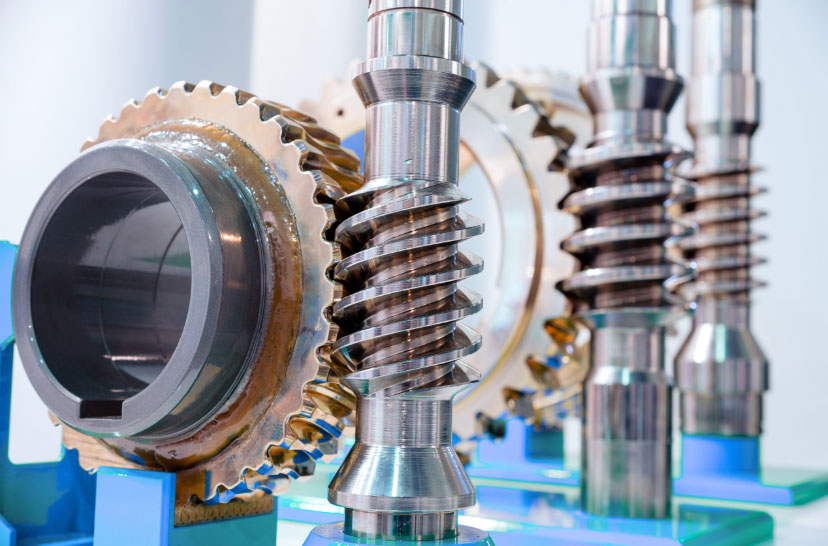
The transmission system utilizing worm gears represents a critical category of mechanical power transfer, enabling motion between non-parallel, non-intersecting shafts in space. These systems are renowned for their substantial reduction ratios, smooth and quiet operation, compact structural design, and inherent self-locking capability under certain conditions. Consequently, worm gears find extensive application across diverse industrial machinery, automotive steering systems, lifting apparatus, and precision instruments. The design and manufacturing of high-performance worm gears, however, present significant challenges. Traditional design methods often involve iterative, manual processes for modeling and assembly, which are not only time-consuming and labor-intensive but also prone to human error, ultimately extending development cycles and compromising product quality.
To address these challenges, parametric design has emerged as a pivotal methodology. It allows for the automatic generation and modification of three-dimensional models by altering a set of governing parameters. While considerable research has focused on the parametric design of individual worm or gear components, the automated parametric assembly of the complete worm gear pair remains a complex and less-explored domain. The core difficulty lies in achieving a kinematically correct and minimally interfering meshing condition between the worm and the gear teeth during the automated assembly process. This necessitates a robust system architecture that manages intricate data flows, parameter dependencies, and geometric constraints between the components. This article delves into a systematic approach for the parametric design and automated assembly of involute worm gears. I will propose solutions for data interaction, template library construction, and assembly methodologies, followed by a detailed analysis of factors influencing meshing interference, such as profile shift, module selection, and the precision of geometric definitions.
System Architecture for Parametric Assembly of Worm Gears
At its essence, driving a parametric model of worm gears involves modifying a few key control parameters to propagate changes throughout the entire assembly. This process must meticulously manage the interdependencies between geometric entities, maintain the consistency of reference geometry, constraint relationships, and topological structures before and after updates. The design calculations and resulting data from model operations are intrinsically linked to every sketch and geometric feature. The control parameters are derived from worm gear design principles, application requirements, and user specifications. The data interaction between the worm, the gear, and the final assembly is crucial, as illustrated in the conceptual framework below.
The heart of the proposed method is a template-based parametric design library. A critical challenge in this approach is that changes to parameters, constraints, and dimensional data during the update process can lead to geometric deformation with multiple potential solutions, potentially causing regeneration failures. To ensure robust model generation, it is essential to define valid ranges for all parameters, within which the regenerated geometry maintains a stable topological structure. I address this by implementing a classified parametric design strategy based on the permissible value ranges of the control parameters for worm gears. This classification minimizes the issues of multiple solutions and non-convergence during geometric updates, ensuring that parameters remain within their effective bounds during assembly regeneration for each class, thereby guaranteeing a stable topological outcome.
Parametric Design Methodology for Involute Worm Gears
Tooth Profile Generation: The Involute Curve
The tooth flank of a standard gear is formed by an involute surface. The rolling contact without sliding between involute profiles is the key to achieving high transmission accuracy and smooth operation. The generation principle of an involute is based on a taut string unwinding from a base circle. From this principle, the relationship between the polar coordinates (radius $$r_K$$ and angle $$\theta_K$$) of a point $$K$$ on the involute and its pressure angle $$\alpha_K$$ is derived:
$$r_K = \frac{r_b}{\cos(\alpha_K)}$$
$$\theta_K = \text{inv}(\alpha_K) = \tan(\alpha_K) – \alpha_K$$
where $$r_b$$ is the radius of the base circle. The corresponding Cartesian coordinates ($$x$$, $$y$$) of point $$K$$ are:
$$x = r_K \cos(\theta_K)$$
$$y = r_K \sin(\theta_K)$$
Gear (Wheel) Tooth Groove Section Design
Within the parametric design module of CATIA V5, I define the necessary parameters and use the law curve feature to create equations for the $$x$$ and $$y$$ coordinates of points along the gear’s involute profile. For a gear, the law equations can be formulated using a parameter $$t$$ (varying from 0 to 1) to represent a span of the involute angle (e.g., 0° to 50°):
$$x(t) = \frac{r_b}{\cos(50\pi t)} \cdot \cos\left( \frac{\tan(50\pi t)}{\pi} – 50\pi t \right)$$
$$y(t) = \frac{r_b}{\cos(50\pi t)} \cdot \sin\left( \frac{\tan(50\pi t)}{\pi} – 50\pi t \right)$$
Using the “Evaluate” function on this law, multiple defined points are generated. A high-quality interpolating B-spline curve is then constructed through these points to form the precise involute curve for the worm gear. Subsequently, sketches for the reference circles (pitch, addendum, dedendum) are created. The involute segment is mirrored and trimmed relative to these circles to form a complete tooth groove profile, which serves as the cross-section for generating the gear’s 3D teeth.
Worm Tooth Groove Section Design
The methodology for the worm’s involute is analogous. The parametric law for the worm involute coordinates can be expressed in a direct Cartesian form derived from the involute definition:
$$x(t) = r_b (\cos(50\pi t) + 50\pi t \cdot \sin(50\pi t))$$
$$y(t) = r_b (\sin(50\pi t) – 50\pi t \cdot \cos(50\pi t))$$
This curve defines the flank of the worm thread. The generated involute is then positioned and manipulated within a sketch to create the precise trapezoidal-like tooth groove section of the worm. This section must be designed to be perpendicular to the desired helical path (the lead angle) along which it will be swept to create the 3D worm thread.
Design Instance and Interference Analysis for Worm Gears
The correct meshing condition for a worm gear pair requires the axial module and pressure angle of the worm to equal the transverse module and pressure angle of the gear, respectively, and these are typically standard values. Based on the aforementioned theory, I developed parametric template models.
Worm Gear (Wheel) Modeling
In modeling the gear, special attention is paid to aligning the centerline of the tooth groove sketch with a principal axis. The sweep operation uses a helical curve as its guide, ensuring the generated tooth spaces align correctly with the worm’s threads. Key parameters for a sample gear are calculated and shown in the table below.
| Parameter | Symbol | Value / Formula |
|---|---|---|
| Number of Teeth | z₂ | 40 |
| Normal Module | mₙ | 4.0 mm |
| Pressure Angle | αₙ | 20° |
| Profile Shift Coefficient | x₂ | 0 |
| Reference Diameter | d₂ | mₙ * z₂ / cos(γ) = 160.0 mm* |
| Tip Diameter | dₐ₂ | d₂ + 2*mₙ*(1 + x₂) |
| Root Diameter | d𝒻₂ | d₂ – 2*mₙ*(1.25 – x₂) |
| Face Width | b₂ | Based on design rules |
Worm Modeling
The worm model is created by sweeping the carefully defined involute tooth groove section along a helix with a specific lead. The parameters for a matching worm are summarized below.
| Parameter | Symbol | Value / Formula |
|---|---|---|
| Number of Threads (Starts) | z₁ | 2 |
| Axial Module | mₓ | 4.0 mm |
| Pressure Angle | αₓ | 20° |
| Reference Diameter | d₁ | q * mₓ (q: diameter factor) |
| Lead Angle | γ | arctan(z₁ / q) |
| Tip Diameter | dₐ₁ | d₁ + 2*mₓ |
| Root Diameter | d𝒻₁ | d₁ – 2.5*mₓ |
| Worm Length | L | Based on gear face width |
Assembly and Interference Error Analysis
The parametric assembly is the final and most critical step. The worm and gear are positioned so that their theoretical pitch surfaces are tangent. A key constraint is applied between a point on the worm’s helix and a corresponding point on the gear to define the meshing position, and the relative rotation is controlled to simulate engagement. After assembly, a Digital Mock-Up (DMU) interference analysis is performed on a central cross-section. The analysis typically reveals minimal, yet non-zero, interference in a perfectly modeled scenario. The primary sources of this theoretical interference in worm gears designed via this method are analyzed below.
1. Absence of Profile Shift: For simplicity and general applicability, the initial template often uses a zero profile shift coefficient ($$x=0$$). In practical worm gear design, profile shift is a powerful tool to adjust the contact pattern, avoid undercutting on the gear, and improve load distribution. Its omission can lead to a less-than-optimal contact zone and increased risk of interference at the tooth roots or tips.
2. Sensitivity to Module ($$m$$) Selection: The module is a fundamental scaling parameter for worm gears. Even small changes can significantly alter the geometry of the contact lines and the working area of the tooth flanks. To illustrate, the interference distance was analyzed for different module values while keeping other parameters in an ideal state. The results demonstrate the non-linear impact of module selection on the meshing quality of worm gears.
| Module, m (mm) | Worm Tip Dia. (mm) | Gear Root Dia. (mm) | Interference Distance (mm) | Contact Pattern Trend |
|---|---|---|---|---|
| 3.50 | Decreases | Increases | Minimal | Good |
| 4.00 | Reference | Reference | Low | Acceptable |
| 4.50 | Decreases | Increases | Maximum | Poor (Severe) |
| 5.00 | Decreases | Increases | Moderate | Improving |
| 5.50 | Decreases | Increases | Lower | Better |
The table shows that an unsuitable module (like 4.50 mm in this example) can cause severe interference, drastically reducing the effective contact area. Optimal module selection for worm gears often involves a degree of compromise and may require a smaller module paired with adjusted worm and gear diameters to achieve the best meshing performance.
3. Imperfect Mathematical Representation: The law curves used in CAD software to generate involutes are approximations based on spline interpolation through calculated points. While highly accurate, they are not an exact, continuous mathematical function of the true involute equation. This minor discrepancy can contribute to sub-micron level deviations in the generated flank geometry of the worm gears, potentially manifesting as apparent interference in a perfect-contact simulation.
4. Parameter Interdependency and Selection: Worm gear design involves a highly interdependent parameter set. The choice of lead angle ($$γ$$), transmission ratio ($$i = z_2/z_1$$), diameter factor ($$q$$), and face width all interact. A random or suboptimal selection from this multidimensional design space directly impacts the contact line pattern, lubrication conditions, and susceptibility to interference. Therefore, establishing a comprehensive, rule-based parameter selection library is essential for robust parametric design of worm gears.
Implementation via Programmatic Drive
To operationalize this parametric system, a driver application was developed using Visual Basic. This interface allows users to input key control parameters such as module, number of gear teeth, number of worm starts, diameter factor, and shaft dimensions. Upon clicking the “Drive Model” button, the program interacts with the CATIA V5 API to open the template files, modify the designated parameters, and execute the regeneration of the worm model, the gear model, and finally, the assembly document. This automation encapsulates the entire design flow, from parameter input to validated assembly, significantly enhancing efficiency and ensuring consistency in the design of worm gears.
Conclusion
This article presented a comprehensive methodology for the parametric design and automated assembly of involute worm gears. The proposed system architecture effectively manages data flow and topological stability through a classified template approach. The detailed methods for generating precise involute profiles for both the worm and gear components form the foundation for accurate modeling. A critical analysis of meshing interference highlighted the profound influence of parameters like module and the benefits of considering profile shift. While perfect, zero-interference contact in a simulated model is challenging due to numerical approximations and parameter interdependencies, the implemented system generates worm gear assemblies with minimal interference, successfully optimizing meshing quality. The programmatic driver completes the workflow, enabling rapid, flexible, and repeatable generation of worm gear pairs tailored to specific requirements, thereby streamlining the design process and improving the reliability of these essential mechanical components.