
In mechanical engineering, the design and analysis of gears are critical for transmitting motion and power between intersecting shafts. Straight bevel gears, in particular, are widely used due to their efficiency in such applications. However, traditional design methods for straight bevel gears can be time-consuming and prone to errors, especially when dealing with complex geometries and load conditions. To address this, I have developed a parametric design system for straight bevel gears using SolidWorks and Visual Basic (VB) for secondary development, followed by finite element analysis (FEA) with COSMOS software. This approach enables rapid generation of accurate three-dimensional models and assesses their structural integrity under specified loads. The integration of parametric design and FEA not only streamlines the design process but also facilitates optimization of gear parameters, ensuring reliability and performance. In this article, I will detail the methodology, implementation, and analysis results, emphasizing the use of tables and formulas to summarize key aspects. The focus will remain on straight bevel gears throughout, as they are central to this study.
The parametric design of straight bevel gears relies on defining key variables that govern the gear geometry. By leveraging SolidWorks’ application programming interface (API) with VB, I created a user-friendly interface to input design parameters and automate model generation. This method transforms characteristic dimensions into parametric variables, allowing for dynamic updates to the gear model based on user inputs. The core parameters include the number of teeth for the pinion and gear (denoted as \( z_1 \) and \( z_2 \)), module (\( m \)), pressure angle (\( \alpha \)), addendum coefficient (\( h_a^* \)), and dedendum coefficient (\( c^* \)). These variables drive the entire design process, with secondary parameters derived through mathematical relationships. For instance, the gear ratio (\( u \)) is calculated as \( u = z_2 / z_1 \), and the reference diameter for the pinion is \( d_1 = m \cdot z_1 \). The use of parametric equations ensures that all dimensions are interrelated, reducing inconsistencies and enhancing design accuracy. Below, I present a table summarizing the primary design variables and their descriptions for straight bevel gears.
| Variable | Symbol | Description |
|---|---|---|
| Number of Teeth (Pinion) | \( z_1 \) | Number of teeth on the smaller gear |
| Number of Teeth (Gear) | \( z_2 \) | Number of teeth on the larger gear |
| Module | \( m \) | Ratio of pitch diameter to number of teeth, in mm |
| Pressure Angle | \( \alpha \) | Angle between tooth profile and tangent line, typically 20° |
| Addendum Coefficient | \( h_a^* \) | Factor for addendum height calculation |
| Dedendum Coefficient | \( c^* \) | Factor for dedendum height calculation |
The parametric modeling process for straight bevel gears begins with creating a blank body based on the input parameters. In SolidWorks, I start by selecting a reference plane, such as the front plane, and sketching the key points that define the gear’s axial cross-section. These points include the apex of the pitch cone, points on the addendum and dedendum circles, and boundaries along the gear width. For example, the addendum height (\( h_a \)) is computed as \( h_a = h_a^* \cdot m \), and the dedendum height (\( h_f \)) as \( h_f = (h_a^* + c^*) \cdot m \). The pitch angle (\( \delta \)) for the pinion is given by \( \delta_1 = \arctan(z_1 / z_2) \), and the cone distance (\( R \)) is \( R = \frac{m}{2} \sqrt{z_1^2 + z_2^2} \). Using these values, I draw points O (apex), A (pitch point), B and C (addendum and dedendum points), and D and E (width boundaries). The blank is then generated by revolving this sketch around the central axis. This step ensures that the basic geometry of the straight bevel gear is accurately represented before adding tooth profiles.
Next, I focus on generating the involute tooth profile for the straight bevel gear. Since the actual tooth shape on a straight bevel gear is based on a spherical involute, which is complex to model directly, I use the equivalent spur gear on the back cone as an approximation. The equivalent number of teeth (\( z_v \)) is calculated as \( z_v = z / \cos \delta \), where \( \delta \) is the pitch angle. The involute curve is defined parametrically in Cartesian coordinates. Let \( r_b \) be the base circle radius, which is \( r_b = \frac{m \cdot z \cdot \cos \alpha}{2} \) for the equivalent gear. The parametric equations for the involute are:
$$ x = r_b (\cos \theta + \theta \sin \theta) $$
$$ y = r_b (\sin \theta – \theta \cos \theta) $$
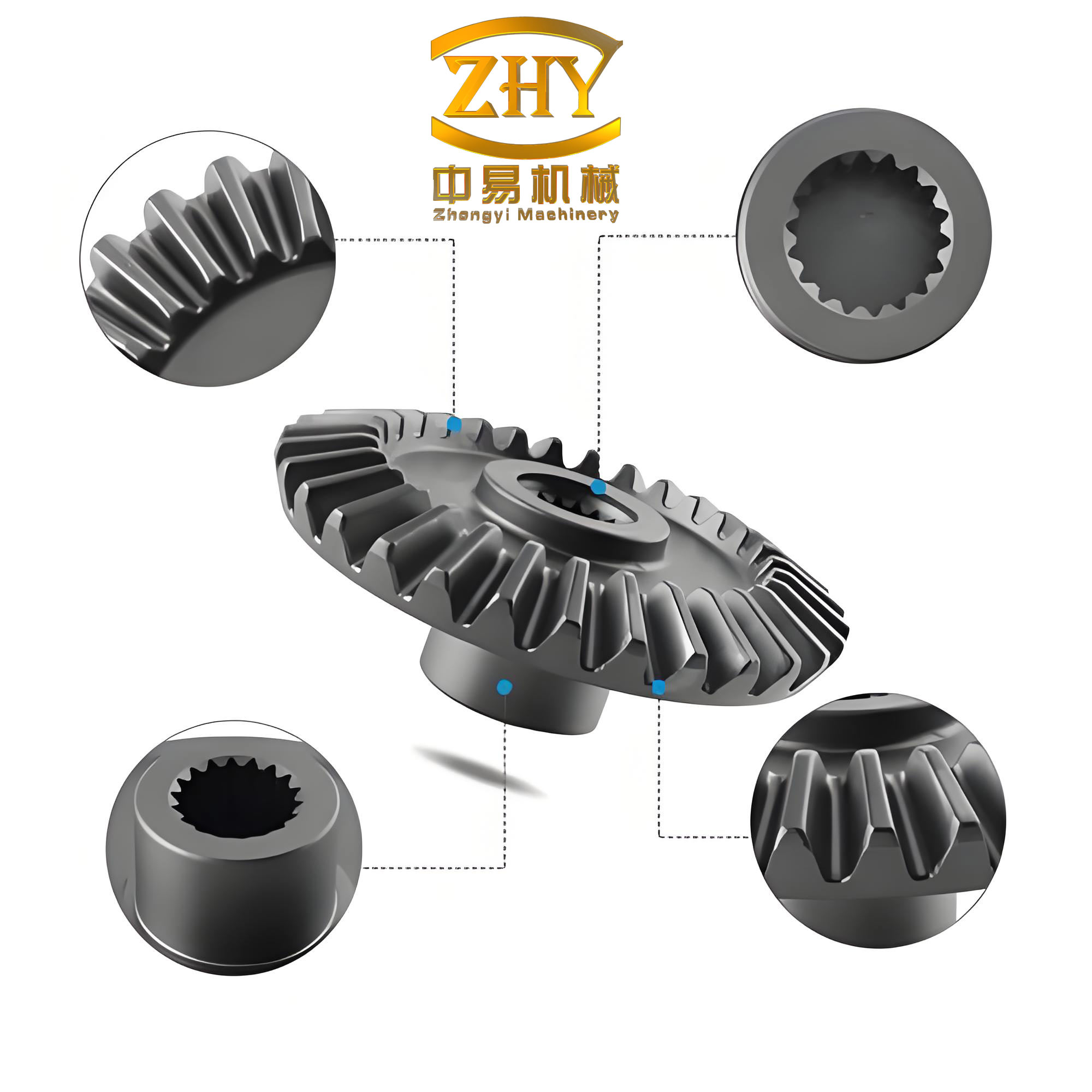
where \( \theta \) is the roll angle, ranging from 0 to a maximum value based on the addendum circle. In SolidWorks, I implement this by calculating a series of points using these equations and fitting a spline curve through them. This approach provides a high-precision approximation of the involute shape. For the straight bevel gear, I create tooth profiles at both the large and small ends by scaling the coordinates according to the cone distance. After sketching one side of the tooth, I mirror it across the base circle to form the complete tooth outline. The tooth space is then created using a lofted cut between the large and small end profiles, resulting in a single tooth slot. The process is repeated for all teeth by applying a circular pattern around the gear axis, with the number of instances equal to the number of teeth. This method efficiently generates the entire gear model, as illustrated in the following visualization of a straight bevel gear.
To automate the parametric design of straight bevel gears, I developed a VB program that interfaces with SolidWorks via its API. The program flow involves initializing SolidWorks, reading user inputs from a custom interface, calculating derived parameters, and executing the modeling steps. Key equations embedded in the code include those for the root angle (\( \delta_f \)) and tip angle (\( \delta_a \)), which are derived as \( \delta_f = \delta + \arctan(h_f / R) \) and \( \delta_a = \delta + \arctan(h_a / R) \), respectively. The face width (\( b \)) is determined by the cone distance and a width factor (\( \psi_R \)), typically between 0.25 and 0.3, so \( b = \psi_R \cdot R \). The VB program ensures that all dimensions are linked through equations, allowing for quick updates when parameters change. For instance, if the module is modified, the entire gear geometry adjusts accordingly. This parametric approach significantly reduces design time for straight bevel gears and minimizes human error. Below is a table summarizing the derived parameters and their formulas for straight bevel gears.
| Parameter | Symbol | Formula |
|---|---|---|
| Gear Ratio | \( u \) | \( u = z_2 / z_1 \) |
| Pitch Angle (Pinion) | \( \delta_1 \) | \( \delta_1 = \arctan(z_1 / z_2) \) |
| Cone Distance | \( R \) | \( R = \frac{m}{2} \sqrt{z_1^2 + z_2^2} \) |
| Addendum Height | \( h_a \) | \( h_a = h_a^* \cdot m \) |
| Dedendum Height | \( h_f \) | \( h_f = (h_a^* + c^*) \cdot m \) |
| Root Angle | \( \delta_f \) | \( \delta_f = \delta + \arctan(h_f / R) \) |
| Tip Angle | \( \delta_a \) | \( \delta_a = \delta + \arctan(h_a / R) \) |
| Equivalent Teeth | \( z_v \) | \( z_v = z / \cos \delta \) |
| Face Width | \( b \) | \( b = \psi_R \cdot R \) |
After generating the parametric model of the straight bevel gear, I proceed to finite element analysis using COSMOS software to evaluate its structural performance under load. The primary goal is to identify stress concentrations, deformation, and potential failure points, which are crucial for optimizing the design of straight bevel gears. I begin by assigning material properties to the gear model. For this study, I selected quenched and tempered 45 steel, a common material for gears due to its strength and durability. The material properties include a Young’s modulus of 210 GPa, Poisson’s ratio of 0.3, yield strength of 355 MPa, and ultimate tensile strength of 600 MPa. These values are input into COSMOS to define the linear elastic behavior of the straight bevel gear during analysis.
For the FEA of the straight bevel gear, I apply boundary conditions and loads that simulate real-world operating conditions. The gear is constrained at the bore and keyway surfaces to restrict all degrees of freedom, including translations and rotations in the X, Y, and Z directions. The load is applied as a normal force (\( F_n \)) on the tooth surface, which is decomposed into tangential (\( F_t \)), radial (\( F_r \)), and axial (\( F_a \)) components based on the pressure angle and gear geometry. The tangential force, for instance, can be calculated as \( F_t = \frac{2T}{d} \), where \( T \) is the torque and \( d \) is the pitch diameter. To simplify the analysis, I assume a static load condition and apply it at the point of contact along the tooth profile. This setup allows for a comprehensive stress analysis of the straight bevel gear under typical transmission loads.
Mesh generation is a critical step in FEA for straight bevel gears, as it discretizes the model into finite elements for numerical solution. In COSMOS, I use solid tetrahedral elements due to their ability to handle complex geometries like those of straight bevel gears. The mesh density is refined in areas of expected high stress, such as the tooth root and fillet regions, to ensure accuracy. The average element size is set to 1 mm, resulting in a mesh with over 100,000 elements for a typical straight bevel gear model. This level of discretization balances computational efficiency with result precision. After meshing, I run the static analysis to obtain stress, strain, and displacement fields. The results for the straight bevel gear indicate that the maximum von Mises stress occurs at the root of the teeth on the smaller end, with a value of approximately 46,960.6 MPa, which exceeds the material’s yield strength. This stress concentration suggests a high risk of fatigue failure, highlighting the need for design adjustments. The maximum displacement is 0.4025 mm, and the maximum strain is 0.1065, both localized in the tooth regions. The table below summarizes the FEA results for the straight bevel gear.
| Parameter | Value | Location |
|---|---|---|
| Maximum von Mises Stress | 46,960.6 MPa | Tooth root at small end |
| Maximum Displacement | 0.4025 mm | Tooth tip region |
| Maximum Strain | 0.1065 | Tooth root area |
The high stress values observed in the FEA of the straight bevel gear necessitate a review of the design parameters. For instance, increasing the module or adjusting the addendum coefficient could reduce stress concentrations. The parametric model allows for quick iterations; by modifying the input variables in the VB interface, I can regenerate the gear and re-run the FEA to evaluate improvements. This iterative process is essential for optimizing straight bevel gears, ensuring they meet strength requirements while minimizing weight and material usage. Additionally, the use of parametric equations enables the exploration of different gear ratios and sizes without manual redesign. The integration of parametric design and FEA thus provides a robust framework for developing reliable straight bevel gears in various applications.
In conclusion, the parametric design and finite element analysis of straight bevel gears using SolidWorks and VB offer a efficient approach to gear development. The method automates model generation based on key variables and assesses structural performance through simulation. The results for straight bevel gears highlight the importance of tooth root strength and the potential for fatigue failure, guiding design optimizations. Future work could extend this approach to other gear types or dynamic load conditions, further enhancing the design process for straight bevel gears. By leveraging parametric modeling and FEA, engineers can achieve higher accuracy and faster development cycles for straight bevel gears in mechanical systems.