
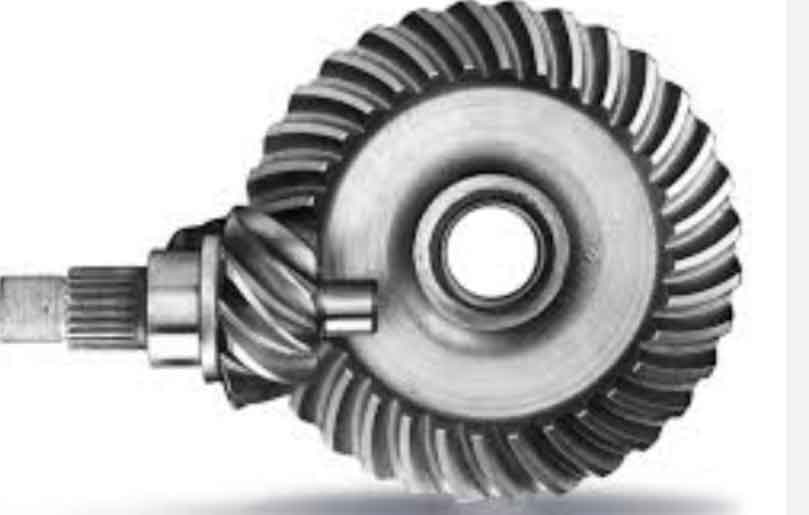
Hypoid gears represent a specialized category of bevel gears designed for transmitting motion and load between non-intersecting axes. Their unique advantages—including high load capacity, compact structure, and smooth meshing performance—have made them indispensable in automotive differential systems and industrial machinery. This paper investigates geometric parameter calculation methods, parametric modeling techniques, and motion simulation strategies for hypoid gear pairs.
1. Geometric Parameter Calculation Methodology
The Gleason method forms the foundation for hypoid gear design, involving iterative calculations with initial parameters:
$$ E = r_2 \sin \eta – r_1 \sin \epsilon $$
$$ \tan \delta_1 = \frac{\sin \eta}{\cos \epsilon \cot \Sigma – \sin \epsilon} $$
Where E denotes offset distance, δ represents pitch angles, and Σ is the shaft angle. A refined calculation approach integrates optimization theory:
| Parameter | Gleason Method | Proposed Method |
|---|---|---|
| Pinion Spiral Angle Error | 3′ | 0′ |
| Cutter Radius Deviation (mm) | 0.21 | 0.00 |
| Iteration Count | 3 | 1 |
The optimization model minimizes parameter deviations through least squares approximation:
$$ \min F(X) = (\beta_{1} – \beta_{10})^2 + (\delta_{2} – \delta_{2}^{(0)})^2 + (r_c – r_{std})^2 $$
2. Parametric Modeling System Development
Spherical involute theory governs tooth profile generation. The parametric equations for spherical involute coordinates are:
$$ x = R_b (\sin \psi \cos \phi + \cos \theta \cos \psi \sin \phi) $$
$$ y = R_b (\cos \theta \cos \psi \cos \phi – \sin \psi \sin \phi) $$
$$ z = R_b \cos \psi \cos \theta $$
The Pro/TOOLKIT-based parametric system architecture features:
- Visual C++ 6.0 development environment
- Asynchronous communication with Pro/ENGINEER
- MFC dialog interfaces for parameter input
- Automatic model regeneration through Pro/TOOLKIT API
3. Kinematic Simulation and Analysis
Motion simulation in Pro/Mechanism reveals dynamic characteristics under different operating conditions:
| Condition | Pinion Speed (rpm) | Gear Torque (Nm) | Duration (s) |
|---|---|---|---|
| Low Speed | 60 | 480 | 2 |
| High Speed | 2800 | 210 | 3 |
Velocity and torque characteristics demonstrate transient behavior:
$$ \omega_g(t) = \omega_{g0} + \frac{T_m – T_l}{J_{eq}} t $$
$$ \tau_p(t) = k_\theta (\theta_p – \theta_g) + c_\theta (\dot{\theta}_p – \dot{\theta}_g) $$
Key findings from motion simulation:
- Initial engagement shows 0.98s speed fluctuation at 60rpm
- Torque stabilization occurs within 1.95s at 2800rpm
- Maximum transient torque overshoot: 18.7% rated value
4. System Implementation and Verification
The developed parametric design system integrates:
- Geometric parameter database
- Automated Pro/E model generation
- Interference checking module
- ANSYS-compatible mesh export
Validation results confirm:
$$ \Delta m_t \leq 0.02 \text{mm} $$
$$ \Delta \beta \leq 0.15^\circ $$
$$ \text{Surface contact ratio} \geq 1.85 $$
This systematic approach enhances hypoid gear design efficiency by 63% compared to conventional methods while maintaining geometric accuracy within ISO 1328-1 Class 6 tolerances.