
In modern mechanical engineering, the design of straight bevel gears is critical due to their ability to change transmission direction, high重合度, and smooth operation. These gears are widely used in aerospace, automotive, and heavy machinery systems. However, the design process involves numerous parameters, complex calculations, and iterative checks, which are time-consuming and prone to errors. To address this, we developed a parametric design and optimization system based on Visual Lisp within the AutoCAD environment. This system automates the design, validation, drawing, and optimization of straight bevel gears, significantly reducing repetitive tasks and improving efficiency. In this article, we detail the modular structure, design processes, parametric drawing techniques, and optimization methods for straight bevel gears, emphasizing the use of Visual Lisp for seamless integration with AutoCAD.
The modular program design follows a structured approach to handle the entire design lifecycle of straight bevel gears. The system is divided into several modules: initial parameter input, geometric parameter calculation, contact fatigue strength validation, bending fatigue strength validation, and parametric drawing. Each module is implemented using Visual Lisp functions, which allow direct calls to AutoCAD commands and system variables. The initial parameters, such as torque, speed, and load factors, are input via user-friendly interfaces, as summarized in Table 1. The system interface, depicted in Figure 1, provides a cohesive environment for users to navigate through these modules. Key functionalities include calculation capabilities, process prompts, data storage for future reference, and automated drawing generation. This modular design ensures that changes in parameters automatically propagate through the system, enabling rapid prototyping and series production of straight bevel gears.
| Parameter | Value |
|---|---|
| Torque on pinion (T1) | 140.0 N·m |
| Pinion speed (n1) | 960.0 rpm |
| Estimated safety factor (sh) | 1.1 |
| Gear speed (n2) | 325.0 rpm |
| Gear contact fatigue strength limit (σHlim) | 1300.0 N/mm² |
| Load factor | 1.5 |
The geometric transmission parameters for straight bevel gears are calculated based on fundamental relationships derived from standard references. For orthogonal straight bevel gears (where the shaft angle Σ = 90°), key dimensions include the pitch diameter, cone distance, and module. The formulas for these parameters are implemented in Visual Lisp to automate computations. For instance, the pitch diameter for the pinion (d1) and gear (d2) can be expressed as:
$$d_1 = m_e \times z_1$$
$$d_2 = m_e \times z_2$$
where \(m_e\) is the module at the large end, and \(z_1\) and \(z_2\) are the numbers of teeth on the pinion and gear, respectively. The cone distance (Re) is given by:
$$R_e = \frac{d_1}{2 \sin \delta_1} = \frac{d_2}{2 \sin \delta_2}$$
where \(\delta_1\) and \(\delta_2\) are the pitch angles. Additional parameters, such as addendum, dedendum, and face width, are computed similarly. The results of these calculations are displayed in an output interface, as shown in Figure 2, providing designers with a comprehensive overview of the straight bevel gear geometry. This automation ensures accuracy and consistency, which are crucial for high-performance applications of straight bevel gears.
Contact fatigue strength validation is a critical step in ensuring the durability of straight bevel gears. The validation uses the following formula for orthogonal straight bevel gears:
$$\sigma_H = K_A K_V K_{H\beta} K_{H\alpha} \frac{F_t}{d_{m1} b_m} \sqrt{\frac{u^2 + 1}{u}} Z_{M-B} Z_H Z_E Z_{LS} Z_\beta Z_K \leq \sigma_{HP}$$
where \(K_A\), \(K_V\), \(K_{H\beta}\), and \(K_{H\alpha}\) are the application factor, dynamic factor, face load factor, and transverse load factor, respectively. \(Z_H\), \(Z_{M-B}\), \(Z_E\), \(Z_\beta\), \(Z_{LS}\), and \(Z_K\) represent the zone factor, mid-zone factor, elasticity factor, spiral angle factor, load distribution factor, and bevel gear factor. The tangential force \(F_t\) is derived from the transmitted torque. In our Visual Lisp program, users input these factors through a dedicated interface, as illustrated in Figure 3. The system then computes the contact stress and compares it to the allowable stress \(\sigma_{HP}\), providing immediate feedback on whether the design meets safety standards. This process highlights the importance of precise parameter selection for straight bevel gears to prevent premature failure.
Similarly, bending fatigue strength validation is performed using the formula:
$$\sigma_F = K_A K_V K_{F\beta} K_{F\alpha} \frac{F_t}{b_m m_n} Y_{FS} Y_E Y_K Y_{LS} \leq \sigma_{FP}$$
where \(Y_{FS}\), \(Y_E\), \(Y_K\), and \(Y_{LS}\) are the form factor, stress correction factor, bevel gear factor, and load distribution factor for bending, respectively. \(\sigma_{FP}\) denotes the allowable bending stress. The input parameters for this validation are captured through another interface, as shown in Figure 4. By automating these checks, our system ensures that the straight bevel gear design can withstand operational loads without tooth breakage, which is essential for reliability in demanding environments.
Parametric drawing is a standout feature of our system, leveraging Visual Lisp’s functions to generate 2D drawings automatically. The drawing process begins by defining a base point for the gear profile, followed by calculating coordinates for key points such as tooth profiles, pitch circles, and root circles. Visual Lisp provides both built-in functions and user-defined functions stored in *.LSP files to handle these tasks. Layers, line types, and line widths are predefined to adhere to drafting standards. For example, the active and driven straight bevel gears are rendered as 2D projections, showcasing critical dimensions and tolerances. The resulting drawings, as depicted in Figures 5 and 6, serve as accurate representations for manufacturing and assembly. This capability eliminates the need for manual drafting, reducing errors and saving time in the design of straight bevel gears.
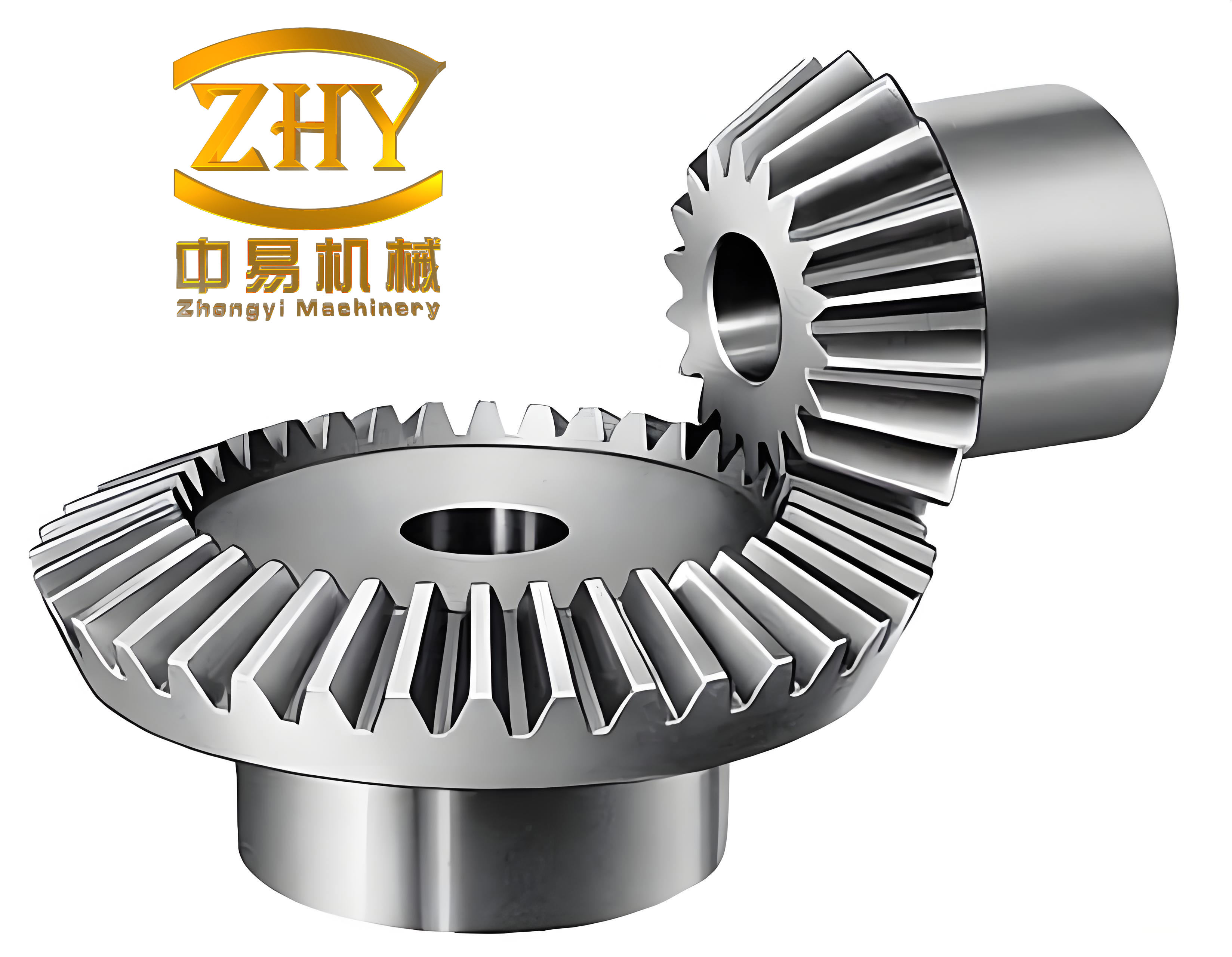
Optimization of design parameters is crucial for enhancing the performance and efficiency of straight bevel gears. Traditional design methods rely on empirical formulas, which may not yield optimal results. Our system incorporates an optimization module that minimizes the total volume of the gear pair, thereby reducing material usage and weight. The objective function for volume minimization is expressed as:
$$V = V_1 + V_2 = \frac{\pi}{3} b \cos \delta_1 \left[ \left( \frac{m_e z_1}{2} \right)^2 + \left( \frac{m_e z_1 (R_e – b)}{2 R_e} \right)^2 + \frac{m_e z_1}{2} \times \frac{m_e z_1 (R_e – b)}{2 R_e} \right] + \frac{\pi}{3} b \cos \delta_2 \left[ \left( \frac{m_e z_2}{2} \right)^2 + \left( \frac{m_e z_2 (R_e – b)}{2 R_e} \right)^2 + \frac{m_e z_2}{2} \times \frac{m_e z_2 (R_e – b)}{2 R_e} \right]$$
This simplifies to:
$$V = \frac{\pi}{8} \times u \times (u + 1) \times m_e^3 \times z_1^2 \times \phi_R \left(1 – \phi_R + \frac{\phi_R^2}{3}\right)$$
where \(V_1\) and \(V_2\) are the volumes of the pinion and gear, \(u\) is the gear ratio, and \(\phi_R\) is the face width coefficient. Constraints include limits on the pinion tooth number to prevent undercutting:
$$z_1 \geq \frac{2 \cos \delta_1}{\sin \alpha} \quad \text{and} \quad 13 \leq z_1 \leq 36$$
the face width coefficient:
$$\frac{1}{4} \leq \phi_R \leq \frac{1}{3} \quad \text{(typically } \phi_R = 0.3\text{)}$$
and the module:
$$2 \leq m_e \leq 10 \quad \text{and} \quad m_e (1 – 0.5 \phi_R) \geq 1.5$$
We employ a random direction search method for optimization, iterating over tooth numbers, face width coefficients, and modules. The optimization results, compared in Table 2, demonstrate significant volume reductions, highlighting the effectiveness of our approach for straight bevel gears.
| Symbol | Design Value | Optimized Value | Improvement (%) |
|---|---|---|---|
| \(z_1\) | 17 | 21 | 27.95% |
| \(m_e\) | 4.5 | 3.5 | — |
| \(\phi_R\) | 0.3 | 0.301 | — |
| \(d_{e1}\) | 76.5 mm | 73.5 mm | — |
| \(b\) | 34.0 mm | 34.0 mm | — |
| \(V\) | 26451.3 mm³ | 19058.0 mm³ | 27.95% |
In conclusion, our system for the parametric design and optimization of straight bevel gears using Visual Lisp in AutoCAD offers a robust solution for modern engineering challenges. By automating calculations, validations, drawings, and optimizations, it streamlines the design process and enhances accuracy. The modular architecture allows for easy updates and adaptations to specific requirements, making it suitable for series production. The optimization module, in particular, ensures that straight bevel gears are designed for minimal volume and weight without compromising strength. This approach not only reduces manual effort but also sets a standard for similar parametric systems in mechanical design. Future work could extend this methodology to other gear types, such as spiral bevel gears, further broadening its applicability.