
In modern mechanical engineering, gear transmission systems are pivotal for transferring motion and power between shafts. Among these, bevel gears play a crucial role in applications requiring the transmission of motion between intersecting axes, commonly found in automotive differentials, industrial machinery, and aerospace systems. The complex geometry of bevel gears, with teeth distributed along a conical surface tapering from the large end to the small end, poses significant challenges in design and modeling. Traditional design methods often involve tedious manual calculations and iterative modeling, which can be time-consuming and error-prone. To address these issues, parametric design has emerged as a powerful approach, enabling the automation of model generation by defining geometric features through mathematical relationships and parameters. This article explores the parametric design and motion simulation of bevel gear transmission systems using advanced CAD software, focusing on efficiency, accuracy, and reliability. By leveraging parametric techniques, designers can rapidly create and modify bevel gear models, while simulation tools allow for virtual testing and validation, ultimately reducing development costs and enhancing performance.
The foundation of parametric design lies in the ability to define a model using a set of variables and equations that govern its geometry. For bevel gears, this involves specifying key parameters such as module, number of teeth, pressure angle, spiral angle, and gear width. These parameters are standardized in many applications, but custom designs often require adjustments to meet specific operational needs. In this context, I will detail the step-by-step process of parametric design for bevel gears, emphasizing the use of software like Creo 5.0 to streamline the workflow. The goal is to demonstrate how parametric design not only accelerates the modeling process but also ensures consistency and adaptability across different gear specifications. Moreover, the integration of motion simulation enables designers to analyze the dynamic behavior of bevel gear transmissions, including aspects like meshing performance, interference detection, and kinematic analysis, all within a virtual environment.
To begin, let’s define the essential design parameters for bevel gears. These parameters serve as inputs for the parametric model and are derived from standard gear design principles. Below is a table summarizing the primary parameters used in the parametric design of bevel gears, along with their symbols and typical values or ranges. This table helps in organizing the data and provides a quick reference for designers.
| Parameter | Symbol | Description | Typical Value/Range |
|---|---|---|---|
| Module | m | Defines the size of teeth, measured in millimeters. | 1 to 20 mm |
| Number of Teeth | Z | Count of teeth on the gear. | 10 to 100 |
| Pressure Angle | α | Angle between the tooth profile and a radial line, affecting strength and meshing. | 20° (standard) |
| Spiral Angle | β | Angle of tooth inclination for spiral bevel gears, reducing noise and vibration. | 0° to 35° |
| Gear Width | b | Axial length of the gear teeth. | 10 to 100 mm |
| Addendum Coefficient | ha* | Factor for addendum height, often 1 for standard gears. | 1.0 |
| Dedendum Coefficient | c* | Factor for dedendum depth, typically 0.25 for clearance. | 0.25 |
| Shaft Angle | Σ | Angle between the axes of mating bevel gears, usually 90°. | 90° |
These parameters are interconnected through a series of geometric relationships that define the tooth profile and overall gear dimensions. In parametric design, these relationships are expressed as equations, allowing for automatic computation of dependent variables. For instance, the pitch diameter (D) of a bevel gear is calculated as the product of the module and the number of teeth: $$D = m \cdot Z$$. Similarly, the addendum (ha) and dedendum (hf) heights are derived using the addendum and dedendum coefficients: $$h_a = (h_a^* + x) \cdot m$$ and $$h_f = (h_a^* + c^* – x) \cdot m$$, where x is the profile shift factor, often zero for standard bevel gears. The cone angle (δ) for a bevel gear is determined by the ratio of the number of teeth on the gear to that on the mating gear, but for a single gear, it can be expressed as: $$\delta = \arctan\left(\frac{Z}{Z_{\text{asm}}}\right)$$, where Z_asm is the number of teeth on the mating gear. These equations form the backbone of the parametric model, enabling the generation of accurate 3D geometry.
In practice, the parametric design process involves creating a master model in CAD software, where all dimensions are driven by parameters and relations. For bevel gears, this starts with defining the base curves, such as the pitch circle, addendum circle, dedendum circle, and base circle at both the large and small ends of the gear. The following table summarizes the key derived parameters and their formulas, which are essential for sketching these curves in the CAD environment.
| Derived Parameter | Symbol | Formula |
|---|---|---|
| Pitch Diameter | D | $$D = m \cdot Z$$ |
| Addendum Diameter | Da | $$D_a = D + 2h_a \cos \delta$$ |
| Dedendum Diameter | Df | $$D_f = D – 2h_f \cos \delta$$ |
| Base Diameter | Db | $$D_b = D \cos \alpha$$ |
| Cone Distance | R | $$R = \frac{D}{2 \sin \delta}$$ |
| Addendum Angle | θa | $$\theta_a = \arctan\left(\frac{h_a}{R}\right)$$ |
| Dedendum Angle | θf | $$\theta_f = \arctan\left(\frac{h_f}{R}\right)$$ |
| Face Width at Addendum | ba | $$b_a = \frac{b}{\cos \theta_a}$$ |
Using these formulas, I can set up a parametric sketch in Creo 5.0. The process begins by creating a new part file and defining parameters through the software’s tools. For example, I input the module (m=7), number of teeth (Z=21), pressure angle (α=20°), and gear width (b=55 mm) as initial parameters. Then, I write relation statements that compute the derived dimensions, such as those listed above. This automated calculation ensures that any change in the input parameters propagates through the entire model, updating all related features accordingly. The sketch typically includes concentric circles representing the pitch, addendum, dedendum, and base circles at the large end, and scaled versions at the small end, based on the cone geometry. This step is critical for accurately defining the tooth profile, which is generated using a curve equation derived from the involute function for straight bevel gears or more complex equations for spiral bevel gears.
For the tooth profile, an involute curve is often used for straight bevel gears, as it provides smooth meshing and constant velocity ratio. The parametric equation for an involute curve in Cartesian coordinates can be expressed as: $$x = r_b (\cos \theta + \theta \sin \theta)$$ and $$y = r_b (\sin \theta – \theta \cos \theta)$$, where $$r_b$$ is the base radius and $$\theta$$ is the involute angle ranging from 0 to a maximum value. In Creo, this is implemented using a curve feature with a parametric equation. For instance, for a bevel gear, the base radius varies along the cone, so the equation is adjusted to account for the conical shape. A sample relation for the curve might be: $$r = \frac{D_b}{2 \cos \delta}$$, $$\theta = t \cdot 60$$, $$x = r \cos \theta + r \sin \theta \cdot \theta \cdot \frac{\pi}{180}$$, $$y = r \sin \theta – r \cos \theta \cdot \theta \cdot \frac{\pi}{180}$$, and $$z = 0$$, where t is a parameter from 0 to 1. This generates a single-sided tooth profile at the large end, which is then mirrored to create the complete tooth shape. The profile is extruded along a path defined by the cone angle to form a 3D tooth, and this tooth is patterned around the gear axis to produce the full set of teeth. This parametric approach allows for rapid regeneration of the gear model with different tooth counts or modules, showcasing the flexibility of bevel gears in design.
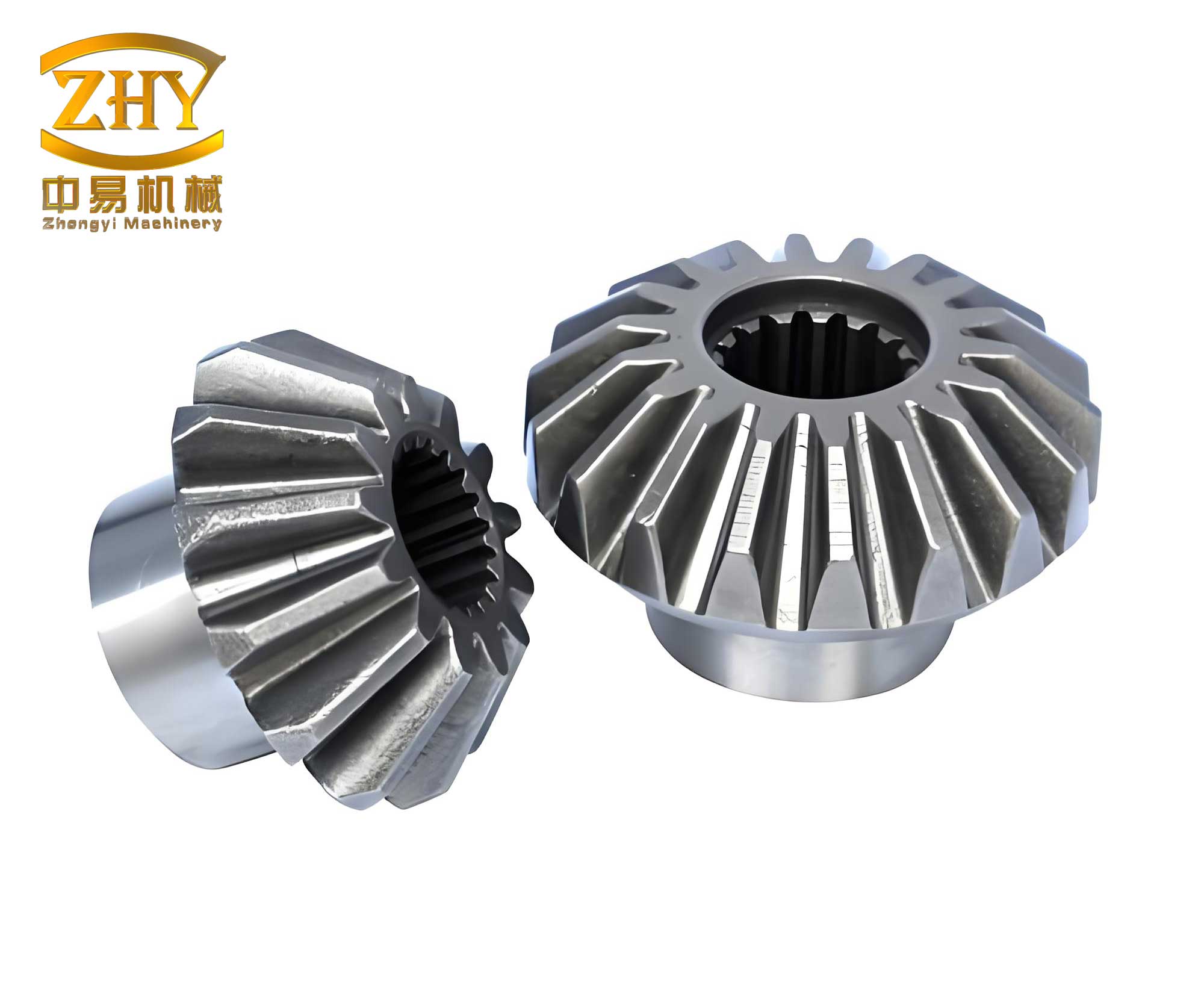
Once the individual bevel gears are modeled, the next step is assembling them into a transmission system. This involves aligning the gears along their respective axes with proper meshing conditions. In Creo’s assembly module, I define datum axes and planes to represent the gear shafts. For a typical orthogonal bevel gear pair (shaft angle of 90°), I first create a base axis for the large bevel gear, often coincident with the assembly’s vertical axis. Then, I generate a plane offset from the reference plane by a distance equal to the axial offset between gears, which for intersecting shafts is zero, but for clarity, I set it based on the pitch cone apex. The intersection of this plane with a perpendicular plane defines the axis for the small bevel gear. Using constraints such as “coincident” and “orient,” I mate the gears so that their pitch cones touch along a common element, ensuring correct meshing. This virtual assembly allows for interference checking and clearance verification, which are crucial for avoiding physical collisions in real-world applications. The parametric nature of the models means that any changes to gear dimensions automatically update the assembly, maintaining proper alignment and meshing.
After assembly, motion simulation is conducted to analyze the dynamic behavior of the bevel gear transmission. In Creo’s mechanism module, I define a gear pair connection between the two gears. This connection specifies the velocity ratio based on the number of teeth, ensuring that the gears rotate in sync. For bevel gears, the velocity ratio is given by: $$i = \frac{Z_2}{Z_1}$$, where Z1 and Z2 are the tooth counts of the driving and driven gears, respectively. In the software, I select the rotational axes of the gears and input this ratio to establish the kinematic relationship. Next, I add a servo motor to the driving gear to provide motion input. The servo motor is configured with a velocity profile, such as constant speed or a function of time, to simulate various operating conditions. For example, I might set the motor to rotate at 100 rpm for 10 seconds to observe the transmission’s response. Running the motion analysis generates an animation of the gears in action, allowing me to visualize meshing, detect any interferences, and measure performance metrics.
Motion simulation offers extensive analysis capabilities beyond simple animation. I can create graphs for displacement, velocity, acceleration, and forces over time. For bevel gears, these graphs help in assessing smoothness of operation, identifying vibrations, and evaluating load distribution. The displacement graph shows the angular position of gears, confirming the correct transmission ratio. Velocity and acceleration graphs reveal any irregularities that might indicate design flaws, such as uneven tooth contact or backlash issues. Additionally, Creo’s interference detection tool can highlight collisions between teeth during motion, enabling corrections before physical prototyping. This virtual testing reduces the need for expensive trials and accelerates the design cycle. For instance, if interference is detected, I can adjust parameters like pressure angle or addendum coefficient in the parametric model and rerun the simulation to verify improvements. This iterative process ensures that the bevel gear transmission meets performance standards reliably.
To further illustrate the parametric design and simulation process, let’s consider a detailed example with specific calculations. Suppose I am designing a pair of straight bevel gears for a right-angle drive with a shaft angle of 90°. The driving gear has 21 teeth, and the driven gear has 40 teeth, both with a module of 5 mm and a pressure angle of 20°. Using the parametric relations, I compute the pitch diameters: $$D_1 = m \cdot Z_1 = 5 \cdot 21 = 105 \text{ mm}$$ and $$D_2 = m \cdot Z_2 = 5 \cdot 40 = 200 \text{ mm}$$. The cone angles are calculated as: $$\delta_1 = \arctan\left(\frac{Z_1}{Z_2}\right) = \arctan\left(\frac{21}{40}\right) \approx 27.5^\circ$$ and $$\delta_2 = 90^\circ – \delta_1 \approx 62.5^\circ$$. The addendum height, assuming ha* = 1 and c* = 0.25, is: $$h_a = (1 + 0) \cdot 5 = 5 \text{ mm}$$ (with no profile shift). The dedendum height is: $$h_f = (1 + 0.25 – 0) \cdot 5 = 6.25 \text{ mm}$$. The cone distance R is: $$R = \frac{D_1}{2 \sin \delta_1} = \frac{105}{2 \sin 27.5^\circ} \approx 113.6 \text{ mm}$$. These values are then used to sketch the gear profiles and generate the 3D models parametrically.
In motion simulation, I set the velocity ratio as: $$i = \frac{Z_2}{Z_1} = \frac{40}{21} \approx 1.905$$, meaning the driven gear rotates slower than the driving gear. With a servo motor applying 100 rpm to the driving gear, the driven gear’s speed is: $$\omega_2 = \frac{\omega_1}{i} = \frac{100}{1.905} \approx 52.5 \text{ rpm}$$. Running the simulation for 10 seconds, I can plot angular velocity versus time to confirm this ratio. Additionally, I might analyze contact patterns by introducing slight misalignments to study their effects on performance. This example underscores how parametric design and simulation work together to optimize bevel gear systems for specific applications, from automotive differentials to industrial machinery.
The advantages of parametric design for bevel gears extend beyond efficiency. It facilitates customization for niche applications, such as high-speed or high-torque environments, where standard gears may not suffice. By adjusting parameters like spiral angle or pressure angle, designers can tailor bevel gears to reduce noise, improve strength, or enhance efficiency. For spiral bevel gears, the parametric equations become more complex due to the curved teeth, but the same principles apply. The addendum and dedendum vary along the tooth length, and the curve equations incorporate helical angles. In Creo, this can be handled using advanced surface modeling techniques, still driven by parameters. Moreover, parametric design supports family tables, where multiple variations of a bevel gear (e.g., different tooth counts or modules) are stored in a single file, streamlining inventory management and production planning.
Motion simulation also integrates with other engineering analyses, such as finite element analysis (FEA) for stress evaluation or computational fluid dynamics (CFD) for lubrication studies. For bevel gears, FEA can predict tooth root stresses and contact pressures under load, ensuring durability. By exporting the parametric model to FEA software, I can simulate real-world loading conditions and optimize material selection or heat treatment processes. Similarly, CFD analysis helps in designing effective lubrication systems for bevel gear transmissions, reducing wear and extending lifespan. These interdisciplinary analyses highlight the holistic benefits of parametric design and simulation, making bevel gears more reliable and cost-effective in long-term operation.
In conclusion, the parametric design and simulation of bevel gear transmission systems represent a significant advancement in mechanical design methodology. By leveraging CAD software like Creo 5.0, designers can create accurate, adaptable 3D models of bevel gears through parameter-driven relationships, drastically reducing modeling time and errors. The integration of motion simulation enables virtual testing of gear meshing, interference detection, and kinematic analysis, providing insights that enhance performance and reliability. This approach not only lowers design costs by minimizing physical prototypes but also accelerates innovation by allowing rapid iteration and optimization. As industries continue to demand higher efficiency and customization, parametric techniques will play an increasingly vital role in the development of bevel gear systems, from automotive to aerospace applications. Future developments may include AI-driven parameter optimization or real-time simulation feedback, further pushing the boundaries of what’s possible in gear design. Ultimately, mastering parametric design and simulation for bevel gears empowers engineers to create more robust and efficient transmission solutions, driving progress in modern manufacturing.