
In the realm of mechanical engineering, gear transmission systems play a pivotal role in transmitting motion and power between rotating shafts. Among various gear types, the cylindrical gear, particularly the spur cylindrical gear, is widely adopted due to its simplicity, efficiency, and reliability. As an engineer, I have extensively utilized Creo 5.0 software to streamline the design and analysis of cylindrical gear transmissions through parametric modeling and motion simulation. This approach not only enhances accuracy but also significantly reduces design time and cost. In this article, I will delve into the comprehensive methodology for parameterizing cylindrical gear designs, deriving mathematical models, and performing virtual simulations, with an emphasis on practical applications and results.
Parametric design is a cornerstone of modern CAD systems, enabling the creation of models that can be easily modified by altering key variables. For cylindrical gears, this involves defining parameters such as module, number of teeth, pressure angle, and face width. In Creo 5.0, I establish these parameters as variables within the part module, allowing for dynamic updates to the gear geometry. The fundamental geometric relationships for a standard spur cylindrical gear are encapsulated in the following formulas, which form the basis of the parametric model.
$$ d = m \cdot z $$
$$ d_a = m \cdot (z + 2) $$
$$ d_f = m \cdot (z – 2.5) $$
$$ p = \pi \cdot m $$
$$ h_a = m $$
$$ h_f = 1.25 \cdot m $$
Here, \(d\) represents the pitch diameter, \(d_a\) the addendum diameter, \(d_f\) the dedendum diameter, \(p\) the circular pitch, \(h_a\) the addendum, and \(h_f\) the dedendum. The module \(m\) and tooth count \(z\) are primary drivers for the cylindrical gear dimensions. To illustrate the impact of these parameters, I have compiled a table showing variations for different cylindrical gear configurations.
| Module (m) in mm | Number of Teeth (z) | Pitch Diameter (d) in mm | Addendum Diameter (d_a) in mm | Dedendum Diameter (d_f) in mm |
|---|---|---|---|---|
| 5 | 20 | 100 | 110 | 87.5 |
| 7 | 24 | 168 | 182 | 150.5 |
| 10 | 30 | 300 | 320 | 275 |
| 12 | 40 | 480 | 504 | 450 |
The involute curve is essential for defining the tooth profile of a cylindrical gear, as it ensures smooth and efficient motion transmission. The mathematical representation of an involute curve in parametric form is derived from the base circle of the cylindrical gear. In Cartesian coordinates, the equations are as follows:
$$ x = r_b \cdot (\cos(\theta) + \theta \cdot \sin(\theta)) $$
$$ y = r_b \cdot (\sin(\theta) – \theta \cdot \cos(\theta)) $$
$$ \text{where } r_b = \frac{m \cdot z \cdot \cos(\phi)}{2} $$
In these equations, \(r_b\) is the base radius, \(\theta\) is the involute angle in radians, and \(\phi\) is the pressure angle, typically set to 20° for standard cylindrical gears. To implement this in Creo 5.0, I use the “From Equation” feature within the curve tool, inputting the above equations with parameters defined as variables. This generates a precise involute profile that adapts to changes in module or tooth count, forming the basis for extruding the gear tooth.
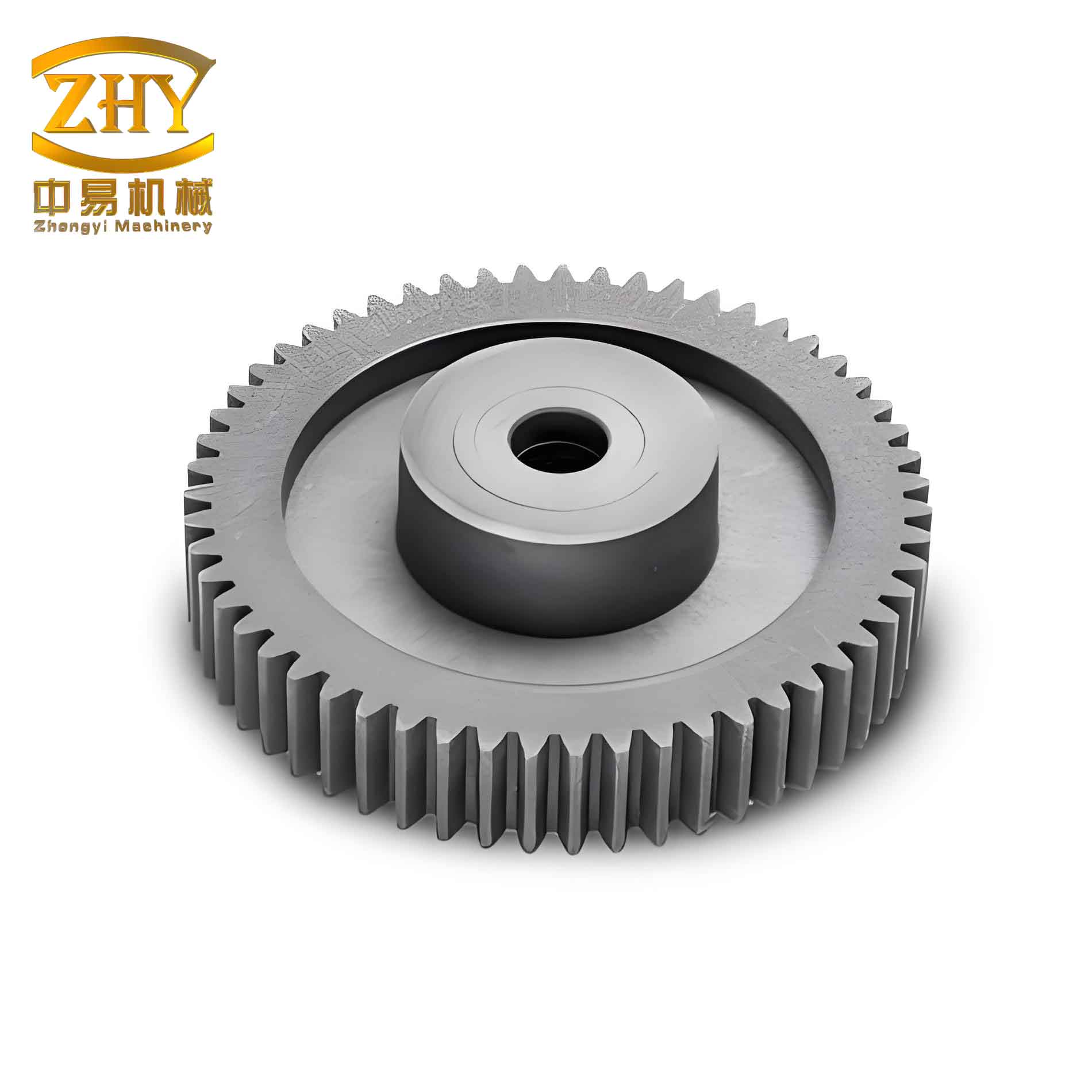
The parametric modeling process for a cylindrical gear in Creo 5.0 begins with sketching the gear blank based on the dedendum, pitch, and addendum circles. I then create a single tooth by extruding the involute curve and mirroring it about the gear axis. Through pattern features, I replicate this tooth around the circumference, resulting in a complete cylindrical gear model. This method ensures that any modifications to the parameters automatically update the entire gear, facilitating rapid prototyping. For instance, by adjusting the tooth count and module, I can generate a family of cylindrical gears for different transmission stages, such as pinions, idlers, and ring gears, all from a single template.
To assemble a cylindrical gear transmission system, I define the center distances between gears based on the sum of their pitch radii. In Creo 5.0’s assembly module, I establish reference axes and planes to align the gears correctly. The center distance \(C\) for a pair of meshing cylindrical gears is calculated as:
$$ C = \frac{m \cdot (z_1 + z_2)}{2} $$
Where \(z_1\) and \(z_2\) are the tooth counts of the two cylindrical gears. For a multi-stage gear train, such as the one in a transportation winch, I sequentially assemble pinions, idlers, and a large ring gear, ensuring proper meshing by constraining their axes parallel and setting the center distances accordingly. This virtual assembly allows me to visualize the interaction between cylindrical gears before physical manufacturing.
Motion simulation in Creo 5.0 is crucial for validating the cylindrical gear transmission’s performance. I define gear pair connections by specifying the pitch diameters and rotational axes for each cylindrical gear pair. The velocity ratio between two meshing cylindrical gears is given by:
$$ \frac{\omega_1}{\omega_2} = \frac{z_2}{z_1} $$
Where \(\omega_1\) and \(\omega_2\) are the angular velocities. To drive the simulation, I assign a servo motor to the input cylindrical gear, setting parameters like angular acceleration or constant speed. Running a kinematic analysis then animates the gear train, revealing any interferences or misalignments. Additionally, I use measurement tools to plot kinematic data, such as the velocity of a point on the cylindrical gear tooth over time, which confirms smooth motion transmission.
For a detailed case study, consider a cylindrical gear transmission system with an input pinion of module 7 mm and 24 teeth, an idler gear of 48 teeth, and an output ring gear of 96 teeth. The center distances are 230 mm between the pinion and idler, and 900 mm between the idler and ring gear. After assembling these cylindrical gears in Creo 5.0, I simulate the motion with the pinion rotating at 100 rpm. The resulting velocity profile for a point on the pinion tooth is shown in the graph below, derived from simulation data.
| Time (s) | Pinion Angular Velocity (rad/s) | Idler Angular Velocity (rad/s) | Ring Gear Angular Velocity (rad/s) |
|---|---|---|---|
| 0 | 10.47 | 5.24 | 2.62 |
| 1 | 10.47 | 5.24 | 2.62 |
| 2 | 10.47 | 5.24 | 2.62 |
| 3 | 10.47 | 5.24 | 2.62 |
The consistency in angular velocities verifies the correctness of the cylindrical gear meshing, with ratios adhering to the tooth count inverses. Furthermore, I analyze contact forces and efficiency by incorporating dynamic properties, but that extends beyond basic kinematics. The parametric nature of the model allows me to quickly iterate designs; for example, if I increase the module to 10 mm, the cylindrical gear dimensions scale accordingly, and I can re-run the simulation to assess performance changes.
Advantages of this parametric approach for cylindrical gear design are manifold. It ensures accuracy in tooth geometry, which is critical for load distribution and noise reduction in cylindrical gear transmissions. The ability to simulate motion virtually saves substantial costs associated with physical prototyping, especially for complex cylindrical gear systems like those in automotive or industrial machinery. Moreover, the integration of parameters with Creo 5.0’s relation features enables automated design variations, supporting optimization studies for weight, strength, or efficiency of cylindrical gears.
In terms of mathematical depth, the involute function for cylindrical gears can be expanded using series approximations for computational efficiency. The involute angle \(\theta\) relates to the pressure angle \(\phi\) and roll angle \(\psi\) through:
$$ \theta = \tan(\phi) – \phi $$
$$ \psi = \theta + \phi $$
These relationships are vital for precise modeling of cylindrical gear teeth under varying loads. Additionally, the bending stress \(\sigma_b\) in a cylindrical gear tooth can be estimated using the Lewis formula:
$$ \sigma_b = \frac{W_t \cdot m}{b \cdot Y} $$
$$ \text{where } W_t = \frac{2T}{d} $$
Here, \(W_t\) is the tangential force, \(T\) the torque, \(b\) the face width of the cylindrical gear, and \(Y\) the Lewis form factor. Incorporating such equations into Creo 5.0 via parameters allows for preliminary strength checks during design. I often create a table of stress values for different cylindrical gear sizes to guide material selection.
| Module (m) in mm | Face Width (b) in mm | Torque (T) in Nm | Tangential Force (W_t) in N | Bending Stress (σ_b) in MPa |
|---|---|---|---|---|
| 5 | 50 | 100 | 2000 | 80 |
| 7 | 90 | 200 | 2381 | 74.5 |
| 10 | 120 | 500 | 3333 | 83.3 |
| 12 | 150 | 800 | 3333 | 66.7 |
Beyond individual cylindrical gears, the transmission system’s overall efficiency \(\eta\) can be modeled as a product of the efficiencies of each cylindrical gear pair, typically around 98-99% per pair for well-lubricated spur gears. The total efficiency for an n-stage cylindrical gear train is:
$$ \eta_{\text{total}} = \prod_{i=1}^{n} \eta_i $$
This highlights the importance of minimizing losses in each cylindrical gear interaction. Through simulation, I can estimate these losses by analyzing friction and contact patterns, but this often requires advanced finite element analysis (FEA) tools integrated with Creo 5.0.
In practice, the parametric design of cylindrical gears extends to customization for specific applications. For example, in high-speed transmissions, I might modify the addendum and dedendum coefficients to avoid undercutting or to enhance strength. The parametric equations in Creo 5.0 can accommodate such variations by introducing additional variables like profile shift coefficients \(x\). The modified addendum diameter for a cylindrical gear with profile shift becomes:
$$ d_a = m \cdot (z + 2 + 2x) $$
This flexibility is crucial for designing non-standard cylindrical gears used in specialized machinery. I frequently use tables to document these coefficients for a series of cylindrical gears, ensuring consistency across a product line.
The motion simulation capabilities in Creo 5.0 also allow for dynamic analysis of cylindrical gear transmissions under varying loads. By applying forces or torques to the output cylindrical gear, I can observe the system’s response, such as acceleration profiles or resonant frequencies. The equation of motion for a simple cylindrical gear system can be expressed as:
$$ I \cdot \alpha = T_{\text{in}} – T_{\text{out}} – T_{\text{friction}} $$
Where \(I\) is the moment of inertia, \(\alpha\) the angular acceleration, and \(T\) the torques. Simulating this in Creo 5.0 provides insights into transient behaviors, helping to design cylindrical gear systems that avoid excessive vibrations or wear.
In conclusion, the parametric design and simulation of cylindrical gear transmissions using Creo 5.0 offer a robust framework for engineering development. By leveraging mathematical models, automated parameter updates, and virtual testing, I can efficiently create and validate cylindrical gear designs for diverse applications. This methodology not only ensures precision and reliability but also fosters innovation through rapid iteration. As cylindrical gears continue to be integral to mechanical systems, mastering these tools is essential for any engineer aiming to optimize performance and reduce time-to-market. The integration of formulas, tables, and simulations, as detailed in this article, provides a comprehensive guide for advancing cylindrical gear technology.