
In modern mechanical engineering, the involute spur gear is a fundamental component widely used in various industries such as metallurgy, mining, petroleum, chemical, coal, power, and construction. Its ability to ensure constant transmission ratios and stable force directions makes it indispensable. However, the complex and variable nature of its tooth profile and structure poses significant challenges in three-dimensional modeling. Traditional design methods often involve repetitive and time-consuming tasks, especially when modifications are required. To address this, I have developed a parametric design system for involute spur gear using CATIA, a powerful 3D software. This approach allows for rapid generation and modification of gear models by simply adjusting key parameters, thereby enhancing design efficiency and reducing manual effort. In this article, I will detail the methodology, from parameter definition to 3D model creation, emphasizing the use of tables and formulas for clarity. The focus will be on spur gear applications, with the term ‘spur gear’ reiterated throughout to underscore its importance.
The design of an involute spur gear hinges on several critical parameters that dictate its geometry and performance. Understanding these parameters is essential for effective parametric modeling. Below, I present a table summarizing the primary parameters involved in spur gear design, along with their descriptions and typical values for standard spur gear.
| Parameter | Symbol | Description | Standard Value (Normal Tooth System) |
|---|---|---|---|
| Module | $$m$$ | Defines the size of the gear teeth, measured in millimeters. | Variable (e.g., 4 mm) |
| Number of Teeth | $$z$$ | Total count of teeth on the spur gear. | Variable (e.g., 25) |
| Pressure Angle | $$\alpha$$ | Angle between the line of action and the tangent to the pitch circle, in degrees. | $$20^\circ$$ |
| Addendum Coefficient | $$h_a$$ | Factor for calculating addendum height. | 1 |
| Dedendum Coefficient | $$h_f$$ | Factor for calculating dedendum height. | 1.25 |
| Tip Clearance Coefficient | $$c$$ | Factor for tip clearance. | 0.25 |
| Profile Shift Coefficient | $$x$$ | Modifies tooth thickness and root geometry; zero for standard spur gear. | 0 |
| Helix Angle | $$\beta$$ | Angle of tooth inclination; zero for straight spur gear. | $$0^\circ$$ |
For a standard involute spur gear with normal tooth system, the parameters are fixed as: $$\alpha = 20^\circ$$, $$h_a = 1$$, $$h_f = 1.25$$, $$c = 0.25$$, $$x = 0$$, and $$\beta = 0^\circ$$. The module $$m$$ and number of teeth $$z$$ are the primary driving variables. From these, derived parameters such as pitch radius, base radius, addendum radius, and dedendum radius are calculated using the following formulas:
$$r = \frac{m \cdot z}{2} \quad \text{(Pitch radius in mm)}$$
$$r_k = r + m \quad \text{(Addendum radius in mm)}$$
$$r_b = r \cdot \cos(\alpha \cdot \frac{\pi}{180}) \quad \text{(Base radius in mm)}$$
$$r_f = r – 1.25 \cdot m \quad \text{(Dedendum radius in mm)}$$
$$s = \frac{m \cdot \pi}{2} \quad \text{(Tooth thickness in mm)}$$
$$p_f \approx 0.38 \cdot m \quad \text{(Root fillet radius in mm)}$$
$$h \quad \text{(Face width in mm, user-defined)}$$
These formulas establish the mathematical foundation for parametric design. By altering $$m$$ and $$z$$, all other dimensions adjust automatically, enabling efficient spur gear customization. For instance, if $$m = 4 \, \text{mm}$$ and $$z = 25$$, then $$r = 50 \, \text{mm}$$, $$r_k = 54 \, \text{mm}$$, $$r_b \approx 46.98 \, \text{mm}$$, and $$r_f = 45 \, \text{mm}$$. This parametric linkage is crucial for dynamic modeling in CATIA.
CATIA’s parametric design capabilities revolve around two core aspects: parameter-driven formulas and curve generation via equations. In the context of spur gear design, I utilize the Formula tool in CATIA to define driving parameters (e.g., $$m$$, $$z$$, $$\alpha$$) and calculated parameters (e.g., $$r$$, $$r_b$$). These parameters are then linked to geometric dimensions, allowing for seamless updates. Additionally, CATIA provides a parameter $$t$$ that varies from 0 to 1, which is instrumental in generating complex curves like the involute profile. Within the Generative Shape Design (GSD) module, the ‘fog’ command (formula-driven curve) enables the creation of parametric equations for the involute. This method involves defining $$x$$ and $$y$$ coordinates as functions of $$t$$, which are subsequently used to plot points and construct spline curves. For a spur gear, the involute parametric equations are derived from the base circle geometry:
$$x(t) = r_b \cdot \sin(t \cdot \pi \cdot 1 \, \text{rad}) – r_b \cdot t \cdot \pi \cdot \cos(t \cdot \pi \cdot 1 \, \text{rad})$$
$$y(t) = r_b \cdot \cos(t \cdot \pi \cdot 1 \, \text{rad}) + r_b \cdot t \cdot \pi \cdot \sin(t \cdot \pi \cdot 1 \, \text{rad})$$
Here, $$t$$ represents a normalized parameter, and $$1 \, \text{rad}$$ ensures angular units are consistent. By evaluating these equations at discrete $$t$$ values (e.g., 0, 0.06, 0.085, 0.11, 0.13, 0.16, 0.185), I obtain key points on the involute curve. These points are then connected using a spline to form a smooth involute profile, which serves as the basis for the spur gear tooth. This approach ensures accuracy and flexibility, as changing $$r_b$$ via parameters automatically updates the curve.
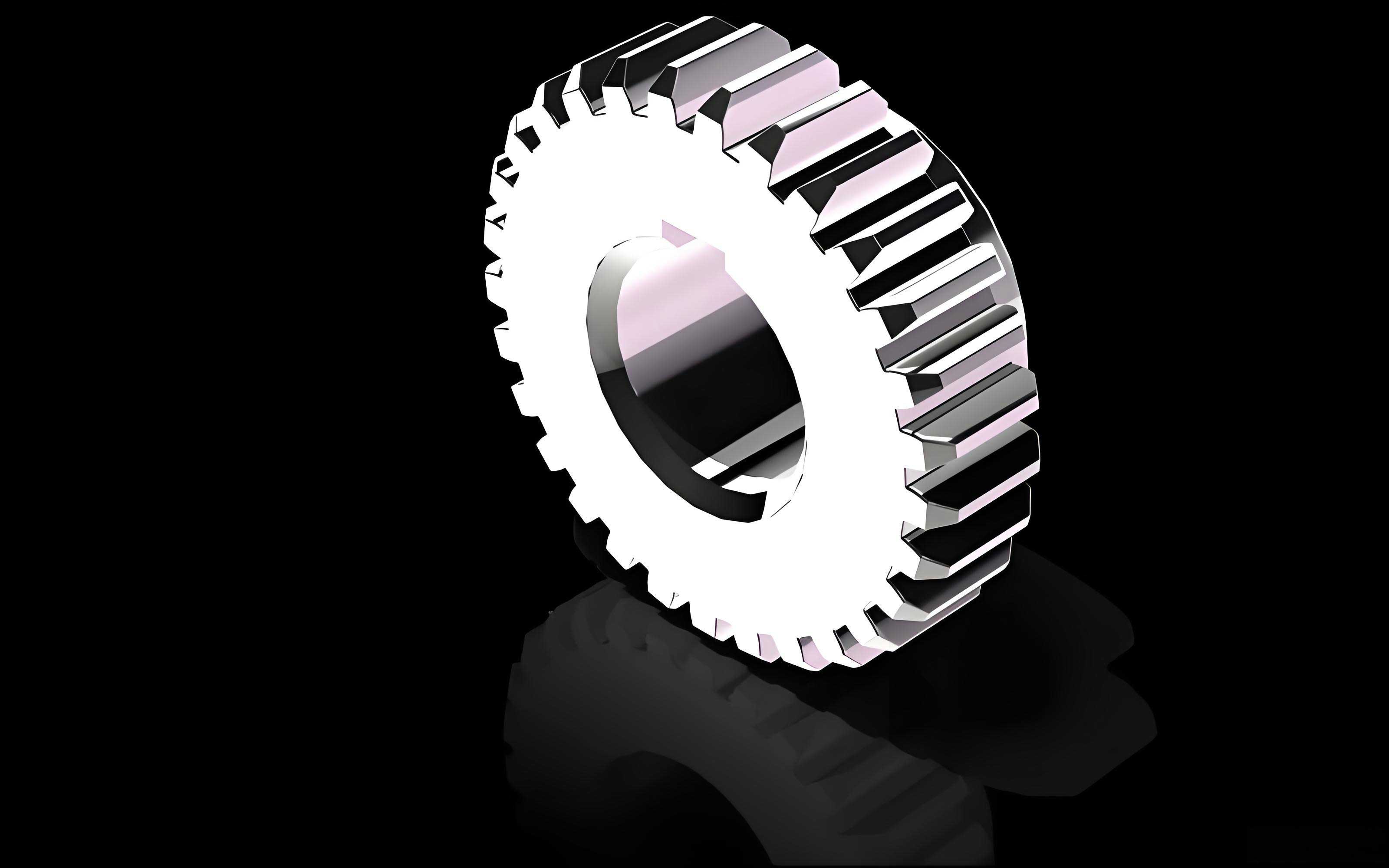
To visualize the spur gear design process, consider the following image that illustrates a typical involute spur gear model generated through parametric methods. This model showcases the precise tooth geometry achievable with CATIA.
The creation of a spur gear model in CATIA involves a step-by-step procedure, from initial sketches to 3D extrusion. I begin by entering the Part Design or Generative Shape Design module and defining the parameters using the Formula tool. As shown earlier, I set $$z$$, $$m$$, and $$\alpha$$ as driving parameters, with derived parameters computed automatically. Next, I sketch the reference circles—addendum circle, pitch circle, base circle, and dedendum circle—on the xy-plane, using the parameter values for radii. For example, the addendum circle radius is input as $$r_k$$ via the formula link. This parametric sketching ensures that any parameter change propagates to the geometry.
With the reference circles in place, I generate the involute curve using the ‘fog’ method. I create separate formulas for $$x(t)$$ and $$y(t)$$ as described, then evaluate them at specific $$t$$ points to get coordinate pairs. In CATIA, I use the Point command to place these coordinates, followed by the Spline command to connect them into a curve. This yields one side of the involute tooth profile for the spur gear. To complete a single tooth, I then perform several operations:
- Find the intersection point $$a$$ between the involute and the pitch circle.
- Create a point $$b$$ on the pitch circle such that the arc length from $$a$$ to $$b$$ equals the tooth thickness $$s$$.
- Construct an auxiliary line through the origin and the midpoint of $$a$$ and $$b$$.
- Mirror the involute curve across this auxiliary line to obtain the opposite side of the tooth.
- Use Trim, Split, and Break commands to refine the profile, ensuring it is closed and includes the root fillet.
The root fillet, with radius $$p_f$$, is added by drawing a tangent from the involute-base circle intersection downward and filleting it with the dedendum circle. This fillet is mirrored similarly, resulting in a complete tooth轮廓. To form the entire spur gear, I employ a circular pattern array with $$z$$ instances around the center. All elements are then joined into a single closed contour, representing the gear’s outer profile. This process highlights the efficiency of parametric design: once set up, generating a new spur gear requires only adjusting $$z$$ or $$m$$.
Transitioning from 2D轮廓 to 3D model involves extrusion and Boolean operations. I extrude the closed profile by the face width $$h$$ to create a solid gear blank. Then, I add features such as bore holes, keyways, or recesses using Pocket and Groove commands. For instance, to create a central hole, I sketch a circle on the gear’s face and use Pocket to remove material. The entire model remains parametrically linked; modifying $$z$$, $$m$$, or $$h$$ triggers a rebuild, instantly producing an updated spur gear. This dynamic capability is invaluable for iterative design and customization, reducing design time from hours to minutes.
To further illustrate the parametric relationships, I summarize the key formulas and their interdependencies in the table below. This table reinforces how changes in driving parameters affect the spur gear dimensions.
| Parameter | Formula | Dependency |
|---|---|---|
| Pitch Radius ($$r$$) | $$r = \frac{m \cdot z}{2}$$ | Directly proportional to $$m$$ and $$z$$. |
| Base Radius ($$r_b$$) | $$r_b = r \cdot \cos(\alpha)$$ | Depends on $$r$$ and $$\alpha$$; critical for involute generation. |
| Addendum Radius ($$r_k$$) | $$r_k = r + m$$ | Increases with $$m$$; defines tooth tip. |
| Dedendum Radius ($$r_f$$) | $$r_f = r – 1.25 \cdot m$$ | Decreases with $$m$$; defines tooth root. |
| Tooth Thickness ($$s$$) | $$s = \frac{m \cdot \pi}{2}$$ | Proportional to $$m$$; affects tooth spacing. |
| Involute $$x$$-coordinate | $$x(t) = r_b \cdot \sin(t \pi) – r_b t \pi \cdot \cos(t \pi)$$ | Function of $$r_b$$ and $$t$$; defines tooth profile. |
| Involute $$y$$-coordinate | $$y(t) = r_b \cdot \cos(t \pi) + r_b t \pi \cdot \sin(t \pi)$$ | Function of $$r_b$$ and $$t$$; defines tooth profile. |
The parametric design system not only streamlines spur gear modeling but also facilitates advanced applications like finite element analysis (FEA), motion simulation, and optimization. By having a parameterized model, I can easily export geometries for stress analysis or adjust parameters to meet specific load requirements. For example, increasing $$m$$ enhances tooth strength, while changing $$z$$ alters gear ratio in assemblies. This flexibility is particularly beneficial for custom spur gear designs in specialized machinery, where standard parts may not suffice.
In conclusion, the parametric design of involute spur gear using CATIA represents a significant advancement in mechanical design automation. By leveraging formulas, tables, and parametric curves, I have demonstrated a method that reduces manual effort, minimizes errors, and accelerates the design cycle. The key takeaway is that with just three driving parameters—$$z$$, $$m$$, and $$\alpha$$—I can rapidly generate accurate spur gear models tailored to diverse applications. This approach underscores the importance of spur gear in engineering and highlights how modern CAD tools like CATIA empower designers to innovate efficiently. As technology evolves, further integration with simulation and manufacturing will continue to enhance the spur gear design process, solidifying its role in industrial progress.
Throughout this discussion, the term ‘spur gear’ has been emphasized to reinforce its centrality in parametric design. The methodologies described here are applicable not only to standard spur gear but also to variants like helical or bevel gears with appropriate modifications. By mastering these techniques, designers can tackle complex gear systems with confidence, ensuring reliability and performance in real-world applications. The future of spur gear design lies in continued parametric refinement and automation, paving the way for smarter, more adaptable mechanical solutions.