
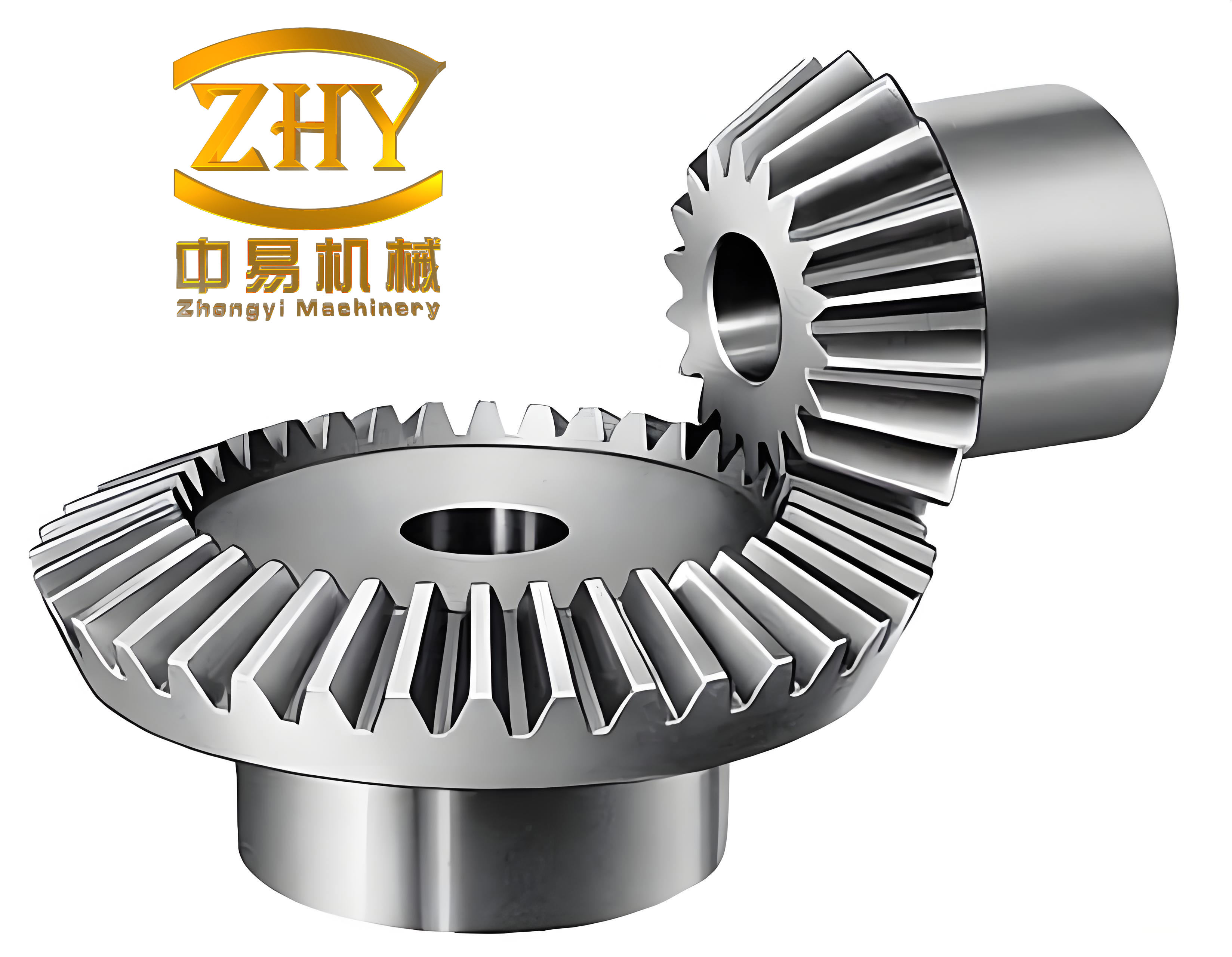
In modern mechanical engineering, parametric design has revolutionized the way we develop complex components like gears. As an engineer specializing in gear systems, I have extensively used Pro/Engineer (Pro/E) for its robust parametric modeling capabilities. This approach allows for efficient design, modification, and analysis of involute straight bevel gears, which are critical in applications such as reducers and transmissions. The straight bevel gear, with its conical shape and straight teeth, is essential for transmitting motion between intersecting shafts. In this article, I will detail the step-by-step parametric design process for an involute straight bevel gear using Pro/E, focusing on key parameters, relational equations, and modeling techniques. By leveraging parametric relationships, we can automate design changes, reduce errors, and accelerate product development. Throughout this discussion, I will emphasize the importance of the straight bevel gear in mechanical systems and how parametric design enhances its reliability and performance.
The foundation of parametric design for a straight bevel gear lies in defining the geometric parameters and their interrelationships. These parameters include module, number of teeth, pressure angle, and cone angle, among others. In Pro/E, we start by inputting these parameters into the software’s parameter table, which serves as a dynamic database for the model. Below is a table summarizing the primary parameters used in the design of a straight bevel gear. This table not only lists the symbols and descriptions but also highlights their roles in the parametric framework.
| Symbol | Description | Typical Value/Range |
|---|---|---|
| m | Module | 1–10 mm |
| z | Number of teeth | 10–100 |
| alpha | Pressure angle | 20° |
| hax | Addendum coefficient | 1 |
| cx | Clearance coefficient | 0.25 |
| x | Profile shift coefficient | 0 (standard) |
| z_asm | Number of teeth in mating gear | Dependent on assembly |
| b | Face width | 5–50 mm |
| delta | Pitch cone angle | Calculated from z and z_asm |
Once the parameters are defined, we establish relational equations that govern the geometry of the straight bevel gear. These equations are derived from gear theory and ensure accurate tooth profile generation. In Pro/E, these relations are input as mathematical expressions that update automatically when parameters change. For instance, the addendum (ha) and dedendum (hf) are calculated based on the module and coefficients. The pitch cone angle (delta) is critical for defining the conical shape of the straight bevel gear and is determined using the arctangent function. Below, I present the core relational equations in LaTeX format, which Pro/E interprets to drive the model. These equations include dependencies for diameters, angles, and dimensions essential for the straight bevel gear’s functionality.
$$ ha = (hax + x) \times m $$
$$ hf = (hax + cx – x) \times m $$
$$ h = (2 \times hax + cx) \times m $$
$$ delta = \atan\left(\frac{z}{z_{\text{asm}}}\right) $$
$$ d = m \times z $$
$$ db = d \times \cos(alpha) $$
$$ da = d + 2 \times ha \times \cos(delta) $$
$$ df = d – 2 \times hf \times \cos(delta) $$
$$ hb = \frac{d – db}{2 \times \cos(delta)} $$
$$ rx = \frac{d}{2 \times \sin(delta)} $$
$$ theta_a = \atan\left(\frac{ha}{rx}\right) $$
$$ theta_b = \atan\left(\frac{hb}{rx}\right) $$
$$ theta_f = \atan\left(\frac{hf}{rx}\right) $$
$$ delta_a = delta + theta_a $$
$$ delta_b = delta – theta_b $$
$$ delta_f = delta – theta_f $$
$$ ba = \frac{b}{\cos(theta_a)} $$
$$ bb = \frac{b}{\cos(theta_b)} $$
$$ bf = \frac{b}{\cos(theta_f)} $$
$$ D0 = \frac{d}{2 \times \tan(delta)} $$
These equations form the backbone of the parametric model for the straight bevel gear. For example, the base diameter (db) ensures the involute profile is accurately generated, while the outer and root diameters (da and df) define the gear’s overall size. The cone-related angles, such as delta_a and delta_f, are vital for constructing the gear’s conical surfaces. By embedding these relations in Pro/E, any change in a primary parameter—like the number of teeth or module—automatically updates the entire geometry, saving time and reducing manual errors. This parametric approach is particularly beneficial for iterative design processes, where multiple variants of the straight bevel gear must be evaluated for performance and compatibility.
With the parameters and relations set, the next step is to create the 3D model of the straight bevel gear in Pro/E. This begins with generating 2D curves that represent key circles at the gear’s large and small ends. In the sketching environment, I draw concentric circles for the addendum circle, pitch circle, base circle, and root circle. These circles are driven by the parametric equations; for instance, the addendum circle diameter is derived from ‘da’, and the root circle from ‘df’. This 2D layout serves as a foundation for building the 3D tooth profile. The process involves switching between different workplanes to account for the conical nature of the straight bevel gear, ensuring that the curves align correctly with the pitch cone angle.
After establishing the 2D curves, I proceed to develop the tooth profile. This involves creating a Cartesian coordinate system at the center of the concentric circles and defining a spline curve from an equation that represents the involute tooth flank. The equation for this spline is based on the base circle and pressure angle, and it is expressed in parametric form. In Pro/E, I use the ‘Curve from Equation’ feature to input this equation, which generates the precise involute curve for one side of the tooth. The equation is as follows:
$$ r = \frac{db}{\cos(delta) \times 2} $$
$$ theta = t \times 60 $$
$$ x = r \times \cos(theta) + r \times \sin(theta) \times theta \times \frac{\pi}{180} $$
$$ y = r \times \sin(theta) – r \times \cos(theta) \times theta \times \frac{\pi}{180} $$
$$ z = 0 $$
Here, ‘t’ is a parameter that varies from 0 to 1, defining the curve’s progression. This equation produces the involute profile, which is essential for the straight bevel gear’s smooth operation and load distribution. Once the single-side tooth flank curve is generated, I mirror it across the central plane to create the symmetrical opposite side. This mirrored curve, combined with the previously drawn circles, forms the complete tooth outline for both the large and small ends of the gear. The use of parametric relations ensures that any adjustments in ‘db’ or ‘delta’ automatically update the curve, maintaining design consistency.
To transform the 2D profiles into a 3D tooth, I employ Pro/E’s ‘Sweep Blend’ command. This feature allows me to create a solid tooth by blending the tooth outlines from the large end to the small end. I select the two end sections—defined by the addendum, dedendum, and flank curves—and Pro/E generates a smooth transition between them. This process results in the first complete tooth of the straight bevel gear. The ‘Sweep Blend’ operation is parameter-driven, meaning that changes in face width ‘b’ or cone angles automatically adjust the tooth geometry. This step is crucial for achieving the tapered form of the straight bevel gear, which enables efficient power transmission between intersecting axes.
With one tooth modeled, I use the ‘Pattern’ feature to create the full set of teeth around the gear’s axis. In Pro/E, I select the ‘Axis’ pattern type, specify the number of instances as the parameter ‘z’ (number of teeth), and set the angular spacing to $$ \frac{360}{z} $$ degrees. This pattern operation replicates the tooth evenly, completing the gear’s overall structure. The parametric nature of this step ensures that if ‘z’ is modified, the pattern updates accordingly, eliminating the need for manual repositioning. This automation is a significant advantage in designing straight bevel gears for custom applications, as it allows rapid prototyping and variation.
The following table summarizes the key modeling steps and their corresponding Pro/E tools, highlighting how parametric design streamlines the process for the straight bevel gear.
| Step | Pro/E Tool/Feature | Description | Parametric Dependency |
|---|---|---|---|
| Parameter Input | Parameters Table | Define initial parameters (e.g., m, z, alpha) | Direct input; drives all relations |
| Relation Setup | Relations Editor | Input mathematical equations for geometry | Linked to parameters; auto-updates |
| 2D Curve Creation | Sketch Environment | Draw circles (addendum, pitch, base, root) | Derived from da, df, db, etc. |
| Tooth Flank Curve | Curve from Equation | Generate involute profile using equations | Based on db, delta, and theta |
| Tooth Mirroring | Mirror Tool | Create symmetrical tooth flank | Dependent on original curve |
| 3D Tooth Formation | Sweep Blend | Blend end sections to form solid tooth | Controlled by b, delta_a, delta_f |
| Full Gear Assembly | Pattern Tool | Array teeth around axis | Number of instances equals z |
Throughout this process, the straight bevel gear’s design is continuously validated against the parametric relations. For example, if I need to adjust the module ‘m’ for higher torque capacity, the entire model—including tooth dimensions and pattern—updates seamlessly. This flexibility is invaluable in applications like planetary gear reducers, where multiple straight bevel gears must mesh precisely. Moreover, the parametric model facilitates subsequent simulations, such as finite element analysis (FEA) for stress evaluation, and manufacturing preparations, like generating CNC toolpaths. By integrating these steps, Pro/E reduces design cycles and enhances the accuracy of the straight bevel gear.
In conclusion, the parametric design of an involute straight bevel gear using Pro/Engineer exemplifies the power of modern CAD tools in mechanical engineering. This approach not only streamlines the creation of complex geometries but also supports adaptability and innovation in gear systems. The straight bevel gear, with its straightforward yet precise tooth form, benefits immensely from parametric relationships that automate dimensional changes and ensure geometric integrity. As I reflect on this process, it is clear that parametric modeling is indispensable for developing efficient, reliable straight bevel gears in industries ranging from automotive to aerospace. Future advancements could involve integrating these models with digital twins for real-time performance monitoring, further extending the utility of the straight bevel gear in smart machinery.