
In the realm of mechanical power transmission, systems designed for transferring motion and force between non-parallel, non-intersecting shafts are of paramount importance. Among these, the screw gear drive, commonly referred to as a worm drive, stands out for its unique capabilities. This drive system, comprising a worm (the screw) and a worm wheel (the gear), is renowned for achieving high reduction ratios within a compact spatial envelope. The inherent design of screw gears allows for smooth and quiet operation, making them indispensable in applications ranging from heavy industrial machinery to precision instrumentation and automotive systems. The primary function is often speed reduction, where the worm, typically the driving member, rotates to drive the worm wheel at a significantly reduced speed, thereby increasing torque. This article delves into a comprehensive methodology for the parametric design of these critical components, leveraging advanced computer-aided design principles to create accurate, modifiable, and reusable three-dimensional models. The focus will be on establishing the fundamental design logic, the underlying mathematical parameter calculations, and the step-by-step process for building a fully parameterized digital model, with the term ‘screw gears’ encompassing both the worm and worm wheel throughout our discussion.
The core advantage of screw gears lies in their kinematic relationship. The velocity ratio or reduction ratio is not dependent on the diameters of the components but is simply the ratio of the number of teeth on the worm wheel (Z₂) to the number of threads or “starts” on the worm (Z₁). This relationship is expressed as:
$$ i = \frac{\omega_1}{\omega_2} = \frac{Z_2}{Z_1} $$
where \( \omega_1 \) is the angular velocity of the worm and \( \omega_2 \) is the angular velocity of the worm wheel. For a single-start worm (Z₁=1) and a worm wheel with 40 teeth, a single revolution of the worm results in only a 9-degree rotation of the wheel, yielding a 40:1 reduction. This characteristic allows for the design of extremely compact high-ratio gearboxes, a defining feature of screw gear assemblies.
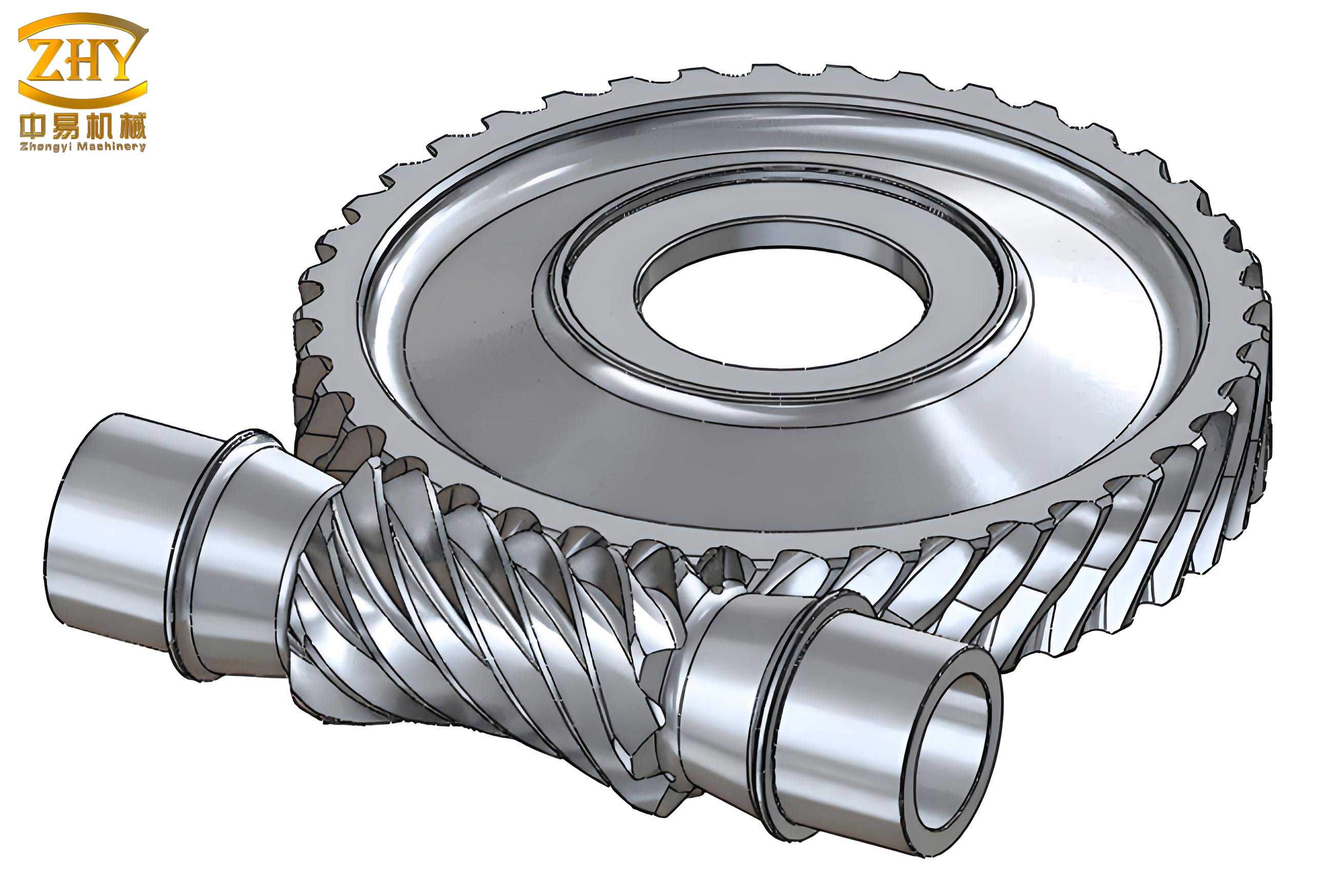
The geometry of screw gears is more complex than that of parallel shaft gears. The worm resembles a screw thread, and its profile can be generated in several forms, the most common being the Archimedean worm, where the axial profile is a straight-sided rack. The mating worm wheel teeth are cut with a hobber that is essentially a replica of the worm, resulting in a enveloping, concave tooth form that wraps around the worm. This conjugate action provides a larger contact area compared to spur or helical gears, contributing to smoother motion and higher load capacity in certain orientations, though often at the cost of lower mechanical efficiency due to significant sliding friction.
The parametric design of screw gears begins with the definition of a core set of input parameters. These primary drivers form the foundation from which all other geometric dimensions are derived. A robust parametric model allows the designer to modify these inputs and instantly regenerate a valid, fully-defined three-dimensional component. The essential primary parameters for a standard cylindrical screw gear set are detailed in the following table:
| Primary Parameter | Symbol | Description |
|---|---|---|
| Normal Module | \( m_n \) | Fundamental size parameter of the tooth, defined in a plane normal to the tooth helix. |
| Number of Worm Threads (Starts) | \( Z_1 \) | The number of independent helical threads on the worm (typically 1, 2, 3, or 4). |
| Number of Worm Wheel Teeth | \( Z_2 \) | The total number of teeth on the worm wheel. |
| Diameter Factor (or Lead Angle Coefficient) | \( q \) | A dimensionless factor relating the worm’s pitch diameter to the module (\( q = d_1 / m \)). It standardizes worm geometry and influences the lead angle. |
| Centre Distance | \( a \) | The nominal distance between the axes of the worm and the worm wheel. |
| Pressure Angle | \( \alpha_n \) | The angle between the tooth profile and a radial line, typically measured in the normal plane (common values are 14.5°, 20°, or 25°). |
With these primary parameters established, a comprehensive suite of secondary dimensions can be calculated. These calculations are the engine of the parametric model. For clarity, we will separate the derivations for the worm and the worm wheel. We will assume the use of an Archimedean worm in the axial section and a standard tooth proportions based on the module. The axial module \( m_x \) is often used interchangeably with the normal module \( m_n \) for simplicity in calculation, related by the worm’s lead angle \( \gamma \): \( m_n = m_x \cos \gamma \).
Worm Parameter Calculations:
The worm is characterized by its threaded geometry. The lead \( p_z \) is the axial distance the thread advances in one complete revolution. The axial pitch \( p_x \) is the distance between corresponding points on adjacent threads, measured axially.
| Parameter | Symbol | Formula | Description/Note |
|---|---|---|---|
| Axial Pitch | \( p_x \) | \( p_x = \pi m \) | Where \( m \) is the axial module. |
| Lead | \( p_z \) | \( p_z = Z_1 \cdot p_x \) | Total axial advancement per worm revolution. |
| Pitch Diameter | \( d_1 \) | \( d_1 = m \cdot q \) | Standardized by the diameter factor \( q \). |
| Lead Angle | \( \gamma \) | \( \tan \gamma = \frac{p_z}{\pi d_1} = \frac{Z_1}{q} \) | A critical angle affecting efficiency and self-locking tendency. |
| Tip Diameter | \( d_{a1} \) | \( d_{a1} = d_1 + 2h_a = m(q + 2) \) | Assuming addendum \( h_a = m \). |
| Root Diameter | \( d_{f1} \) | \( d_{f1} = d_1 – 2h_f = m(q – 2.4) \) | Assuming dedendum \( h_f = 1.2m \). |
| Tooth Height | \( h_1 \) | \( h_1 = h_a + h_f = 2.2m \) | Total radial tooth depth. |
| Worm Length | \( b_1 \) | \( b_1 \approx (11 + 0.06Z_2)m \) for Z₁=1,2 \( b_1 \approx (12.5 + 0.09Z_2)m \) for Z₁=3,4 |
Empirical formulas to ensure sufficient engagement with the worm wheel. |
Worm Wheel Parameter Calculations:
The worm wheel is essentially a special helical gear with a throat that is shaped to envelop the worm. Its pitch diameter is based on the desired centre distance and the worm’s pitch diameter.
| Parameter | Symbol | Formula | Description/Note |
|---|---|---|---|
| Pitch Diameter | \( d_2 \) | \( d_2 = 2a – d_1 \) or \( m Z_2 \) | Must satisfy centre distance condition: \( a = (d_1 + d_2)/2 \). |
| Throat Diameter | \( d_{a2} \) | \( d_{a2} = d_2 + 2h_a = m(Z_2 + 2) \) | Diameter at the root of the worm where wheel teeth are deepest. |
| Tip Diameter (Outside Diameter) | \( d_{e2} \) | \( d_{e2} \le d_{a2} + 2m \) for Z₁=1 \( d_{e2} \le d_{a2} + 1.5m \) for Z₁=2-3 \( d_{e2} \le d_{a2} + m \) for Z₁=4 |
Empirical limits based on the number of worm starts. |
| Root Diameter | \( d_{f2} \) | \( d_{f2} = d_2 – 2h_f = m(Z_2 – 2.4) \) | |
| Wheel Face Width | \( b_2 \) | \( b_2 \le 0.75 d_{a1} \) for Z₁ ≤ 3 \( b_2 \le 0.67 d_{a1} \) for Z₁ = 4 |
Width of the rim containing the teeth. |
| Helix Angle | \( \beta \) | \( \beta = \gamma \) | For a 90° shaft angle, the wheel’s helix angle equals the worm’s lead angle. |
| Throat Radius | \( R_r \) | \( R_r = \frac{d_{a1}}{2} + c \) where \( c \approx 0.2m \) | Radius of the concave throat, matching the worm’s tip contour. |
The parametric modeling process for screw gears involves translating these calculated dimensions into a feature-based, dimension-driven three-dimensional solid model. The first and most critical step is to declare the primary parameters within the software’s parameters table. These are not simple number entries; they are given meaningful names (e.g., “mn”, “Z1”, “q”, “alpha”), and linked through formulas to the secondary parameters. For instance, the parameter “d1” would have its formula defined as `mn * q`. This creates a dependency chain: changing the value of `q` automatically updates `d1`, and any geometric feature built using `d1` will subsequently update.
Parametric Modeling of the Worm:
The worm’s geometry can be broken down into several features. The shaft body is typically a simple revolved protrusion based on the root diameter `df1`. The threaded portion is the core challenge. For an Archimedean worm, the axial tooth profile is a trapezoid. This profile is sketched on a plane containing the worm axis. The key sketch dimensions are driven by parameters: the addendum height (`ha`), dedendum height (`hf`), and the pressure angle which defines the flank angles. This two-dimensional profile is then given motion via a helical sweep. The sweep’s defining property is its pitch, which is precisely the lead `p_z` calculated earlier. The software’s helical sweep function requires either a pitch and height or a pitch and number of turns. For a parametric model, the pitch is set to `p_z` and the height is set to the worm length `b1`. This creates a single thread. To create multiple starts (Z₁ > 1), the initial swept thread is patterned circularly around the axis with an angular offset of \( 360/Z_1 \) degrees between instances. End reliefs or undercuts are added as separate cut features at both ends of the threaded section to serve as tool run-out zones during manufacturing. Finally, standard features like keyways, bearing seats, and chamfers are added, their dimensions also linked to controlling parameters (e.g., keyway size linked to shaft diameter).
Parametric Modeling of the Worm Wheel:
Modeling the worm wheel is generally a two-stage process: creating the wheel blank (hub, web, rim) and generating the enveloping teeth. The blank is a standard revolving shape, its diameters (`de2`, `d2`, `df2`) controlled by parameters. The tooth generation is more complex and is the heart of an accurate screw gear model. The most effective method is to simulate the gear hobbing process digitally.
- Create a Tool Solid: Model a single thread of the mating worm, identical to the design of the actual worm but extended in length. This solid represents the hob cutter.
- Define the Cutting Motion: Position the worm tool solid tangentially to the worm wheel blank at the correct centre distance `a`. The cutting simulation requires two simultaneous motions: the rotation of the worm tool about its own axis and the rotation of the wheel blank about its axis. The ratio of these rotations must be exactly the gear ratio \( Z_2 / Z_1 \).
- Perform a Boolean Subtraction: Using the software’s advanced Boolean or “part subtract” functionality in the context of a kinematic simulation, the volume swept by the rotating worm tool is subtracted from the wheel blank. This process, often called “gear coupling” or “generate gear,” creates the precise, enveloping tooth form of the worm wheel. The resulting geometry is inherently accurate and meshes perfectly with the parametric worm model.
An alternative, more mathematically intensive method for the wheel tooth is to model a single tooth profile using the equation of an involute in the normal plane, which is common for the wheel’s tooth form. The coordinates of an involute curve are given by:
$$ x = r_b (\cos \theta + \theta \sin \theta) $$
$$ y = r_b (\sin \theta – \theta \cos \theta) $$
where \( r_b \) is the base circle radius (\( r_b = \frac{m_n Z_2 \cos \alpha_n}{2} \)) and \( \theta \) is the involute roll angle. This 2D profile is then swept along a helical path with a helix angle \( \beta \) to create one tooth solid, which is then patterned \( Z_2 \) times around the wheel axis. While this method is excellent for demonstration and for certain types of screw gears, the hobbing simulation method often yields a more manufacturable and accurate digital model for standard worm wheels.
The true power of this parametric approach for screw gears is realized in its post-modeling capabilities. Once the master model is built with all constraints and formulas correctly defined, it transforms into a dynamic template. Any change to a primary input parameter, such as the module `m` or the number of starts `Z1`, triggers a cascade of recalculations and a regeneration of the entire three-dimensional geometry. This allows for:
- Rapid Design Iteration: Evaluating different configurations (e.g., changing the ratio by adjusting Z₂, or optimizing strength by changing `q`) takes seconds.
- Creation of Part Families: Using a table of parameters (often called a “design table” or “family table”), an entire series of related screw gears can be generated from one model. A single file can contain the definitions for dozens of variants with different modules, tooth counts, and face widths, all managed from a spreadsheet interface.
- Seamless Integration with Analysis and Manufacturing: The parameter-driven model can be directly used for Finite Element Analysis (FEA) to check stress and deformation under load. Similarly, the same model can be used to generate toolpaths for CNC machining or for programming gear hobbing machines, ensuring perfect consistency from design to production.
- Accurate Assembly Simulation: In a digital assembly, the parametrically designed worm and worm wheel will mesh correctly by design, allowing for interference checks, motion analysis, and the calculation of realistic contact patterns.
In conclusion, the parametric design of screw gears represents a significant advancement over traditional, static drafting methods. By encapsulating the complex interrelationships of geometric parameters into a formula-driven digital model, designers gain unprecedented control, flexibility, and accuracy. The methodology outlined—starting from fundamental kinematic principles, through detailed parameter calculation tables, to advanced feature-based and Boolean modeling techniques—provides a robust framework for developing high-quality screw gear components. The ability to instantly propagate changes through the entire model not only accelerates the design process but also minimizes the risk of human error inherent in manual recalculations. As mechanical systems continue to demand higher performance, greater compactness, and increased reliability, the role of such sophisticated parametric design strategies for critical components like screw gears will only become more central to successful engineering innovation and product development. The parametric model is no longer just a drawing; it is a reusable, intelligent asset that captures engineering intent and logic, ensuring that the final physical screw gears perform exactly as conceived in the digital realm.