
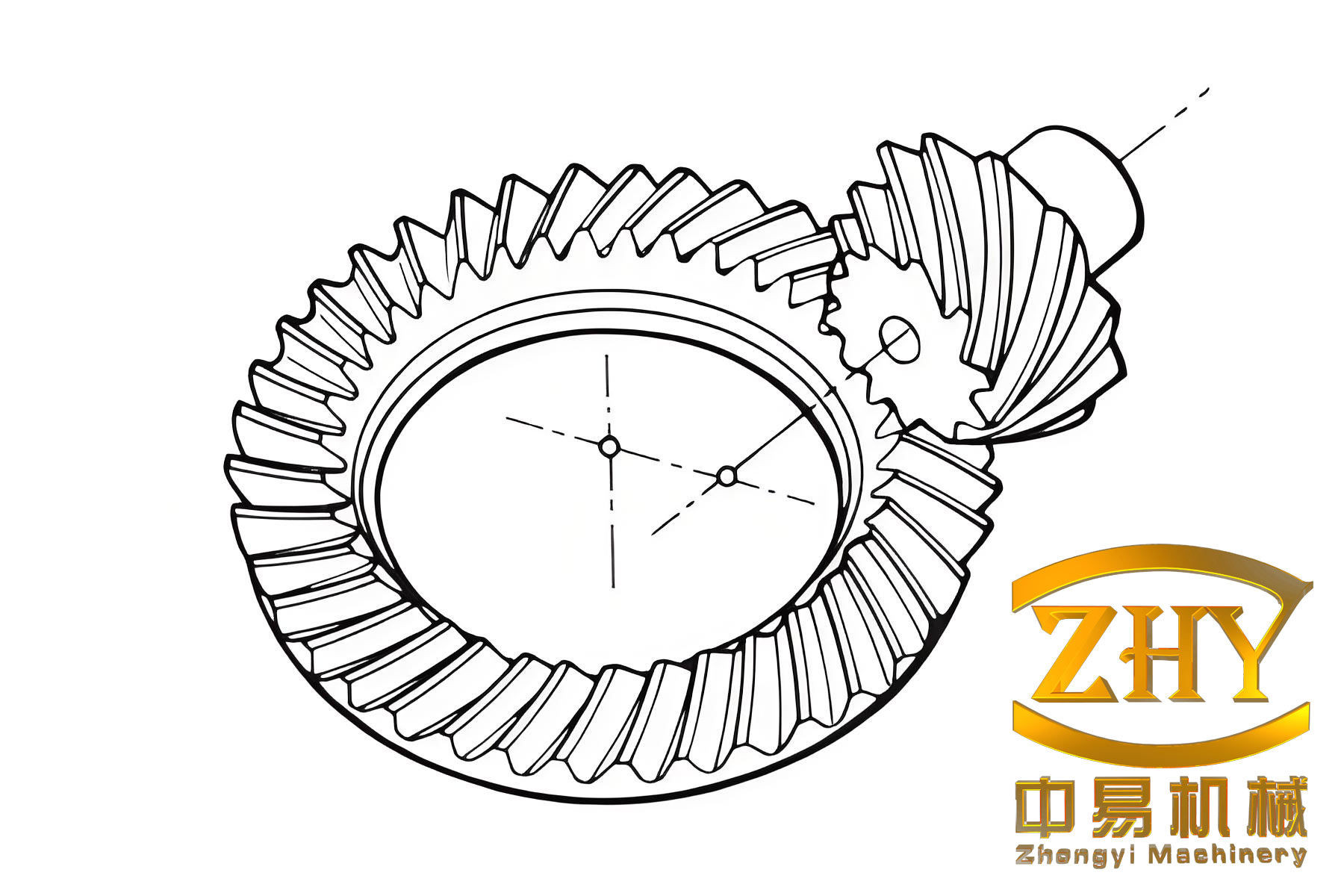
The hypoid bevel gear is a fundamental mechanical component designed to transmit motion and power between non-intersecting, offset axes. Its unique geometry offers significant advantages over other gear types, including higher contact ratios, smoother and quieter operation, reduced impact noise, and superior load-bearing capacity. These benefits have led to the widespread adoption of hypoid bevel gears in critical applications such as automotive rear axles, industrial machinery, and aerospace systems. However, the complex geometry of the hypoid gear tooth flank—a spatially curved surface based on spherical involutes—presents a substantial challenge in computer-aided design (CAD) and modeling. This complexity often results in protracted design cycles, manual iteration, and increased costs. Consequently, developing efficient, accurate, and automated design methodologies is paramount for advancing hypoid gear technology. This article explores a comprehensive approach to hypoid bevel gear design, beginning with the foundational mathematical theory of spherical involutes, progressing through advanced three-dimensional parametric modeling techniques, and concluding with the implementation of a robust parametric design system using secondary development tools. The integration of these methodologies facilitates rapid design iteration, optimization, and validation, marking a significant step forward in gear design automation.
Theoretical Foundation: Spherical Involute Geometry
The accurate generation of the tooth profile is the cornerstone of hypoid bevel gear modeling. Unlike cylindrical gears whose involutes lie on a plane, the tooth flank of a bevel gear is defined on a spherical surface, leading to the spherical involute. The generation principle can be described kinematically. Consider a base cone with its apex at point O and a generating plane tangent to this cone, also with its center at O. The radius of this plane, Rb, is equal to the outer cone distance (the length of the cone’s element). As this plane rolls without slippage on the base cone, starting from an initial position tangent along element OA to a final position tangent along element OB, a point A on the plane traces a curve AA1 on the spherical surface. This curve is defined as the spherical involute.
To derive the mathematical model, two coordinate systems are established. A fixed coordinate system (x, y, z) is defined with its origin at the cone apex O and the z-axis aligned with the cone’s axis. A moving coordinate system (x1, y1, z1) is also defined at O, with its z1-axis aligned along the instantaneous generatrix OC and its x1-axis lying in the generating plane, perpendicular to z1. In this moving system, the coordinates of point A are given by:
$$ \begin{cases}
x_1 = R_b \sin\psi \\
y_1 = 0 \\
z_1 = R_b \cos\psi
\end{cases} $$
where $\psi$ is the variable angle between OA and the z1-axis. The spherical involute as seen in the fixed coordinate system is the result of the pure rolling motion. The transformation between the moving and fixed systems involves two angles: the base cone angle $\delta_b$ and the generating plane’s roll angle $\phi$. The general transformation equations are:
$$ \begin{cases}
x_1 = x \sin\phi – y \cos\phi \\
y_1 = x \cos\phi \cos\delta_b + y \sin\phi \cos\delta_b – z \sin\delta_b \\
z_1 = x \cos\phi \sin\delta_b + y \sin\phi \sin\delta_b + z \cos\delta_b
\end{cases} $$
By substituting the coordinates of point A from the moving system into this transformation and solving for (x, y, z) in the fixed system, we obtain the parametric equations for the spherical involute curve, which is essential for modeling the hypoid bevel gear tooth:
$$ \begin{cases}
x = R_b (\sin\phi \sin\psi + \cos\phi \cos\psi \cos\delta_b) \\
y = R_b (-\cos\phi \sin\psi + \sin\phi \cos\psi \cos\delta_b) \\
z = R_b \cos\psi \sin\delta_b
\end{cases} $$
Here, the roll angle $\phi$ and the angle $\psi$ are related by the condition of pure rolling: $\phi = \psi / \sin\delta_b$. For practical CAD implementation, these equations are adapted. A parameter $t$ (varying from 0 to 1) is introduced, and the equations are written in a form directly usable by software like Pro/ENGINEER (Creo) for curve generation via equations. The adapted form for the gear’s convex side often appears as:
$$ \begin{aligned}
\text{phi} &= t \times 60 \\
\text{psi} &= \text{phi} \times \cos(\alpha) \times \sin(\delta) \\
x &= R_b \times (\sin(\text{phi}) \times \sin(\text{psi}) + \cos(\text{phi}) \times \cos(\text{psi}) \times \cos(\theta)) \\
y &= R_b \times (-\cos(\text{phi}) \times \sin(\text{psi}) + \sin(\text{phi}) \times \cos(\text{psi}) \times \sin(\theta)) \\
z &= R_b \times \cos(\text{psi}) \times \cos(\theta)
\end{aligned} $$
where $\alpha$ is the pressure angle, $\delta$ is the pitch cone angle, and $\theta$ is related to the base cone angle. This mathematical formulation provides the precise trajectory needed to construct the complex tooth profile of a hypoid bevel gear.
Parametric Design Methodology for Hypoid Bevel Gears
Parametric design is a transformative approach in CAD where the geometry of a model is defined not by fixed dimensions but by parameters, variables, and relationships (e.g., equations, constraints). Changing a key driving parameter (like module or number of teeth) automatically triggers a regeneration of the entire model based on predefined rules. For complex components like the hypoid bevel gear, this methodology is invaluable.
The process begins with a fully defined “generic” or “parent” 3D model of the hypoid bevel gear. Every critical dimension in this model is represented as a parameter (e.g., D1, D2). These parameters are linked through relations that encapsulate the gear design formulas. For instance, the pitch diameter is related to the module and number of teeth ($d = m \cdot z$), the addendum is related to the module and addendum coefficient ($h_a = h_{a}^* \cdot m$), and the spiral angle follows specific Gleason or Klingelnberg calculation guidelines. A master parameter table governs the entire geometry.
The power of this system is realized through secondary development—creating custom software applications that interact with the CAD system’s API (Application Programming Interface). For Pro/ENGINEER (Creo), this toolkit is called Pro/Toolkit. A custom application, typically developed in C++ or VB, provides a user-friendly interface. When a user inputs new primary design parameters (e.g., $z_1$, $z_2$, $m_n$, $\beta$) into this interface, the application performs the following automated sequence:
- Accepts the new input values from the GUI.
- Executes the complete set of hypoid bevel gear design calculations based on the chosen standard (e.g., Gleason).
- Connects to the running Pro/ENGINEER session via Pro/Toolkit functions.
- Retrieves the model’s parameter set.
- Updates the values of the critical driving parameters in the model with the newly calculated values.
- Instructs Pro/ENGINEER to regenerate the model.
Within seconds, a new, fully detailed 3D model of the hypoid bevel gear, compliant with the new specifications, is generated. This eliminates all manual remodeling steps, ensures geometric consistency, and dramatically accelerates the design exploration and customization process. The table below summarizes the core advantages of implementing a parametric design system for hypoid bevel gears.
| Aspect | Traditional Direct Modeling | Parametric Design with Secondary Development |
|---|---|---|
| Design Change Process | Manual feature editing, sketch modification, high risk of error and inconsistency. | Automatic regeneration from updated parameters; geometry is recalculated based on immutable relations. |
| Speed for New Variants | Linear time increase with complexity; each variant requires significant manual work. | Near-instantaneous generation after parameter input; time is constant regardless of complexity. |
| Knowledge Capture & Reuse | Design knowledge resides with the expert engineer; difficult to formalize and transfer. | Design rules (formulas, standards) are embedded in the model relations and application logic, enabling reuse by less experienced users. |
| Integration with Analysis | Manual model update required for each analysis iteration, creating a bottleneck. | Seamless integration with FEA; parametric model can be directly driven by optimization algorithms to find best-performing geometry. |
Pro/Toolkit Asynchronous Mode for Robust Integration
The implementation of the parametric system hinges on the communication between the custom application and the CAD software. Pro/Toolkit offers two primary modes for this integration: Synchronous and Asynchronous. The choice of mode has profound implications for the application’s architecture, performance, and user experience.
Synchronous Mode: In this mode, the custom application (either as a DLL or a separate EXE) runs in lockstep with Pro/ENGINEER. The application and Pro/E share the same process space or communicate tightly, and the application must wait for a response from Pro/E after each function call before proceeding. This mode is simpler to set up initially but has limitations. The application is wholly dependent on Pro/E; if Pro/E is not running, the application cannot function. It is less suitable for creating standalone, comprehensive design systems that may need to perform operations before or after CAD interaction.
Asynchronous Mode: This is the preferred architecture for developing professional, standalone parametric design systems for components like the hypoid bevel gear. In asynchronous mode, the custom application is a completely independent executable (.exe) program. It communicates with Pro/ENGINEER via Remote Procedure Calls (RPC). The key advantages are:
- Independence: The application can start independently of Pro/E. It can perform tasks such as preliminary calculations, reading from a database, or displaying its interface without requiring a Pro/E session.
- Flexibility: The application can connect to an already-running Pro/E session or launch a new Pro/E process programmatically, based on need.
- Robustness: The two processes are separate. A crash in one (though undesirable) is less likely to crash the other.
- Advanced Control: It allows for more complex program flow, where the application logic drives the CAD interaction, not the other way around.
The development workflow using Pro/Toolkit Asynchronous Mode involves several key technical steps. First, essential environment variables must be configured on the system to establish the communication pathway, most importantly pointing to the message server executable (pro_comm_msg.exe). Within the Visual C++ development environment, the project must be configured to locate the Pro/Toolkit header files and library files. Critical libraries such as protoolkit.lib, pt_asynchronous.lib, wsock32.lib, and mpr.lib must be linked. The application’s GUI is typically built using a framework like Microsoft Foundation Classes (MFC) to create a native Windows dialog, providing a familiar and responsive user experience for inputting hypoid bevel gear parameters. The core of the application code contains functions to initialize the Pro/Toolkit session, establish the asynchronous connection, retrieve the model object, access and modify its parameters, and finally execute the model regeneration. This architecture forms the backbone of an efficient hypoid bevel gear design automation tool.
Step-by-Step 3D Modeling of a Hypoid Bevel Gear
Creating an accurate and parameter-driven 3D model is the foundational step before any secondary development. The following steps outline a robust modeling strategy suitable for subsequent parametrization, using the spherical involute equations derived earlier. This process describes modeling the driven (ring) hypoid bevel gear.
Step 1: Parameter and Relation Definition. Before any geometry is created, all key design parameters are declared within the CAD software (e.g., in Pro/E’s Parameters dialog). These include: number of teeth ($z$), normal module ($m_n$), face width ($B$), mean spiral angle ($\beta_m$), pressure angle ($\alpha$), shaft angle ($\Sigma$), and offset ($E$). Subsequently, a network of relations (equations) is defined to calculate dependent geometry: pitch diameters, cone angles, addendum, dedendum, outer cone distance ($R_e$), and mean cone distance ($R_m$). This ensures the entire model is controlled by a few primary inputs.
Step 2: Gear Blank Creation. Using the calculated dimensions, the basic gear blank is sketched. This typically involves creating the back cone, front cone, and outer diameter profiles. The sketch is then revolved around the gear axis to form a solid body, representing the raw material before teeth are cut. This blank serves as the substrate onto which the tooth features will be added.
Step 3: Generating the Spherical Involute Tooth Profile. This is the most critical step. A datum curve is created “From Equation.” The coordinate system is selected (usually a cylindrical coordinate system aligned with the gear axis), and the adapted spherical involute equations are entered into the editor. For a hypoid bevel gear, separate curves are often generated for the tooth’s convex and concave sides, and for the heel (large end) and toe (small end) cross-sections. The following table summarizes the key geometric parameters required as input for the spherical involute generation at a given section (e.g., heel).
| Parameter Symbol | Description | Governing Formula / Note |
|---|---|---|
| $R_b$ | Base cone distance at section | Derived from pitch radius and base cone angle: $R_b = R / \cos \delta_b$ |
| $\delta_b$ | Base cone angle | Related to pitch cone angle $\delta$ and pressure angle $\alpha$: $\tan \delta_b = \tan \delta \cdot \cos \beta$ (approx., precise formula depends on gear geometry). |
| $\alpha$ | Normal pressure angle | A primary design input (e.g., 20°, 22.5°). |
| $t$ | Curve parameter | Varies from 0 to a value that generates sufficient involute length. |
Step 4: Constructing the Complete Tooth Cross-Section. The generated spherical involute curve represents only the active flank. Using standard gear geometry, the tip circle arc, root circle arc, and fillet transition curves are constructed in the same plane. These segments are then connected and trimmed with the involute to form a closed, single-tooth cross-sectional sketch at the heel. This process is repeated to create a corresponding cross-sectional sketch at the toe.
Step 5: Creating a Single 3D Tooth. With the heel and toe cross-sections defined, a trajectory (the tooth lengthwise direction, following the root line or a mean path) is sketched. Using a Variable Section Sweep (VSS) or Blend feature, the heel section is swept along the trajectory to the toe section, with the software automatically interpolating the section shape. This results in a solid, three-dimensional representation of a single hypoid bevel gear tooth, complete with its spatially curved flanks.
Step 6: Patterning the Complete Gear. The single tooth is then patterned around the gear axis. The number of instances in the pattern is set equal to the number of teeth parameter ($z$), and the angular spacing is defined as $360^\circ / z$. After the patterning operation, the gear blank is trimmed or the teeth are merged with it, yielding the final, fully formed hypoid bevel gear 3D model. This model is now ready to be controlled by the master parameters.
Application and Future Development Directions
The implementation of a parametric hypoid bevel gear modeling system has immediate and profound applications across the product development lifecycle. In Design, it enables rapid prototyping of gear sets for new vehicle axles or machinery, allowing engineers to evaluate packaging, clearances, and basic geometry in minutes rather than days. In Analysis, the parametric model serves as the direct input for Finite Element Analysis (FEA) to perform stress, contact, and durability studies. Changes to the design parameters automatically update the FEA model, enabling efficient design optimization loops to minimize weight while meeting strength targets. For Manufacturing, the accurate 3D model is essential for generating tool paths for CNC machining, especially for the complex dies used in forging hypoid bevel gears or for direct grinding operations. The parametric system ensures the CAD model is always synchronized with the intended design specifications, reducing errors in manufacturing data preparation.
The future of hypoid bevel gear design lies in the deeper integration of these parametric systems with advanced simulation and data-driven techniques. One promising direction is the coupling of the parametric CAD engine with multi-objective optimization algorithms. An optimization framework could be set up to automatically vary parameters like offset ($E$), spiral angle ($\beta$), and pressure angle ($\alpha$) within defined bounds. For each candidate design, the system would regenerate the model, run automated meshing and FEA contact analysis, and evaluate objectives such as maximum contact pressure, bending stress, transmission error, and gear weight. The algorithm would then intelligently search for the Pareto-optimal set of designs that offer the best trade-offs between performance, durability, and material usage. Furthermore, the integration of machine learning models trained on historical performance data could predict the performance of new hypoid bevel gear geometries, guiding the initial design space exploration and making the optimization process even more efficient. This represents the evolution from computer-aided design to AI-augmented, simulation-driven optimal design for hypoid bevel gears.
Conclusion
The design and manufacture of hypoid bevel gears represent a significant engineering challenge due to their complex, spatially curved geometry. This article has detailed a comprehensive and efficient methodology that addresses this challenge by integrating rigorous mathematical modeling, advanced parametric CAD techniques, and robust software automation via secondary development. The process begins with the precise mathematical definition of the tooth flank using spherical involute theory, which is directly implemented in 3D CAD software to create a fully constrained base model. This model is then transformed into a powerful parametric template, where all critical dimensions are governed by a master set of parameters and the governing design equations. Finally, by leveraging Pro/Toolkit’s asynchronous mode within a custom-developed application, a standalone, user-friendly system is created. This system allows engineers to input primary design requirements and instantly generate new, geometrically accurate 3D models of the hypoid bevel gear. This approach eliminates the repetitive and error-prone aspects of manual modeling, dramatically shortens design cycles, facilitates rapid design iteration and optimization, and seamlessly bridges the gap between design, analysis, and manufacturing. As the industry moves towards greater digitalization and automation, such parametric and integrated design systems will become indispensable tools for developing high-performance, reliable, and cost-effective hypoid bevel gear drives for the demanding applications of the future.