
This study presents a comprehensive methodology for constructing precise mathematical and physical models of asymmetric modified helical gears using rack cutter generation principles. By integrating gear meshing theory with C#-based SolidWorks secondary development, we establish a parametric design framework that enables rapid generation of asymmetric tooth profiles. The contact stress characteristics under varying pressure angles are systematically analyzed through finite element simulations and traditional formula-based calculations.
1. Mathematical Modeling of Asymmetric Helical Gears
The tooth profile generation process employs a dual-pressure-angle rack cutter with modified geometry. The coordinate systems for gear generation are defined as follows:
$$R_i(l_i, u_i) = \begin{bmatrix}
l_i \\
0 \\
u_i \\
1
\end{bmatrix},\quad R_{3i}(l_i, u_i) = M_{3i}R_i$$
where $M_{3i}$ represents coordinate transformation matrices combining pressure angle orientation and helical rotation:
$$M_{3i} = M_{3f}M_{fi} = \begin{bmatrix}
\cos\alpha_{ni} & \pm\sin\alpha_{ni} & 0 & 0 \\
\mp\sin\alpha_{ni} & \cos\alpha_{ni} & 0 & \pm0.25p \\
0 & 0 & 1 & 0 \\
0 & 0 & 0 & 1
\end{bmatrix}\begin{bmatrix}
1 & 0 & 0 & 0 \\
0 & \cos\beta & -\sin\beta & 0 \\
0 & \sin\beta & \cos\beta & 0 \\
0 & 0 & 0 & 1
\end{bmatrix}$$
The meshing equation governing the working flank contact is derived as:
$$f_i = \theta – \frac{n_{3iy}(R_{3ix} + x_nm_n) – n_{3ix}R_{3iy}}{r_pn_{3ix}} = 0$$
2. Parametric Modeling Implementation
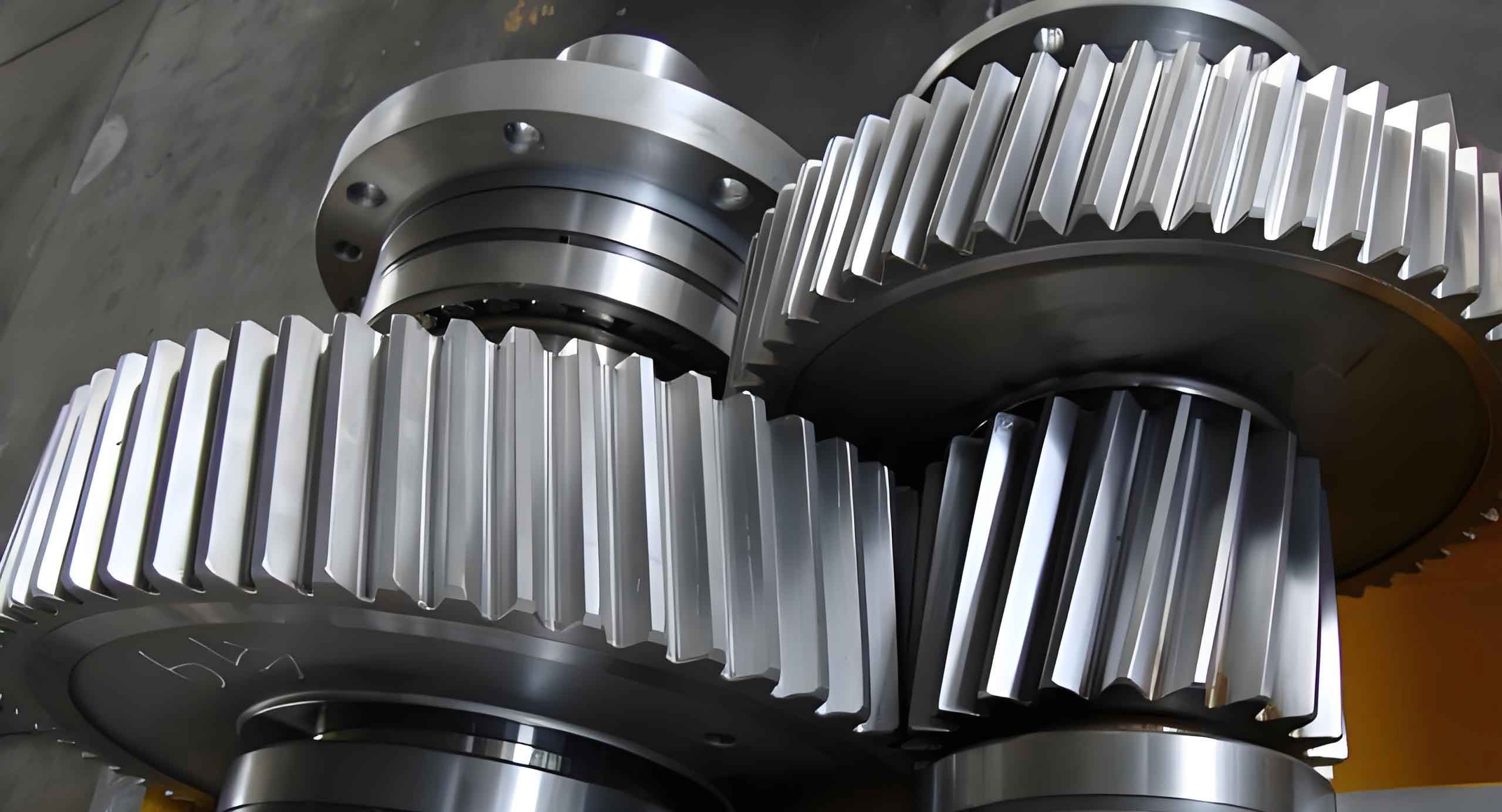
The parametric modeling workflow incorporates three critical stages:
| Stage | Operation | Key Parameters |
|---|---|---|
| 1 | Gear blank generation | $d_a = m_n(z + 2h_a^* + 2x_n)$ |
| 2 | Tooth profile construction | 400-600 discrete points per flank |
| 3 | Helical feature patterning | $\Delta\theta = \frac{2\pi\tan\beta}{z}$ |
The Lagrange interpolation polynomial ensures continuous transition between meshing and fillet regions:
$$y(x) = \sum_{k=1}^5 y_k \prod_{\substack{i=1 \\ i\neq k}}^5 \frac{x – x_i}{x_k – x_i}$$
3. Contact Stress Analysis Methodology
Two complementary approaches are employed for contact stress evaluation:
Finite Element Analysis (FEA):
– Material: 20CrMnTi alloy steel ($E = 210$ GPa, $\nu = 0.3$)
– Mesh: Quadratic tetrahedral elements with localized refinement
– Boundary conditions: 2500 rpm input speed, 25 kW power transmission
Analytical Formula (ISO 6336):
$$ \sigma_H = Z_HZ_EZ_\epsilon Z_\beta \sqrt{\frac{F_t}{d_1b} \cdot \frac{u+1}{u}} $$
where $Z$ factors account for geometry, elasticity, contact ratio, and helix angle effects.
4. Comparative Stress Analysis
The parametric study investigates pressure angle combinations for asymmetric helical gears:
| Working Pressure Angle (°) | Non-working Pressure Angle (°) | FEA Stress (MPa) | Formula Result (MPa) | Deviation (%) |
|---|---|---|---|---|
| 15 | 20 | 712.82 | 676.61 | 5.07 |
| 17.5 | 20 | 680.53 | 657.80 | 3.34 |
| 20 | 20 | 655.45 | 642.99 | 1.90 |
| 22.5 | 20 | 632.58 | 631.09 | 0.23 |
| 25 | 20 | 612.04 | 621.43 | 1.53 |
The stress reduction trend with increasing working pressure angle follows cubic polynomial behavior:
$$\sigma_H(\alpha) = -0.824\alpha^3 + 52.37\alpha^2 – 1092\alpha + 8231\quad (R^2=0.998)$$
5. Design Implications
Key findings for asymmetric helical gear optimization:
1. Non-working flank pressure angle shows negligible influence (<2%) on working flank contact stress
2. 25° working pressure angle reduces contact stress by 6.62% compared to standard 20° symmetric design
3. Minimum 0.23% deviation between FEA and formula methods validates analytical approach
4. Optimal pressure angle selection requires balancing contact stress reduction against bending stress increase
The developed methodology enables efficient design of high-performance helical gears for electric vehicle transmissions and aerospace applications where load capacity and compactness are critical.